
Verwandte Artikel zu How Not to Be Wrong: The Power of Mathematical Thinking
Inhaltsangabe
“Witty, compelling, and just plain fun to read . . ." —Evelyn Lamb, Scientific American
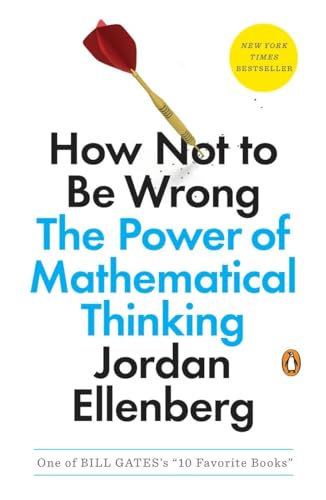
The Freakonomics of math—a math-world superstar unveils the hidden beauty and logic of the world and puts its power in our hands
The math we learn in school can seem like a dull set of rules, laid down by the ancients and not to be questioned. In How Not to Be Wrong, Jordan Ellenberg shows us how terribly limiting this view is: Math isn’t confined to abstract incidents that never occur in real life, but rather touches everything we do—the whole world is shot through with it.
Math allows us to see the hidden structures underneath the messy and chaotic surface of our world. It’s a science of not being wrong, hammered out by centuries of hard work and argument. Armed with the tools of mathematics, we can see through to the true meaning of information we take for granted: How early should you get to the airport? What does “public opinion” really represent? Why do tall parents have shorter children? Who really won Florida in 2000? And how likely are you, really, to develop cancer?
How Not to Be Wrong presents the surprising revelations behind all of these questions and many more, using the mathematician’s method of analyzing life and exposing the hard-won insights of the academic community to the layman—minus the jargon. Ellenberg chases mathematical threads through a vast range of time and space, from the everyday to the cosmic, encountering, among other things, baseball, Reaganomics, daring lottery schemes, Voltaire, the replicability crisis in psychology, Italian Renaissance painting, artificial languages, the development of non-Euclidean geometry, the coming obesity apocalypse, Antonin Scalia’s views on crime and punishment, the psychology of slime molds, what Facebook can and can’t figure out about you, and the existence of God.
Ellenberg pulls from history as well as from the latest theoretical developments to provide those not trained in math with the knowledge they need. Math, as Ellenberg says, is “an atomic-powered prosthesis that you attach to your common sense, vastly multiplying its reach and strength.” With the tools of mathematics in hand, you can understand the world in a deeper, more meaningful way. How Not to Be Wrong will show you how.
Die Inhaltsangabe kann sich auf eine andere Ausgabe dieses Titels beziehen.
Über die Autorin bzw. den Autor
Jordan Ellenberg is the John D. MacArthur Professor of Mathematics at the University of Wisconsin-Madison and a 2015 Guggenheim fellow. He has lectured around the world on his research in number theory and delivered one of the invited addresses at the 2015 Joint Mathematics Meetings, the largest math conference in the world. His writing has appeared in The New York Times, The Washington Post, The Wall Street Journal, The Boston Globe, Wired, and The Believer, and he has been featured on the Today show and NPR’s All Things Considered. He writes a popular column called “Do the Math” for Slate.
Auszug. © Genehmigter Nachdruck. Alle Rechte vorbehalten.
Praise for How Not to Be Wrong
“Brilliantly engaging . . . Ellenberg’s talent for finding real-life situations that enshrine mathematical principles would be the envy of any math teacher. He presents these in fluid succession, like courses in a fine restaurant, taking care to make each insight shine through, unencumbered by jargon or notation. Part of the sheer intellectual joy of the book is watching the author leap nimbly from topic to topic, comparing slime molds to the Bush-Gore Florida vote, criminology to Beethoven’s Ninth Symphony. The final effect is of one enormous mosaic unified by mathematics.”
—Manil Suri, The Washington Post
“Easy to follow, humorously presented . . . This book will help you to avoid the pitfalls that result from not having the right tools. It will help you realize that mathematical reasoning permeates our lives—that it can be, as Mr. Ellenberg writes, a kind of ‘X-ray specs that reveal hidden structures underneath the messy and chaotic surface of the world.’”
—Mario Livio, The Wall Street Journal
“Witty, compelling, and just plain fun to read . . . How Not to Be Wrong can help you explore your mathematical superpowers.”
—Evelyn Lamb, Scientific American
“Mathematicians from Charles Lutwidge Dodgson to Steven Strogatz have celebrated the power of mathematics in life and the imagination. In this hugely enjoyable exploration of everyday maths as ‘an atomic-powered prosthesis that you attach to your common sense,’ Jordan Ellenberg joins their ranks. Ellenberg, an academic and Slate ’s‘Do the Math’ columnist, explains key principles with erudite gusto—whether poking holes in predictions of a U.S. ‘obesity apocalypse,’ or unpicking an attempt by psychologist B. F. Skinner to prove statistically that Shakespeare was a dud at alliteration.”
—Nature
“The book is filled to the rim with anecdotes and ‘good-to-know’ facts. And Ellenberg does not shy away from delving deeply into most topics, both in terms of the underlying mathematical concepts and the background material, which he has researched meticulously. . . . Whereas the book may be aimed at a general audience, who wonder how the mathematics they learned at school might ever be useful, there is much on offer for those who have chosen a professional career in the sciences even when the fundamental ideas discussed are not new. It’s a bit like walking through a well-curated exhibition of a favored painter. Many works you know inside out, but the context and the logic of the presentation may offer refreshing new perspectives and insights.”
—Nature Physics
“Refreshingly lucid while still remaining conceptually rigorous, this book lends insight into how mathematicians think—and shows us how we can start to think like mathematicians as well.”
—The New York Times Book Review
“A poet-mathematician offers an empowering and entertaining primer for the age of Big Data. . . . A rewarding popular math book for just about anyone.”
—Laura Miller, Salon
“A fresh application of complex mathematical thinking to commonplace events . . . How Not to Be Wrong is beautifully written, holding the reader’s attention throughout with well-chosen material, illuminating exposition, wit, and helpful examples. I am reminded of the great writer of recreational mathematics, Martin Gardner: Ellenberg shares Gardner’s remarkable ability to write clearly and entertainingly, bringing in deep mathematical ideas without the reader registering their difficulty.”
—Times Higher Education (London)
“Ellenberg tells engaging, even exciting stories about how ‘the problems we think about every day—problems of politics, of medicine, of commerce, of theology—are shot through with mathematics.’”
—The Washington Post (blog)
“A collection of fascinating examples of math and its surprising applications . . . How Not to Be Wrong is full of interesting and weird mathematical tools and observations.”
—Business Insider
“Wry, accessible, and entertaining . . . Ellenberg finds the commonsense math at work in the everyday world, and his vivid examples and clear descriptions show how ‘math is woven into the way we reason.’”
—Publishers Weekly (starred review)
“Witty and expansive, Ellenberg’s math will leave readers informed, intrigued, and armed with plenty of impressive conversation starters.”
—Kirkus Reviews
“Readers will indeed marvel at how often mathematics shed unexpected light on economics (assessing the performance of investment advisors), public health (predicting the likely prevalence of obesity in thirty years), and politics (explaining why wealthy individuals vote Republican but affluent states go for Democrats). Relying on remarkably few technical formulas, Ellenberg writes with humor and verve as he repeatedly demonstrates that mathematics simply extends common sense.”
—Booklist
“How Not to Be Wrong is a cheery manifesto for the utility of mathematical thinking. Ellenberg’s prose is a delight—informal and robust, irreverent yet serious. Maths is ‘an atomic-powered prosthesis that you attach to your common sense, vastly multiplying its reach and strength,’ he writes. Doing maths ‘is to be, at once, touched by fire and bound by reason. Logic forms a narrow channel through which intuition flows with vastly augmented force.’”
—The Guardian (London)
“The title of this wonderful book explains what it adds to the honorable genre of popular writing on mathematics. Like Lewis Carroll, George Gamow, and Martin Gardner before him, Jordan Ellenberg shows how mathematics can delight and stimulate the mind. But he also shows that mathematical thinking should be in the toolkit of every thoughtful person—of everyone who wants to avoid fallacies, superstitions, and other ways of being wrong.”
—Steven Pinker, Johnstone Family Professor of Psychology, Harvard University, and author of How the Mind Works
“Brilliant and fascinating! Ellenberg shows his readers how to magnify common sense using the tools usually only accessible to those who have studied higher mathematics. I highly recommend it to anyone interested in expanding their worldly savviness—and math IQ!”
—Danica McKellar, actress and bestselling author of Math Doesn’t Suck and Kiss My Math
“Jordan Ellenberg promises to share ways of thinking that are both simple to grasp and profound in their implications, and he delivers in spades. These beautifully readable pages delight and enlighten in equal parts. Those who already love math will eat it up, and those who don’t yet know how lovable math is are in for a most pleasurable surprise.”
—Rebecca Newberger Goldstein, author of Plato at the Googleplex
“With math as with anything else, there’s smart, and then there’s street smart. This book will help you be both. Fans of Freakonomics and The Signal and the Noise will love Ellenberg’s surprising stories, snappy writing, and brilliant lessons in numerical savvy. How Not to Be Wrong is...
„Über diesen Titel“ kann sich auf eine andere Ausgabe dieses Titels beziehen.
Suchergebnisse für How Not to Be Wrong: The Power of Mathematical Thinking

Beispielbild für diese ISBN
How Not to Be Wrong: The Power of Mathematical Thinking
Anbieter: World of Books (was SecondSale), Montgomery, IL, USA
Verkäuferbewertung 5 von 5 Sternen

Paperback. Zustand: Fair. "Witty, compelling, and just plain fun to read . . ." --Evelyn Lamb, Scientific American The Freakonomics of math--a math-world superstar unveils the hidden beauty and logic of the world and puts its power in our hands The math we learn in school can seem like a dull set of rules, laid down by the ancients and not to be questioned. In How Not to Be Wrong, Jordan Ellenberg shows us how terribly limiting this view is: Math isn't confined to abstract incidents that never occur in real life, but rather touches everything we do--the whole world is shot through with it. Math allows us to see the hidden structures underneath the messy and chaotic surface of our world. It's a science of not being wrong, hammered out by centuries of hard work and argument. Armed with the tools of mathematics, we can see through to the true meaning of information we take for granted: How early should you get to the airport? What does "public opinion" really represent? Why do tall parents have shorter children? Who really won Florida in 2000? And how likely are you, really, to develop cancer? How Not to Be Wrong presents the surprising revelations behind all of these questions and many more, using the mathematician's method of analyzing life and exposing the hard-won insights of the academic community to the layman--minus the jargon. Ellenberg chases mathematical threads through a vast range of time and space, from the everyday to the cosmic, encountering, among other things, baseball, Reaganomics, daring lottery schemes, Voltaire, the replicability crisis in psychology, Italian Renaissance painting, artificial languages, the development of non-Euclidean geometry, the coming obesity apocalypse, Antonin Scalia's views on crime and punishment, the psychology of slime molds, what Facebook can and can't figure out about you, and the existence of God. Ellenberg pulls from history as well as from the latest theoretical developments to provide those not trained in math with the knowledge they need. Math, as Ellenberg says, is "an atomic-powered prosthesis that you attach to your common sense, vastly multiplying its reach and strength." With the tools of mathematics in hand, you can understand the world in a deeper, more meaningful way. How Not to Be Wrong will show you how. Artikel-Nr. 00097114700
Gebraucht kaufen
EUR 4,00
Versand gratis
Versand innerhalb von USA
Versand innerhalb von USA
Anzahl: 11 verfügbar
Beispielbild für diese ISBN
How Not to Be Wrong: The Power of Mathematical Thinking
Anbieter: World of Books (was SecondSale), Montgomery, IL, USA
Verkäuferbewertung 5 von 5 Sternen
Paperback. Zustand: Very Good. "Witty, compelling, and just plain fun to read . . ." --Evelyn Lamb, Scientific American The Freakonomics of math--a math-world superstar unveils the hidden beauty and logic of the world and puts its power in our hands The math we learn in school can seem like a dull set of rules, laid down by the ancients and not to be questioned. In How Not to Be Wrong, Jordan Ellenberg shows us how terribly limiting this view is: Math isn't confined to abstract incidents that never occur in real life, but rather touches everything we do--the whole world is shot through with it. Math allows us to see the hidden structures underneath the messy and chaotic surface of our world. It's a science of not being wrong, hammered out by centuries of hard work and argument. Armed with the tools of mathematics, we can see through to the true meaning of information we take for granted: How early should you get to the airport? What does "public opinion" really represent? Why do tall parents have shorter children? Who really won Florida in 2000? And how likely are you, really, to develop cancer? How Not to Be Wrong presents the surprising revelations behind all of these questions and many more, using the mathematician's method of analyzing life and exposing the hard-won insights of the academic community to the layman--minus the jargon. Ellenberg chases mathematical threads through a vast range of time and space, from the everyday to the cosmic, encountering, among other things, baseball, Reaganomics, daring lottery schemes, Voltaire, the replicability crisis in psychology, Italian Renaissance painting, artificial languages, the development of non-Euclidean geometry, the coming obesity apocalypse, Antonin Scalia's views on crime and punishment, the psychology of slime molds, what Facebook can and can't figure out about you, and the existence of God. Ellenberg pulls from history as well as from the latest theoretical developments to provide those not trained in math with the knowledge they need. Math, as Ellenberg says, is "an atomic-powered prosthesis that you attach to your common sense, vastly multiplying its reach and strength." With the tools of mathematics in hand, you can understand the world in a deeper, more meaningful way. How Not to Be Wrong will show you how. Artikel-Nr. CIN0143127535VG
Gebraucht kaufen
EUR 4,00
Versand gratis
Versand innerhalb von USA
Versand innerhalb von USA
Anzahl: 6 verfügbar
Beispielbild für diese ISBN
How Not to Be Wrong: The Power of Mathematical Thinking
Anbieter: World of Books (was SecondSale), Montgomery, IL, USA
Verkäuferbewertung 5 von 5 Sternen
Paperback. Zustand: Good. "Witty, compelling, and just plain fun to read . . ." --Evelyn Lamb, Scientific American The Freakonomics of math--a math-world superstar unveils the hidden beauty and logic of the world and puts its power in our hands The math we learn in school can seem like a dull set of rules, laid down by the ancients and not to be questioned. In How Not to Be Wrong, Jordan Ellenberg shows us how terribly limiting this view is: Math isn't confined to abstract incidents that never occur in real life, but rather touches everything we do--the whole world is shot through with it. Math allows us to see the hidden structures underneath the messy and chaotic surface of our world. It's a science of not being wrong, hammered out by centuries of hard work and argument. Armed with the tools of mathematics, we can see through to the true meaning of information we take for granted: How early should you get to the airport? What does "public opinion" really represent? Why do tall parents have shorter children? Who really won Florida in 2000? And how likely are you, really, to develop cancer? How Not to Be Wrong presents the surprising revelations behind all of these questions and many more, using the mathematician's method of analyzing life and exposing the hard-won insights of the academic community to the layman--minus the jargon. Ellenberg chases mathematical threads through a vast range of time and space, from the everyday to the cosmic, encountering, among other things, baseball, Reaganomics, daring lottery schemes, Voltaire, the replicability crisis in psychology, Italian Renaissance painting, artificial languages, the development of non-Euclidean geometry, the coming obesity apocalypse, Antonin Scalia's views on crime and punishment, the psychology of slime molds, what Facebook can and can't figure out about you, and the existence of God. Ellenberg pulls from history as well as from the latest theoretical developments to provide those not trained in math with the knowledge they need. Math, as Ellenberg says, is "an atomic-powered prosthesis that you attach to your common sense, vastly multiplying its reach and strength." With the tools of mathematics in hand, you can understand the world in a deeper, more meaningful way. How Not to Be Wrong will show you how. Artikel-Nr. 00100962863
Gebraucht kaufen
EUR 4,00
Versand gratis
Versand innerhalb von USA
Versand innerhalb von USA
Anzahl: Mehr als 20 verfügbar
Foto des Verkäufers
How Not to Be Wrong: The Power of Mathematical Thinking
Anbieter: Dream Books Co., Denver, CO, USA
Verkäuferbewertung 5 von 5 Sternen
Zustand: acceptable. This copy has clearly been enjoyedâ"expect noticeable shelf wear and some minor creases to the cover. Binding is strong, and all pages are legible. May contain previous library markings or stamps. Artikel-Nr. 4EKGLF008EGP_ns
Gebraucht kaufen
EUR 5,09
Versand gratis
Versand innerhalb von USA
Versand innerhalb von USA
Anzahl: 1 verfügbar
Foto des Verkäufers
How Not to Be Wrong: The Power of Mathematical Thinking
Anbieter: Dream Books Co., Denver, CO, USA
Verkäuferbewertung 5 von 5 Sternen
Zustand: good. Gently used with minimal wear on the corners and cover. A few pages may contain light highlighting or writing, but the text remains fully legible. Dust jacket may be missing, and supplemental materials like CDs or codes may not be included. May be ex-library with library markings. Ships promptly! Artikel-Nr. DBV.0143127535.G
Gebraucht kaufen
EUR 5,36
Versand gratis
Versand innerhalb von USA
Versand innerhalb von USA
Anzahl: 4 verfügbar
Beispielbild für diese ISBN
How Not to Be Wrong: The Power of Mathematical Thinking
Anbieter: ThriftBooks-Phoenix, Phoenix, AZ, USA
Verkäuferbewertung 5 von 5 Sternen
Paperback. Zustand: Good. No Jacket. Pages can have notes/highlighting. Spine may show signs of wear. ~ ThriftBooks: Read More, Spend Less. Artikel-Nr. G0143127535I3N00
Gebraucht kaufen
EUR 5,98
Versand gratis
Versand innerhalb von USA
Versand innerhalb von USA
Anzahl: 4 verfügbar
Beispielbild für diese ISBN
How Not to Be Wrong: The Power of Mathematical Thinking
Anbieter: ThriftBooks-Dallas, Dallas, TX, USA
Verkäuferbewertung 5 von 5 Sternen
Paperback. Zustand: Good. No Jacket. Pages can have notes/highlighting. Spine may show signs of wear. ~ ThriftBooks: Read More, Spend Less. Artikel-Nr. G0143127535I3N00
Gebraucht kaufen
EUR 5,98
Versand gratis
Versand innerhalb von USA
Versand innerhalb von USA
Anzahl: 4 verfügbar
Beispielbild für diese ISBN
How Not to Be Wrong: The Power of Mathematical Thinking
Anbieter: ThriftBooks-Dallas, Dallas, TX, USA
Verkäuferbewertung 5 von 5 Sternen
Paperback. Zustand: Good. No Jacket. Former library book; Pages can have notes/highlighting. Spine may show signs of wear. ~ ThriftBooks: Read More, Spend Less. Artikel-Nr. G0143127535I3N10
Gebraucht kaufen
EUR 5,98
Versand gratis
Versand innerhalb von USA
Versand innerhalb von USA
Anzahl: 1 verfügbar
Beispielbild für diese ISBN
How Not to Be Wrong: The Power of Mathematical Thinking
Anbieter: ThriftBooks-Atlanta, AUSTELL, GA, USA
Verkäuferbewertung 5 von 5 Sternen
Paperback. Zustand: Good. No Jacket. Pages can have notes/highlighting. Spine may show signs of wear. ~ ThriftBooks: Read More, Spend Less. Artikel-Nr. G0143127535I3N00
Gebraucht kaufen
EUR 5,98
Versand gratis
Versand innerhalb von USA
Versand innerhalb von USA
Anzahl: 5 verfügbar
Beispielbild für diese ISBN
How Not to Be Wrong: The Power of Mathematical Thinking
Anbieter: ThriftBooks-Atlanta, AUSTELL, GA, USA
Verkäuferbewertung 5 von 5 Sternen
Paperback. Zustand: Good. No Jacket. Former library book; Pages can have notes/highlighting. Spine may show signs of wear. ~ ThriftBooks: Read More, Spend Less. Artikel-Nr. G0143127535I3N10
Gebraucht kaufen
EUR 5,98
Versand gratis
Versand innerhalb von USA
Versand innerhalb von USA
Anzahl: 1 verfügbar