
Verwandte Artikel zu Ana of California: A Novel
Inhaltsangabe
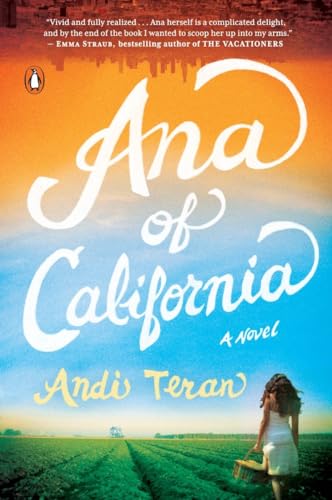
A modern take on the classic coming-of-age novel, inspired by Anne of Green Gables
In the grand tradition of Anne of Green Gables, Bridget Jones’s Diary, and The Three Weissmanns of Westport, Andi Teran’s captivating debut novel offers a contemporary twist on a beloved classic. Fifteen-year-old orphan Ana Cortez has just blown her last chance with a foster family. It’s a group home next—unless she agrees to leave East Los Angeles for a farm trainee program in Northern California.
When she first arrives, Ana can’t tell a tomato plant from a blackberry bush, and Emmett Garber is skeptical that this slight city girl can be any help on his farm. His sister Abbie, however, thinks Ana might be just what they need. Ana comes to love Garber Farm, and even Emmett has to admit that her hard work is an asset. But when she inadvertently stirs up trouble in town, Ana is afraid she might have ruined her last chance at finding a place to belong.
Die Inhaltsangabe kann sich auf eine andere Ausgabe dieses Titels beziehen.
Über die Autorin bzw. den Autor
ANDI TERAN, a native of El Paso, Texas, currently lives in Los Angeles. Ana of California is her first novel.
Auszug. © Genehmigter Nachdruck. Alle Rechte vorbehalten.
ACKNOWLEDGMENTS
CHAPTER ONE
She was out of beginnings, this she knew.
Ana ran her hands through her knotted hair, wondering when she’d last washed it. She’d been up for more than twenty-four hours, and there was still ketchup on her shirt.
“This is the fifth home you’ve been expelled from in the last ten years.”
“To be fair, it was only four. I was at the Mitchell house twice.”
“Well, this time it’s . . . a situation.”
Ana stared at the wall behind the desk. She’d seen the corkboard many times before and had studied the photographs of Mrs. Saucedo’s children over the years. She’d watched them grow older, lose teeth, win ribbons, and pose for class photos. There was always a birthday card or thank-you note pushpinned to the board. Today it was a small California license plate bearing the word MOM.
“I know it’s been hard, but we need to find a solution,” Mrs. Saucedo said, adjusting her glasses. “I’d like us to work together on this.”
Ana let her eyes roam around the room. The walls were still a pale industrial green, and there was a fake tree in the corner, the same one with the rubber branches that would never grow. She remembered the first time she saw the tree and how it had been strung with lights and ornaments. There were reindeer, paper stars, and angels made of tin. One branch was weighed down by a heavy gourd, the middle hollowed out to hold figurines of a man and a woman staring down at a baby, a glittered star hanging above them. She remembered how she wanted to climb inside the gourd and live there forever.
“Feliz Navidad,” Ana said, still staring at the tree. “Those were the first words you said to me.”
Mrs. Saucedo looked down at her desk. Everything was in its place save for Ana’s file, which was thick and open to a photo of a little girl in a pink puffy coat.
“I remember,” she said.
“It was cold, not like today.”
“Yes, it was.”
“It was the first time I ever wished for snow—not that it would ever happen.”
Ana shifted in the chair. The armrests were worn and rough under her fingertips.
“Would you like to talk about what happened that night?” Mrs. Saucedo asked, knowing Ana never did.
This time, though, Ana did want to talk about it. She remembered everything, every detail. Back then, it was referred to as “an accident,” and also, “the incident,” but Ana chose to name it as you would a melodramatic poem or story—“With Sorrow and Black Doves.” She was the only one who had seen what had happened the night she was brought in to child services, and every time she entered Mrs. Saucedo’s small office, the memories of The Night That Started It All returned harsh and fast. She’d managed to shut them away year after year, but there, in that windowless room, the images flickered in the periphery.
“You don’t have to if you don’t want to,” Mrs. Saucedo said, keeping her voice soft and slow, trying to catch Ana’s eyes, which remained fixed on the tree.
If there was anyone she could talk to it was Mrs. Lupe Saucedo, the nice lady behind the desk who genuinely cared about her well-being—even after all these years. Though she hadn’t felt it physically since they’d met almost a decade ago, Mrs. Saucedo’s warmth remained. She remembered how the woman’s arms had embraced her that day and how the scent of roses and clean cotton still tickled her nose. Mrs. Saucedo had whispered to her back then too.
“‘Ya me canso de llorar y no amanece.’”
“You’re not crying and you do have hope.” Mrs. Saucedo sighed. “Please, this isn’t a telenovela. Like I’ve told you many times before, the drama does you no favors.”
“It’s a line from a song, not a comment on my psychological state.”
“Well, I’m glad to hear you still speaking Spanish. I think your grandma would be proud.”
Almost as a reflex, Ana’s hands squeezed the armrests of the chair. She kept her eyes focused anywhere but on Mrs. Saucedo’s face and concentrated instead on her own breathing. She wanted to speak but feared giving in to her tears, so she dipped her chin to her chest.
What she wanted to tell Mrs. Saucedo was that the line had been from her grandma’s—her abuela’s—favorite song, and that she had memorized every word. She wanted to explain that if there had been music playing on the day of the incident, it would have been this very song. She imagined the voice of a banshee swooping in to replace the screaming, how a trumpet might have substituted for blasts, and how she wished the plucking of an acoustic guitar had kept her company in the aftermath of silence, a melancholy soundtrack for the newly alone.
“I don’t speak it as much as I should,” Ana said, instead tucking her hands between her knees, which wouldn’t stop bouncing.
“You understand I have nowhere left to send you, yes? We talked about three strikes less than a year ago, and since then you’ve gone from the group home to another failed foster situation. This is it—no more homes, no more chances,” Mrs. Saucedo said. “It might help to talk about what happened that night, talk about your abuela, and talk about what we can do to get you to where she’d want you to be.”
“If it’s all right with you, I’d rather talk about what’s been going on the past few months.”
Mrs. Saucedo had heard complaints about foster parents before. She anticipated an elaborate explanation, knowing Ana’s flair for the dramatic. In her younger years, Ana’s stories were wildly embellished but had since boiled down to silent defiance after being removed from her third foster home.
“I spoke with Ms. Fenton.”
“I’m desperate to hear what she had to say.”
“I think you know exactly what she said.”
“If you had any idea how we’ve been treated all summer . . .”
“Ana . . .”
“—And how the rules were completely . . .”
“It’s not your place to step in.”
“But it wasn’t right, and someone needed to do something because no one ever does.”
“I understand the conditions were not the best,” Mrs. Saucedo said, trying not to raise her voice. “And for that I apologize. But Ms. Fenton is a longtime foster mother, and despite the strict household, it is not your job to tell her how to discipline the other children.”
“So, I’m just supposed to sit there and let two little kids go without any food for the second day in a row? I’m supposed to kick back while the so-called mother of the house eats the freezer and shelves clean just to prove a stupid point? It’s Ludicrous, capital L.”
“I don’t understand.”
“She doesn’t give any of us lunch or dinner—like zero food—anytime she feels we’re doing something wrong, which is pretty much all the time. She got angry that I gave an ice cream sandwich to the kids to share, and I get that it was the last one in the freezer and everything, but it was all we had. And she took it out on them. It’s not the first time it’s happened, either.”
“Ms. Fenton relayed to me that you were combative and inappropriate, and while...
„Über diesen Titel“ kann sich auf eine andere Ausgabe dieses Titels beziehen.
Suchergebnisse für Ana of California: A Novel

Beispielbild für diese ISBN
Ana of California: A Novel
Verlag:
Penguin Books (edition ), 2015
ISBN 10: 0143126490
ISBN 13: 9780143126492
Gebraucht
Paperback
Anbieter: BooksRun, Philadelphia, PA, USA
Verkäuferbewertung 5 von 5 Sternen

Paperback. Zustand: Very Good. It's a well-cared-for item that has seen limited use. The item may show minor signs of wear. All the text is legible, with all pages included. It may have slight markings and/or highlighting. Artikel-Nr. 0143126490-11-1
Gebraucht kaufen
EUR 4,77
Versand gratis
Versand innerhalb von USA
Versand innerhalb von USA
Anzahl: 1 verfügbar
Beispielbild für diese ISBN
Ana of California: A Novel
Anbieter: World of Books (was SecondSale), Montgomery, IL, USA
Verkäuferbewertung 5 von 5 Sternen
Paperback. Zustand: Very Good. Loosely based on the Anne of Green Gables series, this poignant novel follows Ana, a teenage rebel who has just blown her last chance in a foster home. It's a group home after this, and after hearing stories from other kids, she certainly doesn't want to end up there. Instead, she heads to Northern California to help out on a farm that is looking for a helping hand. To her surprise, she enjoys farm life. But when a misunderstanding stirs up trouble, can she put things right again? Artikel-Nr. 00095337107
Gebraucht kaufen
EUR 4,85
Versand gratis
Versand innerhalb von USA
Versand innerhalb von USA
Anzahl: 1 verfügbar
Beispielbild für diese ISBN
Ana of California: A Novel
Anbieter: World of Books (was SecondSale), Montgomery, IL, USA
Verkäuferbewertung 5 von 5 Sternen
Paperback. Zustand: Good. Loosely based on the Anne of Green Gables series, this poignant novel follows Ana, a teenage rebel who has just blown her last chance in a foster home. It's a group home after this, and after hearing stories from other kids, she certainly doesn't want to end up there. Instead, she heads to Northern California to help out on a farm that is looking for a helping hand. To her surprise, she enjoys farm life. But when a misunderstanding stirs up trouble, can she put things right again? Artikel-Nr. 00094220188
Gebraucht kaufen
EUR 4,85
Versand gratis
Versand innerhalb von USA
Versand innerhalb von USA
Anzahl: 2 verfügbar
Beispielbild für diese ISBN
Ana of California : A Novel
Verlag:
Penguin Publishing Group, 2015
ISBN 10: 0143126490
ISBN 13: 9780143126492
Gebraucht
Softcover
Anbieter: Better World Books, Mishawaka, IN, USA
Verkäuferbewertung 5 von 5 Sternen
Zustand: Very Good. Pages intact with possible writing/highlighting. Binding strong with minor wear. Dust jackets/supplements may not be included. Stock photo provided. Product includes identifying sticker. Better World Books: Buy Books. Do Good. Artikel-Nr. 12306228-6
Gebraucht kaufen
EUR 6,08
Versand gratis
Versand innerhalb von USA
Versand innerhalb von USA
Anzahl: 1 verfügbar
Beispielbild für diese ISBN
Ana of California : A Novel
Verlag:
Penguin Publishing Group, 2015
ISBN 10: 0143126490
ISBN 13: 9780143126492
Gebraucht
Softcover
Anbieter: Better World Books, Mishawaka, IN, USA
Verkäuferbewertung 5 von 5 Sternen
Zustand: Very Good. Former library copy. Pages intact with possible writing/highlighting. Binding strong with minor wear. Dust jackets/supplements may not be included. Includes library markings. Stock photo provided. Product includes identifying sticker. Better World Books: Buy Books. Do Good. Artikel-Nr. 12794250-75
Gebraucht kaufen
EUR 6,08
Versand gratis
Versand innerhalb von USA
Versand innerhalb von USA
Anzahl: 1 verfügbar
Beispielbild für diese ISBN
Ana of California
Anbieter: ThriftBooks-Atlanta, AUSTELL, GA, USA
Verkäuferbewertung 5 von 5 Sternen
Paperback. Zustand: Very Good. No Jacket. May have limited writing in cover pages. Pages are unmarked. ~ ThriftBooks: Read More, Spend Less. Artikel-Nr. G0143126490I4N00
Gebraucht kaufen
EUR 6,23
Versand gratis
Versand innerhalb von USA
Versand innerhalb von USA
Anzahl: 1 verfügbar
Beispielbild für diese ISBN
Ana of California
Anbieter: ThriftBooks-Dallas, Dallas, TX, USA
Verkäuferbewertung 5 von 5 Sternen
Paperback. Zustand: Good. No Jacket. Pages can have notes/highlighting. Spine may show signs of wear. ~ ThriftBooks: Read More, Spend Less. Artikel-Nr. G0143126490I3N00
Gebraucht kaufen
EUR 6,23
Versand gratis
Versand innerhalb von USA
Versand innerhalb von USA
Anzahl: 1 verfügbar
Beispielbild für diese ISBN
Ana of California: A Novel
Anbieter: Wonder Book, Frederick, MD, USA
Verkäuferbewertung 5 von 5 Sternen
Zustand: Good. Good condition. A copy that has been read but remains intact. May contain markings such as bookplates, stamps, limited notes and highlighting, or a few light stains. Artikel-Nr. U14A-04817
Gebraucht kaufen
EUR 6,32
Versand gratis
Versand innerhalb von USA
Versand innerhalb von USA
Anzahl: 1 verfügbar
Beispielbild für diese ISBN
Ana of California: A Novel
Anbieter: Books From California, Simi Valley, CA, USA
Verkäuferbewertung 4 von 5 Sternen

paperback. Zustand: Very Good. Signed. Signed edition. Artikel-Nr. mon0003771152
Gebraucht kaufen
EUR 4,92
EUR 4,38 Versand
Versand innerhalb von USA
Versand innerhalb von USA
Anzahl: 1 verfügbar
Beispielbild für diese ISBN
Ana of California: A Novel
Anbieter: Roundabout Books, Greenfield, MA, USA
Verkäuferbewertung 4 von 5 Sternen
Paperback. Zustand: Very Good. Condition Notes: Clean, unmarked copy with some edge wear. Good binding. Dust jacket included if issued with one. We ship in recyclable American-made mailers. 100% money-back guarantee on all orders. Artikel-Nr. 1393363
Gebraucht kaufen
EUR 9,45
Versand gratis
Versand innerhalb von USA
Versand innerhalb von USA
Anzahl: 1 verfügbar