
Verwandte Artikel zu Cannery Row: Drop Caps (Penguin Drop Caps)
Inhaltsangabe
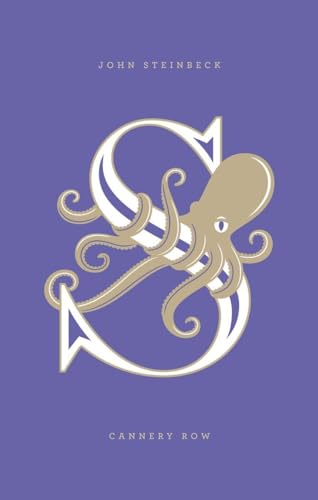
It all begins with a letter. Fall in love with Penguin Drop Caps, a new series of twenty-six collectible and hardcover editions, each with a type cover showcasing a gorgeously illustrated letter of the alphabet. In a design collaboration between Jessica Hische and Penguin Art Director Paul Buckley, the series features unique cover art by Hische, a superstar in the world of type design and illustration, whose work has appeared everywhere from Tiffany & Co. to Wes Anderson's recent film Moonrise Kingdom to Penguin's own bestsellers Committed and Rules of Civility. With exclusive designs that have never before appeared on Hische's hugely popular Daily Drop Cap blog, the Penguin Drop Caps series debuted with an 'A' for Jane Austen's Pride and Prejudice, a 'B' for Charlotte Brönte's Jane Eyre, and a 'C' for Willa Cather's My Ántonia. It continues with more perennial classics, perfect to give as elegant gifts or to showcase on your own shelves.
S is for Steinbeck. Unburdened by the material necessities of the more fortunate, the denizens of Cannery Row discover rewards unknown in more traditional society. Henry the painter sorts through junk lots for pieces of wood to incorporate into the boat he is building, while the girls from Dora Flood’s bordello venture out now and then to enjoy a bit of sunshine. Lee Chong stocks his grocery with almost anything a man could want, and Doc, a young marine biologist who ministers to sick puppies and unhappy souls, unexpectedly finds true love. Cannery Row is just a few blocks long, but the story it harbors is suffused with warmth, understanding, and a great fund of human values. First published in 1945, and drawn from Steinbeck's memories of real inhabitants of Monterey, California, Cannery Row focuses on the acceptance of life as it is—both the loneliness of the individual and the exuberance of community.
Die Inhaltsangabe kann sich auf eine andere Ausgabe dieses Titels beziehen.
Über die Autorin bzw. den Autor
John Steinbeck (1902–1968) was born in Salinas, California. He worked as a laborer and a journalist, and in 1935, when he published Tortilla Flat, he achieved popular success and financial security. Steinbeck wrote more than twenty-five novels and won the Nobel Prize in 1962.
Jessica Hische is a letterer, illustrator, typographer, and web designer. She currently serves on the Type Directors Club board of directors, has been named a Forbes Magazine "30 under 30" in art and design as well as an ADC Young Gun and one of Print Magazine’s "New Visual Artists". She has designed for Wes Anderson, McSweeney's, Tiffany & Co, Penguin Books, and many others. She resides primarily in San Francisco, occasionally in Brooklyn.
Auszug. © Genehmigter Nachdruck. Alle Rechte vorbehalten.
John Steinbeck Centennial Edition (1902-2002)
CANNERY ROW
Born in Salinas, California, in 1902, John Steinbeck grew up in a fertile agricultural valley about twenty-five miles from the Pacific Coast—and both valley and coast would serve as settings for some of his best fiction. In 1919 he went to Stanford University, where he intermittently enrolled in literature and writing courses until he left in 1925 without taking a degree. During the next five years he supported himself as a laborer and journalist in New York City, all the time working on his first novel,Cup of Gold (1929). After marriage and a move to Pacific Grove, he published two California fictions,The Pastures of Heaven (1932) and To a God Unknown (1933), and worked on short stories later collected inThe Long Valley (1938). Popular success and financial security came only withTortilla Flat (1935), stories about Monterey’s paisanos. A ceaseless experimenter throughout his career, Steinbeck changed courses regularly. Three powerful novels of the late 1930s focused on the California laboring class:In Dubious Battle (1936), Of Mice and Men (1937), and the book considered by many his finest,The Grapes of Wrath (1939). Early in the 1940s, Steinbeck became a filmmaker withThe Forgotten Village (1941) and a serious student of marine biology with Sea of Cortez (1941). He devoted his services to the war, writing Bombs Away (1942) and the controversial play-noveletteThe Moon Is Down (1942). Cannery Row (1945), The Wayward Bus (1947),The Pearl (1947), A Russian Journal (1948), another experimental drama,Burning Bright (1950), and The Log from the Sea of Cortez (1951) preceded publication of the monumentalEast of Eden (1952), an ambitious saga of the Salinas Valley and his own family’s history. The last decades of his life were spent in New York City and Sag Harbor with his third wife, with whom he traveled widely. Later books includeSweet Thursday (1954), The Short Reign of Pippin IV: A Fabrication (1957),Once There Was a War (1958), The Winter of Our Discontent (1961), Travels with Charley in Search of America (1962), America and Americans (1966), and the posthumously publishedJournal of a Novel: The East of Eden Letters (1969), Viva Zapata! (1975),The Acts of King Arthur and His Noble Knights (1976), and Working Days: The Journals of The Grapes of Wrath (1989). He died in 1968, having won a Nobel Prize in 1962.
Throughout his life Steinbeck signed his letters with his personal “Pigasus” logo, symbolizing himself “a lumbering soul but trying to fly.” The Latin mottoAd Astra Per Alia Porci translates “To the stars on the wings of a pig.”
JOHN STEINBECK CENTENNIAL EDITION (1902-2002)
JOHN STEINBECK
Cannery Row
Table of Contents
Cannery Row
Cannery Row in Monterey in California is a poem, a stink, a grating noise, a quality of light, a tone, a habit, a nostalgia, a dream. Cannery Row is the gathered and scattered, tin and iron and rust and splintered wood, chipped pavement and weedy lots and junk heaps, sardine canneries of corrugated iron, honky tonks, restaurants and whore houses, and little crowded groceries, and laboratories and flophouses. Its inhabitants are, as the man once said, “whores, pimps, gamblers, and sons of bitches,” by which he meant Everybody. Had the man looked through another peephole he might have said, “Saints and angels and martyrs and holy men,” and he would have meant the same thing.
In the morning when the sardine fleet has made a catch, the purse-seiners waddle heavily into the bay blowing their whistles. The deep-laden boats pull in against the coast where the canneries dip their tails into the bay. The figure is advisedly chosen, for if the canneries dipped their mouths into the bay the canned sardines which emerge from the other end would be metaphorically, at least, even more horrifying. Then cannery whistles scream and all over the town men and women scramble into their clothes and come running down to the Row to go to work. Then shining cars bring the upper classes down: superintendents, accountants, owners who disappear into offices. Then from the town pour Wops and Chinamen and Polaks, men and women in trousers and rubber coats and oilcloth aprons. They come running to clean and cut and pack and cook and can the fish. The whole street rumbles and groans and screams and rattles while the silver rivers offish pour in out of the boats and the boats rise higher and higher in the water until they are empty. The canneries rumble and rattle and squeak until the last fish is cleaned and cut and cooked and canned and then the whistles scream again and the dripping, smelly, tired Wops and Chinamen and Polaks, men and women, straggle out and droop their ways up the hill into the town and Cannery Row becomes itself again—quiet and magical. Its normal life returns. The bums who retired in disgust under the black cypress tree come out to sit on the rusty pipes in the vacant lot. The girls from Dora’s emerge for a bit of sun if there is any. Doc strolls from the Western Biological Laboratory and crosses the street to Lee Chong’s grocery for two quarts of beer. Henri the painter noses like an Airedale through the junk in the grass-grown lot for some part or piece of wood or metal he needs for the boat he is building. Then the darkness edges in and the street light comes on in front of Dora’s—the lamp which makes perpetual moonlight in Cannery Row. Callers arrive at Western Biological to see Doc, and he crosses the street to Lee Chong’s for five quarts of beer.
How can the poem and the stink and the grating noise—the quality of light, the tone, the habit and the dream—be set down alive? When you collect marine animals there are certain flat worms so delicate that they are almost impossible to capture whole, for they break and tatter under the touch. You must let them ooze and crawl of their own will onto a knife blade and then lift them gently into your bottle of sea water. And perhaps that might be the way to write this book—to open the page and to let the stories crawl in by themselves.
1
Lee Chong’s grocery, while not a model of neatness, was a miracle of supply. It was small and crowded but within its single room a man could find everything he needed or wanted to live and to be happy—clothes, food, both fresh and canned, liquor, tobacco, fishing equipment, machinery, boats, cordage, caps, pork chops. You could buy at Lee Chong’s a pair of slippers, a silk kimono, a quarter pint of whiskey and a cigar. You could work out combinations to fit almost any mood. The one commodity Lee Chong did not keep could be had across the lot at Dora’s.
The grocery opened at dawn and did not close until the last wandering vagrant dime had been spent or retired for the night. Not that Lee Chong was avaricious. He wasn’t, but if one wanted to spend money, he was available. Lee’s position in the community surprised him as much as he could be surprised. Over the course of the years everyone in Cannery Row owed him money. He never pressed his clients, but when the bill became too large, Lee cut off credit. Rather than walk into the town up the hill, the client usually paid or tried to.
Lee was round-faced and courteous. He spoke a stately English without ever using the letter R. When the tong wars were going on in California, it happened now and then that Lee found a price on his head. Then he would go secretly to San Francisco and enter a hospital until the trouble blew over. What he did with...
„Über diesen Titel“ kann sich auf eine andere Ausgabe dieses Titels beziehen.
Suchergebnisse für Cannery Row: Drop Caps (Penguin Drop Caps)

Beispielbild für diese ISBN
Cannery Row
Anbieter: Revaluation Books, Exeter, Vereinigtes Königreich
Verkäuferbewertung 5 von 5 Sternen

Hardcover. Zustand: Brand New. reprint edition. 212 pages. 8.00x5.75x1.00 inches. In Stock. Artikel-Nr. x-0143125214
Neu kaufen
EUR 29,86
EUR 11,94 Versand
Versand von Vereinigtes Königreich nach USA
Versand von Vereinigtes Königreich nach USA
Anzahl: 2 verfügbar
Beispielbild für diese ISBN
Cannery Row
Anbieter: Kennys Bookstore, Olney, MD, USA
Verkäuferbewertung 5 von 5 Sternen
Zustand: New. 2014. Reprint. Hardcover. . . . . . Books ship from the US and Ireland. Artikel-Nr. V9780143125211
Neu kaufen
EUR 33,18
EUR 9,36 Versand
Versand innerhalb von USA
Versand innerhalb von USA
Anzahl: 1 verfügbar
Foto des Verkäufers
Cannery Row : Drop Caps
Anbieter: AHA-BUCH GmbH, Einbeck, Deutschland
Verkäuferbewertung 5 von 5 Sternen
Buch. Zustand: Neu. Neuware - It all begins with a letter. Fall in love with Penguin Drop Caps, a new series of twenty-six collectible and hardcover editions, each with a type cover showcasing a gorgeously illustrated letter of the alphabet. In a design collaboration between Jessica Hische and Penguin Art Director Paul Buckley, the series features unique cover art by Hische, a superstar in the world of type design and illustration, whose work has appeared everywhere from Tiffany & Co. to Wes Anderson's recent film Moonrise Kingdom to Penguin's own bestsellers Committed and Rules of Civility. With exclusive designs that have never before appeared on Hische's hugely popular Daily Drop Cap blog, the Penguin Drop Caps series debuted with an 'A' for Jane Austen's Pride and Prejudice, a 'B' for Charlotte Brönte's Jane Eyre, and a 'C' for Willa Cather's My Ántonia. It continues with more perennial classics, perfect to give as elegant gifts or to showcase on your own shelves.S is for Steinbeck.Unburdened by the material necessities of the more fortunate, the denizens of Cannery Row discover rewards unknown in more traditional society. Henry the painter sorts through junk lots for pieces of wood to incorporate into the boat he is building, while the girls from Dora Flood's bordello venture out now and then to enjoy a bit of sunshine. Lee Chong stocks his grocery with almost anything a man could want, and Doc, a young marine biologist who ministers to sick puppies and unhappy souls, unexpectedly finds true love. Cannery Row is just a few blocks long, but the story it harbors is suffused with warmth, understanding, and a great fund of human values. First published in 1945, and drawn from Steinbeck's memories of real inhabitants of Monterey, California,Cannery Rowfocuses on the acceptance of life as it isboththe loneliness of the individual andthe exuberance of community. Artikel-Nr. 9780143125211
Neu kaufen
EUR 34,62
EUR 35,00 Versand
Versand von Deutschland nach USA
Versand von Deutschland nach USA
Anzahl: 2 verfügbar
Foto des Verkäufers
Cannery Row
Anbieter: moluna, Greven, Deutschland
Verkäuferbewertung 5 von 5 Sternen
Gebunden. Zustand: New. John Steinbeck (1902�) was born in Salinas, California. He worked as a laborer and a journalist, and in 1935, when he published Tortilla Flat, he achieved popular success and financial security. Steinbeck wrote more than twenty-five . Artikel-Nr. 5893562
Neu kaufen
EUR 25,87
EUR 48,99 Versand
Versand von Deutschland nach USA
Versand von Deutschland nach USA
Anzahl: 5 verfügbar