
Verwandte Artikel zu Give and Take: Why Helping Others Drives Our Success
Inhaltsangabe
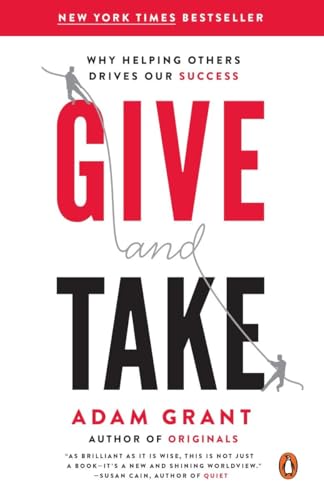
A groundbreaking look at why our interactions with others hold the key to success, from the New York Times bestselling author of Hidden Potential, Think Again, and Originals
For generations, we have focused on the individual drivers of success: passion, hard work, talent, and luck. But in today’s dramatically reconfigured world, success is increasingly dependent on how we interact with others. In Give and Take, Adam Grant, an award-winning researcher and Wharton’s highest-rated professor, examines the surprising forces that shape why some people rise to the top of the success ladder while others sink to the bottom. Praised by social scientists, business theorists, and corporate leaders, Give and Take opens up an approach to work, interactions, and productivity that is nothing short of revolutionary.
Die Inhaltsangabe kann sich auf eine andere Ausgabe dieses Titels beziehen.
Über die Autorin bzw. den Autor
Adam Grant is an organizational psychologist at Wharton, where he has been the top-rated professor for seven straight years. He is an expert in how we can find motivation and meaning, and lead more generous and creative lives. He is the #1 New York Times bestselling author of four books that have sold over 2 million copies and been translated into 35 languages: Give and Take, Originals, Option B, and Power Moves. His books have been recognized as among the year’s best by Amazon, the Financial Times, Harvard Business Review, and the Wall Street Journaland been praised by J.J. Abrams, Richard Branson, Bill and Melinda Gates, Malcolm Gladwell, and Malala Yousafzai.
Adam’s TED talks have been viewed more than 20 million times. He hosts the chart-topping TED podcast WorkLife. His speaking and consulting clients include Google, the NBA, Bridgewater, and the Gates Foundation. He has been recognized as one of the world’s 10 most influential management thinkers, Fortune’s 40 under 40, Oprah’s Super Soul 100, and a World Economic Forum Young Global Leader, and received distinguished scientific achievement awards from the American Psychological Association and the National Science Foundation. Adam writes for the New York Times on work and psychology and serves on the Department of Defense Innovation Board. He received his B.A. from Harvard and his Ph.D. from the University of Michigan, and he is a former Junior Olympic springboard diver. He lives in Philadelphia with his wife Allison, their two daughters, and their son.
Von der hinteren Coverseite
For generations, we have focused on the individual drivers of success: passion, hard work, talent, and luck. But in today's dramatically reconfigured world, success is increasingly dependent on how we interact with others. In Give and Take, Adam Grant, an award-winning researcher and Wharton's highest-rated professor, examines the surprising forces that shape why some people rise to the top of the success ladder while others sink to the bottom. Praised by social scientists, business theorists, and corporate leaders, Give and Take opens up an approach to work, interactions, and productivity that is nothing short of revolutionary.
Auszug. © Genehmigter Nachdruck. Alle Rechte vorbehalten.
1
Good Returns
The Dangers and Rewards of Giving More Than You Get The principle of give and take; that is diplomacy—give one and take ten.
—Mark Twain, author and humorist
On a sunny Saturday afternoon in Silicon Valley, two proud fathers stood on the sidelines of a soccer field. They were watching their young daughters play together, and it was only a matter of time before they struck up a conversation about work. The taller of the two men was Danny Shader, a serial entrepreneur who had spent time at Netscape, Motorola, and Amazon. Intense, dark-haired, and capable of talking about business forever, Shader was in his late thirties by the time he launched his first company, and he liked to call himself the “old man of the Internet.” He loved building companies, and he was just getting his fourth start-up off the ground.
Shader had instantly taken a liking to the other father, a man named David Hornik who invests in companies for a living. At 5'4", with dark hair, glasses, and a goatee, Hornik is a man of eclectic interests: he collects Alice in Wonderland books, and in college he created his own major in computer music. He went on to earn a master’s in criminology and a law degree, and after burning the midnight oil at a law firm, he accepted a job offer to join a venture capital firm, where he spent the next decade listening to pitches from entrepreneurs and deciding whether or not to fund them.
During a break between soccer games, Shader turned to Hornik and said, “I’m working on something—do you want to see a pitch?” Hornik specialized in Internet companies, so he seemed like an ideal investor to Shader. The interest was mutual. Most people who pitch ideas are first-time entrepreneurs, with no track record of success. In contrast, Shader was a blue-chip entrepreneur who had hit the jackpot not once, but twice. In 1999, his first start-up, Accept.com, was acquired by Amazon for $175 million. In 2007, his next company, Good Technology, was acquired by Motorola for $500 million. Given Shader’s history, Hornik was eager to hear what he was up to next.
A few days after the soccer game, Shader drove to Hornik’s office and pitched his newest idea. Nearly a quarter of Americans have trouble making online purchases because they don’t have a bank account or credit card, and Shader was proposing an innovative solution to this problem. Hornik was one of the first venture capitalists to hear the pitch, and right off the bat, he loved it. Within a week, he put Shader in front of his partners and offered him a term sheet: he wanted to fund Shader’s company.
Although Hornik had moved fast, Shader was in a strong position. Given Shader’s reputation, and the quality of his idea, Hornik knew plenty of investors would be clamoring to work with Shader. “You’re rarely the only investor giving an entrepreneur a term sheet,” Hornik explains. “You’re competing with the best venture capital firms in the country, and trying to convince the entrepreneur to take your money instead of theirs.” The best way for Hornik to land the investment was to set a deadline for Shader to make his decision. If Hornik made a compelling offer with a short fuse, Shader might sign it before he had the chance to pitch to other investors. This is what many venture capitalists do to stack the odds in their favor.
But Hornik didn’t give Shader a deadline. In fact, he practically invited Shader to shop his offer around to other investors. Hornik believed that entrepreneurs need time to evaluate their options, so as a matter of principle, he refused to present exploding offers. “Take as much time as you need to make the right decision,” he said. Although Hornik hoped Shader would conclude that the right decision was to sign with him, he put Shader’s best interests ahead of his own, giving Shader space to explore other options.
Shader did just that: he spent the next few weeks pitching his idea to other investors. In the meantime, Hornik wanted to make sure he was still a strong contender, so he sent Shader his most valuable resource: a list of forty references who could attest to Hornik’s caliber as an investor. Hornik knew that entrepreneurs look for the same attributes in investors that we all seek in financial advisers: competence and trustworthiness. When entrepreneurs sign with an investor, the investor joins their board of directors and provides expert advice. Hornik’s list of references reflected the blood, sweat, and tears that he had devoted to entrepreneurs over the course of more than a decade in the venture business. He knew they would vouch for his skill and his character.
A few weeks later, Hornik’s phone rang. It was Shader, ready to announce his decision.
“I’m sorry,” Shader said, “but I’m signing with another investor.” The financial terms of the offer from Hornik and the other investor were virtually identical, so Hornik’s list of forty references should have given him an advantage. And after speaking with the references, it was clear to Shader that Hornik was a great guy.
But it was this very same spirit of generosity that doomed Hornik’s case. Shader worried that Hornik would spend more time encouraging him than challenging him. Hornik might not be tough enough to help Shader start a successful business, and the other investor had a reputation for being a brilliant adviser who questioned and pushed entrepreneurs. Shader walked away thinking, “I should probably add somebody to the board who will challenge me more. Hornik is so affable that I don’t know what he’ll be like in the boardroom.” When he called Hornik, he explained, “My heart said to go with you, but my head said to go with them. I decided to go with my head instead of my heart.”
Hornik was devastated, and he began to second-guess himself. “Am I a dope? If I had applied pressure to take the term sheet, maybe he would have taken it. But I’ve spent a decade building my reputation so this wouldn’t happen. How did this happen?”
David Hornik learned his lesson the hard way: good guys finish last.
Or do they?
According to conventional wisdom, highly successful people have three things in common: motivation, ability, and opportunity. If we want to succeed, we need a combination of hard work, talent, and luck. The story of Danny Shader and David Hornik highlights a fourth ingredient, one that’s critical but often neglected: success depends heavily on how we approach our interactions with other people. Every time we interact with another person at work, we have a choice to make: do we try to claim as much value as we can, or contribute value without worrying about what we receive in return?
As an organizational psychologist and Wharton professor, I’ve dedicated more than ten years of my professional life to studying these choices at organizations ranging from Google to the U.S. Air Force, and it turns out that they have staggering consequences for success. Over the past three decades, in a series of groundbreaking studies, social scientists have discovered that people differ dramatically in their preferences for reciprocity— their desired mix of taking and giving. To shed some light on these preferences, let me introduce you to two kinds of people who fall at opposite ends of the reciprocity spectrum at work. I call them takers and givers. Takers have a distinctive signature: they like to get more than they give.
They tilt reciprocity in their own favor, putting their own interests ahead of others’ needs. Takers believe that the world is a competitive, dog-eat-dog place. They feel that to succeed, they need...
„Über diesen Titel“ kann sich auf eine andere Ausgabe dieses Titels beziehen.
Suchergebnisse für Give and Take: Why Helping Others Drives Our Success

Beispielbild für diese ISBN
Give and Take: Why Helping Others Drives Our Success
Anbieter: World of Books (was SecondSale), Montgomery, IL, USA
Verkäuferbewertung 5 von 5 Sternen

Paperback. Zustand: Fair. A groundbreaking look at why our interactions with others hold the key to success, from the New York Times bestselling author of Hidden Potential, Think Again, and Originals For generations, we have focused on the individual drivers of success: passion, hard work, talent, and luck. But in today's dramatically reconfigured world, success is increasingly dependent on how we interact with others. In Give and Take, Adam Grant, an award-winning researcher and Wharton's highest-rated professor, examines the surprising forces that shape why some people rise to the top of the success ladder while others sink to the bottom. Praised by social scientists, business theorists, and corporate leaders, Give and Take opens up an approach to work, interactions, and productivity that is nothing short of revolutionary. Artikel-Nr. 00110282732
Gebraucht kaufen
EUR 3,85
Versand gratis
Versand innerhalb von USA
Versand innerhalb von USA
Anzahl: 2 verfügbar
Beispielbild für diese ISBN
Give and Take: Why Helping Others Drives Our Success
Anbieter: World of Books (was SecondSale), Montgomery, IL, USA
Verkäuferbewertung 5 von 5 Sternen
Paperback. Zustand: Good. A groundbreaking look at why our interactions with others hold the key to success, from the New York Times bestselling author of Hidden Potential, Think Again, and Originals For generations, we have focused on the individual drivers of success: passion, hard work, talent, and luck. But in today's dramatically reconfigured world, success is increasingly dependent on how we interact with others. In Give and Take, Adam Grant, an award-winning researcher and Wharton's highest-rated professor, examines the surprising forces that shape why some people rise to the top of the success ladder while others sink to the bottom. Praised by social scientists, business theorists, and corporate leaders, Give and Take opens up an approach to work, interactions, and productivity that is nothing short of revolutionary. Artikel-Nr. 00096489104
Gebraucht kaufen
EUR 3,85
Versand gratis
Versand innerhalb von USA
Versand innerhalb von USA
Anzahl: Mehr als 20 verfügbar
Beispielbild für diese ISBN
Give and Take: Why Helping Others Drives Our Success
Anbieter: ThriftBooks-Atlanta, AUSTELL, GA, USA
Verkäuferbewertung 5 von 5 Sternen
Paperback. Zustand: Good. No Jacket. Pages can have notes/highlighting. Spine may show signs of wear. ~ ThriftBooks: Read More, Spend Less. Artikel-Nr. G0143124986I3N00
Gebraucht kaufen
EUR 5,96
Versand gratis
Versand innerhalb von USA
Versand innerhalb von USA
Anzahl: 5 verfügbar
Beispielbild für diese ISBN
Give and Take: Why Helping Others Drives Our Success
Anbieter: ThriftBooks-Phoenix, Phoenix, AZ, USA
Verkäuferbewertung 5 von 5 Sternen
Paperback. Zustand: Good. No Jacket. Pages can have notes/highlighting. Spine may show signs of wear. ~ ThriftBooks: Read More, Spend Less. Artikel-Nr. G0143124986I3N00
Gebraucht kaufen
EUR 5,96
Versand gratis
Versand innerhalb von USA
Versand innerhalb von USA
Anzahl: 4 verfügbar
Beispielbild für diese ISBN
Give and Take: Why Helping Others Drives Our Success
Anbieter: ThriftBooks-Reno, Reno, NV, USA
Verkäuferbewertung 5 von 5 Sternen
Paperback. Zustand: Very Good. No Jacket. May have limited writing in cover pages. Pages are unmarked. ~ ThriftBooks: Read More, Spend Less. Artikel-Nr. G0143124986I4N00
Gebraucht kaufen
EUR 5,96
Versand gratis
Versand innerhalb von USA
Versand innerhalb von USA
Anzahl: 3 verfügbar
Beispielbild für diese ISBN
Give and Take: Why Helping Others Drives Our Success
Anbieter: ThriftBooks-Reno, Reno, NV, USA
Verkäuferbewertung 5 von 5 Sternen
Paperback. Zustand: Good. No Jacket. Former library book; Pages can have notes/highlighting. Spine may show signs of wear. ~ ThriftBooks: Read More, Spend Less. Artikel-Nr. G0143124986I3N10
Gebraucht kaufen
EUR 5,96
Versand gratis
Versand innerhalb von USA
Versand innerhalb von USA
Anzahl: 1 verfügbar
Beispielbild für diese ISBN
Give and Take: Why Helping Others Drives Our Success
Anbieter: ThriftBooks-Dallas, Dallas, TX, USA
Verkäuferbewertung 5 von 5 Sternen
Paperback. Zustand: Good. No Jacket. Pages can have notes/highlighting. Spine may show signs of wear. ~ ThriftBooks: Read More, Spend Less. Artikel-Nr. G0143124986I3N00
Gebraucht kaufen
EUR 5,96
Versand gratis
Versand innerhalb von USA
Versand innerhalb von USA
Anzahl: 4 verfügbar
Beispielbild für diese ISBN
Give and Take: Why Helping Others Drives Our Success
Anbieter: ThriftBooks-Dallas, Dallas, TX, USA
Verkäuferbewertung 5 von 5 Sternen
Paperback. Zustand: Very Good. No Jacket. May have limited writing in cover pages. Pages are unmarked. ~ ThriftBooks: Read More, Spend Less. Artikel-Nr. G0143124986I4N00
Gebraucht kaufen
EUR 5,96
Versand gratis
Versand innerhalb von USA
Versand innerhalb von USA
Anzahl: 4 verfügbar
Beispielbild für diese ISBN
Give and Take: Why Helping Others Drives Our Success
Anbieter: ThriftBooks-Phoenix, Phoenix, AZ, USA
Verkäuferbewertung 5 von 5 Sternen
Paperback. Zustand: Very Good. No Jacket. May have limited writing in cover pages. Pages are unmarked. ~ ThriftBooks: Read More, Spend Less. Artikel-Nr. G0143124986I4N00
Gebraucht kaufen
EUR 5,96
Versand gratis
Versand innerhalb von USA
Versand innerhalb von USA
Anzahl: 3 verfügbar
Beispielbild für diese ISBN
Give and Take: Why Helping Others Drives Our Success
Anbieter: ThriftBooks-Reno, Reno, NV, USA
Verkäuferbewertung 5 von 5 Sternen
Paperback. Zustand: Good. No Jacket. Pages can have notes/highlighting. Spine may show signs of wear. ~ ThriftBooks: Read More, Spend Less. Artikel-Nr. G0143124986I3N00
Gebraucht kaufen
EUR 5,96
Versand gratis
Versand innerhalb von USA
Versand innerhalb von USA
Anzahl: 4 verfügbar