
Verwandte Artikel zu Four Fish: The Future of the Last Wild Food
Inhaltsangabe
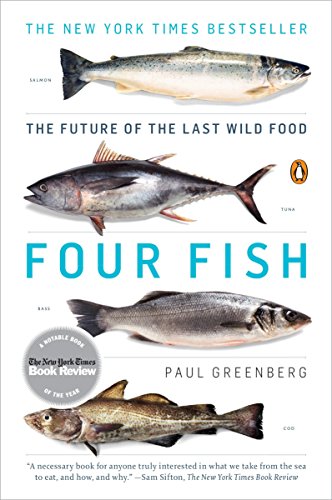
“A necessary book for anyone truly interested in what we take from the sea to eat, and how, and why.” —Sam Sifton, The New York Times Book Review
Acclaimed author of American Catch and The Omega Princple and life-long fisherman, Paul Greenberg takes us on a journey, examining the four fish that dominate our menus: salmon, sea bass, cod, and tuna.
Investigating the forces that get fish to our dinner tables, Greenberg reveals our damaged relationship with the ocean and its inhabitants. Just three decades ago, nearly everything we ate from the sea was wild. Today, rampant overfishing and an unprecedented biotech revolution have brought us to a point where wild and farmed fish occupy equal parts of a complex marketplace.
Four Fish offers a way for us to move toward a future in which healthy and sustainable seafood is the rule rather than the exception.
Die Inhaltsangabe kann sich auf eine andere Ausgabe dieses Titels beziehen.
Über die Autorin bzw. den Autor
Paul Greenberg is the author of the James Beard Award-winning Four Fish and American Catch and a regular contributor to The New York Times. His writing has also appeared in The New Yorker, National Geographic, and GQ, among other publications, and he has lectured widely on ocean issues at institutions ranging from Google to Yale to the U.S. Senate. He lives in New York.
Twitter: @4fishgreenberg
Facebook: facebook.com/fourfish
Web: paulgreenberg.org
Auszug. © Genehmigter Nachdruck. Alle Rechte vorbehalten.
Introduction
In 1978 all the fish I cared about died. They were the biggest largemouth bass I had ever seen, and they lived in a pond ten minutes’ walk from my house on a large estate in the backwoods of Greenwich, Connecticut, perhaps the most famously wealthy town in America. We did not own the house, the estate, the pond, or the largemouth bass, but I still thought of the fish as my fish. I had found them, and the pond was my rightful hunting ground.
My mother had rented the house as she would three other homes in Greenwich, because it gave the illusion of magnificent proprietorship. She tended toward small cottages on large estates— converted stables, liverymen’s accommodations that were the unclaimed, declining appendages of older, fading wealth, unsold because of divorces or other family complications, rented out to us for a reasonable fee that would become unreasonable and impel our moving on to other cottages on other collapsing estates.
Fishing was the one constant during these years. Sensing in it a masculine, character-building quality, my mother arranged it so that the cottages we rented always had access to streams and lakes or abutted other properties we could trespass upon that had such resources. She trusted my instincts for spotting fishy water and used me as a kind of divining rod before signing a lease. And for most of my childhood, we were within a short walk of a potentially fruitful cast. Our longest residence was in the aforementioned house near the giant largemouth bass. In the first two years we lived there, I spent all my summer evenings and weekend mornings pursuing them.
In the winter of 1978, though, a fierce blizzard hit southern Connecticut. Temperatures were often below zero and at one point it snowed for thirty-three hours straight. Perhaps it was the cold that killed the fish, or the copper sulfate I helped the caretaker drag through the pond the previous summer to manage the algal blooms, or maybe even the fishermen I’d noticed trespassing on the estate one day, scoping out my grounds. But whatever caused it, after that winter never again did I spot a living fish. Of course I tried. I trolled pretty much every square foot after school the following year, often with a neighbor who had moved in after the era of the great fish. When two months of dragging lures up and down the shoreline produced not even a strike, my neighbor finally stuck a pin in my irrational bubble of hope.
“I don’t care what you say about what was,” I remember him shouting. “There is not a fucking fish in this whole goddamn lake, and I’m never fishing here again.”
Like any hunter whose grounds have gone bad, I set out looking for new territory. I followed the outflow of the pond down a series of cascades that in turn flattened out into a low, swampy meadow of deep oxbows. Only minuscule shiners, crawfish, and escaped goldfish swam here. Farther and farther I went, until the stream joined a larger river and passage was blocked by a fence that a wealthy landowner had erected. Inspecting a map at the library, I found that this was a significant juncture for my stream (as with “my” pond, I had annexed the stream and referred to it now as “mine”). The point at which it was no longer my stream was where it entered the Byram River, a flow that during the times of Native American sovereignty was called the Armonck, or “fishing place,” but which, according to one local legend, the English renamed because of the native tendency to pester white men with armfuls of shad and herring for trade and the endlessly repeated entreaty “Buy rum? Buy rum?” The Byram continued south for another ten miles after the juncture before widening and finally emptying out into the sea. The beginning of an idea came to me.
Several hundred dollars made it into my account after an ersatz bar mitzvah that my partially Jewish family cobbled together for me when I turned thirteen, and through a debt-leveraged matching grant from the depths of my mother’s complicated finances I was able to purchase a used aluminum boat and a twenty-horsepower outboard engine. Using her good figure and her ability to forge solidarity with the working classes (she had been a friend of the American socialist Michael Harrington and was an experienced strike aide-de-camp), my mother persuaded the Greenwich harbormaster to let us jump the waiting list for a boat slip at the Grass Island Marina. By the summer of 1981, I had a boat, a place to store it, and several thousand square miles of sea for my own use. Better hunting grounds had been found at last.
This was not the time of child seats or swallowproof soda-can tabs. No safety seals secured Tylenol bottles or yogurt containers. Today it would be considered parental negligence, but in that first summer of boat ownership my mother would drive me down to the Grass Island Marina, seat belt–less, in her black secondhand luxury-edition Chrysler Cordoba and drop me off at my thirdhand boat. As I finished dumping my gear out of her trunk, she would light a Dunhill cigarette, cough heavily, and then, with a glance in her rearview, speed off into the childless afternoon ahead of her. So, at the age of thirteen, I learned how to navigate and fish on the sea by myself. It wasn’t difficult—I’m sure most children, given the opportunity, could have figured it out. Once upon a time, being thirteen really did mean you were a man. But the feeling of steaming out into open water in pursuit of wild game, leaving the financial and physical constriction of mainland Connecticut behind, was exhilarating.
I did not have a GPS to plot my position or sonar to help me find fish. There was no cell phone to “check in” with home. I learned to find quarry by chasing flocks of diving terns or following a line of rocks from the shore with the assumption (usually right) that they indicated similar fish-holding rock piles down below the surface. If a rivet came loose from the hull of my boat—a sometime occurrence, since the hull had not been anodized to withstand salt water—I would slip off a flip-flop and hold the errant piece of metal in place with my big toe. I was sometimes able to persuade my older brother to join me, but midway through that first summer he announced that he “no longer wanted to kill things.” I didn’t mind. I was happy to be alone with the fish and the ocean.
By my second year of boat ownership, I began to understand the flow of fish as they came and left Long Island Sound. St. Patrick’s Day, around when the forsythias first bloomed, was the time to test the mudflats for flounder just off the Indian Harbor Yacht Club docks. By April, when the forsythia shriveled to brown and the dogwoods came into flower, mackerel would have passed into the Sound and blackfish would be on the reefs surrounding Great Captain Island—a sure sign that it was time to put the boat in the water. Soon the lilacs would blossom, heralding the arrival of the first weakfish and porgies in May. And by the time lawns were being mowed with ferocity ashore, bluefish were coming into the harbors, devouring the mackerel and menhaden and everything else that had the misfortune to get in their way.
Striped bass, the prize of prizes, were also rumored to make an appearance around this time, though for me those fish remained only a rumor—they were already too rare for a poorly skilled captain to find them. By fall, blackfish would arrive again, along with a reappearance of flounder, and by wintertime, when my boat was back on blocks and nothing could be caught, I would enlist the much more substantial financial resources of my father and cajole him into taking me fishing on the Viking Starship party boat out of...
„Über diesen Titel“ kann sich auf eine andere Ausgabe dieses Titels beziehen.
Suchergebnisse für Four Fish: The Future of the Last Wild Food

Beispielbild für diese ISBN
Four Fish: The Future of the Last Wild Food
Anbieter: World of Books (was SecondSale), Montgomery, IL, USA
Verkäuferbewertung 5 von 5 Sternen

Paperback. Zustand: Very Good. "A necessary book for anyone truly interested in what we take from the sea to eat, and how, and why." --Sam Sifton, The New York Times Book Review Acclaimed author of American Catch and The Omega Princple and life-long fisherman, Paul Greenberg takes us on a journey, examining the four fish that dominate our menus: salmon, sea bass, cod, and tuna. Investigating the forces that get fish to our dinner tables, Greenberg reveals our damaged relationship with the ocean and its inhabitants. Just three decades ago, nearly everything we ate from the sea was wild. Today, rampant overfishing and an unprecedented biotech revolution have brought us to a point where wild and farmed fish occupy equal parts of a complex marketplace. Four Fish offers a way for us to move toward a future in which healthy and sustainable seafood is the rule rather than the exception. Artikel-Nr. 00101945644
Gebraucht kaufen
EUR 4,18
Versand gratis
Versand innerhalb von USA
Versand innerhalb von USA
Anzahl: 6 verfügbar
Beispielbild für diese ISBN
Four Fish: The Future of the Last Wild Food
Anbieter: World of Books (was SecondSale), Montgomery, IL, USA
Verkäuferbewertung 5 von 5 Sternen
Paperback. Zustand: Fair. "A necessary book for anyone truly interested in what we take from the sea to eat, and how, and why." --Sam Sifton, The New York Times Book Review Acclaimed author of American Catch and The Omega Princple and life-long fisherman, Paul Greenberg takes us on a journey, examining the four fish that dominate our menus: salmon, sea bass, cod, and tuna. Investigating the forces that get fish to our dinner tables, Greenberg reveals our damaged relationship with the ocean and its inhabitants. Just three decades ago, nearly everything we ate from the sea was wild. Today, rampant overfishing and an unprecedented biotech revolution have brought us to a point where wild and farmed fish occupy equal parts of a complex marketplace. Four Fish offers a way for us to move toward a future in which healthy and sustainable seafood is the rule rather than the exception. Artikel-Nr. 00097421445
Gebraucht kaufen
EUR 4,18
Versand gratis
Versand innerhalb von USA
Versand innerhalb von USA
Anzahl: 7 verfügbar
Beispielbild für diese ISBN
Four Fish: The Future of the Last Wild Food
Anbieter: World of Books (was SecondSale), Montgomery, IL, USA
Verkäuferbewertung 5 von 5 Sternen
Paperback. Zustand: Good. "A necessary book for anyone truly interested in what we take from the sea to eat, and how, and why." --Sam Sifton, The New York Times Book Review Acclaimed author of American Catch and The Omega Princple and life-long fisherman, Paul Greenberg takes us on a journey, examining the four fish that dominate our menus: salmon, sea bass, cod, and tuna. Investigating the forces that get fish to our dinner tables, Greenberg reveals our damaged relationship with the ocean and its inhabitants. Just three decades ago, nearly everything we ate from the sea was wild. Today, rampant overfishing and an unprecedented biotech revolution have brought us to a point where wild and farmed fish occupy equal parts of a complex marketplace. Four Fish offers a way for us to move toward a future in which healthy and sustainable seafood is the rule rather than the exception. Artikel-Nr. 00098421459
Gebraucht kaufen
EUR 4,18
Versand gratis
Versand innerhalb von USA
Versand innerhalb von USA
Anzahl: 13 verfügbar
Beispielbild für diese ISBN
Four Fish: The Future of the Last Wild Food
Verlag:
Penguin Books (edition Reprint), 2011
ISBN 10: 014311946X
ISBN 13: 9780143119463
Gebraucht
Paperback
Anbieter: BooksRun, Philadelphia, PA, USA
Verkäuferbewertung 5 von 5 Sternen
Paperback. Zustand: Fair. Reprint. The item might be beaten up but readable. May contain markings or highlighting, as well as stains, bent corners, or any other major defect, but the text is not obscured in any way. Artikel-Nr. 014311946X-7-1
Gebraucht kaufen
EUR 4,54
Versand gratis
Versand innerhalb von USA
Versand innerhalb von USA
Anzahl: 2 verfügbar
Beispielbild für diese ISBN
Four Fish: The Future of the Last Wild Food
Anbieter: ThriftBooks-Atlanta, AUSTELL, GA, USA
Verkäuferbewertung 5 von 5 Sternen
Paperback. Zustand: Good. No Jacket. Pages can have notes/highlighting. Spine may show signs of wear. ~ ThriftBooks: Read More, Spend Less. Artikel-Nr. G014311946XI3N00
Gebraucht kaufen
EUR 5,96
Versand gratis
Versand innerhalb von USA
Versand innerhalb von USA
Anzahl: 3 verfügbar
Beispielbild für diese ISBN
Four Fish: The Future of the Last Wild Food
Anbieter: Wonder Book, Frederick, MD, USA
Verkäuferbewertung 5 von 5 Sternen
Zustand: Very Good. Very Good condition. With remainder mark. A copy that may have a few cosmetic defects. May also contain light spine creasing or a few markings such as an owner's name, short gifter's inscription or light stamp. Artikel-Nr. Q05A-04172
Gebraucht kaufen
EUR 6,42
Versand gratis
Versand innerhalb von USA
Versand innerhalb von USA
Anzahl: 1 verfügbar
Beispielbild für diese ISBN
Four Fish: The Future of the Last Wild Food
Anbieter: Wonder Book, Frederick, MD, USA
Verkäuferbewertung 5 von 5 Sternen
Zustand: Good. Good condition. A copy that has been read but remains intact. May contain markings such as bookplates, stamps, limited notes and highlighting, or a few light stains. Artikel-Nr. L18A-04046
Gebraucht kaufen
EUR 6,42
Versand gratis
Versand innerhalb von USA
Versand innerhalb von USA
Anzahl: 3 verfügbar
Beispielbild für diese ISBN
Four Fish : The Future of the Last Wild Food
Verlag:
Penguin Publishing Group, 2011
ISBN 10: 014311946X
ISBN 13: 9780143119463
Gebraucht
Softcover
Anbieter: Better World Books: West, Reno, NV, USA
Verkäuferbewertung 5 von 5 Sternen
Zustand: Very Good. Pages intact with possible writing/highlighting. Binding strong with minor wear. Dust jackets/supplements may not be included. Stock photo provided. Product includes identifying sticker. Better World Books: Buy Books. Do Good. Artikel-Nr. 4687951-20
Gebraucht kaufen
EUR 6,56
Versand gratis
Versand innerhalb von USA
Versand innerhalb von USA
Anzahl: 1 verfügbar
Beispielbild für diese ISBN
Four Fish : The Future of the Last Wild Food
Verlag:
Penguin Publishing Group, 2011
ISBN 10: 014311946X
ISBN 13: 9780143119463
Gebraucht
Softcover
Anbieter: Better World Books, Mishawaka, IN, USA
Verkäuferbewertung 5 von 5 Sternen
Zustand: Good. Pages intact with minimal writing/highlighting. The binding may be loose and creased. Dust jackets/supplements are not included. Stock photo provided. Product includes identifying sticker. Better World Books: Buy Books. Do Good. Artikel-Nr. 4496267-75
Gebraucht kaufen
EUR 7,01
Versand gratis
Versand innerhalb von USA
Versand innerhalb von USA
Anzahl: 5 verfügbar
Beispielbild für diese ISBN
Four Fish: The Future of the Last Wild Food
Verlag:
Penguin Putnam Inc, United States, New York, NY, 2011
ISBN 10: 014311946X
ISBN 13: 9780143119463
Gebraucht
Paperback
Anbieter: WorldofBooks, Goring-By-Sea, WS, Vereinigtes Königreich
Verkäuferbewertung 5 von 5 Sternen
Paperback. Zustand: Very Good. The book has been read, but is in excellent condition. Pages are intact and not marred by notes or highlighting. The spine remains undamaged. Artikel-Nr. GOR005155807
Gebraucht kaufen
EUR 15,53
EUR 6,63 Versand
Versand von Vereinigtes Königreich nach USA
Versand von Vereinigtes Königreich nach USA
Anzahl: 5 verfügbar