
Verwandte Artikel zu Shop Class as Soulcraft: An Inquiry into the Value...
Inhaltsangabe
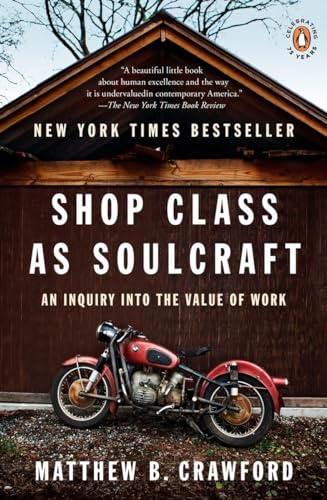
A philosopher/mechanic's wise (and sometimes funny) look at the challenges and pleasures of working with one's hands
“This is a deep exploration of craftsmanship by someone with real, hands-on knowledge. The book is also quirky, surprising, and sometimes quite moving.” —Richard Sennett, author of The Craftsman
Called “the sleeper hit of the publishing season” by The Boston Globe, Shop Class as Soulcraft became an instant bestseller, attracting readers with its radical (and timely) reappraisal of the merits of skilled manual labor. On both economic and psychological grounds, author Matthew B. Crawford questions the educational imperative of turning everyone into a “knowledge worker,” based on a misguided separation of thinking from doing. Using his own experience as an electrician and mechanic, Crawford presents a wonderfully articulated call for self-reliance and a moving reflection on how we can live concretely in an ever more abstract world.
Die Inhaltsangabe kann sich auf eine andere Ausgabe dieses Titels beziehen.
Über die Autorin bzw. den Autor
Matthew B. Crawford is a philosopher and mechanic. He has a Ph.D. in political philosophy from the University of Chicago and served as a postdoctoral fellow on its Committee on Social Thought. Currently a fellow at the University of Virginia's Institute for Advanced Studies in Culture, he owns and operates Shockoe Moto, an independent motorcycle repair shop in Richmond, Virginia.
Auszug. © Genehmigter Nachdruck. Alle Rechte vorbehalten.
Chapter 1
A Brief Case for the Useful Arts
[I]n schools, we create artificial learning environments for our children that they know to be contrived and undeserving of their full attention and engagement. . . . Without the opportunity to learn through the hands, the world remains abstract, and distant, and the passions for learning will not be engaged.
DOUG STOWE, WISDOM OF THE HANDS (BLOG), OCTOBER 16, 2006
Tom Hull teaches welding, machine shop, auto shop, sheet metal work, and c computer-aided drafting at Marshfield High School in Coos Bay, Oregon. He is also president of the Technology Educators of Oregon. Asked about the current state of his profession, he says a lot of schools shut down their shop class programs in the 1990s, when there was a big push for computer literacy. To pay for the new computers, electives were cut. Shop was especially attractive as a target: it is expensive and potentially dangerous. Further, as Hull says, you can t shove fifty students at a time into a shop class, like you can a PE class. In California, three-quarters of high school shop programs have disappeared since the early 1980s, according to the California Industrial and Technology Education Association.
There are efforts in North Carolina, Florida, and California to revive shop, but finding people competent to teach it has become difficult. We have a generation of students that can answer questions on standardized tests, know factoids, but they can t do anything, according to Jim Aschwanden, executive director of the California Agricultural Teachers Association.
Meanwhile, people in the trades are constantly howling about their inability to find workers. The slack has been taken up to some extent by community colleges that offer shop class. Tom Thompson, of Oregon s Department of Education, says there is anecdotal evidence to suggest that one of the fastest-growing segments of the student body at community colleges is people who already have a four-year degree and return to get a marketable trade skill. There are also for-profit schools such as Universal Technical Institute and Wyoming Technical Institute that draw students from around the country. Both graduate about 95 percent of their students, and about 98 percent of those who graduate get jobs in their first year after finishing.
Hull sends out a quarterly newsletter to the graduates of his shop programs. It is like a nineteenth-century almanac, a combination of useful information and intellectual inquiry, as well as examples of human uplift. The newsletter includes shop tips (for example, clever ways to clamp an irregularly shaped object in preparation for welding), book reviews, digressions on aesthetics, and success stories in which he profiles the careers of his former students. A recent issue featured Kyle Cox, a welder and fabricator for Tarheel Aluminum. Hull caught up with his former student as he fabricated an all-aluminum pile-d riving barge on the docks in Charleston. Cox says the job changes every day, and that s what he loves about it. He also likes being useful to the world.
One of Hull s recent columns reflected on the Fibonacci sequence, an infinite series of numbers where the ratio between adjacent pairs approaches a certain value known as the golden ratio, found throughout nature. Hull writes, the sequence portrays a human characteristic as well, as the ratio is not immediately achieved, but gets closer and closer, and not by some steady slope to perfection but by s elf-correcting oscillations about the ideal value. This seems to capture the kind of iterated self criticism, in light of some ideal that is never quite attained, whereby the craftsman advances in his art. You give it your best, learn from your mistakes, and the next time get a little closer to the image you started with in your head. Hull clearly has a h
„Über diesen Titel“ kann sich auf eine andere Ausgabe dieses Titels beziehen.
Suchergebnisse für Shop Class as Soulcraft: An Inquiry into the Value...

Beispielbild für diese ISBN
Shop Class as Soulcraft: An Inquiry into the Value of Work
Anbieter: World of Books (was SecondSale), Montgomery, IL, USA
Verkäuferbewertung 5 von 5 Sternen

Paperback. Zustand: Good. Shop Class as Soulcraft brings alive an experience that was once quite common but now seems to be receding from society -- the experience of making and fixing things with our hands. Those of us who sit in an office often feel a lack of connection to the material world, a sense of loss, and find it difficult to say exactly what we do all day. For those who felt hustled off to college, then to the cubicle, against their own inclinations and natural bents, Shop Class as Soulcraft seeks to restore the honor of the manual trades as a life worth choosing. On both economic and psychological grounds, Crawford questions the educational imperative of turning everyone into a knowledge worker, based on a misguided separation of thinking from doing, the work of the hand from that of the mind. Crawford shows us how such a partition, which began a century ago with the assembly line, degrades work for those on both sides of the divide. But Crawford offers good news as well: The manual trades are very different from the assembly line and from dumbed-down white collar work as well. They require careful thinking and are punctuated by moments of genuine pleasure. Based on his own experience as an electrician and mechanic, Crawford makes a case for the intrinsic satisfactions and cognitive challenges of manual work. The work of builders and mechanics is secure; it cannot be outsourced, and it cannot be made obsolete. Such work ties us to the local communities in which we live and instills the pride that comes from doing work that is genuinely useful. A wholly original debut, Shop Class as Soulcraft offers a passionate call for self-reliance and a moving reflection on how we can live concretely in an ever more abstract world. Artikel-Nr. 00110205786
Gebraucht kaufen
EUR 4,51
Versand gratis
Versand innerhalb von USA
Versand innerhalb von USA
Anzahl: 18 verfügbar
Beispielbild für diese ISBN
Shop Class as Soulcraft: An Inquiry into the Value of Work
Anbieter: World of Books (was SecondSale), Montgomery, IL, USA
Verkäuferbewertung 5 von 5 Sternen
Paperback. Zustand: Fair. Shop Class as Soulcraft brings alive an experience that was once quite common but now seems to be receding from society -- the experience of making and fixing things with our hands. Those of us who sit in an office often feel a lack of connection to the material world, a sense of loss, and find it difficult to say exactly what we do all day. For those who felt hustled off to college, then to the cubicle, against their own inclinations and natural bents, Shop Class as Soulcraft seeks to restore the honor of the manual trades as a life worth choosing. On both economic and psychological grounds, Crawford questions the educational imperative of turning everyone into a knowledge worker, based on a misguided separation of thinking from doing, the work of the hand from that of the mind. Crawford shows us how such a partition, which began a century ago with the assembly line, degrades work for those on both sides of the divide. But Crawford offers good news as well: The manual trades are very different from the assembly line and from dumbed-down white collar work as well. They require careful thinking and are punctuated by moments of genuine pleasure. Based on his own experience as an electrician and mechanic, Crawford makes a case for the intrinsic satisfactions and cognitive challenges of manual work. The work of builders and mechanics is secure; it cannot be outsourced, and it cannot be made obsolete. Such work ties us to the local communities in which we live and instills the pride that comes from doing work that is genuinely useful. A wholly original debut, Shop Class as Soulcraft offers a passionate call for self-reliance and a moving reflection on how we can live concretely in an ever more abstract world. Artikel-Nr. CIN0143117467A
Gebraucht kaufen
EUR 4,51
Versand gratis
Versand innerhalb von USA
Versand innerhalb von USA
Anzahl: 3 verfügbar
Beispielbild für diese ISBN
Shop Class as Soulcraft: An Inquiry into the Value of Work
Anbieter: World of Books (was SecondSale), Montgomery, IL, USA
Verkäuferbewertung 5 von 5 Sternen
Paperback. Zustand: Very Good. Shop Class as Soulcraft brings alive an experience that was once quite common but now seems to be receding from society -- the experience of making and fixing things with our hands. Those of us who sit in an office often feel a lack of connection to the material world, a sense of loss, and find it difficult to say exactly what we do all day. For those who felt hustled off to college, then to the cubicle, against their own inclinations and natural bents, Shop Class as Soulcraft seeks to restore the honor of the manual trades as a life worth choosing. On both economic and psychological grounds, Crawford questions the educational imperative of turning everyone into a knowledge worker, based on a misguided separation of thinking from doing, the work of the hand from that of the mind. Crawford shows us how such a partition, which began a century ago with the assembly line, degrades work for those on both sides of the divide. But Crawford offers good news as well: The manual trades are very different from the assembly line and from dumbed-down white collar work as well. They require careful thinking and are punctuated by moments of genuine pleasure. Based on his own experience as an electrician and mechanic, Crawford makes a case for the intrinsic satisfactions and cognitive challenges of manual work. The work of builders and mechanics is secure; it cannot be outsourced, and it cannot be made obsolete. Such work ties us to the local communities in which we live and instills the pride that comes from doing work that is genuinely useful. A wholly original debut, Shop Class as Soulcraft offers a passionate call for self-reliance and a moving reflection on how we can live concretely in an ever more abstract world. Artikel-Nr. CIN0143117467VG
Gebraucht kaufen
EUR 4,51
Versand gratis
Versand innerhalb von USA
Versand innerhalb von USA
Anzahl: 3 verfügbar
Beispielbild für diese ISBN
Shop Class as Soulcraft: An Inquiry into the Value of Work
Verlag:
Penguin Books (edition Reprint), 2010
ISBN 10: 0143117467
ISBN 13: 9780143117469
Gebraucht
Paperback
Anbieter: BooksRun, Philadelphia, PA, USA
Verkäuferbewertung 5 von 5 Sternen
Paperback. Zustand: Very Good. Reprint. It's a well-cared-for item that has seen limited use. The item may show minor signs of wear. All the text is legible, with all pages included. It may have slight markings and/or highlighting. Artikel-Nr. 0143117467-8-1
Gebraucht kaufen
EUR 5,05
Versand gratis
Versand innerhalb von USA
Versand innerhalb von USA
Anzahl: 2 verfügbar
Beispielbild für diese ISBN
Shop Class as Soulcraft: An Inquiry into the Value of Work
Anbieter: ThriftBooks-Reno, Reno, NV, USA
Verkäuferbewertung 5 von 5 Sternen
Paperback. Zustand: Good. No Jacket. Pages can have notes/highlighting. Spine may show signs of wear. ~ ThriftBooks: Read More, Spend Less. Artikel-Nr. G0143117467I3N00
Gebraucht kaufen
EUR 6,01
Versand gratis
Versand innerhalb von USA
Versand innerhalb von USA
Anzahl: 2 verfügbar
Beispielbild für diese ISBN
Shop Class as Soulcraft: An Inquiry into the Value of Work
Anbieter: ThriftBooks-Dallas, Dallas, TX, USA
Verkäuferbewertung 5 von 5 Sternen
Paperback. Zustand: Good. No Jacket. Pages can have notes/highlighting. Spine may show signs of wear. ~ ThriftBooks: Read More, Spend Less. Artikel-Nr. G0143117467I3N00
Gebraucht kaufen
EUR 6,01
Versand gratis
Versand innerhalb von USA
Versand innerhalb von USA
Anzahl: 3 verfügbar
Beispielbild für diese ISBN
Shop Class as Soulcraft: An Inquiry into the Value of Work
Anbieter: ThriftBooks-Phoenix, Phoenix, AZ, USA
Verkäuferbewertung 5 von 5 Sternen
Paperback. Zustand: Fair. No Jacket. Readable copy. Pages may have considerable notes/highlighting. ~ ThriftBooks: Read More, Spend Less. Artikel-Nr. G0143117467I5N00
Gebraucht kaufen
EUR 6,01
Versand gratis
Versand innerhalb von USA
Versand innerhalb von USA
Anzahl: 1 verfügbar
Beispielbild für diese ISBN
Shop Class as Soulcraft: An Inquiry into the Value of Work
Anbieter: ThriftBooks-Phoenix, Phoenix, AZ, USA
Verkäuferbewertung 5 von 5 Sternen
Paperback. Zustand: Good. No Jacket. Pages can have notes/highlighting. Spine may show signs of wear. ~ ThriftBooks: Read More, Spend Less. Artikel-Nr. G0143117467I3N00
Gebraucht kaufen
EUR 6,01
Versand gratis
Versand innerhalb von USA
Versand innerhalb von USA
Anzahl: 2 verfügbar
Beispielbild für diese ISBN
Shop Class as Soulcraft: An Inquiry into the Value of Work
Anbieter: ThriftBooks-Dallas, Dallas, TX, USA
Verkäuferbewertung 5 von 5 Sternen
Paperback. Zustand: Good. No Jacket. Former library book; Pages can have notes/highlighting. Spine may show signs of wear. ~ ThriftBooks: Read More, Spend Less. Artikel-Nr. G0143117467I3N10
Gebraucht kaufen
EUR 6,01
Versand gratis
Versand innerhalb von USA
Versand innerhalb von USA
Anzahl: 1 verfügbar
Beispielbild für diese ISBN
Shop Class as Soulcraft: An Inquiry into the Value of Work
Anbieter: ThriftBooks-Atlanta, AUSTELL, GA, USA
Verkäuferbewertung 5 von 5 Sternen
Paperback. Zustand: Very Good. No Jacket. May have limited writing in cover pages. Pages are unmarked. ~ ThriftBooks: Read More, Spend Less. Artikel-Nr. G0143117467I4N00
Gebraucht kaufen
EUR 6,01
Versand gratis
Versand innerhalb von USA
Versand innerhalb von USA
Anzahl: 1 verfügbar