
Verwandte Artikel zu Tried by War: Abraham Lincoln as Commander in Chief
Inhaltsangabe
"James M. McPherson’s Tried by War is a perfect primer . . . for anyone who wishes to understand the evolution of the president’s role as commander in chief. Few historians write as well as McPherson, and none evoke the sound of battle with greater clarity." —The New York Times Book Review
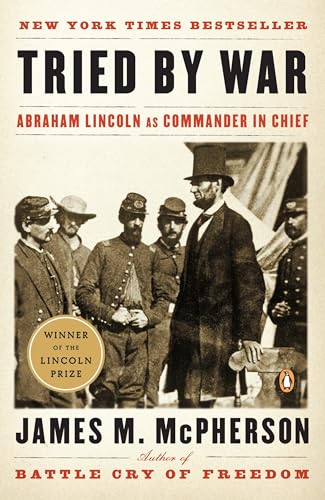
The Pulitzer Prize–winning author reveals how Lincoln won the Civil War and invented the role of commander in chief as we know it
As we celebrate the bicentennial of Lincoln's birth, this study by preeminent, bestselling Civil War historian James M. McPherson provides a rare, fresh take on one of the most enigmatic figures in American history. Tried by War offers a revelatory (and timely) portrait of leadership during the greatest crisis our nation has ever endured. Suspenseful and inspiring, this is the story of how Lincoln, with almost no previous military experience before entering the White House, assumed the powers associated with the role of commander in chief, and through his strategic insight and will to fight changed the course of the war and saved the Union.
Die Inhaltsangabe kann sich auf eine andere Ausgabe dieses Titels beziehen.
Über die Autorin bzw. den Autor
James M. McPherson is the George Henry Davis '86 Professor of History Emeritus at Princeton University. He is the bestselling author of numerous books on the Civil War, including Battle Cry of Freedom, which won the Pulitzer Prize, For Cause and Comrades, which won the prestigious Lincoln Prize, and Crossroads of Freedom. He lives in Princeton, NJ.
Auszug. © Genehmigter Nachdruck. Alle Rechte vorbehalten.
On July 27, 1848, a tall, rawboned Whig congressman from Illinois rose in the House of Representatives to challenge the Mexican War policies of President James K. Polk. An opponent of what he considered an unjust war, Abraham Lincoln mocked his own meager record as a militia captain who saw no action in the Black Hawk War of 1832. “By the way, Mr. Speaker, did you know I am a military hero?” said Lincoln. “Yes, sir . . . I fought, bled, and came away” after “charges upon the wild onions” and “a good many struggles with the musketoes.”
Lincoln might not have indulged his famous sense of humor in this fashion if he had known that thirteen years later he would be- come commander in chief of the U.S. Army in a war that turned out to be forty-seven times more lethal for American soldiers than the Mexican War. On his way to Washington in February 1861 as president- elect of a broken nation, Lincoln spoke in a far more serious manner. He looked back on another war, which had given birth to the nation that now seemed in danger of perishing from the earth. In a speech to the New Jersey legislature in Trenton, Lincoln recalled the story of George Washington and his tiny army, which crossed the ice-choked
Delaware River in a driving sleet storm on Christmas night in 1776 to attack the Hessian garrison in Trenton. “There must have been some- thing more than common that those men struggled for,” said the president-elect. “Something even more than National Indepen- dence . . . something that held out a great promise to all the people of the world for all time to come. I am exceedingly anxious that the Union, the Constitution, and the liberties of the people shall be per- petuated in accordance with the original idea for which that struggle was made.”
Lincoln faced a steep learning curve as commander in chief in the war that began less than two months after that speech at Trenton. He was also painfully aware that his adversary, Jefferson Davis, was much better prepared for that daunting task. A graduate of the U.S. Military Academy at West Point, Davis had fought courageously as a colonel of a Mississippi regiment in the Mexican War and had served as an excellent secretary of war from 1853 to 1857—while Lincoln’s only military experience was his combat with mosquitoes in 1832. Lincoln possessed a keen analytical mind, however, and a fierce de- termination to master any subject to which he applied himself. This determination went back to his childhood. “Among my earliest recol- lections,” Lincoln told an acquaintance in 1860, “I remember how, when a mere child, I used to get irritated when anybody talked to me in a way I could not understand.” Lincoln recalled “going to my little bedroom, after hearing the neighbors talk of an evening with my fa- ther, and spending the night walking up and down, and trying to make out what was the exact meaning of some of their, to me, dark sayings. I could not sleep . . . when I got on such a hunt after an idea, until I had caught it. This was a kind of passion with me, and it has stuck by me.”
Later in life Lincoln mastered Euclidean geometry on his own for mental exercise. As a largely self-taught lawyer, he honed this quality of mind. He was not a quick study but a thorough one. “I am never easy,” he said, “when I am handling a thought, till I have bounded it North, and bounded it South, and bounded it East, and bounded it West.”
Several contemporaries testified to the slow but tenacious qualities of Lincoln’s mind. The mercurial editor of the New York Tribune, Horace Greeley, noted that Lincoln’s intellect worked “not quickly nor brilliantly, but exhaustively.” Lincoln’s law partner William Herndon sometimes expressed impatience with Lincoln’s deliberate manner of researching or arguing a case. But Herndon conceded that his partner “not only went to the root of the question, but dug up the root, and separated and analyzed every fibre of it.”4 Lincoln also fo- cused intently on the central issue in a legal case and refused to be distracted by secondary questions. Another fellow lawyer noted that Lincoln would concede nonessential points to an opponent in the courtroom, lulling him into a sense of complacency. But “by giving away six points and carrying the seventh he carried his case . . . the whole case hanging on the seventh. Any man who took Lincoln
for a simple-minded man would very soon wake up with his back in a ditch.”
As commander in chief Lincoln sought to master the intricacies of military strategy in the same way he had tried to penetrate the mean- ing of mysterious adult conversations when he was a boy. His private secretary John Hay, who lived in the White House, often heard the president walking back and forth in his bedroom at midnight as he di- gested books on military strategy. “He gave himself, night and day, to the study of the military situation,” Hay later wrote. “He read a large number of strategical works. He pored over the reports from the vari- ous departments and districts of the field of war. He held long confer- ences with eminent generals and admirals, and astonished them by the extent of his special knowledge and the keen intelligence of his questions.” Some of those generals, like Lincoln’s courtroom adversaries, eventually found themselves on their backs in a ditch. By 1862 Lincoln’s grasp of military strategy and operations was firm enough almost to justify the assertion of the historian T. Harry Williams: “Lincoln stands out as a great war president, probably the greatest in our history, and a great natural strategist, a better one than any of his generals.”
This encomium is misleading in one respect: Lincoln was not a “natural strategist.” He worked hard to master this subject, just as he had done to become a lawyer. He had to learn the functions of com- mander in chief on the job. The Constitution and the course of Amer- ican history before 1861 did not offer much guidance. Article II, Section 2, of the Constitution states simply: “The President shall be Commander in Chief of the Army and Navy of the United States, and of the Militia of the several States, when called into the actual Service of the United States.” But the Constitution nowhere defines the pow- ers of the president as commander in chief. In Federalist No. 69, Al- exander Hamilton tried to reassure opponents of the Constitution, who feared executive tyranny, that the commander-in-chief power “would amount to nothing more than the supreme command and direction of the military forces, as first General and Admiral” of the nation.
Hamilton’s phrase “supreme command and direction” seems quite forceful, but it lacks specificity. Nor did the precedents created by Presidents James Madison and James K. Polk in the War of 1812 and the Mexican War provide Lincoln with much guidance in a far greater conflict that combined the most dangerous aspects of an internal war and a war against another nation. In a case growing out of the Mexi- can War, the Supreme Court ruled that the president as commander in chief was authorized to employ the army and navy “in the manner he may deem most effectual to harass and conquer and subdue the enemy.” But the Court did not define “most effectual” and seemed to
limit the president’s power by stating that it must be confined to “purely military matters.”7
The vagueness of these definitions and precedents meant that Lin- coln would have to establish most of the powers of commander in chief for himself. He proved to be a more hands-on commander...
„Über diesen Titel“ kann sich auf eine andere Ausgabe dieses Titels beziehen.
Suchergebnisse für Tried by War: Abraham Lincoln as Commander in Chief

Beispielbild für diese ISBN
Tried by War: Abraham Lincoln as Commander in Chief
Anbieter: World of Books (was SecondSale), Montgomery, IL, USA
Verkäuferbewertung 5 von 5 Sternen

Paperback. Zustand: Very Good. "James M. McPherson'sTried by Waris a perfect primer . . . for anyone who wishes to under-stand the evolution of the president's role as commander in chief. Few histo-rians write as well as McPherson, and none evoke the sound of battle with greater clarity."-The New York Times Book Review The Pulitzer Prize-winning author reveals how Lincoln won the Civil War and invented the role of commander in chief as we know it As we celebrate the bicentennial of Lincoln's birth, this study by preeminent, bestselling Civil War historian James M. McPherson provides a rare, fresh take on one of the most enigmatic figures in American history. Tried by War offers a revelatory (and timely) portrait of leadership during the greatest crisis our nation has ever endured. Suspenseful and inspiring, this is the story of how Lincoln, with almost no previous military experience before entering the White House, assumed the powers associated with the role of commander in chief, and through his strategic insight and will to fight changed the course of the war and saved the Union. Artikel-Nr. 00096513988
Gebraucht kaufen
EUR 3,87
Versand gratis
Versand innerhalb von USA
Versand innerhalb von USA
Anzahl: 2 verfügbar
Beispielbild für diese ISBN
Tried by War: Abraham Lincoln as Commander in Chief
Anbieter: World of Books (was SecondSale), Montgomery, IL, USA
Verkäuferbewertung 5 von 5 Sternen
Paperback. Zustand: Good. "James M. McPherson'sTried by Waris a perfect primer . . . for anyone who wishes to under-stand the evolution of the president's role as commander in chief. Few histo-rians write as well as McPherson, and none evoke the sound of battle with greater clarity."-The New York Times Book Review The Pulitzer Prize-winning author reveals how Lincoln won the Civil War and invented the role of commander in chief as we know it As we celebrate the bicentennial of Lincoln's birth, this study by preeminent, bestselling Civil War historian James M. McPherson provides a rare, fresh take on one of the most enigmatic figures in American history. Tried by War offers a revelatory (and timely) portrait of leadership during the greatest crisis our nation has ever endured. Suspenseful and inspiring, this is the story of how Lincoln, with almost no previous military experience before entering the White House, assumed the powers associated with the role of commander in chief, and through his strategic insight and will to fight changed the course of the war and saved the Union. Artikel-Nr. 00086838724
Gebraucht kaufen
EUR 3,87
Versand gratis
Versand innerhalb von USA
Versand innerhalb von USA
Anzahl: 17 verfügbar
Beispielbild für diese ISBN
Tried by War: Abraham Lincoln as Commander in Chief
Anbieter: World of Books (was SecondSale), Montgomery, IL, USA
Verkäuferbewertung 5 von 5 Sternen
Paperback. Zustand: Fair. "James M. McPherson'sTried by Waris a perfect primer . . . for anyone who wishes to under-stand the evolution of the president's role as commander in chief. Few histo-rians write as well as McPherson, and none evoke the sound of battle with greater clarity."-The New York Times Book Review The Pulitzer Prize-winning author reveals how Lincoln won the Civil War and invented the role of commander in chief as we know it As we celebrate the bicentennial of Lincoln's birth, this study by preeminent, bestselling Civil War historian James M. McPherson provides a rare, fresh take on one of the most enigmatic figures in American history. Tried by War offers a revelatory (and timely) portrait of leadership during the greatest crisis our nation has ever endured. Suspenseful and inspiring, this is the story of how Lincoln, with almost no previous military experience before entering the White House, assumed the powers associated with the role of commander in chief, and through his strategic insight and will to fight changed the course of the war and saved the Union. Artikel-Nr. 00086416233
Gebraucht kaufen
EUR 3,87
Versand gratis
Versand innerhalb von USA
Versand innerhalb von USA
Anzahl: 6 verfügbar
Beispielbild für diese ISBN
Tried by War: Abraham Lincoln as Commander in Chief
Verlag:
Penguin Publishing Group (edition 1), 2009
ISBN 10: 0143116142
ISBN 13: 9780143116141
Gebraucht
Paperback
Anbieter: BooksRun, Philadelphia, PA, USA
Verkäuferbewertung 5 von 5 Sternen
Paperback. Zustand: Very Good. 1. It's a well-cared-for item that has seen limited use. The item may show minor signs of wear. All the text is legible, with all pages included. It may have slight markings and/or highlighting. Artikel-Nr. 0143116142-8-6
Gebraucht kaufen
EUR 5,13
Versand gratis
Versand innerhalb von USA
Versand innerhalb von USA
Anzahl: 1 verfügbar
Beispielbild für diese ISBN
Tried by War : Abraham Lincoln As Commander in Chief
Verlag:
Penguin Publishing Group, 2009
ISBN 10: 0143116142
ISBN 13: 9780143116141
Gebraucht
Softcover
Erstausgabe
Anbieter: Better World Books, Mishawaka, IN, USA
Verkäuferbewertung 5 von 5 Sternen
Zustand: Good. 1st Edition. Pages intact with minimal writing/highlighting. The binding may be loose and creased. Dust jackets/supplements are not included. Stock photo provided. Product includes identifying sticker. Better World Books: Buy Books. Do Good. Artikel-Nr. 3992344-6
Gebraucht kaufen
EUR 6,19
Versand gratis
Versand innerhalb von USA
Versand innerhalb von USA
Anzahl: 2 verfügbar
Beispielbild für diese ISBN
Tried by War : Abraham Lincoln As Commander in Chief
Verlag:
Penguin Publishing Group, 2009
ISBN 10: 0143116142
ISBN 13: 9780143116141
Gebraucht
Softcover
Erstausgabe
Anbieter: Better World Books: West, Reno, NV, USA
Verkäuferbewertung 5 von 5 Sternen
Zustand: Good. 1st Edition. Pages intact with minimal writing/highlighting. The binding may be loose and creased. Dust jackets/supplements are not included. Stock photo provided. Product includes identifying sticker. Better World Books: Buy Books. Do Good. Artikel-Nr. 3992344-6
Gebraucht kaufen
EUR 6,19
Versand gratis
Versand innerhalb von USA
Versand innerhalb von USA
Anzahl: 2 verfügbar
Beispielbild für diese ISBN
Tried by War: Abraham Lincoln as Commander in Chief
Verlag:
Penguin Publishing Group, 2009
ISBN 10: 0143116142
ISBN 13: 9780143116141
Gebraucht
Softcover
Anbieter: Wonder Book, Frederick, MD, USA
Verkäuferbewertung 5 von 5 Sternen
Zustand: Very Good. Very Good condition. A copy that may have a few cosmetic defects. May also contain light spine creasing or a few markings such as an owner's name, short gifter's inscription or light stamp. Artikel-Nr. P07A-04100
Gebraucht kaufen
EUR 6,43
Versand gratis
Versand innerhalb von USA
Versand innerhalb von USA
Anzahl: 8 verfügbar
Beispielbild für diese ISBN
Tried by War: Abraham Lincoln as Commander in Chief
Verlag:
Penguin Publishing Group, 2009
ISBN 10: 0143116142
ISBN 13: 9780143116141
Gebraucht
Softcover
Anbieter: Wonder Book, Frederick, MD, USA
Verkäuferbewertung 5 von 5 Sternen
Zustand: As New. Like New condition. A near perfect copy that may have very minor cosmetic defects. Artikel-Nr. Q15Q-00643
Gebraucht kaufen
EUR 6,43
Versand gratis
Versand innerhalb von USA
Versand innerhalb von USA
Anzahl: 1 verfügbar
Beispielbild für diese ISBN
Tried by War: Abraham Lincoln as Commander in Chief
Verlag:
Penguin Publishing Group, 2009
ISBN 10: 0143116142
ISBN 13: 9780143116141
Gebraucht
Paperback
Anbieter: ThriftBooks-Atlanta, AUSTELL, GA, USA
Verkäuferbewertung 5 von 5 Sternen
Paperback. Zustand: As New. No Jacket. Pages are clean and are not marred by notes or folds of any kind. ~ ThriftBooks: Read More, Spend Less. Artikel-Nr. G0143116142I2N00
Gebraucht kaufen
EUR 6,81
Versand gratis
Versand innerhalb von USA
Versand innerhalb von USA
Anzahl: 1 verfügbar
Beispielbild für diese ISBN
Tried by War: Abraham Lincoln as Commander in Chief
Verlag:
Penguin Publishing Group, 2009
ISBN 10: 0143116142
ISBN 13: 9780143116141
Gebraucht
Paperback
Anbieter: ThriftBooks-Atlanta, AUSTELL, GA, USA
Verkäuferbewertung 5 von 5 Sternen
Paperback. Zustand: Very Good. No Jacket. May have limited writing in cover pages. Pages are unmarked. ~ ThriftBooks: Read More, Spend Less. Artikel-Nr. G0143116142I4N00
Gebraucht kaufen
EUR 6,81
Versand gratis
Versand innerhalb von USA
Versand innerhalb von USA
Anzahl: 1 verfügbar