
Verwandte Artikel zu The Assault on Reason: Our Information Ecosystem, from...
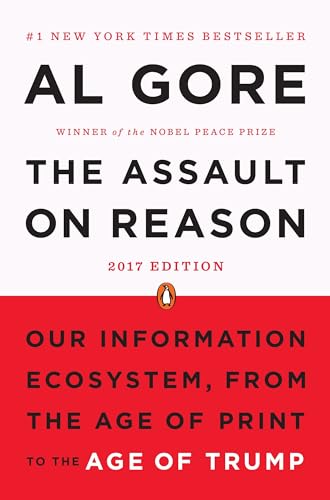
The Assault on Reason: Our Information Ecosystem, from the Age of Print to the Age of Trump, 2017 Edition - Softcover
Inhaltsangabe
Now with a New Preface and Conclusion: “Post-Truth: On Donald Trump and the 2016 Election”
“This book shows a fiery, throw-caution-to-the winds Al Gore, who . . . has decided to lay it all on the line with a blistering assessment of the Bush administration and the state of public discourse in America.” —Michiko Kakutani, The New York Times
“Gore’s faith in human nature is braver and sharper than (the cynics). . . . This book isn’t about him; it’s about the republic whose freedoms depend on increasing reasoned debate and reducing intimidating noise.” —The Boston Globe
What has happened to our country and how can we fix it?
We are in the midst of a deepening crisis for our democracy. After the strangest election cycle in modern American history it is important that we address the grave threats to our way of life that were glaringly revealed in this campaign. In The Assault on Reason, Nobel Peace Prize winner and former Vice President Al Gore examines how faith in the power of reason—the idea that citizens can govern themselves through rational debate—is in peril. Our democracy depends on a well-informed citizenry and a two-way conversation about ideas, but our public sphere has been degraded by fake news and the politics of fear, partisanship, and blind faith. Now updated to investigate the rise of Trump and post-truth politics, The Assault on Reason is a call to rebuild the vitality of American democracy by restoring the nation’s information ecosystem so that we can start making good decisions again.
Die Inhaltsangabe kann sich auf eine andere Ausgabe dieses Titels beziehen.
Über die Autorin bzw. den Autor
Former Vice President Al Gore is the cofounder and chairman of Generation Investment Management. He is a senior partner at Kleiner Perkins Caufield & Byers and a member of Apple Inc.’s board of directors. Gore spends the majority of his time as the chairman of The Climate Reality Project, a nonprofit devoted to solving the climate crisis. Gore was elected to the U.S. House of Representatives in 1976, 1978, 1980, and 1982 and the U.S. Senate in 1984 and 1990. He was inaugurated as the forty-fifth vice president of the United States on January 20, 1993, and served eight years. He is the author of the bestsellers Earth in the Balance, An Inconvenient Truth, The Assault on Reason, Our Choice: A Plan to Solve the Climate Crisis, and, most recently, The Future: Six Drivers of Global Change. He is the subject of an Oscar-winning documentary and is the corecipient, with the Intergovernmental Panel on Climate Change, of the 2007 Nobel Peace Prize for “informing the worldof the dangers posed by climate change.” Former Vice President Gore wasborn on March 31, 1948, and resides in Nashville, Tennessee.
Auszug. © Genehmigter Nachdruck. Alle Rechte vorbehalten.
Chapter 1
The Politics of Fear
Fear is the most powerful enemy of reason. Both fear and reason are essential to human survival, but the relationship between them is unbalanced. Reason may sometimes dissipate fear, but fear frequently shuts down reason. As Edmund Burke wrote in England twenty years before the American Revolution, "No passion so effectually robs the mind of all its powers of acting and reasoning as fear."
Our Founders had a healthy respect for the threat fear poses to reason. They knew that, under the right circumstances, fear can trigger the temptation to surrender freedom to a demagogue promising strength and security in return. They worried that when fear displaces reason, the result is often irrational hatred and division. As Justice Louis D. Brandeis later wrote:
"Men feared witches and burnt women."
Understanding this unequal relationship between fear and reason was crucial to the design of American self-government.
Our Founders rejected direct democracy because of concerns that fear might overwhelm reflective thought. But they counted heavily on the ability of a "well-informed citizenry" to reason together in ways that would minimize the destructive impact of illusory, exaggerated, or excessive fears. "When a man seriously reflects on the precariousness of human affairs, he will become convinced that it is infinitely wiser and safer to form a constitution of our own in a cool deliberate manner, while we have it in our power," wrote Thomas Paine in his legendary pamphlet Common Sense, specifically warning that the Founders should not take the risk of waiting until some fear seized the public imagination, in which event their reasoning processes would be hampered.
Nations succeed or fail and define their essential character by the way they challenge the unknown and cope with fear. And much depends on the quality of their leadership. If leaders exploit public fears to herd people in directions they might not otherwise choose, then fear itself can quickly become a self-perpetuating and freewheeling force that drains national will and weakens national character, diverting attention from real threats deserving of healthy and appropriate fear and sowing confusion about the essential choices that every nation must constantly make about its future.
Leadership means inspiring us to manage through our fears. Demagoguery means exploiting our fears for political gain. There is a crucial difference.
Fear and anxiety have always been a part of life and always will be. Fear is ubiquitous and universal in every human society. It is a normal part of the human condition. And it has always been an enemy of reason. The Roman philosopher and rhetoric teacher Lactantius wrote, "Where fear is present, wisdom cannot be."
We have always defined progress by our success in managing through our fears. Christopher Columbus, Meriwether Lewis and William Clark, Susan B. Anthony, and Neil Armstrong all found success by challenging the unknown and overcoming fear with courage and a sense of proportion that helped them overcome legitimate fears without being distracted by distorted and illusory fears.
The Founders of our country faced dire threats. If they failed in their endeavors, they would have been hanged as traitors. The very existence of our country was at risk. Yet in the teeth of those dangers, they insisted on establishing the freedoms that became the Bill of Rights. Are members of Congress today in more danger than were their predecessors when the British army marched on the Capitol?
Are the dangers we now face so much greater than those that led Franklin Delano Roosevelt to famously remind us that the only thing we have to fear is fear itself? Is America in more danger now than when we faced worldwide fascism on the march—when our fathers fought and won a world war on two fronts simultaneously?
Is the world more dangerous than when we faced an ideological enemy with thousands of missiles poised to annihilate our country at a moment's notice? Fifty years ago, when the nuclear arms race with the Soviet Union was raising tensions in the world and McCarthyism was threatening our liberties at home, President Dwight Eisenhower belatedly said, "Any who act as if freedom's defenses are to be found in suppression and suspicion and fear confess a doctrine that is alien to America." Edward R. Murrow, whose courageous journalism was assaulted by Senator Joseph McCarthy, declared, "We will not be driven by fear into an age of unreason."
It is simply an insult to those who came before us and sacrificed so much on our behalf to imply that we have more to be fearful of than they did. In spite of the dangers they confronted, they faithfully protected our freedoms. It is up to us to do the same.
Yet something is palpably different today. Why in the early years of the twenty-first century are we so much more vulnerable to the politics of fear? There have always been leaders willing to fan public anxieties in order to present themselves as the protectors of the fearful. Demagogues have always promised security in return for the surrender of freedom. Why do we seem to be responding differently today?
The single most surprising new element in America's national conversation is the prominence and intensity of constant fear. Moreover, there is an uncharacteristic and persistent confusion about the sources of that fear; we seem to be having unusual difficulty in distinguishing between illusory threats and legitimate ones.
It is a serious indictment of the present quality of our political discourse that almost three- quarters of all Americans were so easily led to believe that Saddam Hussein was personally responsible for the attacks of September 11, 2001, and that so many Americans still believe that most of the hijackers on September 11 were Iraqis. And it is an indictment of the way our democracy is currently operating that more than 40 percent were so easily convinced that Iraq did in fact have nuclear weapons, even after the most important evidence presented—classified documents that depicted an attempt by Saddam Hussein's regime to purchase yellowcake uranium from the country of Niger—was revealed to have been forged.
Clearly, the current administration has misused fear to manipulate the political process, and I will return to this issue later in this chapter. But I think a far more important question is: How could our nation have become so uncharacteristically vulnerable to such an effective use of fear to manipulate our politics?
A free press is supposed to function as our democracy's immune system against such gross errors of fact and understanding. As Thomas Jefferson once said, "Error of opinion may be tolerated where reason is left free to combat it." So what happened? Why does our immune system no longer operate as it once did? For one thing, there's been a dramatic change in the nature of what philosopher JŸrgen Habermas has described as "the structure of the public forum." As I described in the introduction, the public sphere is simply no longer as open to the vigorous and free exchange of ideas from individuals as it was when America was founded.
When errors of fact and judgment are no longer caught and neutralized by the nation's immune system, it is time to examine the problem and to work toward good health in our political discourse. In order to do this, we need to start paying more attention to new discoveries about the way fear affects the thinking process. And, in fact, recent advances in neuroscience offer new and interesting insights into the nature of fear.
For most of the last century, the human brain was studied almost exclusively in the context of accidents and unusual head injuries. Doctors would note the part of the brain taken out by the injury and then, after careful...
„Über diesen Titel“ kann sich auf eine andere Ausgabe dieses Titels beziehen.
Suchergebnisse für The Assault on Reason: Our Information Ecosystem, from...

Beispielbild für diese ISBN
The Assault on Reason: Our Information Ecosystem, from the Age of Print to the Age of Trump, 2017 Edition
Anbieter: World of Books (was SecondSale), Montgomery, IL, USA
Verkäuferbewertung 5 von 5 Sternen

Paperback. Zustand: Good. Now with a New Preface and Conclusion: "Post-Truth: On Donald Trump and the 2016 Election" "This book shows a fiery, throw-caution-to-the winds Al Gore, who . . . has decided to lay it all on the line with a blistering assessment of the Bush administration and the state of public discourse in America." --Michiko Kakutani, The New York Times "Gore's faith in human nature is braver and sharper than (the cynics). . . . This book isn't about him; it's about the republic whose freedoms depend on increasing reasoned debate and reducing intimidating noise." --The Boston Globe What has happened to our country and how can we fix it? We are in the midst of a deepening crisis for our democracy. After the strangest election cycle in modern American history it is important that we address the grave threats to our way of life that were glaringly revealed in this campaign. In The Assault on Reason, Nobel Peace Prize winner and former Vice President Al Gore examines how faith in the power of reason--the idea that citizens can govern themselves through rational debate--is in peril. Our democracy depends on a well-informed citizenry and a two-way conversation about ideas, but our public sphere has been degraded by fake news and the politics of fear, partisanship, and blind faith. Now updated to investigate the rise of Trump and post-truth politics, The Assault on Reason is a call to rebuild the vitality of American democracy by restoring the nation's information ecosystem so that we can start making good decisions again. Artikel-Nr. 00096600303
Gebraucht kaufen
EUR 3,90
Versand gratis
Versand innerhalb von USA
Versand innerhalb von USA
Anzahl: 7 verfügbar
Beispielbild für diese ISBN
The Assault on Reason: Our Information Ecosystem, from the Age of Print to the Age of Trump
Anbieter: World of Books (was SecondSale), Montgomery, IL, USA
Verkäuferbewertung 5 von 5 Sternen
Zustand: Acceptable. Item in acceptable condition! Textbooks may not include supplemental items i.e. CDs, access codes etc. Artikel-Nr. 00097331060
Gebraucht kaufen
EUR 3,90
Versand gratis
Versand innerhalb von USA
Versand innerhalb von USA
Anzahl: 3 verfügbar
Beispielbild für diese ISBN
The Assault on Reason: Our Information Ecosystem, from the Age of Print to the Age of Trump, 2017 Edition
Anbieter: World of Books (was SecondSale), Montgomery, IL, USA
Verkäuferbewertung 5 von 5 Sternen
Paperback. Zustand: Very Good. Now with a New Preface and Conclusion: "Post-Truth: On Donald Trump and the 2016 Election" "This book shows a fiery, throw-caution-to-the winds Al Gore, who . . . has decided to lay it all on the line with a blistering assessment of the Bush administration and the state of public discourse in America." --Michiko Kakutani, The New York Times "Gore's faith in human nature is braver and sharper than (the cynics). . . . This book isn't about him; it's about the republic whose freedoms depend on increasing reasoned debate and reducing intimidating noise." --The Boston Globe What has happened to our country and how can we fix it? We are in the midst of a deepening crisis for our democracy. After the strangest election cycle in modern American history it is important that we address the grave threats to our way of life that were glaringly revealed in this campaign. In The Assault on Reason, Nobel Peace Prize winner and former Vice President Al Gore examines how faith in the power of reason--the idea that citizens can govern themselves through rational debate--is in peril. Our democracy depends on a well-informed citizenry and a two-way conversation about ideas, but our public sphere has been degraded by fake news and the politics of fear, partisanship, and blind faith. Now updated to investigate the rise of Trump and post-truth politics, The Assault on Reason is a call to rebuild the vitality of American democracy by restoring the nation's information ecosystem so that we can start making good decisions again. Artikel-Nr. 00104954527
Gebraucht kaufen
EUR 3,90
Versand gratis
Versand innerhalb von USA
Versand innerhalb von USA
Anzahl: 2 verfügbar
Beispielbild für diese ISBN
The Assault on Reason: Our Information Ecosystem, from the Age of Print to the Age of Trump
Verlag:
Penguin Books (edition Reprint), 2008
ISBN 10: 0143113623
ISBN 13: 9780143113621
Gebraucht
Paperback
Anbieter: BooksRun, Philadelphia, PA, USA
Verkäuferbewertung 5 von 5 Sternen
Paperback. Zustand: Fair. Reprint. The item might be beaten up but readable. May contain markings or highlighting, as well as stains, bent corners, or any other major defect, but the text is not obscured in any way. Artikel-Nr. 0143113623-7-1
Gebraucht kaufen
EUR 4,85
Versand gratis
Versand innerhalb von USA
Versand innerhalb von USA
Anzahl: 2 verfügbar
Beispielbild für diese ISBN
The Assault on Reason: Our Information Ecosystem, from the Age of Print to the Age of Trump, 2017 Edition
Anbieter: ThriftBooks-Dallas, Dallas, TX, USA
Verkäuferbewertung 5 von 5 Sternen
Paperback. Zustand: Very Good. No Jacket. May have limited writing in cover pages. Pages are unmarked. ~ ThriftBooks: Read More, Spend Less. Artikel-Nr. G0143113623I4N00
Gebraucht kaufen
EUR 6,06
Versand gratis
Versand innerhalb von USA
Versand innerhalb von USA
Anzahl: 1 verfügbar
Beispielbild für diese ISBN
The Assault on Reason: Our Information Ecosystem, from the Age of Print to the Age of Trump
Anbieter: Wonder Book, Frederick, MD, USA
Verkäuferbewertung 5 von 5 Sternen
Zustand: Very Good. Very Good condition. 2017 edition. A copy that may have a few cosmetic defects. May also contain light spine creasing or a few markings such as an owner's name, short gifter's inscription or light stamp. Artikel-Nr. A05A-05884
Gebraucht kaufen
EUR 6,42
Versand gratis
Versand innerhalb von USA
Versand innerhalb von USA
Anzahl: 1 verfügbar
Beispielbild für diese ISBN
The Assault on Reason: Our Information Ecosystem, from the Age of Print to the Age of Trump
Anbieter: Wonder Book, Frederick, MD, USA
Verkäuferbewertung 5 von 5 Sternen
Zustand: Very Good. Very Good condition. A copy that may have a few cosmetic defects. May also contain light spine creasing or a few markings such as an owner's name, short gifter's inscription or light stamp. Artikel-Nr. K12B-04440
Gebraucht kaufen
EUR 6,42
Versand gratis
Versand innerhalb von USA
Versand innerhalb von USA
Anzahl: 4 verfügbar
Beispielbild für diese ISBN
The Assault on Reason: Our Information Ecosystem, from the Age of Print to the Age of Trump, 2017 Edition
Anbieter: AwesomeBooks, Wallingford, Vereinigtes Königreich
Verkäuferbewertung 5 von 5 Sternen
Paperback. Zustand: Very Good. The Assault on Reason: Our Information Ecosystem, from the Age of Print to the Age of Trump, 2017 Edition This book is in very good condition and will be shipped within 24 hours of ordering. The cover may have some limited signs of wear but the pages are clean, intact and the spine remains undamaged. This book has clearly been well maintained and looked after thus far. Money back guarantee if you are not satisfied. See all our books here, order more than 1 book and get discounted shipping. Artikel-Nr. 7719-9780143113621
Gebraucht kaufen
EUR 3,05
EUR 4,86 Versand
Versand von Vereinigtes Königreich nach USA
Versand von Vereinigtes Königreich nach USA
Anzahl: 2 verfügbar
Beispielbild für diese ISBN
The Assault on Reason : Our Information Ecosystem, from the Age of Print to the Age of Trump, 2017 Edition
Verlag:
Penguin Publishing Group, 2008
ISBN 10: 0143113623
ISBN 13: 9780143113621
Gebraucht
Softcover
Anbieter: Better World Books, Mishawaka, IN, USA
Verkäuferbewertung 5 von 5 Sternen
Zustand: Good. Pages intact with minimal writing/highlighting. The binding may be loose and creased. Dust jackets/supplements are not included. Stock photo provided. Product includes identifying sticker. Better World Books: Buy Books. Do Good. Artikel-Nr. 38374619-75
Gebraucht kaufen
EUR 10,10
Versand gratis
Versand innerhalb von USA
Versand innerhalb von USA
Anzahl: 2 verfügbar
Beispielbild für diese ISBN
The Assault on Reason: Our Information Ecosystem, from the Age of Print to the Age of Trump, 2017 Edition
Anbieter: Bahamut Media, Reading, Vereinigtes Königreich
Verkäuferbewertung 4 von 5 Sternen

Paperback. Zustand: Very Good. This book is in very good condition and will be shipped within 24 hours of ordering. The cover may have some limited signs of wear but the pages are clean, intact and the spine remains undamaged. This book has clearly been well maintained and looked after thus far. Money back guarantee if you are not satisfied. See all our books here, order more than 1 book and get discounted shipping. Artikel-Nr. 6545-9780143113621
Gebraucht kaufen
EUR 4,10
EUR 8,23 Versand
Versand von Vereinigtes Königreich nach USA
Versand von Vereinigtes Königreich nach USA
Anzahl: 2 verfügbar