
Verwandte Artikel zu A Fine Mess: A Global Quest for a Simpler, Fairer,...
Inhaltsangabe
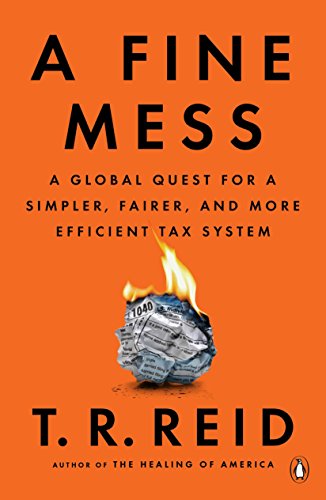
New York Times bestelling author T. R. Reid travels around the world to solve the urgent problem of America's failing tax code, unravelling a complex topic in plain English - and telling a rollicking story along the way.
The U.S. tax code is a total write-off. Crammed with loopholes and special interest provisions, it works for no one except tax lawyers, accountants, and huge corporations. Not for the first time, we have reached a breaking point. That happened in 1922, and again in 1954, and again in 1986. In other words, every thirty-two years. Which means that the next complete overhaul is due in 2018. But what should be in this new tax code? Can we make the U.S. tax system simpler, fairer, and more efficient? Yes, yes, and yes. Can we cut tax rates and still bring in more revenue? Yes.
Other rich countries, from Estonia to New Zealand to the UK—advanced, high-tech, free-market democracies—have all devised tax regimes that are equitable, effective, and easy on the taxpayer. But the United States has languished. So byzantine are the current statutes that, by our government’s own estimates, Americans spend six billion hours and $10 billion every year preparing and filing their taxes. In the Netherlands that task takes a mere fifteen minutes! Successful American companies like Apple, Caterpillar, and Google effectively pay no tax at all in some instances because of loopholes that allow them to move profits offshore. Indeed, the dysfunctional tax system has become a major cause of economic inequality.
In A Fine Mess, T. R. Reid crisscrosses the globe in search of the exact solutions to these urgent problems. With an uncanny knack for making a complex subject not just accessible but gripping, he investigates what makes good taxation (no, that’s not an oxymoron) and brings that knowledge home where it is needed most. Never talking down or reflexively siding with either wing of politics, T. R. Reid presses the case for sensible root-and-branch reforms with a companionable ebullience. This affects everyone. Doing our taxes will never be America's favorite pastime, but it can and should be so much easier and fairer.
Die Inhaltsangabe kann sich auf eine andere Ausgabe dieses Titels beziehen.
Über die Autorin bzw. den Autor
T. R. Reid is a longtime correspondent for The Washington Post and former chief of its Tokyo and London bureaus. He is a commentator for National Public Radio and has been a correspondent for several PBS documentaries. His bestselling books include The Healing of America, The United States of Europe, The Chip, and Confucius Lives Next Door.
Auszug. © Genehmigter Nachdruck. Alle Rechte vorbehalten.
1.
Policy Laboratories
During one of its periodic bursts of anger at the Internal Revenue Service, the U.S. Congress passed a strict new law requiring the Treasury Department to reduce the complexity of America's income tax system. In standard congressional fashion, this mandate for simplicity-it's known as the "anti-complexity clause"-was included in a massively complex piece of legislation that added some thirty thousand words and scores of complicated new deductions, exemptions, and credits to the bloated multivolume corpus of the nation's tax law. If you happen to be browsing through the statute books some restless night, you can find the anti-complexity clause in Subsection IX of subpart (ii) of Section 7803(c)(2)(B) of the Internal Revenue Code.
It's classic: Congress decides to reduce the complexity of our tax code by making it even more complex. It might be funny if the whole taxpaying process in America weren't so maddeningly expensive, inefficient, and time-consuming. At the same time Congress took that principled stand in favor of simplicity, it also added a clause-that would be Section 7803(c)(2)(B)(ii)(III)-requiring that Treasury file a report each year on the overall cost of the income tax regime. The reported burden on U.S. taxpayers turns out to be no laughing matter.
In 2015, the government estimates, American taxpayers spent just over six billion hours preparing and filing their income tax returns. They paid $10.1 billion in fees to the booming tax-preparation industry and another $2 billion for tax software programs (programs that still require hours of work for the typical taxpaying household). For an American household earning the median family income-about $55,000-the average is more than thirty hours per year gathering documents and filling out forms. Tens of millions of Americans have to spend the weekend before April 15-a lovely spring interlude when they should be out on the golf course or at the kids' soccer game-tearing their hair out over instructions like this gem from IRS Form 1041-I: "Go to Part IV of Schedule I to figure line 52 if the estate or trust has qualified dividends or has a gain on lines 18a and 19 of column (2) of Schedule D (Form 1041) (as refigured for the AMT, if necessary)."
The cartoonist Jeff MacNelly used to offer a satire of this process every April 15:
FPO
It doesn't have to be this way.
If you walk down the street in London, Tokyo, Paris, or Lima, you won't see an office of H&R Block or any similar firm; in other nations, people don't need a tax-preparation industry to file their returns. Parliaments and tax collection bureaus all over the world have done what the U.S. Congress seems totally unable to do: they've made paying taxes easy.
In the Netherlands, for example, the Algemene Fiscale Politiek (in essence, the Dutch IRS) has a slogan: "We can't make paying taxes pleasant, but at least we can make it simple." It is certainly simple for my friend Michael, a successful Dutch executive with a six-figure income and all the economic complications that come with his family's upper-bracket lifestyle. An American in the same situation would have to fill out at least a dozen different forms, some of them six pages long (or pay somebody to do it for her). Michael, in contrast, told me that he sets aside fifteen minutes per year to file his federal and local tax returns, and that's usually enough. But sometimes, he said, he needs to check some line item on the return, and that can be time-consuming. At this point, Michael was getting downright indignant. "I mean, some years, it takes me nearly half an hour just to file my tax returns!"
America could learn something from the Netherlands, and from other countries, about how to make the taxpaying process simple. And itÕs not just the complexity problem that we could solve by taking a look at other countries. Almost every government on earth collects taxes (as weÕll see, there are a few lucky nations that get by just fine without taxing their citizens). Many of the developed countries have come up with tax systems that are simpler, fairer, and more efficient than ours. They can show us what to tax, how much to tax it, and how to collect the money thatÕs due.
I traveled the globe looking at tax systems that work better than ours (and some that are worse). I found useful lessons for the United States all over the world. Other countries can show us how to get the same amount of revenue with lower tax rates and how to use the tax code to deal with important national problems, such as the growing inequality of wealth between the richest Americans and everybody else.
Just about every economist and political figure in America agrees these days that our tax code has to be reformed. As Americans elected a new Congress and president in 2016, it appeared that our body politic was finally ready to take on this challenge.
One of the benefits of a comparative study of taxes is that the other countries can serve as policy laboratories for us. In fact, just about every idea that anybody, left or right, has proposed to "fix" the U.S. tax system has already been tried somewhere. For example:
From the right, there have been repeated proposals for a flat-rate income tax, with everybody paying the same rate-about 18%-of their income in tax. Several Republican presidential candidates in the 2012 election, and at least four more in 2016-that would be Ben Carson, Rand Paul, Ted Cruz, and Rick Perry-have backed the flat tax. (Steve Forbes, the publisher who ran for president twice, has been the most prominent advocate of this idea.) Would it work? As it happens, about a dozen countries have actually tried this innovation.
From the left, there have been repeated proposals for a carbon tax, designed to reduce fossil fuel emissions and thus encourage development of "green" forms of energy. As it happens, Australia actually tried this innovation-and quickly gave up on it.
Virtually all economists agree that two of the most widely used deductions in the federal income tax code-the deduction for mortgage interest and the deduction for charitable contributions-cut government revenues by billions of dollars but provide almost no economic benefit. The logical response would be to eliminate them. There are all sorts of proposals floating around Washington, but Congress has never found a politically palatable way to take away these popular write-offs. As it happens, many rich countries have come up with intelligent ways to get rid of these deductions, with minimal impact on home ownership or charitable giving.
The United States provides tax breaks for savings plans, to encourage Americans to put away money for retirement. As with everything else in our tax code, this straightforward idea has become absurdly complex. There's a bewildering variety of different plans, with names that sound like secret code-the 401(k), the 403(b), the 457(b), the SEP, the SARSEP, the ESOP, and so on. There's an IRA, and there's a Roth IRA, which is different, and then there's a myRA, which is different from the other two. There's something called the "nonqualified deferred compensation plan." One of the savings vehicles in our tax code is actually called the SIMPLE IRA, but of course it's not simple at all; the...
„Über diesen Titel“ kann sich auf eine andere Ausgabe dieses Titels beziehen.
Suchergebnisse für A Fine Mess: A Global Quest for a Simpler, Fairer,...

Beispielbild für diese ISBN
A Fine Mess: A Global Quest for a Simpler, Fairer, and More Efficient Tax System
Verlag:
Penguin Books (edition Reprint), 2018
ISBN 10: 0143111140
ISBN 13: 9780143111146
Gebraucht
Paperback
Anbieter: BooksRun, Philadelphia, PA, USA
Verkäuferbewertung 5 von 5 Sternen

Paperback. Zustand: Fair. Reprint. The item might be beaten up but readable. May contain markings or highlighting, as well as stains, bent corners, or any other major defect, but the text is not obscured in any way. Artikel-Nr. 0143111140-7-1
Gebraucht kaufen
EUR 4,39
Versand gratis
Versand innerhalb von USA
Versand innerhalb von USA
Anzahl: 1 verfügbar
Beispielbild für diese ISBN
A Fine Mess: A Global Quest for a Simpler, Fairer, and More Efficient Tax System
Anbieter: ThriftBooks-Atlanta, AUSTELL, GA, USA
Verkäuferbewertung 5 von 5 Sternen
Paperback. Zustand: Fair. No Jacket. Readable copy. Pages may have considerable notes/highlighting. ~ ThriftBooks: Read More, Spend Less. Artikel-Nr. G0143111140I5N00
Gebraucht kaufen
EUR 5,86
Versand gratis
Versand innerhalb von USA
Versand innerhalb von USA
Anzahl: 1 verfügbar
Beispielbild für diese ISBN
A Fine Mess: A Global Quest for a Simpler, Fairer, and More Efficient Tax System
Anbieter: ThriftBooks-Atlanta, AUSTELL, GA, USA
Verkäuferbewertung 5 von 5 Sternen
Paperback. Zustand: Good. No Jacket. Pages can have notes/highlighting. Spine may show signs of wear. ~ ThriftBooks: Read More, Spend Less. Artikel-Nr. G0143111140I3N00
Gebraucht kaufen
EUR 5,86
Versand gratis
Versand innerhalb von USA
Versand innerhalb von USA
Anzahl: 1 verfügbar
Beispielbild für diese ISBN
A Fine Mess: A Global Quest for a Simpler, Fairer, and More Efficient Tax System
Anbieter: ThriftBooks-Dallas, Dallas, TX, USA
Verkäuferbewertung 5 von 5 Sternen
Paperback. Zustand: Good. No Jacket. Pages can have notes/highlighting. Spine may show signs of wear. ~ ThriftBooks: Read More, Spend Less. Artikel-Nr. G0143111140I3N00
Gebraucht kaufen
EUR 5,86
Versand gratis
Versand innerhalb von USA
Versand innerhalb von USA
Anzahl: 1 verfügbar
Beispielbild für diese ISBN
A Fine Mess : A Global Quest for a Simpler, Fairer, and More Efficient Tax System
Verlag:
Penguin Publishing Group, 2018
ISBN 10: 0143111140
ISBN 13: 9780143111146
Gebraucht
Softcover
Anbieter: Better World Books, Mishawaka, IN, USA
Verkäuferbewertung 5 von 5 Sternen
Zustand: Good. Reprint. Former library copy. Pages intact with minimal writing/highlighting. The binding may be loose and creased. Dust jackets/supplements are not included. Includes library markings. Stock photo provided. Product includes identifying sticker. Better World Books: Buy Books. Do Good. Artikel-Nr. 15503573-75
Gebraucht kaufen
EUR 5,93
Versand gratis
Versand innerhalb von USA
Versand innerhalb von USA
Anzahl: 2 verfügbar
Beispielbild für diese ISBN
A Fine Mess : A Global Quest for a Simpler, Fairer, and More Efficient Tax System
Verlag:
Penguin Publishing Group, 2018
ISBN 10: 0143111140
ISBN 13: 9780143111146
Gebraucht
Softcover
Anbieter: Better World Books: West, Reno, NV, USA
Verkäuferbewertung 5 von 5 Sternen
Zustand: Very Good. Reprint. Former library copy. Pages intact with possible writing/highlighting. Binding strong with minor wear. Dust jackets/supplements may not be included. Includes library markings. Stock photo provided. Product includes identifying sticker. Better World Books: Buy Books. Do Good. Artikel-Nr. 15269343-75
Gebraucht kaufen
EUR 5,93
Versand gratis
Versand innerhalb von USA
Versand innerhalb von USA
Anzahl: 1 verfügbar
Beispielbild für diese ISBN
A Fine Mess: A Global Quest for a Simpler, Fairer, and More Efficient Tax System
Anbieter: BookOutlet, Jefferson City, TN, USA
Verkäuferbewertung 5 von 5 Sternen
Paperback. Zustand: New. Paperback. Publisher overstock, may contain remainder mark on edge. Artikel-Nr. 9780143111146B
Beispielbild für diese ISBN
A Fine Mess: A Global Quest for a Simpler, Fairer, and More Efficient Tax System
Anbieter: WorldofBooks, Goring-By-Sea, WS, Vereinigtes Königreich
Verkäuferbewertung 5 von 5 Sternen
Paperback. Zustand: Very Good. The book has been read, but is in excellent condition. Pages are intact and not marred by notes or highlighting. The spine remains undamaged. Artikel-Nr. GOR014686521
Gebraucht kaufen
EUR 3,58
EUR 6,54 Versand
Versand von Vereinigtes Königreich nach USA
Versand von Vereinigtes Königreich nach USA
Anzahl: 1 verfügbar
Foto des Verkäufers
A Fine Mess: A Global Quest for a Simpler, Fairer, and More Efficient Tax System
Anbieter: WeBuyBooks, Rossendale, LANCS, Vereinigtes Königreich
Verkäuferbewertung 5 von 5 Sternen
paperback. Zustand: Good. Most items will be dispatched the same or the next working day. A copy that has been read but remains in clean condition. All of the pages are intact and the cover is intact and the spine may show signs of wear. The book may have minor markings which are not specifically mentioned. Artikel-Nr. rev1725867994
Gebraucht kaufen
EUR 3,99
EUR 6,56 Versand
Versand von Vereinigtes Königreich nach USA
Versand von Vereinigtes Königreich nach USA
Anzahl: 1 verfügbar
Foto des Verkäufers
A Fine Mess: A Global Quest for a Simpler, Fairer, and More Efficient Tax System
Anbieter: WeBuyBooks, Rossendale, LANCS, Vereinigtes Königreich
Verkäuferbewertung 5 von 5 Sternen
paperback. Zustand: Like New. Most items will be dispatched the same or the next working day. An apparently unread copy in perfect condition. Dust cover is intact with no nicks or tears. Spine has no signs of creasing. Pages are clean and not marred by notes or folds of any kind. Artikel-Nr. rev5384955127
Gebraucht kaufen
EUR 3,99
EUR 6,56 Versand
Versand von Vereinigtes Königreich nach USA
Versand von Vereinigtes Königreich nach USA
Anzahl: 1 verfügbar