
Verwandte Artikel zu Crashed: How a Decade of Financial Crises Changed the...
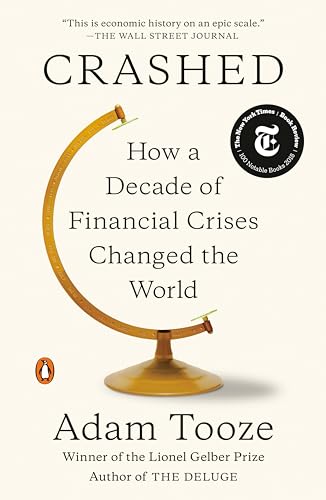
Inhaltsangabe
WINNER OF THE LIONEL GELBER PRIZE
A NEW YORK TIMES NOTABLE BOOK OF 2018
ONE OF THE ECONOMIST'S BOOKS OF THE YEAR
A NEW YORK TIMES CRITICS' TOP BOOK
"An intelligent explanation of the mechanisms that produced the crisis and the response to it...One of the great strengths of Tooze's book is to demonstrate the deeply intertwined nature of the European and American financial systems."--The New York Times Book Review
From the prizewinning economic historian and author of Shutdown and The Deluge, an eye-opening reinterpretation of the 2008 economic crisis (and its ten-year aftermath) as a global event that directly led to the shockwaves being felt around the world today.
We live in a world where dramatic shifts in the domestic and global economy command the headlines, from rollbacks in US banking regulations to tariffs that may ignite international trade wars. But current events have deep roots, and the key to navigating today’s roiling policies lies in the events that started it all—the 2008 economic crisis and its aftermath. Despite initial attempts to downplay the crisis as a local incident, what happened on Wall Street beginning in 2008 was, in fact, a dramatic caesura of global significance that spiraled around the world, from the financial markets of the UK and Europe to the factories and dockyards of Asia, the Middle East, and Latin America, forcing a rearrangement of global governance. With a historian’s eye for detail, connection, and consequence, Adam Tooze brings the story right up to today’s negotiations, actions, and threats—a much-needed perspective on a global catastrophe and its long-term consequences.
Die Inhaltsangabe kann sich auf eine andere Ausgabe dieses Titels beziehen.
Über die Autorinnen und Autoren
Adam Tooze is the author of Wages of Destruction, winner of the Wolfson and Longman History Today Prize. He is the Kathryn and Shelby Cullom Davis Professor of History at Columbia University. He formerly taught at Yale University, where he was Director of International Security Studies, and at the University of Cambridge. He has worked in executive development with several major corporations and contributed to the National Intelligence Council. He has written and reviewed for Foreign Affairs, the Financial Times, The Guardian, the Sunday Telegraph, The Wall Street Journal, Die Zeit, Sueddeutsche Zeitung, Tageszeitung and Spiegel Magazine, New Left Review, and the London Review of Books.
Adam Tooze, winner of the Wolfson and Longman History Today Prizes, is Professor of History at Columbia University. He formerly taught at Yale University, where he was Director of International Security Studies, and at the University of Cambridge. He has worked in executive development with several major corporations and contributed to the National Intelligence Council. He has written and reviewed for Foreign Affairs, The Financial Times, The Guardian, and the Wall Street Journal.
Auszug. © Genehmigter Nachdruck. Alle Rechte vorbehalten.
Chapter 1
The "Wrong Crisis"
On April 5, 2006, the youthful junior senator from Illinois Barack Obama took time out from discussion of an India nuclear deal on Capitol Hill to attend the opening of a new think tank project at Brookings. The Brookings Institution is widely regarded as the most influential social science research center in the world. Obama's Brookings appearance was an audition that would define his presidency. The keynote he delivered was for a new initiative-the Hamilton Project-launched by Robert Rubin, one of the kingmakers of the Democratic Party. Rubin personified the link forged in the 1990s between centrist Democrats and globally minded bankers that reshaped the American economic policy agenda. In 1993 Rubin had moved from his position at the top of Wall Street, as cochairman at Goldman Sachs, to serve as the first head of the National Economic Council, which Bill Clinton had called into existence as a counterpart to the National Security Council. Two years later Rubin was appointed Treasury secretary. Alongside Rubin presiding over the Brookings meeting in April 2006 was a youthful economist by the name of Peter Orszag, also a veteran of the Clinton administration, who would go on to become Obama's budget director. It was from among the veterans of Rubin's Treasury that Obama would recruit virtually his entire economics team in 2008. Twelve months ahead of the financial crisis, two and a half years before Obama took office, the launch of the Hamilton Project presents the worldview of some of his most influential advisers in microcosm. It reveals both what they could see and what they could not.
I
Having returned to the business world in 1999, Rubin was worried about the drift in Washington. Globalization had been the central challenge of the 1990s. In the new millennium it was even more so. But two years into President Bush's second term, the policies of the Republican administration were putting America at risk. Rather than mitigating the pressures of global competition, they were dividing American society. This risked provoking both an antiglobalization backlash and a catastrophic financial crisis that would call into question America's monetary stability and the global standing of the dollar.
Not that Rubin and his circle were doing badly out of a world of globalization. After the Treasury, Rubin had retired to an influential sinecure as a nonexecutive chairman of the board at Citigroup. Orszag, who started his career bouncing back and forth among academia, government and consulting, would in due course end up at Citigroup too. But for average Americans the story was different. There had been good moments. The Clintonites still celebrated the 1990s and the twin booms of tech and Wall Street. But since the 1970s wages had not kept up with productivity. For the meritocrats of the Hamilton Project it was clear where the finger of blame pointed. America's schools were failing to give its young people the education essential to stay ahead of the game. The first reports issued by the Hamilton Project bristled with proposals to improve the recruitment of teachers and make better use of kids' summer vacations. It was the kind of nuts-and-bolts, "evidence-based," nonideological approach to productivity improvement that dominated economic policy discussion of the era. Its purpose, however, was eminently political. As Obama put it in his keynote:
"When you invest in education and health care and benefits for working Americans, it pays dividends throughout every level of our economy. . . . I think that if you polled many of the people in this room, most of us are strong free traders and most of us believe in markets. Bob [Rubin] and I have had a running debate now for about a year about how do we, in fact, deal with the losers in a globalized economy. There has been a tendency in the past for us to say, well, look, we have got to grow the pie, and we will retrain those who need retraining. But, in fact, we have never taken that side of the equation as seriously as we need to take it. . . . Just remember . . . [t]here are people in places like Decatur, Illinois, or Galesburg, Illinois, who have seen their jobs eliminated. They have lost their health care. They have lost their retirement security. . . . They believe that this may be the first generation in which their children do worse than they do."
This was a betrayal of the American Dream of endless uplift, and that risked spilling over into a political backlash. As Obama put it: "Some of that, then, will end up manifesting itself in the sort of nativist sentiment, protectionism, and anti-immigration sentiment that we are debating here in Washington. So there are real consequences to the work that is being done here. This is not a bloodless process."
Amid the fears about globalization and the risk of populist revolt already evident in 2006, there was one note of economic nationalism that Obama himself was not afraid to strike: "When you keep the deficit low and our debt out of the hands of foreign nations, then we can all win." Alongside global competitiveness, the other preoccupation that defined the Hamilton team was the question of debt.
As Clinton's Treasury secretary, Robert Rubin's great boast was to have turned the deficits of the Reagan era into substantial budget surpluses. Since then under the Republicans, America was headed fast in the wrong direction. In June 2001, in the wake of the dot-com bust and a disputed election, the Bush administration had delivered a tax cut estimated to cost the federal government $1.35 trillion over ten years. This paid off key constituencies, but it also wiped out Rubin's surpluses and it did so deliberately. The Republicans had convinced themselves that surpluses tended to encourage more government spending. Their approach was the obverse, what Republican strategists of the Reagan era first dubbed "starving the beast." By entrenching tax cuts and courting a fiscal crisis they would create an irresistible imperative to slash spending, curb entitlements to social welfare and shrink the footprint of government.
The problem was that the spending cuts that were supposed to follow the tax cuts never happened. The terrorist attack of September 11, 2001, put America on a war footing. The Bush administration responded with a huge surge in defense and security spending. In a manner horribly reminiscent of Vietnam, it then plunged America into the Iraq quagmire. In 2006, as the Hamilton group met, Iraq was on the edge of a bloody sectarian civil war. The question now was how to get out. Iraq was not only demoralizing and humiliating. It was also hugely expensive. The Bush administration did its best to keep the costs of the war off the regular budget. So a cottage industry of Democratic Party experts set itself to doing the sums. By 2008 the bill for Afghanistan and Iraq alone was at least $904 billion. Less conservative estimates put the bill as high as $3 trillion. It was certainly more than the United States had spent on any war since World War II.
Of course it could have been paid for. America was far richer than it was at the time of Pearl Harbor. But the Bush administration was not only not going to reverse its tax cuts; in May 2003 it doubled down, introducing a further round of tax relief. Given that the military budget was sacrosanct and the rest of discretionary expenditure was not large enough to make a difference, the Republicans proposed to close the gap with grossly inequitable cuts to welfare "entitlements." Those, however, could not pass the Senate, where the Republican majority was wafer thin and "moderates" held the balance. It was this logjam that turned Rubin's budget surplus of $86.4 billion in 2000 into a record...
„Über diesen Titel“ kann sich auf eine andere Ausgabe dieses Titels beziehen.
Suchergebnisse für Crashed: How a Decade of Financial Crises Changed the...

Beispielbild für diese ISBN
Crashed How a Decade of Financ
Anbieter: World of Books (was SecondSale), Montgomery, IL, USA
Verkäuferbewertung 5 von 5 Sternen

Zustand: Good. Item in good condition. Textbooks may not include supplemental items i.e. CDs, access codes etc. Artikel-Nr. 00108051856
Gebraucht kaufen
EUR 8,91
Versand gratis
Versand innerhalb von USA
Versand innerhalb von USA
Anzahl: 4 verfügbar
Beispielbild für diese ISBN
Crashed: How a Decade of Financial Crises Changed the World
Anbieter: BookOutlet, Jefferson City, TN, USA
Verkäuferbewertung 5 von 5 Sternen
Paperback. Zustand: New. Paperback. Publisher overstock, may contain remainder mark on edge. Artikel-Nr. 9780143110354B
Beispielbild für diese ISBN
Crashed: How a Decade of Financial Crises Changed the World
Anbieter: Wonder Book, Frederick, MD, USA
Verkäuferbewertung 5 von 5 Sternen
Zustand: Very Good. Very Good condition. A copy that may have a few cosmetic defects. May also contain light spine creasing or a few markings such as an owner's name, short gifter's inscription or light stamp. Artikel-Nr. K05R-00295
Gebraucht kaufen
EUR 9,44
Versand gratis
Versand innerhalb von USA
Versand innerhalb von USA
Anzahl: 1 verfügbar
Beispielbild für diese ISBN
Crashed: How a Decade of Financial Crises Changed the World
Anbieter: Eagle Eye Books, Decatur, GA, USA
Verkäuferbewertung 4 von 5 Sternen

Paper Back. Zustand: New. Artikel-Nr. 911867
Neu kaufen
EUR 18,84
EUR 3,48 Versand
Versand innerhalb von USA
Versand innerhalb von USA
Anzahl: 1 verfügbar
Beispielbild für diese ISBN
Crashed: How a Decade of Financial Crises Changed the World
Anbieter: Roundabout Books, Greenfield, MA, USA
Verkäuferbewertung 4 von 5 Sternen
Paperback. Zustand: New. Condition Notes: New from the publisher. Artikel-Nr. 1210090
Beispielbild für diese ISBN
Crashed: How a Decade of Financial Crises Changed the World
Anbieter: Kennys Bookstore, Olney, MD, USA
Verkäuferbewertung 5 von 5 Sternen
Zustand: New. 2019. Illustrated. paperback. . . . . . Books ship from the US and Ireland. Artikel-Nr. V9780143110354
Neu kaufen
EUR 28,93
EUR 9,15 Versand
Versand innerhalb von USA
Versand innerhalb von USA
Anzahl: 15 verfügbar
Beispielbild für diese ISBN
Crashed: How a Decade of Financial Crises Changed the World
Anbieter: Revaluation Books, Exeter, Vereinigtes Königreich
Verkäuferbewertung 5 von 5 Sternen
Paperback. Zustand: Brand New. reprint edition. 704 pages. 8.43x5.50x1.40 inches. In Stock. Artikel-Nr. xr0143110357
Neu kaufen
EUR 25,93
EUR 14,58 Versand
Versand von Vereinigtes Königreich nach USA
Versand von Vereinigtes Königreich nach USA
Anzahl: 2 verfügbar
Beispielbild für diese ISBN
Crashed: How a Decade of Financial Crises Changed the World
Anbieter: Revaluation Books, Exeter, Vereinigtes Königreich
Verkäuferbewertung 5 von 5 Sternen
Paperback. Zustand: Brand New. reprint edition. 704 pages. 8.43x5.50x1.40 inches. In Stock. Artikel-Nr. 0143110357
Neu kaufen
EUR 30,05
EUR 14,58 Versand
Versand von Vereinigtes Königreich nach USA
Versand von Vereinigtes Königreich nach USA
Anzahl: 1 verfügbar
Foto des Verkäufers
Crashed : How a Decade of Financial Crises Changed the World
Verlag:
Penguin Publishing Group Aug 2019, 2019
ISBN 10: 0143110357
ISBN 13: 9780143110354
Neu
Taschenbuch
Anbieter: AHA-BUCH GmbH, Einbeck, Deutschland
Verkäuferbewertung 5 von 5 Sternen
Taschenbuch. Zustand: Neu. Neuware - WINNER OF THE LIONEL GELBER PRIZEA NEW YORK TIMES NOTABLE BOOK OF 2018ONE OF THE ECONOMIST'S BOOKS OF THE YEARA NEW YORK TIMES CRITICS' TOP BOOK 'An intelligent explanation of the mechanisms that produced the crisis and the response to it.One of the great strengths of Tooze's book is to demonstrate the deeply intertwined nature of the European and American financial systems.'--The New York Times Book Review From the prizewinning economic historian and author of Shutdown and The Deluge, an eye-opening reinterpretation of the 2008 economic crisis (and its ten-year aftermath) as a global event that directly led to the shockwaves being felt around the world today. We live in a world where dramatic shifts in the domestic and global economy command the headlines, from rollbacks in US banking regulations to tariffs that may ignite international trade wars. But current events have deep roots, and the key to navigating today's roiling policies lies in the events that started it all--the 2008 economic crisis and its aftermath. Despite initial attempts to downplay the crisis as a local incident, what happened on Wall Street beginning in 2008 was, in fact, a dramatic caesura of global significance that spiraled around the world, from the financial markets of the UK and Europe to the factories and dockyards of Asia, the Middle East, and Latin America, forcing a rearrangement of global governance. With a historian's eye for detail, connection, and consequence, Adam Tooze brings the story right up to today's negotiations, actions, and threats--a much-needed perspective on a global catastrophe and its long-term consequences. Artikel-Nr. 9780143110354
Neu kaufen
EUR 41,26
EUR 30,50 Versand
Versand von Deutschland nach USA
Versand von Deutschland nach USA
Anzahl: 1 verfügbar
Foto des Verkäufers
Crashed: How a Decade of Financial Crises Changed the World
Anbieter: moluna, Greven, Deutschland
Verkäuferbewertung 5 von 5 Sternen
Zustand: New. Über den AutorAdam Tooze is the author of Wages of Destruction, winner of the Wolfson and Longman History Today Prize. He is the Kathryn and Shelby Cullom Davis Professor of History at Columbia University. He formerly . Artikel-Nr. 291042723
Neu kaufen
EUR 22,83
EUR 48,99 Versand
Versand von Deutschland nach USA
Versand von Deutschland nach USA
Anzahl: 2 verfügbar