
Verwandte Artikel zu Robert E. Lee: A Life (Penguin Lives Biographies)
Inhaltsangabe
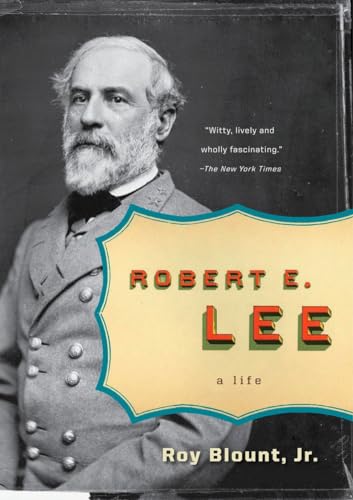
A “witty, lively and wholly fascinating” (The New York Times) portrait of an iconic Southern hero
With lively storytelling and full-hearted Southern directness, Roy Blount, Jr., presents a unique portrait of Robert E. Lee. Fascinated by the qualities that made Lee such a charismatic, though reluctant, leader, Blount vividly conveys Lee’s audacity and uncanny successes in battle, as well as his humility, his quirky sense of humor, and the sorrowful sense of responsibility he felt for his outnumbered, half-starved army. The first concise biography of this American legend, Robert E. Lee will appeal to history and military buffs, students of Southern culture, and every reader curious about the makeup of a man who has become an American icon.
Die Inhaltsangabe kann sich auf eine andere Ausgabe dieses Titels beziehen.
Über die Autorin bzw. den Autor
Roy Blount, Jr., grew up in Georgia and served in the army before becoming a celebrated humorist and cultural journalist. He has written for magazines as diverse as Sports Illustrated and The New York Review of Books and is the author of numerous books that include his recent memoir Be Sweet.
Auszug. © Genehmigter Nachdruck. Alle Rechte vorbehalten.
CHAPTER ONE
It is well that war is so terrible, or we should grow too fond of it. -Robert E. Lee, at Fredericksburg
Shut up, Bobby Lee. It's no real pleasure in life. -The Misfit, in Flannery O'Connor's "A Good Man Is Hard to Find"
In his dashing (if sometimes depressive) antebellum prime, he may have been the most beautiful person in America, a sort of precursor-cross between England's Cary Grant and Virginia's Randolph Scott. He was in his element gossiping with belles about their beaux at balls. In theaters of grinding, hellish human carnage he kept a pet hen for company. He had tiny feet that he loved his children to tickle. None of these things seems to fit, for if ever there was a grave American icon, it is Robert Edward Lee-hero of the Confederacy in the American Civil War, a unifying national figure for a century or so thereafter, and currently a symbol of nobility to some, of slavery to others.
After Lee's death in 1870, Frederick Douglass, the former fugitive slave who had become the nation's most prominent African American, wrote, "We can scarcely take up a newspaper...that is not filled with nauseating flatteries" of Lee, from which "it would seem...that the soldier who kills the most men in battle, even in a bad cause, is the greatest Christian, and entitled to the highest place in heaven." Two years later one of Lee's ex-generals, Jubal A. Early, apotheosized his late commander as follows: "Our beloved Chief stands, like some lofty column which rears its head among the highest, in grandeur, simple, pure and sublime."
In 1907 President Theodore Roosevelt expressed mainstream American sentiment in a letter to the Committee of Arrangement for the Celebration of the Hundredth Anniversary of Lee's birth: General Lee has left us the memory, not merely of his extraordinary skill as a General, his dauntless courage and high leadership... but also of that serene greatness of soul characteristic of those who most readily recognize the obligations of civic duty....He stood that hardest of all strains, the strain of bearing himself well through the gray evening of failure; and therefore out of what seemed failure he helped to build the wonderful and mighty triumph of our national life, in which all his countrymen, north and south, share.
Teddy Roosevelt, Gen. Douglas MacArthur, and President Harry S. Truman had at least three things in common with Lee: They were all brave soldiers, staunch leaders of men, and, in no pejorative sense, mama's boys. Both Truman and MacArthur were adjured by their strong-minded mothers to grow up just like Robert E. Lee, and they never stopped taking that charge to heart.
When a white mob tried to prevent the integration of public schools in Little Rock, Arkansas, in 1957, Robert Penn Warren wrote, "Can the man howling in the mob imagine General R. E. Lee, CSA, shaking hands with Orval Faubus, governor of Arkansas?" Certainly not-Lee was too fine. But at the turn of the twenty-first century, a portrait of Lee on the James River floodwall in Richmond, Virginia, was defaced, restored, denounced by the National Association for the Advancement of Colored People, and defended by white supremacist David Duke. U.S. Attorney General-designate John Ashcroft was widely disparaged for having called Lee a "patriot." "We've got to stand up and speak in this respect," Ashcroft had written, "or else we'll be taught that [Lee and other Confederate leaders] were giving their lives, subscribing their sacred fortunes and their honor to some perverted agenda."
One thing that can be said for Lee is that he would have welcomed none of these pronouncements. If the self-effacing patrician could have known that his face would live on for so long as a quasi-religious, recurrently divisive symbol, it might have made him moan, as he did after sending thousands of men to be cut to ribbons at Gettysburg, "Too bad! Too bad! OH! TOO BAD!" He was one of the few great men of whom it can be said that his sense of honor was rooted in genuine-if in fact far from simple or serene-humility. The most sublime word, Lee said, was "duty." In 1860 he wrote to Robert E. Lee Jr., who was starting college:
You must be frank in the world, frankness is the child of honesty and courage. Say just what you mean to do on every occasion, and take it for granted you mean to do right....Never do anything wrong to make a friend or keep one; the man who requires you to do so, is dearly purchased at a sacrifice. Deal kindly, but firmly with all your classmates; you will find it the policy which wears best. Above all do not appear to others what you are not.
Did he speak in such tones to himself? He was the last avatar, wrote Edmund Wilson approvingly, of "classical antique virtue, at once aristocratic and republican." But he was also a man. And isn't it true, as Montgomery Clift said in the role of Robert E. Lee Prewitt in From Here to Eternity, "Ain't nothin the matter with a soldier that ain't the matter with everybody else"?
We may think we know Lee because we have a mental image: gray. Not only the uniform, the mythic horse, the hair and beard, but the resignation with which he accepted dreary burdens that offered "neither pleasure nor advantage": in particular, the Confederacy, a cause of which he took a dim view until he went to war for it. He did not see right and wrong in tones of gray, and yet his moralizing could generate a fog, as in a letter from the front to his invalid wife: "You must endeavour to enjoy the pleasure of doing good. That is all that makes life valuable." All right. But then he adds: "When I measure my own by that standard I am filled with confusion and despair."
His own hand probably never drew human blood nor fired a shot in anger, and his only Civil War wound was a faint scratch on the cheek from a sharpshooter's bullet, but many thousands of men died quite horribly in battles where he was the dominant-fiery-spirit, and most of the casualties were on the other side. If we take as a given Lee's granitic conviction that everything is God's will, however, he was born to lose.
He was usually kinder than most great men. But in even the most sympathetic versions of his life story he comes across as a bit of a stick-certainly compared with his scruffy nemesis, Ulysses S. Grant; his zany, ferocious "right arm," Stonewall Jackson; and the dashing "eyes" of his army, Jeb Stuart. For these men, the Civil War was just the ticket. Lee, however, has come down in history as too fine for the bloodbath of 1861-65. As an icon he has enabled Americans of the South and also of the North to feel that somehow the American family was too decent to have brought upon itself four years of domestic carnage. To efface the squalor and horror of the war we have the image of Abraham Lincoln freeing the slaves, and we have the image of Robert E. Lee nobly putting down his sword and standing selflessly for reconciliation. Both of those images have undergone reassessment-for many contemporary Americans, Lee is at best the moral equivalent of Hitler's brilliant field marshal Erwin Rommel (who, however, turned against Hitler, as Lee never did against Jefferson Davis, who, to be sure, was no Hitler)-but they haven't gone away.
Can we recast Lee in terms more edifying in this century?
One problem is that Lee's life didn't fit him. He appears to have been too fine for his childhood, for his education, for his profession, for his marriage, and for the Confederacy. Not according to him. According to him, he was not fine enough. For all his audacity on the battlefield, he accepted rather passively one raw deal after another, bending over backward for everyone from Jefferson Davis to James McNeill Whistler's mother.
By what can we know him? The works of a general are battles, campaigns, and usually memoirs. The engagements of the Civil War shape up more as bloody muddles than as...
„Über diesen Titel“ kann sich auf eine andere Ausgabe dieses Titels beziehen.
Suchergebnisse für Robert E. Lee: A Life (Penguin Lives Biographies)

Beispielbild für diese ISBN
Robert E Lee A Life Penguin Li
Anbieter: World of Books (was SecondSale), Montgomery, IL, USA
Verkäuferbewertung 5 von 5 Sternen

Zustand: Good. Item in very good condition! Textbooks may not include supplemental items i.e. CDs, access codes etc. Artikel-Nr. 00072235650
Gebraucht kaufen
EUR 3,85
Versand gratis
Versand innerhalb von USA
Versand innerhalb von USA
Anzahl: 1 verfügbar
Beispielbild für diese ISBN
Robert E. Lee: A Life (Penguin Lives Biographies)
Verlag:
Penguin Publishing Group (edition Reprint), 2006
ISBN 10: 0143038664
ISBN 13: 9780143038665
Gebraucht
Paperback
Anbieter: BooksRun, Philadelphia, PA, USA
Verkäuferbewertung 5 von 5 Sternen
Paperback. Zustand: Very Good. Reprint. It's a well-cared-for item that has seen limited use. The item may show minor signs of wear. All the text is legible, with all pages included. It may have slight markings and/or highlighting. Artikel-Nr. 0143038664-11-1
Gebraucht kaufen
EUR 4,33
Versand gratis
Versand innerhalb von USA
Versand innerhalb von USA
Anzahl: 1 verfügbar
Beispielbild für diese ISBN
Robert E. Lee : A Life
Verlag:
Penguin Publishing Group, 2006
ISBN 10: 0143038664
ISBN 13: 9780143038665
Gebraucht
Softcover
Anbieter: Better World Books, Mishawaka, IN, USA
Verkäuferbewertung 5 von 5 Sternen
Zustand: Good. Pages intact with minimal writing/highlighting. The binding may be loose and creased. Dust jackets/supplements are not included. Stock photo provided. Product includes identifying sticker. Better World Books: Buy Books. Do Good. Artikel-Nr. 5435569-6
Gebraucht kaufen
EUR 5,96
Versand gratis
Versand innerhalb von USA
Versand innerhalb von USA
Anzahl: 1 verfügbar
Beispielbild für diese ISBN
Robert E. Lee : A Life
Verlag:
Penguin Publishing Group, 2006
ISBN 10: 0143038664
ISBN 13: 9780143038665
Gebraucht
Softcover
Anbieter: Better World Books: West, Reno, NV, USA
Verkäuferbewertung 5 von 5 Sternen
Zustand: Good. Former library copy. Pages intact with minimal writing/highlighting. The binding may be loose and creased. Dust jackets/supplements are not included. Includes library markings. Stock photo provided. Product includes identifying sticker. Better World Books: Buy Books. Do Good. Artikel-Nr. GRP102773244
Gebraucht kaufen
EUR 5,96
Versand gratis
Versand innerhalb von USA
Versand innerhalb von USA
Anzahl: 1 verfügbar
Beispielbild für diese ISBN
Robert E. Lee: A Life (Penguin Lives Biographies)
Verlag:
Penguin Publishing Group, 2006
ISBN 10: 0143038664
ISBN 13: 9780143038665
Gebraucht
Softcover
Anbieter: Wonder Book, Frederick, MD, USA
Verkäuferbewertung 5 von 5 Sternen
Zustand: Very Good. Very Good condition. A copy that may have a few cosmetic defects. May also contain light spine creasing or a few markings such as an owner's name, short gifter's inscription or light stamp. Artikel-Nr. B05A-02947
Gebraucht kaufen
EUR 6,19
Versand gratis
Versand innerhalb von USA
Versand innerhalb von USA
Anzahl: 3 verfügbar
Beispielbild für diese ISBN
Robert E. Lee: A Life
Verlag:
Penguin Publishing Group, 2006
ISBN 10: 0143038664
ISBN 13: 9780143038665
Gebraucht
Paperback
Anbieter: ThriftBooks-Dallas, Dallas, TX, USA
Verkäuferbewertung 5 von 5 Sternen
Paperback. Zustand: Very Good. No Jacket. May have limited writing in cover pages. Pages are unmarked. ~ ThriftBooks: Read More, Spend Less. Artikel-Nr. G0143038664I4N00
Gebraucht kaufen
EUR 6,24
Versand gratis
Versand innerhalb von USA
Versand innerhalb von USA
Anzahl: 1 verfügbar
Beispielbild für diese ISBN
Robert E. Lee: A Life
Verlag:
Penguin Publishing Group, 2006
ISBN 10: 0143038664
ISBN 13: 9780143038665
Gebraucht
Paperback
Anbieter: ThriftBooks-Atlanta, AUSTELL, GA, USA
Verkäuferbewertung 5 von 5 Sternen
Paperback. Zustand: Very Good. No Jacket. May have limited writing in cover pages. Pages are unmarked. ~ ThriftBooks: Read More, Spend Less. Artikel-Nr. G0143038664I4N00
Gebraucht kaufen
EUR 6,24
Versand gratis
Versand innerhalb von USA
Versand innerhalb von USA
Anzahl: 1 verfügbar
Beispielbild für diese ISBN
Robert E. Lee: A Life
Verlag:
Penguin Publishing Group, 2006
ISBN 10: 0143038664
ISBN 13: 9780143038665
Gebraucht
Paperback
Anbieter: ThriftBooks-Reno, Reno, NV, USA
Verkäuferbewertung 5 von 5 Sternen
Paperback. Zustand: Very Good. No Jacket. May have limited writing in cover pages. Pages are unmarked. ~ ThriftBooks: Read More, Spend Less. Artikel-Nr. G0143038664I4N00
Gebraucht kaufen
EUR 6,24
Versand gratis
Versand innerhalb von USA
Versand innerhalb von USA
Anzahl: 1 verfügbar
Beispielbild für diese ISBN
Robert E. Lee: A Life (Penguin Lives Biographies)
Verlag:
Penguin Publishing Group, 2006
ISBN 10: 0143038664
ISBN 13: 9780143038665
Gebraucht
Paperback
Anbieter: WorldofBooks, Goring-By-Sea, WS, Vereinigtes Königreich
Verkäuferbewertung 5 von 5 Sternen
Paperback. Zustand: Very Good. The book has been read, but is in excellent condition. Pages are intact and not marred by notes or highlighting. The spine remains undamaged. Artikel-Nr. GOR005233202
Gebraucht kaufen
EUR 3,98
EUR 6,52 Versand
Versand von Vereinigtes Königreich nach USA
Versand von Vereinigtes Königreich nach USA
Anzahl: 1 verfügbar
Beispielbild für diese ISBN
Robert E. Lee: A Life (Penguin Lives Biographies)
Anbieter: AwesomeBooks, Wallingford, Vereinigtes Königreich
Verkäuferbewertung 5 von 5 Sternen
Paperback. Zustand: Very Good. Robert E. Lee: A Life (Penguin Lives Biographies) This book is in very good condition and will be shipped within 24 hours of ordering. The cover may have some limited signs of wear but the pages are clean, intact and the spine remains undamaged. This book has clearly been well maintained and looked after thus far. Money back guarantee if you are not satisfied. See all our books here, order more than 1 book and get discounted shipping. Artikel-Nr. 7719-9780143038665
Gebraucht kaufen
EUR 6,00
EUR 4,80 Versand
Versand von Vereinigtes Königreich nach USA
Versand von Vereinigtes Königreich nach USA
Anzahl: 2 verfügbar