
Verwandte Artikel zu An Ordinary Man: An Autobiography
Inhaltsangabe
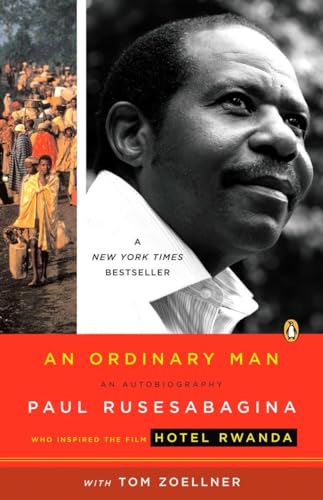
The remarkable autobiography of the globally-recognized human rights champion whose heroism inspired the film Hotel Rwanda
“Fascinating…your book is called An Ordinary Man, yet you took on an extraordinary feat with courage, determination, and diplomacy.” – Oprah, O, The Oprah Magazine
As Rwanda was thrown into chaos during the 1994 genocide, Rusesabagina, a hotel manager, turned the luxurious Hotel Milles Collines into a refuge for more than 1,200 Tutsi and moderate Hutu refugees, while fending off their would-be killers with a combination of diplomacy and deception. In An Ordinary Man, he tells the story of his childhood, retraces his accidental path to heroism, revisits the 100 days in which he was the only thing standing between his “guests” and a hideous death, and recounts his subsequent life as a refugee and activist.
Die Inhaltsangabe kann sich auf eine andere Ausgabe dieses Titels beziehen.
Über die Autorin bzw. den Autor
Paul Rusesabagina has received many awards and honors, including the National Civil Rights Museum Freedom Award, the Presidential Medal of Freedom, the Rescuer of Humanity Award and the The Lantos Human Rights Prize. He formed the Hotel Rwanda Rusesabagina Foundation to provide voice to victims of genocide and support peace efforts in Rwanda and throughout the world.
Auszug. © Genehmigter Nachdruck. Alle Rechte vorbehalten.
AN ORDINARY MAN
AN ORDINARY MAN
AN AUTOBIOGRAPHY
PAUL RUSESABAGINA
with Tom Zoellner
VIKING
“Many fledging moralists in those days were going about our town proclaiming that there was nothing to be done about it and we should bow to the inevitable. And Tarrou, Rieux, and their friends might give one answer or another, but its conclusion was always the same, their certitude that a fight must be put up, in this way or that, and there must be no bowing down. The essential thing was to save the greatest possible number of persons from dying and being doomed to unending separation. And to do this there was only one resource: to fight the plague. There was nothing admirable about this attitude; it was merely logical.”
—From The Plague, by Albert Camus
ACKNOWLEDGMENTS
AUTHOR’S NOTE
INTRODUCTION
CHAPTER ONE
CHAPTER TWO
CHAPTER THREE
CHAPTER FOUR
CHAPTER FIVE
CHAPTER SIX
CHAPTER SEVEN
CHAPTER EIGHT
CHAPTER NINE
CHAPTER TEN
CHAPTER ELEVEN
SELECTED BIBLIOGRAPHY
ACKNOWLEDGMENTS
The authors wish to thank Kathryn Court, Jill Kneerim,
Alexis Washam, and Paul Buckley for their invaluable
assistance in the production of this book.
AUTHOR’S NOTE
This is a work of nonfiction. All of the people and events described herein are true as I remember them. For legal and ethical reasons, I have given pseudonyms to a handful of private Rwandan citizens. Each time this is done, the change is noted in the text.
Paul Rusesabagina
INTRODUCTION
My name is Paul Rusesabagina. I am a hotel manager. In April 1994, when a wave of mass murder broke out in my country, I was able to hide 1, 268 people inside the hotel where I worked.
When the militia and the Army came with orders to kill my guests, I took them into my office, treated them like friends, offered them beer and cognac, and then persuaded them to neglect their task that day. And when they came back, I poured more drinks and kept telling them they should leave in peace once again. It went on like this for seventy-six days. I was not particularly eloquent in these conversations. They were no different from the words I would have used in saner times to order a shipment of pillow-cases, for example, or tell the shuttle van driver to pick up a guest at the airport. I still don’t understand why those men in the militias didn’t just put a bullet in my head and execute every last person in the rooms upstairs but they didn’t. None of the refugees in my hotel were killed. Nobody was beaten. Nobody was taken away and made to disappear. People were being hacked to death with machetes all over Rwanda, but that five-story building became a refuge for anyone who could make it to our doors. The hotel could offer only an illusion of safety, but for whatever reason, the illusion prevailed and I survived to tell the story, along with those I sheltered. There was nothing particularly heroic about it. My only pride in the matter is that I stayed at my post and continued to do my job as manager when all other aspects of decent life vanished. I kept the Hotel Mille Collines open, even as the nation descended into chaos and eight hundred thousand people were butchered by their friends, neighbors, and countrymen.
It happened because of racial hatred. Most of the people hiding in my hotel were Tutsis, descendants of what had once been the ruling class of Rwanda. The people who wanted to kill them were mostly Hutus, who were traditionally farmers. The usual stereotype is that Tutsis are tall and thin with delicate noses, and Hutus are short and stocky with wider noses, but most people in Rwanda fit neither description. This divide is mostly artificial, a leftover from history, but people take it very seriously, and the two groups have been living uneasily alongside each other for more than five hundred years.
You might say the divide also lives inside me. I am the son of a Hutu farmer and his Tutsi wife. My family cared not the least bit about this when I was growing up, but since bloodlines are passed through the father in Rwanda, I am technically a Hutu. I married a Tutsi woman, whom I love with a fierce passion, and we had a child of mixed descent together. This type of blended family is typical in Rwanda, even with our long history of racial prejudice. Very often we can’t tell each other apart just by looking at one another. But the difference between Hutu and Tutsi means everything in Rwanda. In the late spring and early summer of 1994 it meant the difference between life and death.
Between April 6, when the plane of President Juvenal Habyarimana was shot down with a missile, and July 4, when the Tutsi rebel army captured the capital of Kigali, approximately eight hundred thousand Rwandans were slaughtered. This is a number that cannot be grasped with the rational mind. It is like trying—all at once—to understand that the earth is surrounded by billions of balls of gas just like our sun across a vast blackness. You cannot understand the magnitude. Just try! Eight hundred thousand lives snuffed out in one hundred days. That’s eight thousand lives a day. More than five lives per minute. Each one of those lives was like a little world in itself. Some person who laughed and cried and ate and thought and felt and hurt just like any other person, just like you and me. A mother’s child, every one irreplaceable.
And the way they died …I can’t bear to think about it for long. Many went slowly from slash wounds, watching their own blood gather in pools in the dirt, perhaps looking at their own severed limbs, oftentimes with the screams of their parents or their children or their husbands in their ears. Their bodies were cast aside like garbage, left to rot in the sun, shoveled into mass graves with bulldozers when it was all over. It was not the largest genocide in the history of the world, but it was the fastest and most efficient.
At the end, the best you can say is that my hotel saved about four hours’ worth of people. Take four hours away from one hundred days and you have an idea of just how little I was able to accomplish against the grand design.
What did I have to work with? I had a five-story building. I had a cooler full of drinks. I had a small stack of cash in the safe. And I had a working telephone and I had my tongue. It wasn’t much. Anybody with a gun or a machete could have taken these things away from me quite easily. My disappearance—and that of my family—would have barely been noticed in the torrents of blood coursing through Rwanda in those months. Our bodies would have joined the thousands in the east-running rivers floating toward Lake Victoria, their skins turning white with water rot.
I wonder today what exactly it was that allowed me to stop the killing clock for four hours.
There were a few things in my favor, but they do not explain everything. I was a Hutu because my father was Hutu, and this gave me a certain amount of protection against immediate execution. But it was not only Tutsis who were slaughtered in the genocide; it was also the thousands of moderate Hutus who were suspected of sympathizing with or even helping the Tutsi “cockroaches.” I was certainly one of these cockroach-lovers. Under the standards of mad extremism at work then I was a prime candidate for a beheading.
Another surface advantage: I had control of a luxury hotel, which was one of the few places during the genocide that...
„Über diesen Titel“ kann sich auf eine andere Ausgabe dieses Titels beziehen.
Suchergebnisse für An Ordinary Man: An Autobiography

Beispielbild für diese ISBN
An Ordinary Man: An Autobiography
Anbieter: World of Books (was SecondSale), Montgomery, IL, USA
Verkäuferbewertung 5 von 5 Sternen

Zustand: Good. Item in good condition. Textbooks may not include supplemental items i.e. CDs, access codes etc. Artikel-Nr. 00066144892
Gebraucht kaufen
EUR 3,63
Versand gratis
Versand innerhalb von USA
Versand innerhalb von USA
Anzahl: Mehr als 20 verfügbar
Beispielbild für diese ISBN
An Ordinary Man: An Autobiography
Anbieter: World of Books (was SecondSale), Montgomery, IL, USA
Verkäuferbewertung 5 von 5 Sternen
Zustand: Acceptable. Item in acceptable condition! Textbooks may not include supplemental items i.e. CDs, access codes etc. Artikel-Nr. 00095920888
Gebraucht kaufen
EUR 3,63
Versand gratis
Versand innerhalb von USA
Versand innerhalb von USA
Anzahl: 2 verfügbar
Beispielbild für diese ISBN
An Ordinary Man: An Autobiography
Verlag:
Penguin Books (edition Reprint), 2007
ISBN 10: 0143038605
ISBN 13: 9780143038603
Gebraucht
Paperback
Anbieter: BooksRun, Philadelphia, PA, USA
Verkäuferbewertung 5 von 5 Sternen
Paperback. Zustand: Fair. Reprint. The item might be beaten up but readable. May contain markings or highlighting, as well as stains, bent corners, or any other major defect, but the text is not obscured in any way. Artikel-Nr. 0143038605-7-1
Gebraucht kaufen
EUR 4,19
Versand gratis
Versand innerhalb von USA
Versand innerhalb von USA
Anzahl: 1 verfügbar
Beispielbild für diese ISBN
An Ordinary Man: An Autobiography
Verlag:
Penguin Books (edition Reprint), 2007
ISBN 10: 0143038605
ISBN 13: 9780143038603
Gebraucht
Paperback
Anbieter: BooksRun, Philadelphia, PA, USA
Verkäuferbewertung 5 von 5 Sternen
Paperback. Zustand: Very Good. Reprint. It's a well-cared-for item that has seen limited use. The item may show minor signs of wear. All the text is legible, with all pages included. It may have slight markings and/or highlighting. Artikel-Nr. 0143038605-11-6
Gebraucht kaufen
EUR 4,66
Versand gratis
Versand innerhalb von USA
Versand innerhalb von USA
Anzahl: 1 verfügbar
Beispielbild für diese ISBN
An Ordinary Man: An Autobiography
Anbieter: ThriftBooks-Atlanta, AUSTELL, GA, USA
Verkäuferbewertung 5 von 5 Sternen
Paperback. Zustand: Very Good. No Jacket. May have limited writing in cover pages. Pages are unmarked. ~ ThriftBooks: Read More, Spend Less. Artikel-Nr. G0143038605I4N00
Gebraucht kaufen
EUR 5,82
Versand gratis
Versand innerhalb von USA
Versand innerhalb von USA
Anzahl: 1 verfügbar
Beispielbild für diese ISBN
An Ordinary Man: An Autobiography
Anbieter: ThriftBooks-Dallas, Dallas, TX, USA
Verkäuferbewertung 5 von 5 Sternen
Paperback. Zustand: Good. No Jacket. Pages can have notes/highlighting. Spine may show signs of wear. ~ ThriftBooks: Read More, Spend Less. Artikel-Nr. G0143038605I3N00
Gebraucht kaufen
EUR 5,82
Versand gratis
Versand innerhalb von USA
Versand innerhalb von USA
Anzahl: 1 verfügbar
Beispielbild für diese ISBN
An Ordinary Man: An Autobiography
Anbieter: ThriftBooks-Atlanta, AUSTELL, GA, USA
Verkäuferbewertung 5 von 5 Sternen
Paperback. Zustand: As New. No Jacket. Pages are clean and are not marred by notes or folds of any kind. ~ ThriftBooks: Read More, Spend Less. Artikel-Nr. G0143038605I2N00
Gebraucht kaufen
EUR 5,82
Versand gratis
Versand innerhalb von USA
Versand innerhalb von USA
Anzahl: 1 verfügbar
Beispielbild für diese ISBN
An Ordinary Man: An Autobiography
Anbieter: ThriftBooks-Atlanta, AUSTELL, GA, USA
Verkäuferbewertung 5 von 5 Sternen
Paperback. Zustand: Fair. No Jacket. Readable copy. Pages may have considerable notes/highlighting. ~ ThriftBooks: Read More, Spend Less. Artikel-Nr. G0143038605I5N00
Gebraucht kaufen
EUR 5,82
Versand gratis
Versand innerhalb von USA
Versand innerhalb von USA
Anzahl: 1 verfügbar
Beispielbild für diese ISBN
An Ordinary Man: An Autobiography
Anbieter: ThriftBooks-Phoenix, Phoenix, AZ, USA
Verkäuferbewertung 5 von 5 Sternen
Paperback. Zustand: Very Good. No Jacket. May have limited writing in cover pages. Pages are unmarked. ~ ThriftBooks: Read More, Spend Less. Artikel-Nr. G0143038605I4N00
Gebraucht kaufen
EUR 5,82
Versand gratis
Versand innerhalb von USA
Versand innerhalb von USA
Anzahl: 1 verfügbar
Beispielbild für diese ISBN
An Ordinary Man: An Autobiography
Anbieter: ThriftBooks-Dallas, Dallas, TX, USA
Verkäuferbewertung 5 von 5 Sternen
Paperback. Zustand: Very Good. No Jacket. May have limited writing in cover pages. Pages are unmarked. ~ ThriftBooks: Read More, Spend Less. Artikel-Nr. G0143038605I4N00
Gebraucht kaufen
EUR 5,82
Versand gratis
Versand innerhalb von USA
Versand innerhalb von USA
Anzahl: 1 verfügbar