
Inhaltsangabe
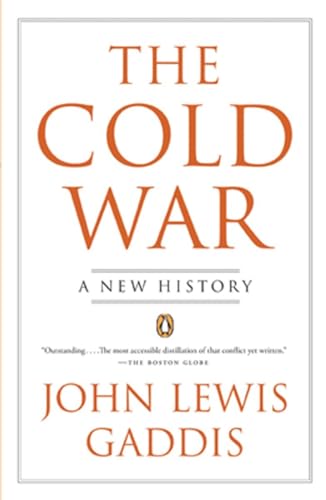
“Outstanding . . . The most accessible distillation of that conflict yet written.” —The Boston Globe
“Energetically written and lucid, it makes an ideal introduction to the subject.” —The New York Times
The “dean of Cold War historians” (The New York Times) now presents the definitive account of the global confrontation that dominated the last half of the twentieth century. Drawing on newly opened archives and the reminiscences of the major players, John Lewis Gaddis explains not just what happened but why—from the months in 1945 when the U.S. and the U.S.S.R. went from alliance to antagonism to the barely averted holocaust of the Cuban Missile Crisis to the maneuvers of Nixon and Mao, Reagan and Gorbachev. Brilliant, accessible, almost Shakespearean in its drama, The Cold War stands as a triumphant summation of the era that, more than any other, shaped our own.
Gaddis is also the author of On Grand Strategy.
Die Inhaltsangabe kann sich auf eine andere Ausgabe dieses Titels beziehen.
Über die Autorin bzw. den Autor
John Lewis Gaddis is the Robert A. Lovett Professor of History of Yale University. He is the author of numerous books, including On Grand Strategy, The United States and the Origins of the Cold War, 1941-1947 (1972); Strategies of Containment: A Critical Appraisal of Postwar American National Security (1982); The Long Peace: Inquiries into the History of the Cold War (1987); We Now Know: Rethinking Cold War History (1997); The Landscape of History: How Historians Map the Past (2002); and Surprise, Security, and the American Experience (2004).
Auszug. © Genehmigter Nachdruck. Alle Rechte vorbehalten.
PROLOGUE
THE VIEW FORWARD
IN 1946 a forty-three-year-old Englishman named Eric Blair rented a house at the edge of the world—a house in which he expected to die. It was on the northern tip of the Scottish island of Jura, at the end of a dirt track, inaccessible by automobile, with no telephone or electricity. The nearest shop, the only one on the island, was some twenty-five miles to the south. Blair had reasons to want remoteness. Dejected by the recent death of his wife, he was suffering from tuberculosis and would soon begin coughing up blood. His country was reeling from the costs of a military victory that had brought neither security, nor prosperity, nor even the assurance that freedom would survive. Europe was dividing into two hostile camps, and the world seemed set to follow. With atomic bombs likely to be used, any new war would be apocalyptic. And he needed to finish a novel.
Its title was 1984, an inversion of the year in which he completed it, and it appeared in Great Britain and the United States in 1949 under Blair’s pen name, George Orwell. The reviews, the New York Times noted, were “overwhelmingly admiring,” but “with cries of terror rising above the applause.”1 This was hardly surprising because 1984 evoked an age, only three and a half decades distant, in which totalitarianism has triumphed everywhere. Individuality is smothered, along with law, ethics, creativity, linguistic clarity, honesty about history, and even love—apart, of course, from the love everyone is forced to feel for the Stalin-like dictator “Big Brother” and his counterparts, who run a world permanently at war. “If you want a picture of the future,” Orwell’s hero Winston Smith is told, as he undergoes yet another session of relentless torture, “imagine a boot stamping on a human face—forever.”2
Orwell did die early in 1950—in a London hospital, not on his island—knowing only that his book had impressed and frightened its first readers. Subsequent readers responded similarly: 1984 became the single most compelling vision in the post–World War II era of what might follow it. As the real year 1984 approached, therefore, comparisons with Orwell’s imaginary year became inescapable. The world was not yet totalitarian, but dictators dominated large parts of it. The danger of war between the United States and the Soviet Union—two superpowers instead of the three Orwell had anticipated—seemed greater than it had for many years. And the apparently permanent conflict known as the “Cold War,” which began while Orwell was still alive, showed not the slightest signs of ending.
But then, on the evening of January 16, 1984, an actor Orwell would have recognized from his years as a film reviewer appeared on television in his more recent role as president of the United States. Ronald Reagan’s reputation until this moment had been that of an ardent Cold Warrior. Now, though, he envisaged a different future:
Just suppose with me for a moment that an Ivan and an Anya could find themselves, say, in a waiting room, or sharing a shelter from the rain or a storm with a Jim and Sally, and that there was no language barrier to keep them from getting acquainted. Would they then deliberate the differences between their respective governments? Or would they find themselves comparing notes about their children and what each other did for a living? . . . They might even have decided that they were all going to get together for dinner some evening soon. Above all, they would have proven that people don’t make wars.3
It was an unexpectedly gentle invitation for human faces to prevail over boots, dictators, and the mechanisms of war. It set in motion, in Orwell’s year 1984, the sequence of events by which they would do so. Just over a year after Reagan’s speech, an ardent enemy of totalitarianism took power in the Soviet Union. Within six years, that country’s control over half of Europe had collapsed. Within eight, the Union of Soviet Socialist Republics—the country that had provoked Orwell’s great gloomy prophecy in the first place—had itself ceased to exist.
These things did not happen simply because Reagan gave a speech or because Orwell wrote a book: the remainder of this book complicates the causation. It is worth starting with visions, though, because they establish hopes and fears. History then determines which prevail.
CHAPTER ONE
THE RETURN OF FEAR
We waited for them to come ashore. We could see their faces. They looked like ordinary people. We had imagined something different. Well, they were Americans!
—LIUBOVA KOZINCHENKA,
Red Army, 58th Guards Division
I guess we didn’t know what to expect from the Russians, but when you looked at them and examined them, you couldn’t tell whether, you know? If you put an American uniform on them, they could have been American!
—AL ARONSON,
U.S. Army, 69th Infantry Division1
THIS WAS THE WAY the war was supposed to end: with cheers, handshakes, dancing, drinking, and hope. The date was April 25, 1945, the place the eastern German city of Torgau on the Elbe, the event the first meeting of the armies, converging from opposite ends of the earth, that had cut Nazi Germany in two. Five days later Adolf Hitler blew his brains out beneath the rubble that was all that was left of Berlin. Just over a week after that, the Germans surrendered unconditionally. The leaders of the victorious Grand Alliance, Franklin D. Roosevelt, Winston Churchill, and Josef Stalin, had already exchanged their own handshakes, toasts, and hopes for a better world at two wartime summits—Teheran in November, 1943, and Yalta in February, 1945. These gestures would have meant little, though, had the troops they commanded not been able to stage their own more boisterous celebration where it really counted: on the front lines of a battlefield from which the enemy was now disappearing.
Why, then, did the armies at Torgau approach one another warily, as if they’d been expecting interplanetary visitors? Why did the resemblances they saw seem so surprising—and so reassuring? Why, despite these, did their commanders insist on separate surrender ceremonies, one for the western front at Reims, in France, on May 7th, another for the eastern front in Berlin on May 8th? Why did the Soviet authorities try to break up spontaneous pro-American demonstrations that erupted in Moscow following the official announcement of the German capitulation? Why did the American authorities, during the week that followed, abruptly suspend critical shipments of Lend-Lease aid to the U.S.S.R., and then resume them? Why did Roosevelt’s key aide Harry Hopkins, who had played a decisive role in crafting the Grand Alliance in 1941, have to rush to Moscow six weeks after his boss’s death to try to save it? Why for that matter, years later, would Churchill title his memoir of these events Triumph and Tragedy?
The answer to all of these questions is much the same: that the war had been won by a coalition whose principal members were already at war—ideologically and geopolitically if not militarily—with one another. Whatever the Grand Alliance’s triumphs in the spring of 1945, its success had always depended upon the pursuit of compatible objectives by incompatible systems. The tragedy was this: that victory would require the victors either to cease to be who they were, or to give up much of what they had hoped, by fighting the war, to...
„Über diesen Titel“ kann sich auf eine andere Ausgabe dieses Titels beziehen.
Weitere beliebte Ausgaben desselben Titels

Suchergebnisse für The Cold War: A New History

Foto des Verkäufers
The Cold War: A New History
Anbieter: Dream Books Co., Denver, CO, USA
Verkäuferbewertung 5 von 5 Sternen

Zustand: good. Gently used with minimal wear on the corners and cover. A few pages may contain light highlighting or writing, but the text remains fully legible. Dust jacket may be missing, and supplemental materials like CDs or codes may not be included. May be ex-library with library markings. Ships promptly! Artikel-Nr. DBV.0143038273.G
Gebraucht kaufen
EUR 3,67
Versand gratis
Versand innerhalb von USA
Versand innerhalb von USA
Anzahl: 2 verfügbar
Beispielbild für diese ISBN
The Cold War: A New History
Anbieter: World of Books (was SecondSale), Montgomery, IL, USA
Verkäuferbewertung 5 von 5 Sternen
Zustand: Acceptable. Item in acceptable condition! Textbooks may not include supplemental items i.e. CDs, access codes etc. Artikel-Nr. 00104255673
Gebraucht kaufen
EUR 3,71
Versand gratis
Versand innerhalb von USA
Versand innerhalb von USA
Anzahl: 2 verfügbar
Foto des Verkäufers
The Cold War: A New History
Anbieter: Dream Books Co., Denver, CO, USA
Verkäuferbewertung 5 von 5 Sternen
Zustand: acceptable. This copy has clearly been enjoyedâ"expect noticeable shelf wear and some minor creases to the cover. Binding is strong, and all pages are legible. May contain previous library markings or stamps. Artikel-Nr. 4EKGU9008A2E_ns
Gebraucht kaufen
EUR 4,00
Versand gratis
Versand innerhalb von USA
Versand innerhalb von USA
Anzahl: 2 verfügbar
Beispielbild für diese ISBN
The Cold War: A New History
Anbieter: World of Books (was SecondSale), Montgomery, IL, USA
Verkäuferbewertung 5 von 5 Sternen
Zustand: Good. Item in good condition and has highlighting/writing on text. Used texts may not contain supplemental items such as CDs, info-trac etc. Artikel-Nr. 00104725347
Gebraucht kaufen
EUR 5,25
Versand gratis
Versand innerhalb von USA
Versand innerhalb von USA
Anzahl: 1 verfügbar
Beispielbild für diese ISBN
The Cold War: A New History
Anbieter: ThriftBooks-Dallas, Dallas, TX, USA
Verkäuferbewertung 5 von 5 Sternen
Paperback. Zustand: Good. No Jacket. Pages can have notes/highlighting. Spine may show signs of wear. ~ ThriftBooks: Read More, Spend Less. Artikel-Nr. G0143038273I3N00
Gebraucht kaufen
EUR 5,85
Versand gratis
Versand innerhalb von USA
Versand innerhalb von USA
Anzahl: 5 verfügbar
Beispielbild für diese ISBN
The Cold War: A New History
Anbieter: ThriftBooks-Phoenix, Phoenix, AZ, USA
Verkäuferbewertung 5 von 5 Sternen
Paperback. Zustand: Fair. No Jacket. Readable copy. Pages may have considerable notes/highlighting. ~ ThriftBooks: Read More, Spend Less. Artikel-Nr. G0143038273I5N00
Gebraucht kaufen
EUR 5,85
Versand gratis
Versand innerhalb von USA
Versand innerhalb von USA
Anzahl: 3 verfügbar
Beispielbild für diese ISBN
The Cold War: A New History
Anbieter: ThriftBooks-Reno, Reno, NV, USA
Verkäuferbewertung 5 von 5 Sternen
Paperback. Zustand: Good. No Jacket. Pages can have notes/highlighting. Spine may show signs of wear. ~ ThriftBooks: Read More, Spend Less. Artikel-Nr. G0143038273I3N00
Gebraucht kaufen
EUR 5,85
Versand gratis
Versand innerhalb von USA
Versand innerhalb von USA
Anzahl: 5 verfügbar
Beispielbild für diese ISBN
The Cold War: A New History
Anbieter: ThriftBooks-Reno, Reno, NV, USA
Verkäuferbewertung 5 von 5 Sternen
Paperback. Zustand: Fair. No Jacket. Readable copy. Pages may have considerable notes/highlighting. ~ ThriftBooks: Read More, Spend Less. Artikel-Nr. G0143038273I5N00
Gebraucht kaufen
EUR 5,85
Versand gratis
Versand innerhalb von USA
Versand innerhalb von USA
Anzahl: 3 verfügbar
Beispielbild für diese ISBN
The Cold War: A New History
Anbieter: ThriftBooks-Dallas, Dallas, TX, USA
Verkäuferbewertung 5 von 5 Sternen
Paperback. Zustand: Fair. No Jacket. Former library book; Readable copy. Pages may have considerable notes/highlighting. ~ ThriftBooks: Read More, Spend Less. Artikel-Nr. G0143038273I5N10
Gebraucht kaufen
EUR 5,85
Versand gratis
Versand innerhalb von USA
Versand innerhalb von USA
Anzahl: 1 verfügbar
Beispielbild für diese ISBN
The Cold War: A New History
Anbieter: ThriftBooks-Atlanta, AUSTELL, GA, USA
Verkäuferbewertung 5 von 5 Sternen
Paperback. Zustand: Good. No Jacket. Former library book; Pages can have notes/highlighting. Spine may show signs of wear. ~ ThriftBooks: Read More, Spend Less. Artikel-Nr. G0143038273I3N10
Gebraucht kaufen
EUR 5,85
Versand gratis
Versand innerhalb von USA
Versand innerhalb von USA
Anzahl: 1 verfügbar