
Verwandte Artikel zu The Inner Voice: The Making of a Singer
Inhaltsangabe
The fascinating personal story of one of the most celebrated talents in today’s music scene
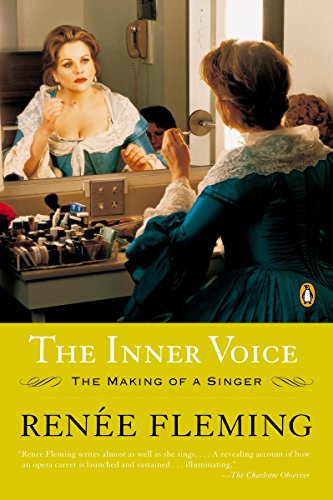
The star of the Metropolitan Opera's recent revival of Dvorak's Rusalka, soprano Renée Fleming brings a consummately beautiful voice, striking interpretive talents, and compelling artistry to bear on performances that have captivated audiences in opera houses and recital halls throughout the world. In The Inner Voice—a book that is the story of her own artistic development and the “autobiography” of her voice—this great performer presents a unique and privileged look at the making of a singer and offers hard-won, practical advice to aspiring performance artists everywhere. From her youth as the child of two singing teachers through her years at Juilliard, from her struggles to establish her career to her international success, The Inner Voice is a luminous, articulate, and candid self-portrait of a contemporary artist—and the most revelatory examination yet of the performing life.
Die Inhaltsangabe kann sich auf eine andere Ausgabe dieses Titels beziehen.
Über die Autorin bzw. den Autor
Renée Fleming has been heralded throughout the world by public and press as one of the great voices of our time. An international artist for more than a decade, she is recognized for her compelling artistry, beautiful sound, and interpretive talents.
Auszug. © Genehmigter Nachdruck. Alle Rechte vorbehalten.
Introduction
I am no stranger to having my luggage searched. Like any other international traveler, I have spent a good portion of my life waiting in customs lines while people I did not know rifled through my musical scores and peered inside my shoes. But the dogs were something new. I wasn’t in the airport, after all, but in my dressing room, waiting to rehearse Tchaikovsky in St. Petersburg, and the bomb-sniffing dogs had come in to make sure that I wasn’t a terrorist disguised as an opera singer. German shepherds shoved their muzzles into my purse and nosed between the gowns hanging in the closet. They sniffed at the makeup, the wigs, and the piano and then looked back at me with heavy skepticism, making me feel vaguely guilty.
I had come to St. Petersburg to take part in a gala performance, a beautiful evening filled with music and dance. I was the only non-Russian who would perform for fifty heads of state for the three-hundredth anniversary celebration of the city, and I was to sing Tatyana’s letter scene from Eugene Onegin on the stage of the historic Maryinsky Theatre. During the nineteenth century, this elegant theater had been home to the Russian Imperial Opera, founded by Catherine the Great in 1783. It had seen the world premieres of such landmark Russian operas as Boris Godunov, Prince Igor, and The Queen of Spades, and Verdi’s La Forza del Destino had been written for the house. The world- renowned ballet of the Maryinsky Theatre had premiered Sleeping Beauty, The Nutcracker, and La Bayadère all on this stage, and in the orchestra pit had stood Berlioz, Wagner, Mahler, Schoenberg, and, most important of all to me today, Tchaikovsky, conducting their masterpieces. I took a deep breath. This wasn’t the first time history had weighed heavily on my shoulders.
I had never been to St. Petersburg before, and many people had warned me about the dangers there. I was told to watch out for the mafia, potential kidnappings, hotel robberies, and at the very least a mugging, but my information was clearly outdated. Everyone was helpful, and the whole place wore an air of elegance. I found the city beautiful, with its splendid baroque palaces and neoclassical facades set out like a series of pastel cakes along the wide boulevards. The cathedrals, the canals, every street and sidewalk were groomed for the anniversary. The sea itself seemed to have a polished glow, and the government had even sprayed the clouds to keep it from raining during the visit of President George W. Bush, Tony Blair, Jacques Chirac, Gerhard Schröder, Junichiro Koizumi, and other world leaders. It was the city’s finest hour, but, unfortunately, it wasn’t mine: my translator and guide was a fourteen-year-old girl who lived only for AC/DC, Alice Cooper, and basketball, and my hotel room had no window. When I say “no window,” I don’t mean that I had a bad view—I mean that I had, quite literally, no window. When I was told that there were no other rooms available, I pulled out my Valery Gergiev trump card and said I would have to call him about getting another hotel. There are many ways in which a soprano relies upon the guidance of a conductor, and not all of them are confined to the stage. As a result of dropping the most powerful name in Russian music today, I got a window and a view.
Some aspects of the performance turned out unimaginably well: I was given a beautiful nightgown and robe from a production of La Traviata to wear, and they fit me perfectly. Other things didn’t go quite so smoothly. There were no plans to block the performance, and I was simply instructed, “Do it the way you did it last time.” But I hadn’t sung the role for years and couldn’t remember where I had been standing on some other stage with a different set. The famous Maryinsky Theatre was an impossible maze of back passageways that all seemed to lead nowhere. I could have used the assistance of one of those bomb-sniffing dogs to find my way from my dressing room to the stage—a feeling that perfectly mirrored the hopelessness I felt inside the Russian language.
Though my German and French are fluent, and my Italian, taxi-, restaurant-, and opera- interview-proficient, my Russian beyond nyet and da is nil. I had learned the role of Tatyana by rote years earlier when I first sang it in Dallas, and of all the heroines I’ve sung, she is the one I feel most closely aligned to: “Let me perish, but first let me summon, in dazzling hope, a bliss as yet unknown.” Even if I didn’t speak the language, it was still my responsibility to find a way to sound as authentic as a national, especially since I was singing the most beloved soprano aria in the Russian repertoire to a house full of Russians. This requires, first, not only memorizing the words, but taking apart every sentence in order to understand how each word is translated. It also involves a painstaking study of their exact pronunciation and inflection. I pay close attention to how words end, whether the vowels are open or closed, which consonants are doubled. Many of the most challenging sounds for a singer are in the Russian language, and it takes a great deal of time and patience to learn how to make them seem authentic.
Once that’s in place, the subsequent task of learning the role comes along much more quickly. When performing an opera, I have to memorize not only my own text, but the text of everyone around me onstage, so that I’m ultimately involved in a dialogue, as opposed to simply staring blankly at my colleagues while they make unintelligible sounds. I’ve devised many tricks over the years to help with memorization, and although it seems obvious, the most important one is learning to connect the words with their meanings. Ten minutes of concentrated memorization with a full understanding of what I’m saying is worth hours of mindless repetition. Using alphabetization, alliteration, onomatopoeia, and rhyming, especially in languages like Russian and Czech, and having a visual memory of the music on the page are also essential. I do anything I can come up with to grind the text into the gray matter between my ears. Interestingly enough, the more difficult the etching, the longer it lasts. Six years after learning a role as complex as Tatyana may find me mumbling the confrontation scene with Onegin while waiting in line at the post office, despite the sideways glances of other customers.
Of course, I was hardly the first American soprano to find herself in this position. Our national tradition of pressing ahead and assuming everything will work out in the end dates all the way back to Lillian Nordica, formerly Lillian Norton of Farmington, Maine. She must have been the first true American superstar on the international scene. When she came to the Imperial Opera in St. Petersburg in 1880, she was twenty-two years old and had virtually no career behind her, but the Maryinsky engaged her to sing a dozen leading roles in the 1880–1881 season alone. A dozen roles at twenty-two. Comparatively speaking, I had nothing to worry about.
For this performance, I was coached in Russian by Irina, a smartly dressed and professional musical presence in the theater. Valery Gergiev has single-handedly built up the reputation of the Kirov Opera until it has achieved a towering international position, often keeping his artists employed through more lucrative Western tours. Russia is a society that recognizes artistic potential in children from a very early age, and it has consequently produced not only talented performers but a people with a deep and intelligent appreciation for the arts.
Which only made me all the more nervous about Tatyana. Her letter scene is fourteen minutes long and extremely wordy, and I suddenly wished I could trade my program...
„Über diesen Titel“ kann sich auf eine andere Ausgabe dieses Titels beziehen.
Suchergebnisse für The Inner Voice: The Making of a Singer

Beispielbild für diese ISBN
The Inner Voice The Making of
Verlag:
Penguin Publishing Group, 2005
ISBN 10: 0143035940
ISBN 13: 9780143035947
Gebraucht
Softcover
Anbieter: World of Books (was SecondSale), Montgomery, IL, USA
Verkäuferbewertung 5 von 5 Sternen

Zustand: Acceptable. Item in acceptable condition! Textbooks may not include supplemental items i.e. CDs, access codes etc. Artikel-Nr. 00092631153
Gebraucht kaufen
EUR 3,96
Versand gratis
Versand innerhalb von USA
Versand innerhalb von USA
Anzahl: 5 verfügbar
Beispielbild für diese ISBN
The Inner Voice The Making of
Verlag:
Penguin Publishing Group, 2005
ISBN 10: 0143035940
ISBN 13: 9780143035947
Gebraucht
Softcover
Anbieter: World of Books (was SecondSale), Montgomery, IL, USA
Verkäuferbewertung 5 von 5 Sternen
Zustand: Good. Item in good condition and has highlighting/writing on text. Used texts may not contain supplemental items such as CDs, info-trac etc. Artikel-Nr. 00089483932
Gebraucht kaufen
EUR 3,96
Versand gratis
Versand innerhalb von USA
Versand innerhalb von USA
Anzahl: 4 verfügbar
Beispielbild für diese ISBN
The Inner Voice The Making of
Verlag:
Penguin Publishing Group, 2005
ISBN 10: 0143035940
ISBN 13: 9780143035947
Gebraucht
Softcover
Anbieter: World of Books (was SecondSale), Montgomery, IL, USA
Verkäuferbewertung 5 von 5 Sternen
Zustand: Very Good. Item in very good condition! Textbooks may not include supplemental items i.e. CDs, access codes etc. Artikel-Nr. 00108142415
Gebraucht kaufen
EUR 3,96
Versand gratis
Versand innerhalb von USA
Versand innerhalb von USA
Anzahl: 1 verfügbar
Beispielbild für diese ISBN
The Inner Voice: The Making of a Singer
Verlag:
Penguin Publishing Group (edition Reprint), 2005
ISBN 10: 0143035940
ISBN 13: 9780143035947
Gebraucht
Paperback
Anbieter: BooksRun, Philadelphia, PA, USA
Verkäuferbewertung 5 von 5 Sternen
Paperback. Zustand: Very Good. Reprint. It's a well-cared-for item that has seen limited use. The item may show minor signs of wear. All the text is legible, with all pages included. It may have slight markings and/or highlighting. Artikel-Nr. 0143035940-11-1
Gebraucht kaufen
EUR 5,57
Versand gratis
Versand innerhalb von USA
Versand innerhalb von USA
Anzahl: 1 verfügbar
Beispielbild für diese ISBN
The Inner Voice: The Making of a Singer
Verlag:
Penguin Publishing Group, 2005
ISBN 10: 0143035940
ISBN 13: 9780143035947
Gebraucht
Paperback
Anbieter: ThriftBooks-Reno, Reno, NV, USA
Verkäuferbewertung 5 von 5 Sternen
Paperback. Zustand: Very Good. No Jacket. May have limited writing in cover pages. Pages are unmarked. ~ ThriftBooks: Read More, Spend Less. Artikel-Nr. G0143035940I4N00
Gebraucht kaufen
EUR 5,88
Versand gratis
Versand innerhalb von USA
Versand innerhalb von USA
Anzahl: 1 verfügbar
Beispielbild für diese ISBN
The Inner Voice: The Making of a Singer
Verlag:
Penguin Publishing Group, 2005
ISBN 10: 0143035940
ISBN 13: 9780143035947
Gebraucht
Paperback
Anbieter: ThriftBooks-Dallas, Dallas, TX, USA
Verkäuferbewertung 5 von 5 Sternen
Paperback. Zustand: Very Good. No Jacket. May have limited writing in cover pages. Pages are unmarked. ~ ThriftBooks: Read More, Spend Less. Artikel-Nr. G0143035940I4N00
Gebraucht kaufen
EUR 5,88
Versand gratis
Versand innerhalb von USA
Versand innerhalb von USA
Anzahl: 1 verfügbar
Beispielbild für diese ISBN
The Inner Voice: The Making of a Singer
Verlag:
Penguin Publishing Group, 2005
ISBN 10: 0143035940
ISBN 13: 9780143035947
Gebraucht
Paperback
Anbieter: ThriftBooks-Atlanta, AUSTELL, GA, USA
Verkäuferbewertung 5 von 5 Sternen
Paperback. Zustand: Very Good. No Jacket. May have limited writing in cover pages. Pages are unmarked. ~ ThriftBooks: Read More, Spend Less. Artikel-Nr. G0143035940I4N00
Gebraucht kaufen
EUR 5,88
Versand gratis
Versand innerhalb von USA
Versand innerhalb von USA
Anzahl: 1 verfügbar
Beispielbild für diese ISBN
The Inner Voice : The Making of a Singer
Verlag:
Penguin Publishing Group, 2005
ISBN 10: 0143035940
ISBN 13: 9780143035947
Gebraucht
Softcover
Anbieter: Better World Books, Mishawaka, IN, USA
Verkäuferbewertung 5 von 5 Sternen
Zustand: Good. 1 Edition. Pages intact with minimal writing/highlighting. The binding may be loose and creased. Dust jackets/supplements are not included. Stock photo provided. Product includes identifying sticker. Better World Books: Buy Books. Do Good. Artikel-Nr. 304496-6
Gebraucht kaufen
EUR 6,05
Versand gratis
Versand innerhalb von USA
Versand innerhalb von USA
Anzahl: 3 verfügbar
Beispielbild für diese ISBN
The Inner Voice: The Making of a Singer
Verlag:
Penguin Publishing Group, 2005
ISBN 10: 0143035940
ISBN 13: 9780143035947
Gebraucht
Softcover
Anbieter: Wonder Book, Frederick, MD, USA
Verkäuferbewertung 5 von 5 Sternen
Zustand: Very Good. Very Good condition. A copy that may have a few cosmetic defects. May also contain light spine creasing or a few markings such as an owner's name, short gifter's inscription or light stamp. Artikel-Nr. I13A-03477
Gebraucht kaufen
EUR 6,99
Versand gratis
Versand innerhalb von USA
Versand innerhalb von USA
Anzahl: 2 verfügbar
Beispielbild für diese ISBN
Inner Voice : The Making of a Singer
Verlag:
Penguin Group USA Inc September 2005, 2005
ISBN 10: 0143035940
ISBN 13: 9780143035947
Gebraucht
Paper Back
Anbieter: Eagle Eye Books, Decatur, GA, USA
Verkäuferbewertung 4 von 5 Sternen

Paper Back. Zustand: Used. Artikel-Nr. 773451
Gebraucht kaufen
EUR 4,48
EUR 3,48 Versand
Versand innerhalb von USA
Versand innerhalb von USA
Anzahl: 1 verfügbar