
Verwandte Artikel zu The Right Nation: Conservative Power in America
Inhaltsangabe
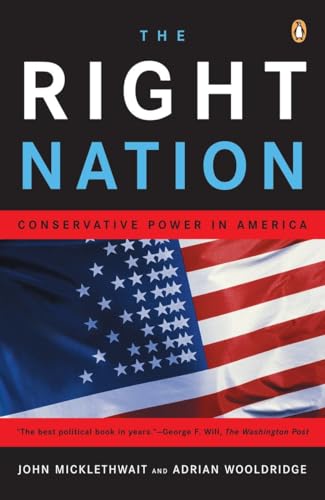
The Right Nation is not "for" liberals, and it's not "for" conservatives. It's for any of us who want to understand one of the most important forces shaping American life. How did America's government become so much more conservative in just a generation? Compared to Europe-or to America under Richard Nixon-even President Howard Dean would preside over a distinctly more conservative nation in many crucial respects: welfare is gone; the death penalty is deeply rooted; abortion is under siege; regulations are being rolled back; the pillars of New Deal liberalism are turning to sand. Conservative positions have not prevailed everywhere, of course, but this book shows us why they've been so successfully advanced over such a broad front: because the battle has been waged by well-organized, shrewd, and committed troops who to some extent have been lucky in their enemies.
John Micklethwait and Adrian Wooldridge, like modern-day Tocquevilles, have the perspective to see this vast subject in the round, unbeholden to forces on either side. They steer The Economist's coverage of the United States and have unrivaled access to resources and-because of the magazine's renown for iconoclasm and analytical rigor-have had open-door access wherever the book's research has led them. And it has led them everywhere: To reckon with the American right, you have to get out there where its centers are and understand the power flow among the brain trusts, the mouthpieces, the organizers, and the foot soldiers. The authors write with wit and skewer whole herds of sacred cows, but they also bring empathy to bear on a subject that sees all too little of it. You won't recognize this America from the far-left's or the far-right's caricatures. Divided into three parts-history, anatomy, and prophecy-The Right Nation comes neither to bury the American conservative movement nor to praise it blindly but to understand it, in all its dimensions, as the most powerful and effective political movement of our age.
Chapter One
FROM KENNEBUNKPORT TO CRAWFORD
Sir Lewis Namier, the great historian of English politics in the age of George III, once remarked that "English history, and especially English parliamentary history, is made by families rather than individuals." The same could be said of American political history, especially in the age of George I and George II. There is no better introduction to the radical transformation of Republicanism in the past generation-from patrician to populist, from Northeastern to Southwestern, from pragmatic to ideological-than the radical transformation of Republicanism's current leading family, the Bushes.
Grandfather Prescott
The Bushes began political life as classic establishment Republicans: WASPs who summered in Kennebunkport, educated their children at boarding schools and the Ivy League and claimed family ties to the British royal family (Queen Elizabeth II is the thirteenth cousin of the first President Bush). George W.'s paternal great-grandfather, Samuel P. Bush, was a steel and railroad executive who became the first president of the National Association of Manufacturers and a founding member of the United States Chamber of Commerce. His maternal great-grandfather, George Herbert Walker, was even grander. The cofounder of W. A. Harriman, Wall Street's oldest private investment bank, Walker's stature was summed up by his twin Manhattan addresses: his office at One Wall Street and his home at One Sutton Place. There was certainly muck beneath this brass: both Walker and Bush had their share of Wall Street shenanigans and cozy government deals, but in the age...
Die Inhaltsangabe kann sich auf eine andere Ausgabe dieses Titels beziehen.
Über die Autorin bzw. den Autor
Both John Micklethwait and Adrian Wooldridge were educated at Oxford and went on to work for The Economist. John Micklethwait has overseen the magazine's Los Angeles and New York bureaus and is now its U.S. editor. Adrian Wooldridge has served as West Coast correspondent, social-policy correspondent, and management editor, and is currently Washington, D.C., correspondent. Together, they have coauthored three books, The Witch Doctors, A Future Perfect: The Challenge and Hidden Promise of Globalisation, and The Company: A Short History of a Revolutionary Idea.
Both John Micklethwait and Adrian Wooldridge were educated at Oxford and went on to work for The Economist. John Micklethwait has overseen the magazine's Los Angeles and New York bureaus and is now its U.S. editor. Adrian Wooldridge has served as West Coast correspondent, social-policy correspondent, and management editor, and is currently Washington, D.C., correspondent. Together, they have coauthored three books, The Witch Doctors, A Future Perfect: The Challenge and Hidden Promise of Globalisation, and The Company: A Short History of a Revolutionary Idea.
Auszug. © Genehmigter Nachdruck. Alle Rechte vorbehalten.
Chapter One
FROM KENNEBUNKPORT TO CRAWFORD
Sir Lewis Namier, the great historian of English politics in the age of George III, once remarked that "English history, and especially English parliamentary history, is made by families rather than individuals." The same could be said of American political history, especially in the age of George I and George II. There is no better introduction to the radical transformation of Republicanism in the past generation-from patrician to populist, from Northeastern to Southwestern, from pragmatic to ideological-than the radical transformation of Republicanism's current leading family, the Bushes.
Grandfather Prescott
The Bushes began political life as classic establishment Republicans: WASPs who summered in Kennebunkport, educated their children at boarding schools and the Ivy League and claimed family ties to the British royal family (Queen Elizabeth II is the thirteenth cousin of the first President Bush). George W.'s paternal great-grandfather, Samuel P. Bush, was a steel and railroad executive who became the first president of the National Association of Manufacturers and a founding member of the United States Chamber of Commerce. His maternal great-grandfather, George Herbert Walker, was even grander. The cofounder of W. A. Harriman, Wall Street's oldest private investment bank, Walker's stature was summed up by his twin Manhattan addresses: his office at One Wall Street and his home at One Sutton Place. There was certainly muck beneath this brass: both Walker and Bush had their share of Wall Street shenanigans and cozy government deals, but in the age of Rockefeller, Vanderbilt and Morgan such things were expected.
The first family member to hold high political office was George W.'s grandfather, Prescott Bush. Prescott was the very image of a patrician: immensely tall, a gifted athlete and a stickler for proper behavior. Exactly the sort of chap you might expect to find in the marbled corridors of the Senate. At Yale, he excelled at golf, tennis and baseball, sang with the All-Time Whiffenpoof Quartet and joined the college's most exclusive secret society, the Skull and Bones. He married Walker's daughter, Dorothy in 1921, and five years later joined W. A. Harriman, which in the next decade merged into Brown Brothers Harriman.
Prescott belonged firmly to the progressive wing of the GOP: liberal on domestic policies and internationalist on foreign affairs. He even sent his son George to Andover rather than his own school, St. George's, because he thought it was more modern. His liberalism cost him his first bid for a Senate seat in 1950. During the election campaign a radio broadcaster described him as "the president of the birth-control league." This was a particularly incendiary accusation in Connecticut, which was then one of two states in the country that outlawed the sale of condoms. It also contained a grain of truth: Prescott was a member of Planned Parenthood and a friend of Estelle Griswold, the woman whose legal challenge to the state's ban on contraception later persuaded the Supreme Court to enshrine the right of sexual privacy in Griswold v. Connecticut (1965) and thus laid the foundation for Roe v. Wade. Anti-Bush leaflets appeared on every pew in every Catholic church in the state and Prescott was narrowly defeated.
Prescott eventually made it to the Senate in a special election in 1952 caused by the death of the sitting senator, and stood true to his brand of moderate Republicanism for two terms. He cosponsored the bill that created the Peace Corps and strongly supported civil rights, a higher minimum wage and larger immigration quotas. "Bush Says Tax Burden May Have to Be Bigger," reads one delightful newspaper headline from his Senate years. Prescott beseeched his fellow senators to "have the courage to raise the required revenues by approving whatever levels of taxation may be necessary" to pay the nation's bills for defense, science and education. Shortly after ill health forced Prescott to retire in 1962, he received an honorary law degree from his alma mater, Yale, alongside the young President Kennedy The citation read: "You have served your country well and personified the best in both political parties." For Prescott, partisanship was a dirty word.
The best linksman on the Hill, he frequently played golf with Eisenhower. A firm believer that "manners makyth man," he once took Joseph McCarthy to one side and lectured him for more than an hour on his boorish behavior. His hostility to the radical Right was as much aesthetic as intellectual. When McCarthy came to Connecticut to address a Republican meeting, Prescott recoiled at the rowdy crowd: "I never saw such a wild bunch of monkeys in any meeting I ever attended." At home he was such a stickler for standards that friends called him the "Ten Commandments Man."
He insisted that his four sons and many grandsons wear jackets and ties at dinner, even at their summer home in Kennebunkport, and that none of them leave the house on Sunday. Relaxation was of a bracing kind-either hunting or playing sports with alarming enthusiasm. This was to prove a permanent trait, but much else was to change.
George H. W. and the move to Texas
Prescott's son, George Herbert Walker Bush, could easily have followed him into his world of East Coast privilege. He was educated at Andover and Yale, where he outstripped even his father, proving that he possessed a superabundance of character, athleticism and leadership. He married the eligible Barbara Pierce and was showered with offers of jobs on Wall Street when he graduated. A lifetime of lunches in the Partners' Room of Brown Brothers Harriman, with its deep maroon carpeting and dark wood paneling, was his for the asking.
Yet the young George H. W. was made of sterner stuff. He had joined the navy straight out of school, and had been shot down by the Japanese in 1944 and rescued by an American submarine, making him perhaps the country's youngest war hero. He wanted to make his career on the new American frontier. The day after he graduated from Yale in 1948 George climbed into his red Studebaker and drove to Odessa, West Texas, to take a job with Dresser Industries, which supplied parts for the state's booming oil industry.
Bush was not exactly turning his back on his powerful family. Prescott Bush sat on the board of Dresser Industries, and warmly recommended his son for a job. Prescott had even given George his new car. All the same, Odessa was a godforsaken town-a scattering of oil jacks and tin-roofed warehouses in the middle of the vast West Texan wilderness. In gracious New Haven George had lived next door to the president of Yale University; in Odessa he and Barbara lived in a shotgun house next door to two prostitutes (a mother-daughter team, no less). But, ugly as it might be, the town was booming. Odessa and its sister city, Midland, sat on top of the largest concentration of oil ever found in the continental United States. The wildcatters and roughnecks who arrived there every day were willing to endure anything-the tornadoes and sandstorms, the distance from civilization, the endless tedium, living in tent cities and chicken coops-in order to make themselves rich.
The Bushes soon moved from Odessa to Midland, a white-collar town twenty miles down the highway. They were not the only patrician family to seek their fortune in Midland. The town soon boasted Ivy League clubs and posh cocktail parties, and the hyperactive Bushes inevitably became pillars of the local establishment. But for all that, Midland was still an entrepreneurial frontier town. Its population tripled during the 1950s. Yalies and roughnecks worked side by side to carve a living out of the desert. George W. remembers an idyllic existence playing on unpaved streets. By the time the Bushes left for Houston in...
„Über diesen Titel“ kann sich auf eine andere Ausgabe dieses Titels beziehen.
Suchergebnisse für The Right Nation: Conservative Power in America

Beispielbild für diese ISBN
The Right Nation: Conservative Power in America
Verlag:
Penguin Publishing Group, 2005
ISBN 10: 0143035398
ISBN 13: 9780143035398
Gebraucht
Softcover
Anbieter: World of Books (was SecondSale), Montgomery, IL, USA
Verkäuferbewertung 5 von 5 Sternen

Zustand: Good. Item in good condition. Textbooks may not include supplemental items i.e. CDs, access codes etc. Artikel-Nr. 00104737609
Gebraucht kaufen
EUR 4,35
Versand gratis
Versand innerhalb von USA
Versand innerhalb von USA
Anzahl: 3 verfügbar
Beispielbild für diese ISBN
The Right Nation: Conservative Power in America
Verlag:
Penguin Publishing Group, 2005
ISBN 10: 0143035398
ISBN 13: 9780143035398
Gebraucht
Softcover
Anbieter: World of Books (was SecondSale), Montgomery, IL, USA
Verkäuferbewertung 5 von 5 Sternen
Zustand: Acceptable. Item in acceptable condition! Textbooks may not include supplemental items i.e. CDs, access codes etc. Artikel-Nr. 00099381857
Gebraucht kaufen
EUR 4,35
Versand gratis
Versand innerhalb von USA
Versand innerhalb von USA
Anzahl: 1 verfügbar
Beispielbild für diese ISBN
The Right Nation: Conservative Power in America
Verlag:
Penguin Publishing Group (edition ), 2005
ISBN 10: 0143035398
ISBN 13: 9780143035398
Gebraucht
Paperback
Anbieter: BooksRun, Philadelphia, PA, USA
Verkäuferbewertung 5 von 5 Sternen
Paperback. Zustand: Very Good. It's a well-cared-for item that has seen limited use. The item may show minor signs of wear. All the text is legible, with all pages included. It may have slight markings and/or highlighting. Artikel-Nr. 0143035398-11-1
Gebraucht kaufen
EUR 5,03
Versand gratis
Versand innerhalb von USA
Versand innerhalb von USA
Anzahl: 3 verfügbar
Beispielbild für diese ISBN
The Right Nation : Conservative Power in America
Verlag:
Penguin Publishing Group, 2005
ISBN 10: 0143035398
ISBN 13: 9780143035398
Gebraucht
Softcover
Anbieter: Better World Books, Mishawaka, IN, USA
Verkäuferbewertung 5 von 5 Sternen
Zustand: Good. Reprint. Pages intact with minimal writing/highlighting. The binding may be loose and creased. Dust jackets/supplements are not included. Stock photo provided. Product includes identifying sticker. Better World Books: Buy Books. Do Good. Artikel-Nr. 4074321-6
Gebraucht kaufen
EUR 6,14
Versand gratis
Versand innerhalb von USA
Versand innerhalb von USA
Anzahl: 2 verfügbar
Beispielbild für diese ISBN
The Right Nation : Conservative Power in America
Verlag:
Penguin Publishing Group, 2005
ISBN 10: 0143035398
ISBN 13: 9780143035398
Gebraucht
Softcover
Anbieter: Better World Books, Mishawaka, IN, USA
Verkäuferbewertung 5 von 5 Sternen
Zustand: Very Good. Reprint. Pages intact with possible writing/highlighting. Binding strong with minor wear. Dust jackets/supplements may not be included. Stock photo provided. Product includes identifying sticker. Better World Books: Buy Books. Do Good. Artikel-Nr. 2226204-75
Gebraucht kaufen
EUR 6,14
Versand gratis
Versand innerhalb von USA
Versand innerhalb von USA
Anzahl: 1 verfügbar
Beispielbild für diese ISBN
The Right Nation: Conservative Power in America
Verlag:
Penguin Publishing Group, 2005
ISBN 10: 0143035398
ISBN 13: 9780143035398
Gebraucht
Softcover
Anbieter: Wonder Book, Frederick, MD, USA
Verkäuferbewertung 5 von 5 Sternen
Zustand: Good. Good condition. A copy that has been read but remains intact. May contain markings such as bookplates, stamps, limited notes and highlighting, or a few light stains. Bundled media such as CDs, DVDs, floppy disks or access codes may not be included. Artikel-Nr. M06P-01533
Gebraucht kaufen
EUR 6,21
Versand gratis
Versand innerhalb von USA
Versand innerhalb von USA
Anzahl: 1 verfügbar
Beispielbild für diese ISBN
The Right Nation: Conservative Power in America
Verlag:
Penguin Publishing Group, 2005
ISBN 10: 0143035398
ISBN 13: 9780143035398
Gebraucht
Softcover
Anbieter: Wonder Book, Frederick, MD, USA
Verkäuferbewertung 5 von 5 Sternen
Zustand: Very Good. Very Good condition. A copy that may have a few cosmetic defects. May also contain light spine creasing or a few markings such as an owner's name, short gifter's inscription or light stamp. Artikel-Nr. V12P-00870
Gebraucht kaufen
EUR 6,21
Versand gratis
Versand innerhalb von USA
Versand innerhalb von USA
Anzahl: 3 verfügbar
Beispielbild für diese ISBN
The Right Nation: Conservative Power in America
Verlag:
Penguin Publishing Group, 2005
ISBN 10: 0143035398
ISBN 13: 9780143035398
Gebraucht
Paperback
Anbieter: ThriftBooks-Atlanta, AUSTELL, GA, USA
Verkäuferbewertung 5 von 5 Sternen
Paperback. Zustand: Good. No Jacket. Pages can have notes/highlighting. Spine may show signs of wear. ~ ThriftBooks: Read More, Spend Less. Artikel-Nr. G0143035398I3N00
Gebraucht kaufen
EUR 6,97
Versand gratis
Versand innerhalb von USA
Versand innerhalb von USA
Anzahl: 1 verfügbar
Beispielbild für diese ISBN
The Right Nation: Conservative Power in America
Anbieter: AwesomeBooks, Wallingford, Vereinigtes Königreich
Verkäuferbewertung 5 von 5 Sternen
Paperback. Zustand: Very Good. The Right Nation: Conservative Power in America This book is in very good condition and will be shipped within 24 hours of ordering. The cover may have some limited signs of wear but the pages are clean, intact and the spine remains undamaged. This book has clearly been well maintained and looked after thus far. Money back guarantee if you are not satisfied. See all our books here, order more than 1 book and get discounted shipping. Artikel-Nr. 7719-9780143035398
Gebraucht kaufen
EUR 4,04
EUR 4,81 Versand
Versand von Vereinigtes Königreich nach USA
Versand von Vereinigtes Königreich nach USA
Anzahl: 2 verfügbar
Beispielbild für diese ISBN
The Right Nation : Conservative Power in America
Verlag:
Penguin Publishing Group, 2005
ISBN 10: 0143035398
ISBN 13: 9780143035398
Gebraucht
Softcover
Anbieter: Better World Books Ltd, Dunfermline, Vereinigtes Königreich
Verkäuferbewertung 5 von 5 Sternen
Zustand: Good. Reprint. Pages intact with minimal writing/highlighting. The binding may be loose and creased. Dust jackets/supplements are not included. Stock photo provided. Product includes identifying sticker. Better World Books: Buy Books. Do Good. Artikel-Nr. 4074321-6
Gebraucht kaufen
EUR 5,62
EUR 5,83 Versand
Versand von Vereinigtes Königreich nach USA
Versand von Vereinigtes Königreich nach USA
Anzahl: 1 verfügbar