
Verwandte Artikel zu The Lobster Coast: Rebels, Rusticators, and the Struggle...
Inhaltsangabe
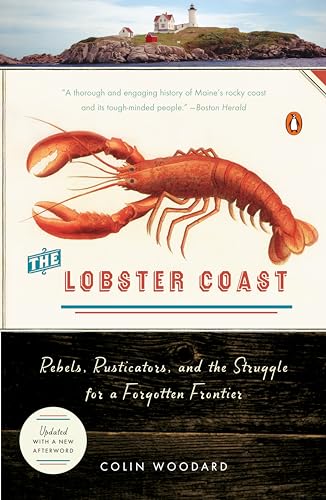
“A thorough and engaging history of Maine’s rocky coast and its tough-minded people.”—Boston Herald
“[A] well-researched and well-written cultural and ecological history of stubborn perseverance.”—USA Today
For more than four hundred years the people of coastal Maine have clung to their rocky, wind-swept lands, resisting outsiders’ attempts to control them while harvesting the astonishing bounty of the Gulf of Maine. Today’s independent, self-sufficient lobstermen belong to the communities imbued with a European sense of ties between land and people, but threatened by the forces of homogenization spreading up the eastern seaboard.
In the tradition of William Warner’s Beautiful Swimmers, veteran journalist Colin Woodard (author of American Character: A History of the Epic Struggle Between Individual Liberty and the Common Good) traces the history of the rugged fishing communities that dot the coast of Maine and the prized crustacean that has long provided their livelihood. Through forgotten wars and rebellions, and with a deep tradition of resistance to interference by people “from away,” Maine’s lobstermen have defended an earlier vision of America while defying the “tragedy of the commons”—the notion that people always overexploit their shared property. Instead, these icons of American individualism represent a rare example of true communal values and collaboration through grit, courage, and hard-won wisdom.
Die Inhaltsangabe kann sich auf eine andere Ausgabe dieses Titels beziehen.
Über die Autorin bzw. den Autor
Colin Woodard, an award-winning writer and journalist, is currently the state and national affairs writer at the Portland Press Herald and Maine Sunday Telegram and received a 2012 George Polk Award for an investigative project he did for those papers. A longtime foreign correspondent for The Christian Science Monitor, the San Francisco Chronicle, and The Chronicle of Higher Education, he has reported from more than fifty foreign countries and seven continents. His work has appeared in dozens of publications, including The Economist, Smithsonian, The Washington Post, Politico, Newsweek, The Daily Beast, The Guardian, Bloomberg View, and Washington Monthly. A graduate of Tufts University and the University of Chicago, he is the author of several books, including American Nations and The Republic of Pirates.
Auszug. © Genehmigter Nachdruck. Alle Rechte vorbehalten.
one
Monhegan
In winter the Laura B., the mail boat to Monhegan Island, is usually fairly empty. A handful of islanders gather in the small aft cabin, warming themselves by the tiny black stove, while their groceries and shopping bags chill on the deck alongside rows of propane tanks and other large island-bound parcels. Mailbags rest in the starboard cubbyhole, protected from the elements, which can be extremely assertive during the fourteen-mile crossing from the mainland. From November to April, the Laura B. is the only link to the mainland for Monhegan's sixty year-round residents, making the round-trip journey from the tiny fishing town of Port Clyde only three times a week.
But on this last day of November, the Laura B. is packed with people. There are nearly as many people on board as live on the island this time of year, most of them mainlanders on their way out to help friends and family prepare for the most important day of Monhegan's year. Tomorrow, December 1, is Trap Day, the day Monhegan's lobstermen begin their unique, winter- only lobster season.
At a time of year when most of Maine's seven thousand lobster- men have hauled up their traps and brought their boats around to secure winter anchorages, Monhegan's fourteen lobstermen are getting ready to set their traps for the first time since spring. Once the fishermen have set their traps, they'll continue fishing through the dead of winter, braving ferocious weather and subzero temperatures that often leave their twenty-eight- to forty- foot boats encased in frozen spray. The lobstermen can handle this with the help of a sternman or two, but on Trap Day they need all the help they can get moving their heavy traps down to the town wharf. There are only twenty aging, beat-up pickups on the island, but each lobsterman needs to get a gang of six hundred traps, weighted metal cages weighing forty to fifty pounds apiece, out of their backyard, down the hill, and stacked up on the town wharf where they can be loaded onto the lobster boat. It can't be done much beforehand because the island's 8,400 traps can't fit on the granite wharf. Even if they did fit, they'd make offloading the Laura B. next to impossible. So, just before Trap Day, the entire village and dozens of mainlanders turn out to move the traps in the maritime equivalent of a barn-raising ceremony.
I'm on my way out to help Zoe Zanidakis, the island's only female lobster boat captain and onetime proprietor of the Monhegan House, one of the island's three summer inns. But there's a problem. About two months ago, Zoe quit answering her phone. She stopped picking up her cell phone and left e-mail and answering machine messages unreturned. It was as if Zoe had dropped off the face of the earth. After failing to track her down through several mutual acquaintances— nobody seemed to know where she was—I decided to board Laura B. as planned and track her down on the island. After all, no Monhegan lobsterman would ever miss Trap Day, least of all a ninth-generation islander like Zoe. Monhegan lobstermen make or break their season in the first few weeks of December, harvesting lobsters in an area that has not been fished in six months. But Trap Day has a ritualistic importance that transcends dollars and cents. “It's like cleaning the slate,” one islander explained to me. “We all come together to get the boats ready and any of the crap and hard feelings that have accumulated in the community are wiped away.” As we pass Allen Island and begin the final, seven-mile open ocean crossing, I'm certain Zoe is out there on the gray, humplike shape looming on the horizon.
It's a mild day for Maine in early winter—forty-five degrees and almost sunny, with still air and gently swelling seas—so many of the passengers spread out on deck, lounging amid the luggage, propane, and building supplies. I join them, and halfway up the port rail I find Billy Payne, who runs one of the island's two small stores. Billy, tanned from a vacation in South Carolina, tells me Zoe is nowhere to be found. “They say she's in a movie out in Hollywood,” he says, breaking into an understated smile. “But nobody seems to know for sure.”
The Laura B. lolls along, unperturbed by the swells. She's nearly sixty years old, and her wooden hull is only sixty-five feet long, but she was built for tougher chores than the Monhegan mail run: running soldiers and ammunition around Pacific bases during the Second World War. Slowly, steadily, Monhegan grows before us, its features becoming more detailed with each passing minute. First the rocky cliffs emerge from their forested crown. Then the forest reveals its inner anatomy of pine, spruce, and fir trees, straight and tall on the island's interior, stunted or dead along the exposed headlands. Guillemots and other cold-loving seabirds flutter over the primeval scene.
At first only one or two houses are apparent, poking out from the forest like lost children, along with the lighthouse tower, which sticks up from its hilltop like a ship's funnel. But as we round the island's northern tip and head down the western shore, the village slowly reveals itself. A cluster of wood-shingled houses, fish houses, and boat sheds stand on the gentle hillsides facing the shore. There are two hundred all told, but as we approach the harbor it's clear that most of the buildings are boarded up for the winter.
We slip past the nasty ledges guarding the north entrance and into the harbor, or what passes for one. Monhegan, a sausage-shaped island two miles long and three-quarters of a mile wide, doesn't have a single deepwater cove or inlet in which one can protect so much as a skiff. All it has is Manana, a small grass-covered hump of rock that protrudes from the sea alongside Monhegan like a whale calf cuddling next to its mother. Monhegan's lobster boats are moored in the narrow passage between the two islands, an anchorage as uncomfortable as it is beautiful. The four-hundred-yard-wide passage is well protected by the tall islands on either side, and the ledges at the narrow north entrance afford reasonable cover from northeasterly winds. But the harbor is completely open to the south, and in a southwesterly storm the seas race through the harbor unimpeded. During particularly fierce winter storms, waves have crashed through low-lying parts of the village, but the lobster boats themselves ride the tempests out on their heavy moorings. We enter the harbor and come alongside the town's heavy granite wharf. Stacks of lobster traps are already growing at the base of the wharf, and one of the town's aging pickups is driving down the dirt road, piled high with more traps to be unloaded. But as we tie up and begin collecting our bags from their pile on the foredeck, the first thing I notice is the camera crew.
The three-man crew has set up a tripod-mounted camera and a big pole-mounted mike right on the edge of the wharf to film the mail boat's arrival. The height of the tide is such that the camera is pointed right in our faces, and a couple of people pause to stare at it as we head down the gangway. “Just move along,” one of the cameramen barks, waving us along with a gloved hand. “Pretend we're not here.” I try but just up the hill from the wharf I encounter a giant boom crane, poised to capture Trap Day action on the wharf. As I stand, gaping, the pickup pulls alongside me.
I drop my bags and start stacking lobster traps.
A burly, red-faced man in a flannel shirt has climbed to the top of the truckload of traps, stacked six-high in the same inverted ziggurat pattern farmers use for hay bales, which makes sense since the traps are approximately the same size and weight as a large hay bale. He passes traps down to the four of us on the ground and we carry them, in turn, to the growing stack on the...
„Über diesen Titel“ kann sich auf eine andere Ausgabe dieses Titels beziehen.
Suchergebnisse für The Lobster Coast: Rebels, Rusticators, and the Struggle...

Beispielbild für diese ISBN
The Lobster Coast Rebels Rusti
Anbieter: World of Books (was SecondSale), Montgomery, IL, USA
Verkäuferbewertung 5 von 5 Sternen

Zustand: Good. Item in good condition. Textbooks may not include supplemental items i.e. CDs, access codes etc. Artikel-Nr. 00102378182
Gebraucht kaufen
EUR 4,91
Versand gratis
Versand innerhalb von USA
Versand innerhalb von USA
Anzahl: 3 verfügbar
Beispielbild für diese ISBN
The Lobster Coast Rebels Rusti
Anbieter: World of Books (was SecondSale), Montgomery, IL, USA
Verkäuferbewertung 5 von 5 Sternen
Zustand: Very Good. Item in very good condition! Textbooks may not include supplemental items i.e. CDs, access codes etc. Artikel-Nr. 00109710449
Gebraucht kaufen
EUR 4,91
Versand gratis
Versand innerhalb von USA
Versand innerhalb von USA
Anzahl: 1 verfügbar
Beispielbild für diese ISBN
The Lobster Coast Rebels Rusti
Anbieter: World of Books (was SecondSale), Montgomery, IL, USA
Verkäuferbewertung 5 von 5 Sternen
Zustand: Acceptable. Item in acceptable condition! Textbooks may not include supplemental items i.e. CDs, access codes etc. Artikel-Nr. 00101070811
Gebraucht kaufen
EUR 4,91
Versand gratis
Versand innerhalb von USA
Versand innerhalb von USA
Anzahl: 4 verfügbar
Beispielbild für diese ISBN
The Lobster Coast: Rebels, Rusticators, and the Struggle for a Forgotten Frontier
Anbieter: ThriftBooks-Dallas, Dallas, TX, USA
Verkäuferbewertung 5 von 5 Sternen
Paperback. Zustand: Fair. No Jacket. Readable copy. Pages may have considerable notes/highlighting. ~ ThriftBooks: Read More, Spend Less. Artikel-Nr. G0143035347I5N00
Gebraucht kaufen
EUR 5,76
Versand gratis
Versand innerhalb von USA
Versand innerhalb von USA
Anzahl: 2 verfügbar
Beispielbild für diese ISBN
The Lobster Coast: Rebels, Rusticators, and the Struggle for a Forgotten Frontier
Anbieter: ThriftBooks-Reno, Reno, NV, USA
Verkäuferbewertung 5 von 5 Sternen
Paperback. Zustand: Good. No Jacket. Pages can have notes/highlighting. Spine may show signs of wear. ~ ThriftBooks: Read More, Spend Less. Artikel-Nr. G0143035347I3N00
Gebraucht kaufen
EUR 5,76
Versand gratis
Versand innerhalb von USA
Versand innerhalb von USA
Anzahl: 1 verfügbar
Beispielbild für diese ISBN
The Lobster Coast: Rebels, Rusticators, and the Struggle for a Forgotten Frontier
Anbieter: ThriftBooks-Atlanta, AUSTELL, GA, USA
Verkäuferbewertung 5 von 5 Sternen
Paperback. Zustand: Good. No Jacket. Pages can have notes/highlighting. Spine may show signs of wear. ~ ThriftBooks: Read More, Spend Less. Artikel-Nr. G0143035347I3N00
Gebraucht kaufen
EUR 5,76
Versand gratis
Versand innerhalb von USA
Versand innerhalb von USA
Anzahl: 1 verfügbar
Beispielbild für diese ISBN
The Lobster Coast: Rebels, Rusticators, and the Struggle for a Forgotten Frontier
Anbieter: ThriftBooks-Reno, Reno, NV, USA
Verkäuferbewertung 5 von 5 Sternen
Paperback. Zustand: Fair. No Jacket. Readable copy. Pages may have considerable notes/highlighting. ~ ThriftBooks: Read More, Spend Less. Artikel-Nr. G0143035347I5N00
Gebraucht kaufen
EUR 5,76
Versand gratis
Versand innerhalb von USA
Versand innerhalb von USA
Anzahl: 2 verfügbar
Beispielbild für diese ISBN
The Lobster Coast: Rebels, Rusticators, and the Struggle for a Forgotten Frontier
Anbieter: ThriftBooks-Atlanta, AUSTELL, GA, USA
Verkäuferbewertung 5 von 5 Sternen
Paperback. Zustand: Fair. No Jacket. Former library book; Readable copy. Pages may have considerable notes/highlighting. ~ ThriftBooks: Read More, Spend Less. Artikel-Nr. G0143035347I5N10
Gebraucht kaufen
EUR 5,76
Versand gratis
Versand innerhalb von USA
Versand innerhalb von USA
Anzahl: 1 verfügbar
Beispielbild für diese ISBN
The Lobster Coast: Rebels, Rusticators, and the Struggle for a Forgotten Frontier
Anbieter: ThriftBooks-Phoenix, Phoenix, AZ, USA
Verkäuferbewertung 5 von 5 Sternen
Paperback. Zustand: Fair. No Jacket. Readable copy. Pages may have considerable notes/highlighting. ~ ThriftBooks: Read More, Spend Less. Artikel-Nr. G0143035347I5N00
Gebraucht kaufen
EUR 5,76
Versand gratis
Versand innerhalb von USA
Versand innerhalb von USA
Anzahl: 2 verfügbar
Beispielbild für diese ISBN
The Lobster Coast: Rebels, Rusticators, and the Struggle for a Forgotten Frontier
Anbieter: ThriftBooks-Atlanta, AUSTELL, GA, USA
Verkäuferbewertung 5 von 5 Sternen
Paperback. Zustand: Fair. No Jacket. Readable copy. Pages may have considerable notes/highlighting. ~ ThriftBooks: Read More, Spend Less. Artikel-Nr. G0143035347I5N00
Gebraucht kaufen
EUR 5,76
Versand gratis
Versand innerhalb von USA
Versand innerhalb von USA
Anzahl: 2 verfügbar