
Verwandte Artikel zu The First World War
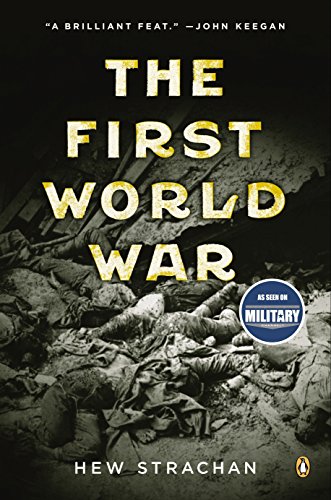
Inhaltsangabe
“This serious, compact survey of the war’s history stands out as the most well-informed, accessible work available.” (Los Angeles Times)
Nearly a century has passed since the outbreak of World War I, yet as military historian Hew Strachan (winner of the 2016 Pritzker Literature Award) argues in this brilliant and authoritative new book, the legacy of the “war to end all wars” is with us still. The First World War was a truly global conflict from the start, with many of the most decisive battles fought in or directly affecting the Balkans, Africa, and the Ottoman Empire. Even more than World War II, the First World War continues to shape the politics and international relations of our world, especially in hot spots like the Middle East and the Balkans.
Strachan has done a masterful job of reexamining the causes, the major campaigns, and the consequences of the First World War, compressing a lifetime of knowledge into a single definitive volume tailored for the general reader. Written in crisp, compelling prose and enlivened with extraordinarily vivid photographs and detailed maps, The First World War re-creates this world-altering conflict both on and off the battlefield—the clash of ideologies between the colonial powers at the center of the war, the social and economic unrest that swept Europe both before and after, the military strategies employed with stunning success and tragic failure in the various theaters of war, the terms of peace and why it didn’t last.
Drawing on material culled from many countries, Strachan offers a fresh, clear-sighted perspective on how the war not only redrew the map of the world but also set in motion the most dangerous conflicts of today. Deeply learned, powerfully written, and soon to be released with a new introduction that commemorates the hundredth anniversary of the outbreak of the war, The First World War remains a landmark of contemporary history.
Die Inhaltsangabe kann sich auf eine andere Ausgabe dieses Titels beziehen.
Über die Autorin bzw. den Autor
Hew Strachan (winner of the 2016 Pritzker Military Museum & Library Literature Award for Lifetime Achievement in Military Writing) is the Chichele Professor of the History of War and a fellow of All Souls College, Oxford University. The editor of The Oxford History of the First World War, he is writing a three-volume history of the First World War, the first volume of which was published in 2001 to wide acclaim.
Auszug. © Genehmigter Nachdruck. Alle Rechte vorbehalten.
In Britain popular interest in the First World War runs at levels that surprise almost all other nations, with the possible exception of France. The concluding series of Blackadder, the enormously successful BBC satirization of the history of England, saw its heroes in the trenches. Its humour assumed an audience familiar with château-bound generals, goofy staff officers and cynical but long-suffering infantrymen. The notion that British soldiers were ‘lions led by donkeys’ continues to provoke a debate that has not lost its passion, even if it is now devoid of originality. For a war that was global, it is a massively restricted vision: a conflict measured in yards of mud along a narrow corridor of Flanders and northern France. It knows nothing of the Italian Alps or of the Masurian lakes; it bypasses the continents of Africa and Asia; and it forgets the war’s other participants – diplomats and sailors, politicians and labourers, women and children. Casualty levels do not provide a satisfactory explanation for such insularity. British deaths in the First World War may have exceeded those of the Second, and Britain is unusual, if not unique, in this respect. The reverse is true for Germany and Russia, as it is for the United States. However, even losses of three-quarters of a million proved to be little more than a blip in demographic terms. The influenza epidemic that swept from Asia through Europe and America in 1918–19 killed more people than the First World War. By the mid-1920s the population of Britain, like those of other belligerents, was recovering to its pre-war levels. In the crude statistics of rates of marriage and reproduction there was no ‘lost generation’.
But the British, and particularly the better educated classes, believed there was. The legacy of literature, and its effects on the shaping of memory, have proved far more influential than economic or political realities. In 1961, Benjamin Britten incorporated nine poems by Wilfred Owen in his War Requiem, which he dedicated to the memory of four friends who had been killed in 1914–18. The work was first performed at the consecration of the Coventry Cathedral in 1962. The old cathedral was a casualty of the Second World War, not the First, but Britten was following an established pattern in conflating the commemoration of the two wars. Armistice Day for the First World War, 11 November 1918, and the act of remembrance on the nearest Sunday to it, was appropriated to honour the dead of 1939–45. Today Remembrance Sunday embraces not only every subsequent war in which Britain has been engaged but also more general reflections on war itself, and on its cost in blood and suffering. The annual service at the Cenotaph in Whitehall is therefore deeply paradoxical. A ceremony weighted with nationalism, attended by the Queen and orchestrated as a military parade, bemoans wars fought in the nation’s name. It cuts away war’s triumphalism, and in the process seems to question the necessity of the very conflicts in which those it commemorates met their deaths.
Wilfred Owen himself embodied some of these paradoxes. Owen was killed in action on 4 November 1918: his mother did not receive the news until after the fighting was over. The war both did for Owen and made him. He returned to the front line when he could probably have avoided doing so, telling his mentor, Siegfried Sassoon, ‘Serenity Shelley never dreamed of crowns me’. The war gave him the material which transformed him into one of the greatest English poets of the twentieth century. For schoolchildren throughout Britain his verses are often their first and most profound encounter with the First World War. Niall Ferguson’s interpretation of the conflict, The Pity of War, published on the occasion of the armistice’s eightieth anniversary in 1998, used Owen’s words in its title. But it is worth recalling what Owen makes explicit but his readers tend to overlook – that his subject was war as a general phenomenon, more than the First World War in particular. Dulce et decorum est pro patria mori, that ‘it is sweet and fitting to die for one’s country’, is, he insists, ‘an old lie’. By quoting Horace, Owen places himself along a continuum that embraces two millennia; he says little, if anything, about the peculiarities that explained the horrors of the war in which he himself served and died.
Owen did not achieve canonical status until the 1960s: Britten popularised him. The first edition of his poems, prepared by Sassoon in December 1920, sold 730 copies. A further 700 copies, printed in 1921, were still not sold out by 1929. By then the collected poems of another victim of the war, Rupert Brooke, had run to 300,000 copies. Brooke knew his Horace as well as Owen did, but for Brooke’s ‘The Soldier’ death in battle was both sweet and fitting. Of course Brooke’s continuing popularity reflected in large measure the desire of wives and mothers, of parents and children, to find solace in their mourning. They needed the reassurance that their loss was not vain. But it makes another point – that the First World War was capable of many interpretations, and that until at least the late 1920s those different meanings co-existed with each other. Every adult across Europe, and many in Africa, Asia, the Americas and Australasia, had his or her own sense of the war’s significance. The conviction that the war was both wasteful and futile was neither general nor even dominant.
When the great powers of Europe embarked on war in 1914 popular conceptions of combat were shaped more by the past than by prognostications of the future. The literature of warning, both popular and professional, was abundant. But hope prevailed over realism, and in truth the circumstances of the outbreak created little choice: for every nation the war seemed to be one of national self-defence, and the obligations on its citizens were therefore irrefutable. By December 1916 the nature of the war, its costs and casualties, and their threat of social upheaval, were self-evident. But even then none of the belligerents seized the opportunity of negotiation which the United States held out. The differences in values and ideologies look less stark than they seemed then only because we have been hardened by the later clashes between Fascism and Bolshevism, and between both of them and western liberalism. The very fact of the United States’s entry into the war in April 1917 makes the point. Woodrow Wilson had been ‘too proud to fight’. He was deeply opposed to the use of war for the furtherance of policy, and the evidence of the battles of Verdun and the Somme in 1916 should have consolidated that belief. So when he took the United States into the war he laboured under few illusions as to the horrors which men like Wilfred Owen had experienced at first hand. But he concluded that the United States had to wage war if it was to shape the future of international relations. It may have been a vision which the Senate rejected in the war’s immediate aftermath, but it still inspires American foreign policy.
This is of course the biggest paradox in our understanding of the war. On the one hand it was an unnecessary war fought in a manner that defied common sense, but on the other it was the war that shaped the world in which we still live. When the First World War began, historians, especially in Imperial Germany, identified a ‘long’ nineteenth century, starting with the French Revolution in 1789 and ending in 1914. For their successors that was when the ‘short’ twentieth century began, and it ended with the conclusion of the Cold War in 1990. The subsequent conflicts in the Balkans brought home to many the role played by the multinational Habsburg...
„Über diesen Titel“ kann sich auf eine andere Ausgabe dieses Titels beziehen.
Suchergebnisse für The First World War

Beispielbild für diese ISBN
The First World War
Anbieter: ThriftBooks-Dallas, Dallas, TX, USA
Verkäuferbewertung 5 von 5 Sternen

Paperback. Zustand: Fair. No Jacket. Readable copy. Pages may have considerable notes/highlighting. ~ ThriftBooks: Read More, Spend Less. Artikel-Nr. G0143035185I5N00
Gebraucht kaufen
EUR 6,10
Versand gratis
Versand innerhalb von USA
Versand innerhalb von USA
Anzahl: 1 verfügbar
Beispielbild für diese ISBN
The First World War
Anbieter: ThriftBooks-Atlanta, AUSTELL, GA, USA
Verkäuferbewertung 5 von 5 Sternen
Paperback. Zustand: Good. No Jacket. Pages can have notes/highlighting. Spine may show signs of wear. ~ ThriftBooks: Read More, Spend Less. Artikel-Nr. G0143035185I3N00
Gebraucht kaufen
EUR 6,10
Versand gratis
Versand innerhalb von USA
Versand innerhalb von USA
Anzahl: 1 verfügbar
Beispielbild für diese ISBN
The First World War
Anbieter: ThriftBooks-Atlanta, AUSTELL, GA, USA
Verkäuferbewertung 5 von 5 Sternen
Paperback. Zustand: Fair. No Jacket. Readable copy. Pages may have considerable notes/highlighting. ~ ThriftBooks: Read More, Spend Less. Artikel-Nr. G0143035185I5N00
Gebraucht kaufen
EUR 6,10
Versand gratis
Versand innerhalb von USA
Versand innerhalb von USA
Anzahl: 1 verfügbar
Beispielbild für diese ISBN
The First World War
Verlag:
Penguin Publishing Group, 2005
ISBN 10: 0143035185
ISBN 13: 9780143035183
Gebraucht
Softcover
Anbieter: Better World Books: West, Reno, NV, USA
Verkäuferbewertung 5 von 5 Sternen
Zustand: Very Good. Reprint. Former library copy. Pages intact with possible writing/highlighting. Binding strong with minor wear. Dust jackets/supplements may not be included. Includes library markings. Stock photo provided. Product includes identifying sticker. Better World Books: Buy Books. Do Good. Artikel-Nr. 7627335-75
Gebraucht kaufen
EUR 6,12
Versand gratis
Versand innerhalb von USA
Versand innerhalb von USA
Anzahl: 1 verfügbar
Beispielbild für diese ISBN
The First World War
Verlag:
Penguin Publishing Group, 2005
ISBN 10: 0143035185
ISBN 13: 9780143035183
Gebraucht
Softcover
Anbieter: Better World Books, Mishawaka, IN, USA
Verkäuferbewertung 5 von 5 Sternen
Zustand: Good. Reprint. Pages intact with minimal writing/highlighting. The binding may be loose and creased. Dust jackets/supplements are not included. Stock photo provided. Product includes identifying sticker. Better World Books: Buy Books. Do Good. Artikel-Nr. 4990499-6
Gebraucht kaufen
EUR 6,12
Versand gratis
Versand innerhalb von USA
Versand innerhalb von USA
Anzahl: 5 verfügbar
Beispielbild für diese ISBN
The First World War
Verlag:
Penguin Publishing Group, 2005
ISBN 10: 0143035185
ISBN 13: 9780143035183
Gebraucht
Softcover
Anbieter: Better World Books, Mishawaka, IN, USA
Verkäuferbewertung 5 von 5 Sternen
Zustand: Good. Reprint. Former library copy. Pages intact with minimal writing/highlighting. The binding may be loose and creased. Dust jackets/supplements are not included. Includes library markings. Stock photo provided. Product includes identifying sticker. Better World Books: Buy Books. Do Good. Artikel-Nr. 4953795-6
Gebraucht kaufen
EUR 6,12
Versand gratis
Versand innerhalb von USA
Versand innerhalb von USA
Anzahl: 1 verfügbar
Beispielbild für diese ISBN
The First World War
Verlag:
Penguin Publishing Group, 2005
ISBN 10: 0143035185
ISBN 13: 9780143035183
Gebraucht
Softcover
Anbieter: Better World Books, Mishawaka, IN, USA
Verkäuferbewertung 5 von 5 Sternen
Zustand: Very Good. Reprint. Pages intact with possible writing/highlighting. Binding strong with minor wear. Dust jackets/supplements may not be included. Stock photo provided. Product includes identifying sticker. Better World Books: Buy Books. Do Good. Artikel-Nr. 5425464-75
Gebraucht kaufen
EUR 6,12
Versand gratis
Versand innerhalb von USA
Versand innerhalb von USA
Anzahl: 2 verfügbar
Beispielbild für diese ISBN
The First World War
Verlag:
Penguin Publishing Group, 2005
ISBN 10: 0143035185
ISBN 13: 9780143035183
Gebraucht
Softcover
Anbieter: Better World Books: West, Reno, NV, USA
Verkäuferbewertung 5 von 5 Sternen
Zustand: Good. Reprint. Pages intact with minimal writing/highlighting. The binding may be loose and creased. Dust jackets/supplements are not included. Stock photo provided. Product includes identifying sticker. Better World Books: Buy Books. Do Good. Artikel-Nr. 4990499-6
Gebraucht kaufen
EUR 6,12
Versand gratis
Versand innerhalb von USA
Versand innerhalb von USA
Anzahl: 1 verfügbar
Beispielbild für diese ISBN
The First World War
Anbieter: Wonder Book, Frederick, MD, USA
Verkäuferbewertung 5 von 5 Sternen
Zustand: Good. Good condition. A copy that has been read but remains intact. May contain markings such as bookplates, stamps, limited notes and highlighting, or a few light stains. Artikel-Nr. F17B-04343
Gebraucht kaufen
EUR 6,36
Versand gratis
Versand innerhalb von USA
Versand innerhalb von USA
Anzahl: 2 verfügbar
Foto des Verkäufers
The First World War
Anbieter: Dream Books Co., Denver, CO, USA
Verkäuferbewertung 5 von 5 Sternen
Zustand: acceptable. This copy has clearly been enjoyedâ"expect noticeable shelf wear and some minor creases to the cover. Binding is strong, and all pages are legible. May contain previous library markings or stamps. Artikel-Nr. DBV.0143035185.A
Gebraucht kaufen
EUR 6,40
Versand gratis
Versand innerhalb von USA
Versand innerhalb von USA
Anzahl: 1 verfügbar