
Verwandte Artikel zu Marrying Mozart
Inhaltsangabe
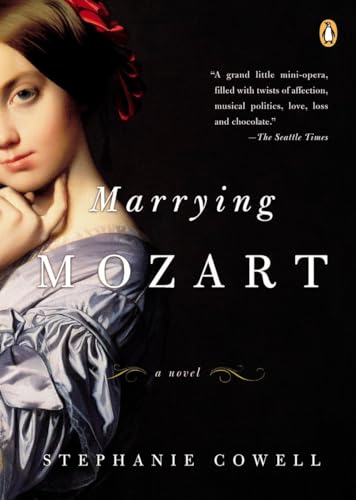
Amadeus meets Little Women in this irresistibly delightful historical novel by award-winning author Stephanie Cowell. The year is 1777 and the four Weber sisters, daughters of a musical family, share a crowded, artistic life in a ramshackle house. While their father scrapes by as a music copyist and their mother secretly draws up a list of prospective suitors in the kitchen, the sisters struggle with their futures, both marital and musical—until twenty-one-year-old Wolfgang Mozart walks into their lives. Bringing eighteenth-century Europe to life with unforgiving winters, yawning princes, scheming parents, and the enduring passions of young talent, Stephanie Cowell’s richly textured tale captures a remarkable historical figure—and the four young women who engage his passion, his music, and his heart.
Die Inhaltsangabe kann sich auf eine andere Ausgabe dieses Titels beziehen.
Über die Autorin bzw. den Autor
Stephanie Cowell is the author of Nicholas Cooke: Actor, Soldier, Physician, Priest; The Physician of London (American Book Award 1996), and The Players: A Novel of the Young Shakespeare. She is also the author of Marrying Mozart, which was translated into seven languages and has been optioned for a movie. Visit her at stephaniecowell.com and everydaylivesfrenchimpressionists.blogspot.com.
Auszug. © Genehmigter Nachdruck. Alle Rechte vorbehalten.
part one
Mannheim and the Webers, 1777
Up five flights of cracking wood steps of a modest town house in the city of Mannheim, Fridolin Weber stood peering over his candle, which cast a dim light down the rounded banister below. “Mind the broken step,” he called convivially to his visitors. “Come this way, come this way.”
Of middle years, he was a lean man but for a small round stomach under his vest, and he wore a long coat to his knees and mended white cotton hose to his breech buckles. His lank graying hair was caught with a frayed black ribbon at his neck and hung limply down his back. He craned his long neck to see down the stairs.
Behind him, the front parlor of the cramped apartment had been dusted, polished, and abundantly lit with eight candles. There, near the clavier, his four daughters, age eleven to nineteen, stood dressed in their best ordinary gowns, hair glistening with curls that one hour before had been tightly wrapped in rags. It was Thursday. Things somehow always turned out well on Thursday evenings when friends came.
The rest of the rooms were dark, except for the fire in the kitchen, for all the candles were in here. The parlor had been tidied, and a shawl draped over the clavier; all the music had been sorted in neat heaps on the floor. Weber’s corpulent wife, Maria Caecilia, emerged from the kitchen as if she had not been baking there for hours, and stood by his side, murmuring the words he knew she would speak. “There won’t be enough wine. Your cousin Alfonso drinks like a fish.”
“Pour small glasses,” he said, squeezing her arm, and then, turning to the dark stair again, called down happily, “Yes, come up, come up, dear friends—I’ve been waiting for you.”
From the darkness of the stair emerged Heinemann, a violinist from court, extending his always damp hands, and balding Cousin Alfonso, who wore his wig only for his cello performances. The four girls stood nudging one another, whispering, curtseying. Their hands were a little worn and pricked from washing and sewing. There was about them the scent of youth, youth that, with a little soap and a clean petticoat, was as fresh as flowers.
Wine was poured in small glasses, and two more musicians arrived. Every now and then Fridolin Weber peered through the window down to the street. He knew everybody, everything. He knew the world of music especially, because he copied it page after page for a small fee. In addition, he was a versatile musician. For what occasion had he not played his half-dozen instruments at which he was adequately proficient, or poured forth his meager, congenial, slightly hoarse singing voice? But he was modest, his narrow shoulders rounded.
“Who else do you expect this Thursday, Weber?” asked Alfonso, already enjoying his third glass of wine. “You seem to be waiting. Is it Grossmeyer, the choirmaster? He had rehearsal this night, I thought.”
“Some new friends, recommended to me—a matron from Salzburg and her twenty-one-year-old son, who has composed a great deal already.” He leaned against the window frame to look down, and then drew in his breath with pleasure. “Perhaps that ... yes, that must be them. They’re making their way to the door below.” Negotiating among chairs, music stands, and guests, he crossed the room and opened the door to the landing once again. The cold breeze whisked into the room, and the candles fluttered. “Come up, come up,” he cried.
An ample-busted woman with a long mournful face under her piled hair appeared panting on the top step. Behind her, trying to slow his climb in consideration, was her son, a pale young man with large eyes and a large nose, somewhat below middle height but neatly made with supple hands beneath his lace cuffs.
“Frau Mozart, a pleasure, and Herr Mozart, I presume?”
“You’re most gracious to invite us,” replied Frau Mozart.
In a flurry of consultation the four girls disappeared into another room and returned with two more chairs that they offered, and Weber himself brought more wine. Introductions were made, and bows exchanged. Frau Mozart balanced her wine cautiously on her knee. She wore no rouge, and she gathered her dark skirts closely, as if wanting to leave as little of them as possible flowing about her; her mouth was compressed like a tightly drawn purse. She looked into every corner of the room, taking in the piles of music and the few sconces without candles.
Weber rubbed his hands and rocked back and forth in his pleasure. “Do I understand you’ve arrived from Salzburg just two weeks ago? And that your husband is employed there as musician by the Archbishop’s court?”
“Indeed, sir; we’ve come here looking for greater opportunities for my son.”
“Why, there are opportunities enough here, Alfonso will tell you. I copy, I compose a little, I play several instruments. If music is wanted, I’m there to make it.” All this time Herr Mozart said nothing, but looked about the room seriously, bowing when he caught someone’s eye.
Cakes and coffee came; the wondrous fragrance of the hot beverage stirred with cinnamon and cream filled the rooms. Weber would not stint on his Thursday evenings, not even if they had nothing but porridge for three days following, thick and lumpy, with no sugar and only third- quality milk.
“Now we’ll have music,” Fridolin Weber cried when the cake lay in crumbs on coat fronts and across the parlor floor. “What’s an evening without music? Alfonso, have you brought parts for your new trio? Come, come.”
At once the four girls clustered against the wall to make room, while Weber, with a sweep of his coattails, sat down at the clavier and candles were moved to illuminate the music. The sound of strings and clavier soared through the small chamber, Fridolin Weber playing deftly, nodding, exclaiming at passages that pleased him. They finished the last movement with a great sweep of Heinemann’s bow, after which he lay his violin on his knee, perspiring and wearing a great smile. Some other brief pieces followed, and then Weber stood and called, “And will you play something as well, Herr Mozart?”
The young man leapt up to the clavier; he pushed back his cuffs and began a sonata andante with variations. Each successive variation gathered in depth. Weber leaned forward. There was a rare delicacy to the young man’s playing, and an unusual strength in his left hand, which made the musicians look at one another. Heinemann grinned, showing small, darkened teeth. He sat breathing through his mouth, fingers drumming on his breeches above the buckle.
Maria Caecilia Weber maneuvered her full skirts through the crowded room, refilling the coffee cups. She glanced briefly at the man with little white hands who played with such concentrated intimacy, noting that when a spoon she carried clattered to the floor, his shoulders stiffened slightly, and he did not lower them again for a few minutes.
The music ended as abruptly as it had begun, and both Alfonso and Heinemann rose to their feet clapping firmly. The young man’s face was still absorbed, as if he barely noticed the small parlor with its shadowy gathering. He said in his light tenor voice, “A fine instrument, Herr Weber. It reminds me of one I knew in London when I was there years ago as a boy. The Tschudi clavier. My sister and I played a duet on it; it had a remarkable mechanism for color and volume.” “Sir, I thank you,” replied Fridolin, rubbing his hands. “If an instrument could have a soul, mine does. Yes, yes, whatever you all may say, we know it. We all know it....
„Über diesen Titel“ kann sich auf eine andere Ausgabe dieses Titels beziehen.
Suchergebnisse für Marrying Mozart

Beispielbild für diese ISBN
Marrying Mozart
Anbieter: World of Books (was SecondSale), Montgomery, IL, USA
Verkäuferbewertung 5 von 5 Sternen

Paperback. Zustand: Good. Amadeus meets Little Women in this irresistibly delightful historical novel by award-winning author Stephanie Cowell. The year is 1777 and the four Weber sisters, daughters of a musical family, share a crowded, artistic life in a ramshackle house. While their father scrapes by as a music copyist and their mother secretly draws up a list of prospective suitors in the kitchen, the sisters struggle with their futures, both marital and musical?until twenty-one-year-old Wolfgang Mozart walks into their lives. Bringing eighteenth-century Europe to life with unforgiving winters, yawning princes, scheming parents, and the enduring passions of young talent, Stephanie Cowell?s richly textured tale captures a remarkable historical figure?and the four young women who engage his passion, his music, and his heart. Artikel-Nr. 00087566482
Gebraucht kaufen
EUR 4,49
Versand gratis
Versand innerhalb von USA
Versand innerhalb von USA
Anzahl: 11 verfügbar
Beispielbild für diese ISBN
Marrying Mozart
Verlag:
Penguin Publishing Group (edition Reprint), 2004
ISBN 10: 014303457X
ISBN 13: 9780143034575
Gebraucht
Paperback
Anbieter: BooksRun, Philadelphia, PA, USA
Verkäuferbewertung 5 von 5 Sternen
Paperback. Zustand: Fair. Reprint. The item might be beaten up but readable. May contain markings or highlighting, as well as stains, bent corners, or any other major defect, but the text is not obscured in any way. Artikel-Nr. 014303457X-7-1
Gebraucht kaufen
EUR 5,18
Versand gratis
Versand innerhalb von USA
Versand innerhalb von USA
Anzahl: 1 verfügbar
Beispielbild für diese ISBN
Marrying Mozart
Verlag:
Penguin Publishing Group, 2004
ISBN 10: 014303457X
ISBN 13: 9780143034575
Gebraucht
Softcover
Anbieter: Wonder Book, Frederick, MD, USA
Verkäuferbewertung 5 von 5 Sternen
Zustand: Good. Good condition. A copy that has been read but remains intact. May contain markings such as bookplates, stamps, limited notes and highlighting, or a few light stains. Bundled media such as CDs, DVDs, floppy disks or access codes may not be included. Artikel-Nr. I01A-09936
Gebraucht kaufen
EUR 6,42
Versand gratis
Versand innerhalb von USA
Versand innerhalb von USA
Anzahl: 1 verfügbar
Beispielbild für diese ISBN
Marrying Mozart
Anbieter: ThriftBooks-Atlanta, AUSTELL, GA, USA
Verkäuferbewertung 5 von 5 Sternen
Paperback. Zustand: Very Good. No Jacket. May have limited writing in cover pages. Pages are unmarked. ~ ThriftBooks: Read More, Spend Less. Artikel-Nr. G014303457XI4N00
Gebraucht kaufen
EUR 6,45
Versand gratis
Versand innerhalb von USA
Versand innerhalb von USA
Anzahl: 1 verfügbar
Beispielbild für diese ISBN
Marrying Mozart
Anbieter: ThriftBooks-Phoenix, Phoenix, AZ, USA
Verkäuferbewertung 5 von 5 Sternen
Paperback. Zustand: Very Good. No Jacket. May have limited writing in cover pages. Pages are unmarked. ~ ThriftBooks: Read More, Spend Less. Artikel-Nr. G014303457XI4N00
Gebraucht kaufen
EUR 6,45
Versand gratis
Versand innerhalb von USA
Versand innerhalb von USA
Anzahl: 1 verfügbar
Beispielbild für diese ISBN
Marrying Mozart
Anbieter: ThriftBooks-Reno, Reno, NV, USA
Verkäuferbewertung 5 von 5 Sternen
Paperback. Zustand: Very Good. No Jacket. May have limited writing in cover pages. Pages are unmarked. ~ ThriftBooks: Read More, Spend Less. Artikel-Nr. G014303457XI4N00
Gebraucht kaufen
EUR 6,45
Versand gratis
Versand innerhalb von USA
Versand innerhalb von USA
Anzahl: 1 verfügbar
Beispielbild für diese ISBN
Marrying Mozart
Anbieter: ThriftBooks-Dallas, Dallas, TX, USA
Verkäuferbewertung 5 von 5 Sternen
Paperback. Zustand: Very Good. No Jacket. May have limited writing in cover pages. Pages are unmarked. ~ ThriftBooks: Read More, Spend Less. Artikel-Nr. G014303457XI4N00
Gebraucht kaufen
EUR 6,45
Versand gratis
Versand innerhalb von USA
Versand innerhalb von USA
Anzahl: 1 verfügbar
Beispielbild für diese ISBN
Marrying Mozart
Verlag:
Penguin Publishing Group, 2004
ISBN 10: 014303457X
ISBN 13: 9780143034575
Gebraucht
Softcover
Anbieter: Better World Books, Mishawaka, IN, USA
Verkäuferbewertung 5 von 5 Sternen
Zustand: Very Good. First Printing. Pages intact with possible writing/highlighting. Binding strong with minor wear. Dust jackets/supplements may not be included. Stock photo provided. Product includes identifying sticker. Better World Books: Buy Books. Do Good. Artikel-Nr. GRP73096832
Gebraucht kaufen
EUR 6,56
Versand gratis
Versand innerhalb von USA
Versand innerhalb von USA
Anzahl: 1 verfügbar
Beispielbild für diese ISBN
Marrying Mozart
Verlag:
Penguin Publishing Group, 2004
ISBN 10: 014303457X
ISBN 13: 9780143034575
Gebraucht
Softcover
Anbieter: Better World Books, Mishawaka, IN, USA
Verkäuferbewertung 5 von 5 Sternen
Zustand: Good. First Printing. Former library copy. Pages intact with minimal writing/highlighting. The binding may be loose and creased. Dust jackets/supplements are not included. Includes library markings. Stock photo provided. Product includes identifying sticker. Better World Books: Buy Books. Do Good. Artikel-Nr. GRP98544227
Gebraucht kaufen
EUR 6,56
Versand gratis
Versand innerhalb von USA
Versand innerhalb von USA
Anzahl: 1 verfügbar
Foto des Verkäufers
Marrying Mozart
Verlag:
Penguin Publishing Group, 2004
ISBN 10: 014303457X
ISBN 13: 9780143034575
Gebraucht
Softcover
Anbieter: Dream Books Co., Denver, CO, USA
Verkäuferbewertung 5 von 5 Sternen
Zustand: good. Gently used with minimal wear on the corners and cover. A few pages may contain light highlighting or writing, but the text remains fully legible. Dust jacket may be missing, and supplemental materials like CDs or codes may not be included. May be ex-library with library markings. Ships promptly! Artikel-Nr. DBV.014303457X.G
Gebraucht kaufen
EUR 7,27
Versand gratis
Versand innerhalb von USA
Versand innerhalb von USA
Anzahl: 1 verfügbar