
Verwandte Artikel zu Swann's Way (In Search of Lost Time)
Inhaltsangabe
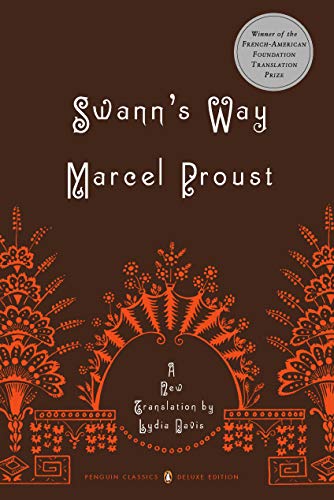
The first volume of one of the greatest novels of the twentieth century, in Lydia Davis's award-winning translation
Marcel Proust’s In Search of Lost Time is one of the most entertaining reading experiences in any language and arguably the finest novel of the twentieth century. But since its original prewar translation there has been no completely new version in English. Now, Penguin Classics brings Proust’s masterpiece to new audiences throughout the world, beginning with Lydia Davis’s internationally acclaimed translation of the first volume, Swann’s Way.
Swann's Way is one of the preeminent novels of childhood: a sensitive boy's impressions of his family and neighbors, all brought dazzlingly back to life years later by the taste of a madeleine. It also enfolds the short novel "Swann in Love," an incomparable study of sexual jealousy that becomes a crucial part of the vast, unfolding structure of In Search of Lost Time. The first volume of the work that established Proust as one of the finest voices of the modern age—satirical, skeptical, confiding, and endlessly varied in his response to the human condition—Swann's Way also stands on its own as a perfect rendering of a life in art, of the past recreated through memory.
Die Inhaltsangabe kann sich auf eine andere Ausgabe dieses Titels beziehen.
Über die Autorinnen und Autoren
Marcel Proust (1871–1922) was born in Auteuil, France. In his twenties, following a year in the army, he became a conspicuous society figure, frequenting the most fashionable Paris salons of the day. After 1899, however, his chronic asthma, the death of his parents, and his growing disillusionment with humanity caused him to lead an increasingly retired life. From 1907 on, he rarely emerged from a cork-lined room in his apartment on boulevard Haussmann. There he insulated himself against the distractions of city life and the effects of trees and flowers—though he loved them, they brought on his attacks of asthma. He slept by day and worked by night, writing letters and devoting himself to the completion of In Search of Lost Time.
Lydia Davis, a 2003 MacArthur Fellow, is the author of a novel, The End of the Story, and three volumes of short fiction, the latest of which is Samuel Johnson Is Indignant. She is also the translator of numerous works by Maurice Blanchot, Michel Leiris, Pierre Jean Jouve, and many others and was recently named a Chevalier of the Order of Arts and Letters by the French government. Her essay on close translation of Proust appeared in the April 2004 issue of the Yale Review.
Christopher Prendergast (series editor) is a professor emeritus of French literature at the University of Cambridge and a Fellow of King’s College.
Marcel Proust (1871–1922) was born in Auteuil, France. In his twenties, following a year in the army, he became a conspicuous society figure, frequenting the most fashionable Paris salons of the day. After 1899, however, his chronic asthma, the death of his parents, and his growing disillusionment with humanity caused him to lead an increasingly retired life. From 1907 on, he rarely emerged from a cork-lined room in his apartment on boulevard Haussmann. There he insulated himself against the distractions of city life and the effects of trees and flowers—though he loved them, they brought on his attacks of asthma. He slept by day and worked by night, writing letters and devoting himself to the completion of In Search of Lost Time.
Lydia Davis, a 2003 MacArthur Fellow, is the author of a novel, The End of the Story, and three volumes of short fiction, the latest of which is Samuel Johnson Is Indignant. She is also the translator of numerous works by Maurice Blanchot, Michel Leiris, Pierre Jean Jouve, and many others and was recently named a Chevalier of the Order of Arts and Letters by the French government. Her essay on close translation of Proust appeared in the April 2004 issue of the Yale Review.
Christopher Prendergast (series editor) is a professor emeritus of French literature at the University of Cambridge and a Fellow of King’s College.
Auszug. © Genehmigter Nachdruck. Alle Rechte vorbehalten.
Swann's Way
Part 1
Combray
For a long time, I went to bed early. Sometimes, my candle scarcely out, my eyes would close so quickly that I did not have time to say to myself: “I’m falling asleep.” And, half an hour later, the thought that it was time to try to sleep would wake me; I wanted to put down the book I thought I still had in my hands and blow out my light; I had not ceased while sleeping to form reflec-tions on what I had just read, but these reflections had taken a rather peculiar turn; it seemed to me that I myself was what the book was talking about: a church, a quartet, the rivalry between François I and Charles V. This belief lived on for a few seconds after my waking; it did not shock my reason but lay heavy like scales on my eyes and kept them from realizing that the candlestick was no longer lit. Then it began to grow unintelligible to me, as after metempsychosis do the thoughts of an earlier existence; the subject of the book detached itself from me, I was free to apply myself to it or not; immediately I recovered my sight and I was amazed to find a darkness around me soft and restful for my eyes, but perhaps even more so for my mind, to which it appeared a thing without cause, incomprehensible, a thing truly dark. I would ask myself what time it might be; I could hear the whistling of the trains which, remote or nearby, like the singing of a bird in a forest, plotting the distances, described to me the extent of the deserted countryside where the traveler hastens toward the nearest station; and the little road he is following will be engraved on his memory by the excitement he owes to new places, to unaccustomed ctivities, to the recent conversation and the farewells under the unfamiliar lamp that follow him still through the silence of the night, to the imminent sweetness of his return.
I would rest my cheeks tenderly against the lovely cheeks of the pillow, which, full and fresh, are like the cheeks of our childhood. I would strike a match to look at my watch. Nearly midnight. This is the hour when the invalid who has been obliged to go off on a journey and has had to sleep in an unfamiliar hotel, wakened by an attack, is cheered to see a ray of light under the door. How fortunate, it’s already morning! In a moment the servants will be up, he will be able to ring, someone will come help him. The hope of being relieved gives him the courage to suffer. In fact he thought he heard footsteps; the steps approach, then recede. And the ray of light that was under his door has disappeared. It is midnight; they have just turned off the gas; the last servant has gone and he will have to suffer the whole night through without remedy.
I would go back to sleep, and would sometimes afterward wake again for brief moments only, long enough to hear the organic creak of the woodwork, open my eyes and stare at the kaleidoscope of the darkness, savor in a momentary glimmer of consciousness the sleep into which were plunged the furniture, the room, that whole of which I was only a small part and whose insensibility I would soon return to share. Or else while sleeping I had effortlessly returned to a period of my early life that had ended forever, rediscovered one of my childish terrors such as my great-uncle pulling me by my curls, a terror dispelled on the day—the dawn for me of a new era—when they were cut off. I had forgotten that event during my sleep, I recovered its memory as soon as I managed to wake myself up to escape the hands of my great-uncle, but as a precautionary measure I would completely surround my head with my pillow before returning to the world of dreams.
Sometimes, as Eve was born from one of Adam’s ribs, a woman was born during my sleep from a cramped position of my thigh. Formed from the pleasure I was on the point of enjoying, she, I imagined, was the one offering it to me. My body, which felt in hers my own warmth, would try to find itself inside her, I would wake up. The rest of humanity seemed very remote compared with this woman I had left scarcely a few moments before; my cheek was still warm from her kiss, my body aching from the weight of hers. If, as sometimes happened, she had the features of a woman I had known in life, I would devote myself entirely to this end: to finding her again, like those who go off on a journey to see a longed-for city with their own eyes and imagine that one can enjoy in reality the charm of a dream. Little by little the memory of her would fade, I had forgotten the girl of my dream.
A sleeping man holds in a circle around him the sequence of the hours, the order of the years and worlds. He consults them instinctively as he wakes and reads in a second the point on the earth he occupies, the time that has elapsed before his waking; but their ranks can be mixed up, broken. If toward morning, after a bout of insomnia, sleep overcomes him as he is reading, in a position quite different from the one in which he usually sleeps, his raised arm alone is enough to stop the sun and make it retreat, and, in the first minute of his waking, he will no longer know what time it is, he will think he has only just gone to bed. If he dozes off in a position still more displaced and divergent, after dinner sitting in an armchair for instance, then the confusion among the disordered worlds will be complete, the magic armchair will send him traveling at top speed through time and space, and, at the moment of opening his eyelids, he will believe he went to bed several months earlier in another country. But it was enough if, in my own bed, my sleep was deep and allowed my mind to relax entirely; then it would let go of the map of the place where I had fallen asleep and, when I woke in the middle of the night, since I did not know where I was, I did not even understand in the first moment who I was; I had only, in its original simplicity, the sense of existence as it may quiver in the depths of an animal; I was more destitute than a cave dweller; but then the memory—not yet of the place where I was, but of several of those where I had lived and where I might have been—would come to me like help from on high to pull crossed centuries of civilization in one second, and the image confusedly glimpsed of oil lamps, then of wing-collar shirts, gradually recomposed my self’s original features.
Perhaps the immobility of the things around us is imposed on them by our certainty that they are themselves and not anything else, by the immobility of our mind confronting them. However that may be, when I woke thus, my mind restlessly attempting, without success, to discover where I was, everything revolved around me in the darkness, things, countries, years. My body, too benumbed to move, would try to locate, according to the form of its fatigue, the position of its limbs so as to deduce from this the direction of the wall, the placement of the furniture, so as to reconstruct and name the dwelling in which it found itself. Its memory, the memory of its ribs, its knees, its shoulders, offered in succession several of the rooms where it had slept, while around it the invisible walls, changing place according to the shape of the imagined room, spun through the shadows. And even before my mind, hesitating on the thresholds of times and shapes, had identified the house by reassembling the circumstances, it—my body—would recall the kind of bed in each one, the location of the doors, the angle at which the light came in through the windows, the existence of a hallway, along with the thought I had had as I fell asleep and that I had recovered upon waking. My stiffened side, trying to guess its orientation, would imagine, for instance, that it lay facing the wall in a big canopied bed and immediately I would say to myself: “Why, I went to sleep in the end even though Mama didn’t...
„Über diesen Titel“ kann sich auf eine andere Ausgabe dieses Titels beziehen.
Suchergebnisse für Swann's Way (In Search of Lost Time)

Beispielbild für diese ISBN
Swann's Way: In Search of Lost Time, Volume 1 (Penguin Classics Deluxe Edition)
Anbieter: World of Books (was SecondSale), Montgomery, IL, USA
Verkäuferbewertung 5 von 5 Sternen

Paperback. Zustand: Good. The first volume of one of the greatest novels of the twentieth century, in Lydia Davis's award-winning translation Marcel Proust's In Search of Lost Time is one of the most entertaining reading experiences in any language and arguably the finest novel of the twentieth century. But since its original prewar translation there has been no completely new version in English. Now, Penguin Classics brings Proust's masterpiece to new audiences throughout the world, beginning with Lydia Davis's internationally acclaimed translation of the first volume, Swann's Way. Swann's Way is one of the preeminent novels of childhood: a sensitive boy's impressions of his family and neighbors, all brought dazzlingly back to life years later by the taste of a madeleine. It also enfolds the short novel "Swann in Love," an incomparable study of sexual jealousy that becomes a crucial part of the vast, unfolding structure of In Search of Lost Time. The first volume of the work that established Proust as one of the finest voices of the modern age--satirical, skeptical, confiding, and endlessly varied in his response to the human condition--Swann's Way also stands on its own as a perfect rendering of a life in art, of the past recreated through memory. Artikel-Nr. 00110735649
Gebraucht kaufen
EUR 10,45
Versand gratis
Versand innerhalb von USA
Versand innerhalb von USA
Anzahl: 2 verfügbar
Beispielbild für diese ISBN
Swann's Way Vol. 1 : In Search of Lost Time, Volume 1 (Penguin Classics Deluxe Edition)
Verlag:
Penguin Publishing Group, 2004
ISBN 10: 0142437964
ISBN 13: 9780142437964
Gebraucht
Softcover
Anbieter: Better World Books, Mishawaka, IN, USA
Verkäuferbewertung 5 von 5 Sternen
Zustand: Good. Pages intact with minimal writing/highlighting. The binding may be loose and creased. Dust jackets/supplements are not included. Stock photo provided. Product includes identifying sticker. Better World Books: Buy Books. Do Good. Artikel-Nr. 4750469-6
Gebraucht kaufen
EUR 11,34
Versand gratis
Versand innerhalb von USA
Versand innerhalb von USA
Anzahl: 1 verfügbar
Foto des Verkäufers
Swann's Way: In Search of Lost Time, Vol. 1 (Penguin Classics Deluxe Edition)
Anbieter: TNT ENTERPRIZES, Libertyville, IL, USA
Verkäuferbewertung 4 von 5 Sternen

Soft cover. Zustand: Fine. Softcover. New Translation by Lydia Davis. Book is in fine condition. Artikel-Nr. B10806
Gebraucht kaufen
EUR 9,09
EUR 6,67 Versand
Versand innerhalb von USA
Versand innerhalb von USA
Anzahl: 1 verfügbar
Beispielbild für diese ISBN
Swann's Way: In Search of Lost Time, Vol. 1 (Penguin Classics Deluxe Edition)
Anbieter: Magers and Quinn Booksellers, Minneapolis, MN, USA
Verkäuferbewertung 5 von 5 Sternen
paperback. Zustand: Very Good. May have light to moderate shelf wear and/or a remainder mark. Complete. Clean pages. paperback. Artikel-Nr. 650936
Gebraucht kaufen
EUR 23,37
EUR 3,55 Versand
Versand innerhalb von USA
Versand innerhalb von USA
Anzahl: 1 verfügbar
Beispielbild für diese ISBN
Swann's Way: In Search of Lost Time, Vol. 1 (Penguin Classics Deluxe Edition)
Anbieter: Magers and Quinn Booksellers, Minneapolis, MN, USA
Verkäuferbewertung 5 von 5 Sternen
paperback. Zustand: New. Brand New. Artikel-Nr. 776030
Neu kaufen
EUR 23,37
EUR 3,55 Versand
Versand innerhalb von USA
Versand innerhalb von USA
Anzahl: 4 verfügbar
Beispielbild für diese ISBN
Swann's Way: In Search of Lost Time, Volume 1 (Penguin Classics Deluxe Edition)
Anbieter: Majestic Books, Hounslow, Vereinigtes Königreich
Verkäuferbewertung 4 von 5 Sternen
Zustand: New. pp. 496. Artikel-Nr. 8233542
Neu kaufen
EUR 25,07
EUR 7,65 Versand
Versand von Vereinigtes Königreich nach USA
Versand von Vereinigtes Königreich nach USA
Anzahl: 1 verfügbar
Beispielbild für diese ISBN
Swann's Way: In Search of Lost Time, Volume 1 (Penguin Classics Deluxe Edition)
Anbieter: Revaluation Books, Exeter, Vereinigtes Königreich
Verkäuferbewertung 5 von 5 Sternen
Paperback. Zustand: Brand New. reprint edition. 496 pages. 5.75x8.25x1.25 inches. In Stock. Artikel-Nr. 0142437964
Neu kaufen
EUR 22,13
EUR 14,71 Versand
Versand von Vereinigtes Königreich nach USA
Versand von Vereinigtes Königreich nach USA
Anzahl: 1 verfügbar
Beispielbild für diese ISBN
Swann's Way: In Search of Lost Time, Volume 1 (Penguin Classics Deluxe Edition)
Anbieter: Revaluation Books, Exeter, Vereinigtes Königreich
Verkäuferbewertung 5 von 5 Sternen
Paperback. Zustand: Brand New. reprint edition. 496 pages. 5.75x8.25x1.25 inches. In Stock. Artikel-Nr. __0142437964
Neu kaufen
EUR 23,12
EUR 14,71 Versand
Versand von Vereinigtes Königreich nach USA
Versand von Vereinigtes Königreich nach USA
Anzahl: 1 verfügbar
Beispielbild für diese ISBN
Swann's Way: In Search of Lost Time, Volume 1 (Penguin Classics Deluxe Edition)
Anbieter: Revaluation Books, Exeter, Vereinigtes Königreich
Verkäuferbewertung 5 von 5 Sternen
Paperback. Zustand: Brand New. reprint edition. 496 pages. 5.75x8.25x1.25 inches. In Stock. Artikel-Nr. xr0142437964
Neu kaufen
EUR 25,91
EUR 14,71 Versand
Versand von Vereinigtes Königreich nach USA
Versand von Vereinigtes Königreich nach USA
Anzahl: 2 verfügbar
Beispielbild für diese ISBN
Swann's Way: In Search of Lost Time, Volume 1 (Penguin Classics Deluxe Edition)
Anbieter: Revaluation Books, Exeter, Vereinigtes Königreich
Verkäuferbewertung 5 von 5 Sternen
Paperback. Zustand: Brand New. reprint edition. 496 pages. 5.75x8.25x1.25 inches. In Stock. Artikel-Nr. xi0142437964
Neu kaufen
EUR 25,91
EUR 14,71 Versand
Versand von Vereinigtes Königreich nach USA
Versand von Vereinigtes Königreich nach USA
Anzahl: 2 verfügbar