
Verwandte Artikel zu The Opposite of Fate: Memories of a Writing Life
Inhaltsangabe
Delve into the stories from Amy Tan's life that inspired bestselling novels like The Joy Luck Club and The Valley of Amazement and the new memoir, Where the Past Begins
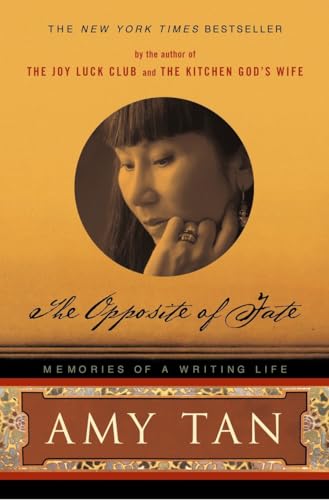
Amy Tan has touched millions of readers with haunting and sympathetic novels of cultural complexity and profound empathy. With the same spirit and humor that characterize her acclaimed novels, she now shares her insight into her own life and how she escaped the curses of her past to make a future of her own. She takes us on a journey from her childhood of tragedy and comedy to the present day and her arrival as one of the world's best-loved novelists. Whether recalling arguments with her mother in suburban California or introducing us to the ghosts that inhabit her computer, The Opposite of Fate offers vivid portraits of choices, attitudes, charms, and luck in action--a refreshing antidote to the world-weariness and uncertainties we all face today.
Die Inhaltsangabe kann sich auf eine andere Ausgabe dieses Titels beziehen.
Über die Autorin bzw. den Autor
Amy Tan is the author of The Joy Luck Club, The Kitchen God’s Wife, The Hundred Secret Senses, The Bonesetter's Daughter, The Opposite of Fate, Saving Fish from Drowning, The Backyard Bird Chronicles, and two children’s books, The Moon Lady and The Chinese Siamese Cat, which has been adapted as Sagwa, a PBS series for children. Tan was also the co-producer and co-screenwriter of the film version of The Joy Luck Club, and her essays and stories have appeared in numerous magazines and anthologies. Her work has been translated into more than twenty-five languages. Tan, who has a master’s degree in linguistics from San Jose University, has worked as a language specialist to programs serving children with developmental disabilities. She lives with her husband in San Francisco and New York.
Auszug. © Genehmigter Nachdruck. Alle Rechte vorbehalten.
FATE AND FAITH
My mother believed in God's will for many years. It was as if she had turned on a celestial faucet and goodness kept pouring out. She said it was faith that kept all these good things coming our way, only I thought she said "fate," because she couldn't pronounce that "th" sound in "faith."
And later, I discovered that maybe it was fate all along, that faith was just an illusion that somehow you're in control. I found out the most I could have was hope, and with that I was not denying any possibility, good or bad. I was just saying, If there is a choice, dear God or whatever you are, here's where the odds should be placed. —The Joy Luck Club
the cliffsnotes version of my life
Soon after my first book was published, I found myself often confronted with the subject of my mortality. I remember being asked by a young woman what I did for a living. "I'm an author," I said with proud new authority.
"A contemporary author?" she wanted to know.
And being newly published at the time, I had to think for a moment before I realized that if I were not contemporary I would be the alternative, which is, of course, dead.
Since then I have preferred to call myself a writer. A writer writes-she writes in the present progressive tense. Whereas an author, unless she is clearly said to be "contemporary," is in the past tense, someone who once wrote, someone who no longer has to sharpen her pencil, so to speak. To me, the word author is as chilling as rigor mortis, and I shudder when I hear myself introduced as such when I lecture at universities. This is probably due to the fact that when I was an English major at a university, all the authors I read were, sad to say, not contemporary.
What compels ardent readers of my work to ask me questions concerning my time-limited authorhood? In lecture halls and on live radio shows, I have been stunned by questions as deadly as these: "What would you like written on your tombstone?" "Which book would you like people to remember you by?" "Does it make you feel honored that your books probably will be in circulation at the library long after you're gone?"
I don't find those questions nearly as appalling as this one: "Are you loaded?" which is what a nine-year-old girl in Nashville once asked me at a book signing. I wondered whether the child might have just come from a school program on crime prevention or substance abuse and was now worried that all adults carried loaded weapons or were loaded on drugs. I said to her gently, "What kind of loaded are you worried about?"
"You know," the girl snapped, "loaded like filthy rich." I glanced over to her mother, expecting that she would reprimand her daughter. And the mother looked right at me and said, "Well, are you?"
I've grown accustomed to public scrutiny. Yet nothing prepared me for what I consider the ultimate reminder of an author's mortality. It happened when I was at yet another bookstore, about to give yet another reading. I was waiting in the wings, as the store manager delivered a long introduction on my credentials as an author. Glancing to my side, I saw a wire book rack crammed with cheap and familiar booklets. They were CliffsNotes, self-proclaimed as "your key to the classics."
As we all know, CliffsNotes have served as the midnight salvation of many a literature student, and if the sad truth be known, this former honors English major used them to write incisive papers on-dare I say it?-Ulysses, Lord Jim, and Hamlet.
Imagine: There I was, in a bookstore, recalling these past sins, about to read from my own published work. I gave a silent apology to my fellow authors Jim Joyce, Joe Conrad, and Bill Shakespeare, may they rest in peace. And then my eyes landed on another familiar title: The Joy Luck Club. I stared at those CliffsNotes, thinking to myself, But I'm not dead yet.
I flipped through the pages and found an obituary-like biography of the author, me, Amy Tan. I was shocked to learn that I once had carried on "a relationship with an older German man, who had close contacts with drug dealers and organized crime."
Could this possibly be describing my Franz? True, he was older than I was, twenty-two years to my sixteen when we met. And yes, he was friends with a couple of Canadian hippies who sold hashish, but I don't remember them being that organized about it. Whatever the case, does my personal history of having once dated a loser constitute the sort of information needed by "serious students," as Cliff refers to them? Will this make them "secure in the knowledge that they have a basic understanding of the work"?
In page after chilling page, I saw that my book had been hacked apart, autopsied, and permanently embalmed into chapter-by-chapter blow-by-blows: plot summaries, genealogy charts, and-ai-ya!-even Chinese horoscopes. Further in, I was impressed to learn of all the clever nuances I'd apparently embedded into the phrase "invisible strength," which is what a mother in the book taught her chess-playing daughter, Waverly. According to Cliff, I meant for "invisible strength" to refer to the "human will," as well as to represent "female power" and "the power of foreigners." It was amazing what I had accomplished.
The truth is, I borrowed that phrase from my mother, who used to say something like it to me whenever I was whining out loud. She'd say, "Fang pi bu-cho, cho pi bu-fang," which is commonly uttered by Chinese parents, and which translates approximately to: "There's more power in silence."
What my mother intended that I understand, however, was precisely this: "No one wants to hear you make a big stink over nothing, so shut up." The strict linguist might want to note that the literal translation of that Chinese phrase runs along these noble lines: "Loud farts don't smell, the really smelly ones are deadly silent."
Anyway, that's the sort of literary symbolism I use with phrases like "invisible strength"-not the sort of analysis you find in CliffsNotes, I might add.
At the end of the booklet was a list of questions. I read one: "Which daughter in the book is most like Amy Tan? Why?" What luck. This very question was often asked of me in interviews, and I had never known what to say. Here in my quaking hands, just one page turn away, was the definitive answer. But one page later, I discovered these were just discussion questions, no answers were given, and thus I was left to ponder my existential angst in the usual fashion.
In spite of my initial shock, I admit that I am perversely honored to be in CliffsNotes. Look at me: I'm sitting in the $4.95 bookstore bleachers along with Shakespeare, Conrad, and Joyce. Now, I'm not saying that I've reached their same literary status. I acknowledge there is a fundamental difference that separates us. I am a contemporary author and they are not. And since I'm not dead yet, I can talk back.
*
One of the problems of being a contemporary author is that you are confronted with frequent opportunities to see what people have written about you in the way of reviews, profiles, or student theses. It's all rather appalling. Good, bad, or ugly, there before your very eyes is an analysis of you, your intentions, and the deeper, more subterranean meanings of your books-say, the dichotomy between two cultures and two generations, or the sociopolitical concerns of immigration and assimilation-the subject matter that makes you sound high-minded when, really, your reasons for writing were more haphazard and personal.
The truth is, when I write, I begin with a simple question: How do things happen? Early in life, what I thought about that affected what I should hope. And in my family, there were two pillars of beliefs: Christian faith on my father's side, Chinese fate on my mother's. Picture...
„Über diesen Titel“ kann sich auf eine andere Ausgabe dieses Titels beziehen.
Suchergebnisse für The Opposite of Fate: Memories of a Writing Life

Beispielbild für diese ISBN
The Opposite of Fate: Memories of a Writing Life
Anbieter: World of Books (was SecondSale), Montgomery, IL, USA
Verkäuferbewertung 5 von 5 Sternen

Zustand: Acceptable. Item in acceptable condition! Textbooks may not include supplemental items i.e. CDs, access codes etc. Artikel-Nr. 00084067147
Gebraucht kaufen
EUR 4,05
Versand gratis
Versand innerhalb von USA
Versand innerhalb von USA
Anzahl: 1 verfügbar
Beispielbild für diese ISBN
The Opposite of Fate: Memories of a Writing Life
Anbieter: World of Books (was SecondSale), Montgomery, IL, USA
Verkäuferbewertung 5 von 5 Sternen
Zustand: Good. Item in good condition. Textbooks may not include supplemental items i.e. CDs, access codes etc. Artikel-Nr. 00090438059
Gebraucht kaufen
EUR 4,05
Versand gratis
Versand innerhalb von USA
Versand innerhalb von USA
Anzahl: 6 verfügbar
Beispielbild für diese ISBN
The Opposite of Fate: Memories of a Writing Life
Anbieter: World of Books (was SecondSale), Montgomery, IL, USA
Verkäuferbewertung 5 von 5 Sternen
Zustand: Very Good. Item in very good condition! Textbooks may not include supplemental items i.e. CDs, access codes etc. Artikel-Nr. 00098875595
Gebraucht kaufen
EUR 4,05
Versand gratis
Versand innerhalb von USA
Versand innerhalb von USA
Anzahl: 2 verfügbar
Beispielbild für diese ISBN
The Opposite of Fate: Memories of a Writing Life
Verlag:
Penguin Books (edition Reprint), 2004
ISBN 10: 0142004898
ISBN 13: 9780142004890
Gebraucht
Paperback
Anbieter: BooksRun, Philadelphia, PA, USA
Verkäuferbewertung 5 von 5 Sternen
Paperback. Zustand: Very Good. Reprint. It's a well-cared-for item that has seen limited use. The item may show minor signs of wear. All the text is legible, with all pages included. It may have slight markings and/or highlighting. Artikel-Nr. 0142004898-11-6
Gebraucht kaufen
EUR 5,11
Versand gratis
Versand innerhalb von USA
Versand innerhalb von USA
Anzahl: 1 verfügbar
Beispielbild für diese ISBN
The Opposite of Fate: Memories of a Writing Life
Verlag:
Penguin Publishing Group (edition Reprint), 2004
ISBN 10: 0142004898
ISBN 13: 9780142004890
Gebraucht
Paperback
Anbieter: BooksRun, Philadelphia, PA, USA
Verkäuferbewertung 5 von 5 Sternen
Paperback. Zustand: Very Good. Reprint. It's a well-cared-for item that has seen limited use. The item may show minor signs of wear. All the text is legible, with all pages included. It may have slight markings and/or highlighting. Artikel-Nr. 0142004898-11-18
Gebraucht kaufen
EUR 5,18
Versand gratis
Versand innerhalb von USA
Versand innerhalb von USA
Anzahl: 1 verfügbar
Beispielbild für diese ISBN
The Opposite of Fate: Memories of a Writing Life
Anbieter: Wonder Book, Frederick, MD, USA
Verkäuferbewertung 5 von 5 Sternen
Zustand: Good. Good condition. With remainder mark. A copy that has been read but remains intact. May contain markings such as bookplates, stamps, limited notes and highlighting, or a few light stains. Artikel-Nr. D06D-00479
Gebraucht kaufen
EUR 5,32
Versand gratis
Versand innerhalb von USA
Versand innerhalb von USA
Anzahl: 1 verfügbar
Beispielbild für diese ISBN
The Opposite of Fate: Memories of a Writing Life
Verlag:
Penguin Publishing Group, 2004
ISBN 10: 0142004898
ISBN 13: 9780142004890
Gebraucht
Softcover
Anbieter: Wonder Book, Frederick, MD, USA
Verkäuferbewertung 5 von 5 Sternen
Zustand: Very Good. Very Good condition. A copy that may have a few cosmetic defects. May also contain light spine creasing or a few markings such as an owner's name, short gifter's inscription or light stamp. Artikel-Nr. I25B-02418
Gebraucht kaufen
EUR 6,43
Versand gratis
Versand innerhalb von USA
Versand innerhalb von USA
Anzahl: 1 verfügbar
Beispielbild für diese ISBN
The Opposite of Fate: Memories of a Writing Life
Verlag:
Penguin Publishing Group, 2004
ISBN 10: 0142004898
ISBN 13: 9780142004890
Gebraucht
Softcover
Anbieter: Wonder Book, Frederick, MD, USA
Verkäuferbewertung 5 von 5 Sternen
Zustand: Good. Good condition. A copy that has been read but remains intact. May contain markings such as bookplates, stamps, limited notes and highlighting, or a few light stains. Artikel-Nr. A03B-03554
Gebraucht kaufen
EUR 6,43
Versand gratis
Versand innerhalb von USA
Versand innerhalb von USA
Anzahl: 4 verfügbar
Beispielbild für diese ISBN
The Opposite of Fate : Memories of a Writing Life
Verlag:
Penguin Publishing Group, 2004
ISBN 10: 0142004898
ISBN 13: 9780142004890
Gebraucht
Softcover
Anbieter: Better World Books: West, Reno, NV, USA
Verkäuferbewertung 5 von 5 Sternen
Zustand: Good. Reprint. Pages intact with minimal writing/highlighting. The binding may be loose and creased. Dust jackets/supplements are not included. Stock photo provided. Product includes identifying sticker. Better World Books: Buy Books. Do Good. Artikel-Nr. 4279179-20
Gebraucht kaufen
EUR 6,57
Versand gratis
Versand innerhalb von USA
Versand innerhalb von USA
Anzahl: 2 verfügbar
Beispielbild für diese ISBN
The Opposite of Fate : Memories of a Writing Life
Verlag:
Penguin Publishing Group, 2004
ISBN 10: 0142004898
ISBN 13: 9780142004890
Gebraucht
Softcover
Anbieter: Better World Books, Mishawaka, IN, USA
Verkäuferbewertung 5 von 5 Sternen
Zustand: Good. Reprint. Pages intact with minimal writing/highlighting. The binding may be loose and creased. Dust jackets/supplements are not included. Stock photo provided. Product includes identifying sticker. Better World Books: Buy Books. Do Good. Artikel-Nr. 4279179-20
Gebraucht kaufen
EUR 6,57
Versand gratis
Versand innerhalb von USA
Versand innerhalb von USA
Anzahl: 2 verfügbar