
Verwandte Artikel zu Hitler's Scientists: Science, War, and the Devil's...
Inhaltsangabe
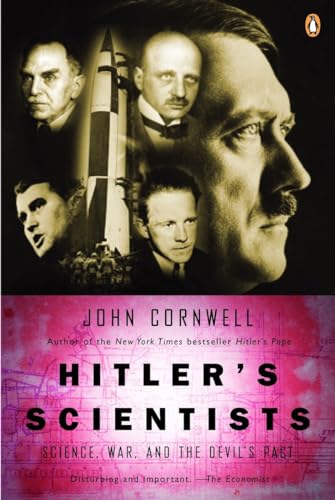
An eye-opening account of the rise of science in Germany through to Hitler’s regime, and the frightening Nazi experiments that occurred during the Reich
A shocking account of Nazi science, and a compelling look at the the dramatic rise of German science in the nineteenth century, its preeminence in the early twentieth, and the frightening developments that led to its collapse in 1945, this is the compelling story of German scientists under Hitler’s regime. Weaving the history of science and technology with the fortunes of war and the stories of men and women whose discoveries brought both benefits and destruction to the world, Hitler's Scientists raises questions that are still urgent today. As science becomes embroiled in new generations of weapons of mass destruction and the war against terrorism, as advances in biotechnology outstrip traditional ethics, this powerful account of Nazi science forms a crucial commentary on the ethical role of science.
Die Inhaltsangabe kann sich auf eine andere Ausgabe dieses Titels beziehen.
Über die Autorin bzw. den Autor
John Cornwell is in the department of history and philosophy of science at Cambridge University. He is a regular feature writer at the Sunday Times (London) and the author and editor of four books on science, including Power to Harm, on the Louisville Prozac trial, as well as Hitler's Pope: The Secret History of Pius XII and Breaking Faith: Can the Catholic Church Save Itself?
Auszug. © Genehmigter Nachdruck. Alle Rechte vorbehalten.
Hitler's Scientists
Science, War, and the Devil's PactBy John CornwellPenguin Books
Copyright ©2004 John CornwellAll right reserved.
ISBN: 0142004804
Chapter One
Hitler the ScientistOn his twenty-seventh birthday, 23 March 1939, Wernher vonBraun, Germany's brilliant young rocket engineer, met Adolf Hitlerfor the first time. The F|hrer had agreed to be briefed on theprogress of the army's advanced ballistic missile programme atKummersdorf West, a research facility south of Berlin.
Walter Dornberger, von Braun's superior, has left an eye-witnessimpression of Hitler's encounter with one of the most significanthigh-tech inventions of the century. It was, he reported, 'a cold,wet day, with an overcast sky and water still dripping from therain-drenched pines'. Hitler's thoughts seemed elsewhere. 'Hisremarkably tanned features, the unsightly snub nose, little blackmoustache and extremely thin lips showed no sort of interestin what we were to show him.' Dornberger put on a series ofdemonstrations of roaring rockets and guidance systems to impresshis F|hrer: he demonstrated the power of a 650-pound thrustrocket motor, then showed off one with a 2,200-pound thrust forcomparison. But Hitler 'kept his eyes steadfastly fixed on me',wrote Dornberger. 'I still don't know whether he understood whatI was talking about.'
Next the young von Braun, a fleshy-looking young man ofJunker stock, gave a presentation of the internal workings of an A3rocket using a cutaway model; Hitler apparently listened, closely atfirst, but then stalked off shaking his head as if uncomprehending.Another static demonstration took place, this time with an A5,which was to precede in development a much larger and moresophisticated missile-the A4, the army's missile of choice as along-range weapon.
At lunch Dornberger sat diagonally opposite Hitler. 'As he atehis mixed vegetables and drank his habitual glass of Fachingenmineral water ... [Hitler] chatted with Becker about what theyhad seen,' wrote Dornberger. 'I couldn't tell much from whatwas said, but he seemed a little more interested than during thedemonstration or immediately after.' Later Hitler made the laconicremark, 'Es war doch gewaltig!' (That was tremendous). Dornbergerremained puzzled. The visit had seemed 'strange' to him, 'ifnot downright unbelievable'. Dornberger had been used to visitorsbeing 'enraptured, thrilled, and carried away by the spectacle', likeLuftwaffe chief Hermann Goering, who, on being shown therocket hardware, leaped about laughing and slapping his thighswith unrestrained glee.
Reflecting on the episode after the war, Dornberger wrote thatHitler did not grasp the significance of missile technology for thefuture. 'He could not fit the rocket into his plans, and what wasworse for us at that time, did not believe the time was ripe for it.He certainly had no feeling for technological progress, upon whichthe basic conditions for our work depended.'
The episode encapsulates Hitler's approach to new technology:his tendency to make decisions in isolation, depending on thecertitude of his personal intuition and inspiration, rather than onthe basis of careful inquiry and the conclusions of committees. Asit happened, Hitler was right to be suspicious of the imminenteffectiveness of ballistic missiles in 1939; nor did his apparentlukewarm reaction indicate an unwillingness, as Dornberger infers,to fund further research, at first on a medium level of priority. Intime, however, the story of the F|hrer's decisions and ambitionsfor the Nazi rocket programme-a technology in which Germanywas a generation ahead of the rest of the world-would revealprofound flaws in his capacities as leader of one of the most advancedscientific nations. Hitler became seriously interested in rockets onlyat a point when defeat seemed inevitable: the deployment of theV2 was to be no more an act of ritualistic vengeance, a gestureof what the novelist Thomas Mann described as 'technologicalromanticism', than a rational strategy that could help win the war.
Hitler's Bio-political Rhetoric
Hitler's knowledge and appreciation of science and technologywere warped, degenerate and profoundly racist. At the Nurembergtrials of the Nazi leadership, Albert Speer, Hitler's architect and hisArmaments Minister from February 1942, proclaimed that he,Speer, was 'the most important representative of a technocracywhich had showed no compunction in applying all its know-howagainst humanity'. In a statement to the judge, Speer commentedthat in a mechanized age dictatorships required, and had produced,a type of individual who took orders uncritically. 'The nightmareof many people that some day nations will be dominated by technology,'he declared, 'almost came true in Hitler's authoritarian system.Every state in the world is now in danger of being terrorized bytechnology. But this seems inevitable in a modern dictatorship.Hence: the more demanding individual freedom and the self-awarenessof the individual. The former Nazi minister hadrevealed no such refined ratiocinations while serving the ThirdReich, yet faced with the hangman's noose he admitted the insidiousexploitation of science and technology in Hitler's totalitarianstate, while intimating future dangers for the victors of WorldWar II.
What was absent, however, from his 'confession', which alludesprincipally to weapons technology, communications and the media,was an acknowledgement that Adolf Hitler's view of science, at itsmost influential at the outset of the regime, featured crudeborrowings from the ambit of pathology and racist 'genetics', toarticulate his notion of the German nation state and its destiny.Hitler's favoured rhetorical metaphors, as he rose to power, havebeen described as 'bio-political'. Hitler subscribed to the idea ofthe German nation state as a type of anatomy, subject to circumstancesof health and disease like the human body.
Hitler betrayed a profound ignorance of Mendelism and particulateinheritance. His 'biological' notions of race evidently foundtheir origins in Joseph Arthur de Gobineau, the French nineteenth-centuryman of letters and early exponent of racial theory, anda tradition of latter-day racist 'philosophers': Houston StewartChamberlain, Erwin Baur, Eugen Fischer and Fritz Lenz. Hitlerbelieved that the purity of the Germanic-Aryan race had beencompromised through a 'blending process'. The task ahead was toencourage and preserve uncontaminated stocks of Aryan blood.
By 1925, as Hitler completed his political testament Mein Kampf,the racist epithets of Teutonic supremacy, culled from the pamphletsof his lean days in Vienna, were giving way to a vulgarizedversion of geopolitics, Lebensraum-the quest for living space, alliedto pseudo-scientific quasi-medical imagery. He harped on theintroduction of undesirable hereditary strains into the healthyNordic body, the Volkskvrper, and extraneous factors operating likepathogens. Jews were invaders, undermining the integrity of theGerman organism-bacilli, cancers, gangrene, tumours, abscesses.His political programme was seen in terms of cures, surgery, purgingand antidotes. He lamented in 1925 that the state did nothave the means to 'master the disease' which was penetrating the'bloodstream of our people unhindered'. Such ideas, bogus asthey were pernicious, culled from the so-called discipline of racialhygiene, contained inevitable propensities towards solutions whichsaw the German Volk as a patient, the Jew as a sickness and Hitleras the beneficent physician.
The images of Jews as a disease were all too familiar by themid-1930s as...
„Über diesen Titel“ kann sich auf eine andere Ausgabe dieses Titels beziehen.
Suchergebnisse für Hitler's Scientists: Science, War, and the Devil's...

Beispielbild für diese ISBN
Hitler's Scientists: Science, War, and the Devil's Pact
Verlag:
Penguin Publishing Group, 2004
ISBN 10: 0142004804
ISBN 13: 9780142004807
Gebraucht
Softcover
Anbieter: Wonder Book, Frederick, MD, USA
Verkäuferbewertung 5 von 5 Sternen

Zustand: Very Good. Very Good condition. A copy that may have a few cosmetic defects. May also contain light spine creasing or a few markings such as an owner's name, short gifter's inscription or light stamp. Bundled media such as CDs, DVDs, floppy disks or access codes may not be included. Artikel-Nr. E12O-00144
Gebraucht kaufen
EUR 6,24
Versand gratis
Versand innerhalb von USA
Versand innerhalb von USA
Anzahl: 1 verfügbar
Beispielbild für diese ISBN
Hitler's Scientists: Science, War, and the Devil's Pact
Verlag:
Penguin Publishing Group, 2004
ISBN 10: 0142004804
ISBN 13: 9780142004807
Gebraucht
Softcover
Anbieter: Wonder Book, Frederick, MD, USA
Verkäuferbewertung 5 von 5 Sternen
Zustand: Very Good. Very Good condition. A copy that may have a few cosmetic defects. May also contain light spine creasing or a few markings such as an owner's name, short gifter's inscription or light stamp. Artikel-Nr. R01J-02312
Gebraucht kaufen
EUR 6,24
Versand gratis
Versand innerhalb von USA
Versand innerhalb von USA
Anzahl: 1 verfügbar
Beispielbild für diese ISBN
Hitler's Scientists : Science, War, and the Devil's Pact
Verlag:
Penguin Publishing Group, 2004
ISBN 10: 0142004804
ISBN 13: 9780142004807
Gebraucht
Softcover
Anbieter: Better World Books, Mishawaka, IN, USA
Verkäuferbewertung 5 von 5 Sternen
Zustand: Good. Reprint. Pages intact with minimal writing/highlighting. The binding may be loose and creased. Dust jackets/supplements are not included. Stock photo provided. Product includes identifying sticker. Better World Books: Buy Books. Do Good. Artikel-Nr. 3128739-6
Gebraucht kaufen
EUR 8,10
Versand gratis
Versand innerhalb von USA
Versand innerhalb von USA
Anzahl: 1 verfügbar
Beispielbild für diese ISBN
Hitler's Scientists: Science, War, and the Devil's Pact
Anbieter: Revaluation Books, Exeter, Vereinigtes Königreich
Verkäuferbewertung 5 von 5 Sternen
Paperback. Zustand: Brand New. reprint edition. 576 pages. 8.00x5.50x1.25 inches. In Stock. Artikel-Nr. x-0142004804
Neu kaufen
EUR 32,19
EUR 14,60 Versand
Versand von Vereinigtes Königreich nach USA
Versand von Vereinigtes Königreich nach USA
Anzahl: 2 verfügbar
Foto des Verkäufers
Hitler's Scientists: Science, War, and the Devil's Pact.
Anbieter: Borkert, Schwarz und Zerfaß GbR, Berlin, Deutschland
Verkäuferbewertung 5 von 5 Sternen
Paperback. Zustand: Gut. Sehr guter Zustand mit geringfügigen Gebrauchsspuren. Very good condition with minor signs of wear. --- CONTENTS: List of Illustrations - - Acknowledgements - - Introduction: Understanding the Germans - - PART ONE: Hitler's Scientific Inheritance - - 1. Hitler the Scientist - - 2. Germany the Science Mecca - - 38 - - 47 - - 61 - - 71 - - 3. Fritz Haber - - 4. The Poison Gas Scientists - - 5. The 'Science' of Racial Hygiene - - 6. Eugenics and Psychiatry - - 85 - - 93 - - III - - PART TWO: The New Physics 1918-1933 - - 7. Physics after the First War - - 8. German Science Survives - - PART THREE: Nazi Enthusiasm, Compliance and Oppression 1933-1939 - - 9. The Dismissals - - 127 - - 10. Engineers and Rocketeers - - 142 - - 11. Medicine under Hitler - - 152 - - 12. The Cancer Campaign - - XV - - I - - 21 - - 167 - - 13. Geopolitik and Lebensraum - - 14. Nazi Physics - - 15. Himmler's Pseudo-science - - 16. Deutsche Mathematik - - PART FOUR: The Science of Destruction and Defence 1933-1943 - - 17. Fission Mania - - 18. World War II - - 19. Machines of War - - 20. Radar - - 21. Codes - - PART FIVE: The Nazi Atomic Bomb 1941-1945 - - 22. Copenhagen - - 23. Speer and Heisenberg - - 24. Haigerloch and Los Alamos - - PART SIX: Science in Hell 1942-1945 - - 25. Slave Labour at Dora - - 26. The 'Science' of Extermination and Human Experiment - - 27. The Devil's Chemists - - 28. Wonder Weapons - - PART SEVEN: In Hitler's Shadow - - 29. Farm Hall - - 30. Heroes, Villains and Fellow Travellers - - 31. Scientific Plunder - - PART EIGHT: Science from the Cold War to the War on Terrorism - - 32. Nuclear Postures - - 33. Uniquely Nazi? - - 34. Science at War Again - - Notes - - Select Bibliography - - Index. ISBN 0142004804 Sprache: Englisch Gewicht in Gramm: 550. Artikel-Nr. 1247303
Gebraucht kaufen
EUR 10,00
EUR 40,00 Versand
Versand von Deutschland nach USA
Versand von Deutschland nach USA
Anzahl: 1 verfügbar
Beispielbild für diese ISBN
Hitler's Scientists: Science, War, and the Devil's Pact
Verlag:
Penguin Publishing Group, 2004
ISBN 10: 0142004804
ISBN 13: 9780142004807
Gebraucht
Softcover
Anbieter: LiLi - La Liberté des Livres, CANEJAN, Frankreich
Verkäuferbewertung 4 von 5 Sternen

Zustand: very good. Le livre peut montrer des signes d'usure dus a une utilisation constante, etre marque, porter des marques d'identification ou presenter plusieurs dommages esthetiques mineurs. vendeur professionnel; envoi soigne en 24/48h. Artikel-Nr. 2506020001020
Gebraucht kaufen
EUR 10,35
EUR 65,00 Versand
Versand von Frankreich nach USA
Versand von Frankreich nach USA
Anzahl: 1 verfügbar
Foto des Verkäufers
Hitler s Scientists
Anbieter: moluna, Greven, Deutschland
Verkäuferbewertung 5 von 5 Sternen
Zustand: New. John Cornwell is in the department of history and philosophy of science at Cambridge University. He is a regular feature writer at the Sunday Times (London) and the author and editor of four books on science, including Power to Harm, on the Lo. Artikel-Nr. 897435292
Neu kaufen
EUR 27,62
EUR 48,99 Versand
Versand von Deutschland nach USA
Versand von Deutschland nach USA
Anzahl: Mehr als 20 verfügbar