
Verwandte Artikel zu The Fall of Berlin 1945
Inhaltsangabe
"A tale drenched in drama and blood, heroism and cowardice, loyalty and betrayal."—Jonathan Yardley, The Washington Post
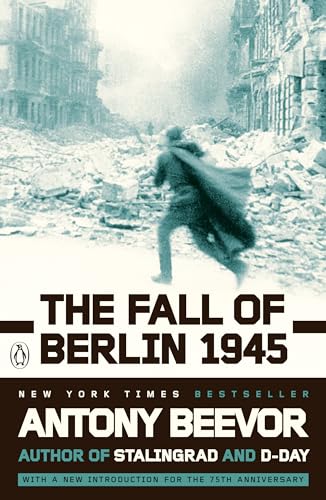
The Red Army had much to avenge when it finally reached the frontiers of the Third Reich in January 1945. Frenzied by their terrible experiences with Wehrmacht and SS brutality, they wreaked havoc—tanks crushing refugee columns, mass rape, pillage, and unimaginable destruction. Hundreds of thousands of women and children froze to death or were massacred; more than seven million fled westward from the fury of the Red Army. It was the most terrifying example of fire and sword ever known.
Antony Beevor, renowned author of D-Day and The Battle of Arnhem, has reconstructed the experiences of those millions caught up in the nightmare of the Third Reich's final collapse. The Fall of Berlin is a terrible story of pride, stupidity, fanaticism, revenge, and savagery, yet it is also one of astonishing endurance, self-sacrifice, and survival against all odds.
Die Inhaltsangabe kann sich auf eine andere Ausgabe dieses Titels beziehen.
Über die Autorin bzw. den Autor
Antony Beevor was educated at Winchester and Sandhurst. A regular officer in the 11th Hussars, he served in Germany and England. He has published several novels, and his works of nonfiction include The Spanish Civil War; Crete: The Battle and the Resistance, which won the 1993 Runciman Award; Stalingrad: The Fateful Siege: 1942—1943; and Berlin: The Downfall, 1945. With his wife, Artemis Cooper, he wrote Paris: After the Liberation: 1944—1949. His book Stalingrad was awarded the Samuel Johnson Prize for Non-Fiction, the Wolfson History Prize, and the Hawthornden Prize in 1999.
Auszug. © Genehmigter Nachdruck. Alle Rechte vorbehalten.
Berlin in the New Year
Berliners, gaunt from short rations and stress, had little to celebrate at Christmas in 1944. Much of the capital of the Reich had been reduced to rubble by bombing raids. The Berlin talent for black jokes had turned to gallows humour. The quip of that unfestive season was: 'Be practical: give a coffin.'
The mood in Germany had changed exactly two years before. Rumours had begun to circulate just before Christmas 1942 that General Paulus's Sixth Army had been encircled on the Volga by the Red Army. The Nazi regime found it hard to admit that the largest formation in the whole of the Wehrmacht was doomed to annihilation in the ruins of Stalingrad and in the frozen steppe outside. To prepare the country for bad news, Joseph Goebbels, the Reichsminister for Propaganda, had announced a 'German Christmas', which in National Socialist terms meant austerity and ideological determination, not candles and pine wreaths and singing Heilige Nacht. By 1944, the traditional roast goose had become a distant memory.
In streets where the façade of a house had collapsed, pictures could still be seen hanging on the walls of what had been a sitting room or bedroom. The actress Hildegard Knef gazed at a piano left exposed on the remnants of a floor. Nobody could get to it, and she wondered how long it would be before it tumbled down to join the rubble below. Messages from families were scrawled on gutted buildings to tell a son returning from the front that they were all right and staying elsewhere. Nazi Party notices warned: 'Looters will be punished with death!'
Air raids were so frequent, with the British by night and the Americans by day, that Berliners felt that they spent more time in cellars and air raid shelters than in their own beds. The lack of sleep contributed to the strange mixture of suppressed hysteria and fatalism. Far fewer people seemed to worry about being denounced to the Gestapo for defeatism, as the rash of jokes indicated. The ubiquitous initials LSR for Luftschutzraum, or air raid shelter, were said to stand for 'Lernt schnell Russisch': 'Learn Russian quickly'. Most Berliners had entirely dropped the 'Heil Hitler!' greeting. When Lothar Loewe, a Hitler Youth who had been away from the city, used it on entering a shop, everyone turned and stared at him. It was the last time he uttered the words when not on duty. Loewe found that the most common greeting had become 'Bleib übrig!' - 'Survive!'.
The humour also reflected the grotesque, sometimes surreal, images of the time. The largest air raid construction in Berlin was the Zoo bunker, a vast ferro-concrete fortress of the totalitarian age, with flak batteries on the roof and huge shelters below, into which crowds of Berliners packed when the sirens sounded. The diarist Ursula von Kardorff described it as 'like a stage-set for the prison scene in Fidelio'. Meanwhile, loving couples embraced on concrete spiral staircases as if taking part in a 'travesty of a fancy-dress ball'.
There was a pervasive atmosphere of impending downfall in personal lives as much as in the nation's existence. People spent their money recklessly, half-assuming that it would soon be worthless. And there were stories, although hard to confirm, of girls and young women coupling with strangers in dark corners around the Zoo station and in the Tiergarten. The desire to dispense with innocence is said to have become even more desperate later as the Red Army approached Berlin.
The air raid shelters themselves, lit with blue lights, could indeed provide a foretaste of claustrophobic hell, as people pushed in, bundled in their warmest clothes and carrying small cardboard suitcases containing sandwiches and thermos. In theory, all basic needs were catered for in the shelters. There was a Sanitätsraum with a nurse, where women could go into labour. Childbirth seemed to be accelerated by the vibrations from bomb explosions, which felt as if they came as much from the centre of the earth as from ground level. The ceilings were painted with luminous paint for the frequent occasions during the air raids when the lights failed, first dimming then flickering off. Water supplies ceased when mains were hit, and the Aborts, or lavatories, soon became disgusting, a real distress for a nation preoccupied with hygiene. Often the lavatories were sealed off by the authorities because there were so many cases of depressed people who, having locked the door, committed suicide.
For a population of around three million, Berlin did not have enough shelters, so they were usually overcrowded. In the main corridors, seating halls and bunk rooms, the air was foul from overuse and condensation dripped from the ceilings. The complex of shelters under the Gesundbrunner U-Bahn station had been designed to take 1,500 people, yet often more than three times that number packed in. Candles were used to measure the diminishing levels of oxygen. When a candle placed on the floor went out, children were picked up and held at shoulder height. When a candle on a chair went out, then the evacuation of the level began. And if a third candle, positioned at about chin level began to sputter, then the whole bunker was evacuated, however heavy the attack above.
The foreign workers in Berlin, three hundred thousand strong and identifiable by a letter painted on their clothes to denote their country of origin, were simply forbidden entry to underground bunkers and cellars. This was partly an extension of the Nazi policy to stop them mingling intimately with the German race, but the overriding concern of the authorities was to save the lives of Germans. A forced labourer, particularly an 'Ostarbeiter', or eastern worker, most of whom had been rounded up in the Ukraine and Belorussia, was regarded as expendable. Yet many foreign workers, conscripted as well as volunteers, enjoyed a far greater degree of freedom than the unfortunates consigned to camps. Those who worked in armaments factories around the capital, for example, had created their own refuge and Bohemian sub-culture with newssheets and plays in the depths of the Friedrichstrasse station. Their spirits were rising visibly as the Red Army advanced, while those of their exploiters fell. Most Germans looked on foreign workers with trepidation. They saw them as a Trojan Horse garrison ready to attack and revenge themselves as soon as the enemy armies approached the city.
Berliners suffered from an atavistic and visceral fear of the Slav invader from the east, worked up after a dozen years of ideological indoctrination. Fear was easily turned to hate. As the Red Army approached, Goebbels's propaganda harked on again and again about the atrocities at Nemmersdorf, when Red Army troops invaded the south-eastern corner of East Prussia the previous autumn and raped and murdered the inhabitants of this village.
Some people had their own reasons for refusing to take shelter during a bombing raid. A married man who used to visit his mistress regularly in the district of Prenzlauerberg could not go down to the communal cellar because that would have aroused suspicions. One evening, the building received a direct hit, and the luckless adulterer, who had been sitting on a sofa, was buried up to his neck in rubble. After the raid, a boy called Eric Schmidtke and a Czech labourer, whose illegal presence in the cellar had been tolerated, heard his screams of pain, and ran upstairs towards the sound. After he had been dug out and carried off for treatment, the fourteen-year-old Eric then had to go to tell the injured man's wife that her husband had been badly injured in this other woman's flat. She started screaming in anger. The fact that he had been with this woman agitated her far more than his fate. Children in those times received a harsh introduction to the realities of the...
„Über diesen Titel“ kann sich auf eine andere Ausgabe dieses Titels beziehen.
Suchergebnisse für The Fall of Berlin 1945

Beispielbild für diese ISBN
The Fall of Berlin 1945
Anbieter: World of Books (was SecondSale), Montgomery, IL, USA
Verkäuferbewertung 5 von 5 Sternen

Paperback. Zustand: Good. Chronicles the horror of Berlin's fall to the Soviets in 1945, recalling the starvation, exposure, artillery fire, rape, and mass destruction that marked the Red Army's final push on Germany's capital. Artikel-Nr. 00106255473
Gebraucht kaufen
EUR 4,31
Versand gratis
Versand innerhalb von USA
Versand innerhalb von USA
Anzahl: 9 verfügbar
Beispielbild für diese ISBN
The Fall of Berlin 1945
Anbieter: World of Books (was SecondSale), Montgomery, IL, USA
Verkäuferbewertung 5 von 5 Sternen
Paperback. Zustand: Fair. Chronicles the horror of Berlin's fall to the Soviets in 1945, recalling the starvation, exposure, artillery fire, rape, and mass destruction that marked the Red Army's final push on Germany's capital. Artikel-Nr. 00100875402
Gebraucht kaufen
EUR 4,31
Versand gratis
Versand innerhalb von USA
Versand innerhalb von USA
Anzahl: 7 verfügbar
Foto des Verkäufers
The Fall of Berlin 1945
Anbieter: Dream Books Co., Denver, CO, USA
Verkäuferbewertung 5 von 5 Sternen
Zustand: acceptable. This copy has clearly been enjoyedâ"expect noticeable shelf wear and some minor creases to the cover. Binding is strong, and all pages are legible. May contain previous library markings or stamps. Artikel-Nr. 4EKGU9007TD6_ns
Gebraucht kaufen
EUR 4,32
Versand gratis
Versand innerhalb von USA
Versand innerhalb von USA
Anzahl: 4 verfügbar
Beispielbild für diese ISBN
The Fall of Berlin 1945
Verlag:
Penguin Books (edition Reissue), 2003
ISBN 10: 0142002801
ISBN 13: 9780142002803
Gebraucht
Paperback
Anbieter: BooksRun, Philadelphia, PA, USA
Verkäuferbewertung 5 von 5 Sternen
Paperback. Zustand: Very Good. Reissue. It's a well-cared-for item that has seen limited use. The item may show minor signs of wear. All the text is legible, with all pages included. It may have slight markings and/or highlighting. Artikel-Nr. 0142002801-11-1
Gebraucht kaufen
EUR 5,82
Versand gratis
Versand innerhalb von USA
Versand innerhalb von USA
Anzahl: 2 verfügbar
Beispielbild für diese ISBN
The Fall of Berlin 1945
Verlag:
Penguin Publishing Group, 2003
ISBN 10: 0142002801
ISBN 13: 9780142002803
Gebraucht
Softcover
Anbieter: Better World Books: West, Reno, NV, USA
Verkäuferbewertung 5 von 5 Sternen
Zustand: Good. Pages intact with minimal writing/highlighting. The binding may be loose and creased. Dust jackets/supplements are not included. Stock photo provided. Product includes identifying sticker. Better World Books: Buy Books. Do Good. Artikel-Nr. 4069625-20
Gebraucht kaufen
EUR 6,35
Versand gratis
Versand innerhalb von USA
Versand innerhalb von USA
Anzahl: 3 verfügbar
Beispielbild für diese ISBN
The Fall of Berlin 1945
Verlag:
Penguin Publishing Group, 2003
ISBN 10: 0142002801
ISBN 13: 9780142002803
Gebraucht
Softcover
Anbieter: Better World Books, Mishawaka, IN, USA
Verkäuferbewertung 5 von 5 Sternen
Zustand: Good. Former library copy. Pages intact with minimal writing/highlighting. The binding may be loose and creased. Dust jackets/supplements are not included. Includes library markings. Stock photo provided. Product includes identifying sticker. Better World Books: Buy Books. Do Good. Artikel-Nr. GRP18506584
Gebraucht kaufen
EUR 6,35
Versand gratis
Versand innerhalb von USA
Versand innerhalb von USA
Anzahl: 1 verfügbar
Beispielbild für diese ISBN
The Fall of Berlin 1945
Anbieter: ThriftBooks-Reno, Reno, NV, USA
Verkäuferbewertung 5 von 5 Sternen
Paperback. Zustand: Fair. No Jacket. Readable copy. Pages may have considerable notes/highlighting. ~ ThriftBooks: Read More, Spend Less. Artikel-Nr. G0142002801I5N00
Gebraucht kaufen
EUR 6,39
Versand gratis
Versand innerhalb von USA
Versand innerhalb von USA
Anzahl: 3 verfügbar
Beispielbild für diese ISBN
The Fall of Berlin 1945
Anbieter: ThriftBooks-Dallas, Dallas, TX, USA
Verkäuferbewertung 5 von 5 Sternen
Paperback. Zustand: Good. No Jacket. Pages can have notes/highlighting. Spine may show signs of wear. ~ ThriftBooks: Read More, Spend Less. Artikel-Nr. G0142002801I3N00
Gebraucht kaufen
EUR 6,39
Versand gratis
Versand innerhalb von USA
Versand innerhalb von USA
Anzahl: 1 verfügbar
Beispielbild für diese ISBN
The Fall of Berlin 1945
Anbieter: ThriftBooks-Dallas, Dallas, TX, USA
Verkäuferbewertung 5 von 5 Sternen
Paperback. Zustand: Fair. No Jacket. Readable copy. Pages may have considerable notes/highlighting. ~ ThriftBooks: Read More, Spend Less. Artikel-Nr. G0142002801I5N00
Gebraucht kaufen
EUR 6,39
Versand gratis
Versand innerhalb von USA
Versand innerhalb von USA
Anzahl: 3 verfügbar
Beispielbild für diese ISBN
The Fall of Berlin 1945
Anbieter: ThriftBooks-Dallas, Dallas, TX, USA
Verkäuferbewertung 5 von 5 Sternen
Paperback. Zustand: Fair. No Jacket. Former library book; Readable copy. Pages may have considerable notes/highlighting. ~ ThriftBooks: Read More, Spend Less. Artikel-Nr. G0142002801I5N10
Gebraucht kaufen
EUR 6,39
Versand gratis
Versand innerhalb von USA
Versand innerhalb von USA
Anzahl: 1 verfügbar