
Verwandte Artikel zu Shackleton's Way: Leadership Lessons from the Great...
Inhaltsangabe
Lead your business to survival and success by following the example of legendary explorer Ernest Shackleton
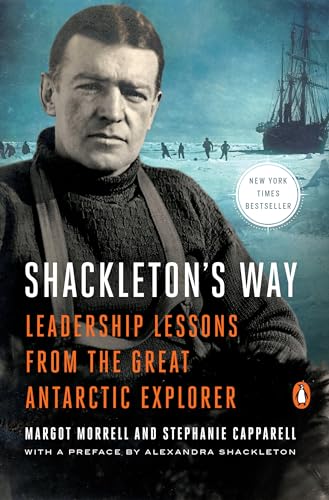
Sir Ernest Shackleton has been called "the greatest leader that ever came on God's earth, bar none" for saving the lives of the twenty-seven men stranded with him in the Antarctic for almost two years. Because of his courageous actions, he remains to this day a model for great leadership and masterful crisis management. Now, through anecdotes, the diaries of the men in his crew, and Shackleton's own writing, Shackleton's leadership style and time-honored principles are translated for the modern business world. Written by two veteran business observers and illustrated with ship photographer Frank Hurley's masterpieces and other rarely seen photos, this practical book helps today's leaders follow Shackleton's triumphant example.
"An important addition to any leader's library." -Seattle Times
Die Inhaltsangabe kann sich auf eine andere Ausgabe dieses Titels beziehen.
Über die Autorin bzw. den Autor
Margot Morrell, a twenty-year veteran of corporate America, has worked in financial services and consulting. Her research into Shackleton's leadership has taken her to such far-flung destinations as Antarctica, Australia, and Argentina.
Stephanie Capparrell, a journalist for more than twenty years, is an editor for the Wall Street Journal's Marketplace page.
Auszug. © Genehmigter Nachdruck. Alle Rechte vorbehalten.
The Path to Leadership
When Ernest Shackleton was at the zenith of his popularity as an explorer, he was invited back to his boys' school, Dulwich College in London, to present some academic honors. That was about as close as he ever got to a Dulwich prize, he joked, to the cheers of the students.
Indeed, Shackleton's early years revealed little promise of the glories to come. An early biographer, Hugh Robert Mill, a friend and mentor of the explorer, joked that the only sign in Shackleton's childhood that he would go to the Antarctic was a class ranking that was decidedly "south of the equator and sometimes perilously near the Pole." At the time of the Dulwich speech, a teacher interviewed by a schoolboy magazine remembered the young Shackleton as "a rolling stone." Students and teachers alike saw the boy as an introvert who was more interested in books than in games but who had a hard time with his studies. "He could do better," was a common refrain in school reports.
One classmate did see a hint of Shackleton in the making. He recalled some forty years after the incident how the young student had beaten up a schoolyard bully who had been picking on a smaller boy. From an early age, Shackleton gravitated to the role of protector, stepping up to the front to insist on fair play.
Ernest Henry Shackleton was a natural as a big brother. He was born on February 15, 1874, in Kilkea, County Kildare, Ireland, the second of ten children. He was a healthy and good-looking boy, with slate blue eyes and dark hair. His family and closest friends saw him as humorous, imaginative, and mischievous. By all accounts, he grew up in a loving home surrounded by attentive females. In addition to his eight sisters, his grandmother and aunts often helped his mother with the children. It is no wonder that many people would later remark on his strong feminine sensibilities. Despite a burly physique; enormous stamina; and a tough, no-nonsense manner, he could be nurturing and gentle, quick to forgive frailties, and generous without seeking thanks in return. One friend called him "a Viking with a mother's heart." Both men and women saw this duality in Shackleton and found it irresistible. Shackleton himself was aware of it: "I am a curious mixture with something feminine in me as well as being a man.... I have committed all sorts of crimes in thought if not always in action and don't worry much about it, yet I hate to see a child suffer, or to be false in any way."
The family home had its own split personality, according to Dr. Alexander Macklin, the physician on two of Shackleton's three independent expeditions. He wrote that Shackleton's Irish mother, Henrietta Gavan, was "warm-hearted and altogether happy-go-lucky." His father Henry, on the other hand, was "a grave, cautious, solid Yorkshire Quaker." A Shackleton ancestor had immigrated to Ireland in the eighteenth century to open a school. Shackleton's father ran a farm and settled his family in the lush land of county Kildare. When Ernest was six years old, the elder Shackleton left farming to study medicine at Trinity College in Dublin. He became a homeopathic doctor, a vocation that provided the family with solid, upper middle-class comforts.
Shackleton learned from his family a broad and sympathetic view of the world that helped shape his evenhanded, democratic leadership style.
Henry Shackleton headed a strict, though apparently not oppressive, household. The Bible was read aloud in the home, and young Ernest, who had flair for the dramatic, led his siblings into the children's temperance movement. They would gather outside pubs, singing songs about the perils of alcohol-a display of youthful activism that suggests the family's religious bearings. Sir Ernest's branch of the Shackletons left the Quaker religion in the late eighteenth century to join the Church of England. It seems, however, that the family maintained some of its Quaker culture. In the late nineteenth century, Quakers were active worldwide in many progressive political movements: abolition, prison reform, education reform, pacifism, women's suffrage, and the temperance movement, which held that alcohol was a chief cause of family violence and poverty.
Throughout his life, Shackleton was described as being ahead of his time in his attitude toward and treatment of his men. He also encouraged his sisters to always express themselves and develop their own careers, and they became impressively self-sufficient women for their day, choosing vocations such as artist, midwife, customs officer, and writer. As an adult, Shackleton would abandon temperance and other religious practices and embrace his share of vices. But he maintained his faith and his moral compass, balancing his contemplative, spiritual side with a practical, humanistic commitment. Later in life, Shackleton's wife wrote a bio-graphical note for Dulwich alumni in which she stated her husband was "interested in social welfare movements." Ultimately, his authority as a leader rested on his genuine regard and respect for the men he led.
If Ernest Shackleton had anything in common with his father it was that they both pursued their interests with great passion. The edler Shackleton relished domesticity, never more content than when poring over scientific texts at his last family home in Sydenham, in London. He lived there for thirty-two years, tending to his medical practice, his family, and a meticulously kept rose garden. Ernest, by contrast, loved poetry and the sea. He was to become famously incapable of staying put, going to the ends of the earth to seek adventure. What he definitely didn't want was to follow his father's wish that he become a doctor.
Ernest was ten years old when his family moved to England. His spoken English forever retained traces of his Irish roots and so he was always identified, for better or for worse, as an outsider. His Anglo-Irish culture helped shape his independent mindset, giving him a healthy disregard for custom, clan, and class.
In England, Shackleton was sent to school for the first time. He was eleven years old. Until then, his father had educated him and his siblings at home. From the start, Shackleton showed a certain discomfort in a formal classroom setting, and wasn't destined to stay long in it. His first school was Fir Lodge in Croydon, south of London. Shackleton's classmates teased the newcomer, goading him and another Irish boy to fight each other on St. Patrick's Day. The boys gave him the nickname "Micky," and he adopted it for life, signing his name as such in letters to his wife and close friends.
When he was thirteen years old, Shackleton was sent to Dulwich College, a solid boys' school attended mostly by day students who were the children of professionals. He was seen as immature and inattentive to schoolwork, so was often placed with students a year younger. One teacher reported that the young Shackleton "wants waking up." Another predicted, "He has not yet fully exerted himself." a schoolmaster who met Shackleton after he had become a famous explorer confessed, "We never discovered you when you were at Dulwich."
"No," Shackleton replied sympathetically, "but I had not then discovered myself."
Shackleton complained the school didn't make things interesting. Geography was "names of towns, lists of capes and bays and islands," he said. Worse, it took great poets and writers and made them dull by "the dissection, the parsing" of their work. Shackleton seemed a typically moody teen, but he was never disruptive or rebellious. Instead, he plotted an escape. He announced at fifteen years of age that he was going to leave home for life on the seas. "I wanted to be free," he wrote later. "I wanted to escape from a routine which didn't at all agree with my nature and which, therefore, was doing no good to my character. Some boys take to school like ducks to water; for...
„Über diesen Titel“ kann sich auf eine andere Ausgabe dieses Titels beziehen.
Suchergebnisse für Shackleton's Way: Leadership Lessons from the Great...

Beispielbild für diese ISBN
Shackleton's Way: Leadership L
Anbieter: World of Books (was SecondSale), Montgomery, IL, USA
Verkäuferbewertung 5 von 5 Sternen

Zustand: Very Good. Item in very good condition! Textbooks may not include supplemental items i.e. CDs, access codes etc. Artikel-Nr. 00109785489
Gebraucht kaufen
EUR 3,66
Versand gratis
Versand innerhalb von USA
Versand innerhalb von USA
Anzahl: 1 verfügbar
Beispielbild für diese ISBN
Shackleton's Way: Leadership L
Anbieter: World of Books (was SecondSale), Montgomery, IL, USA
Verkäuferbewertung 5 von 5 Sternen
Zustand: Good. Item in good condition. Textbooks may not include supplemental items i.e. CDs, access codes etc. Artikel-Nr. 00091690953
Gebraucht kaufen
EUR 3,66
Versand gratis
Versand innerhalb von USA
Versand innerhalb von USA
Anzahl: Mehr als 20 verfügbar
Beispielbild für diese ISBN
Shackleton's Way: Leadership L
Anbieter: World of Books (was SecondSale), Montgomery, IL, USA
Verkäuferbewertung 5 von 5 Sternen
Zustand: Acceptable. Item in acceptable condition! Textbooks may not include supplemental items i.e. CDs, access codes etc. Artikel-Nr. 00099772477
Gebraucht kaufen
EUR 3,66
Versand gratis
Versand innerhalb von USA
Versand innerhalb von USA
Anzahl: 8 verfügbar
Beispielbild für diese ISBN
Shackleton's Way: Leadership Lessons from the Great Antarctic Explorer
Verlag:
Penguin Books (edition ), 2002
ISBN 10: 0142002364
ISBN 13: 9780142002360
Gebraucht
Paperback
Anbieter: BooksRun, Philadelphia, PA, USA
Verkäuferbewertung 5 von 5 Sternen
Paperback. Zustand: Fair. The item might be beaten up but readable. May contain markings or highlighting, as well as stains, bent corners, or any other major defect, but the text is not obscured in any way. Artikel-Nr. 0142002364-7-18
Gebraucht kaufen
EUR 4,52
Versand gratis
Versand innerhalb von USA
Versand innerhalb von USA
Anzahl: 1 verfügbar
Beispielbild für diese ISBN
Shackleton's Way: Leadership Lessons from the Great Antarctic Explorer
Anbieter: ThriftBooks-Dallas, Dallas, TX, USA
Verkäuferbewertung 5 von 5 Sternen
Paperback. Zustand: Fair. No Jacket. Readable copy. Pages may have considerable notes/highlighting. ~ ThriftBooks: Read More, Spend Less. Artikel-Nr. G0142002364I5N00
Gebraucht kaufen
EUR 5,94
Versand gratis
Versand innerhalb von USA
Versand innerhalb von USA
Anzahl: 1 verfügbar
Beispielbild für diese ISBN
Shackleton's Way: Leadership Lessons from the Great Antarctic Explorer
Anbieter: ThriftBooks-Atlanta, AUSTELL, GA, USA
Verkäuferbewertung 5 von 5 Sternen
Paperback. Zustand: Very Good. No Jacket. May have limited writing in cover pages. Pages are unmarked. ~ ThriftBooks: Read More, Spend Less. Artikel-Nr. G0142002364I4N00
Gebraucht kaufen
EUR 5,94
Versand gratis
Versand innerhalb von USA
Versand innerhalb von USA
Anzahl: 1 verfügbar
Beispielbild für diese ISBN
Shackleton's Way: Leadership Lessons from the Great Antarctic Explorer
Anbieter: ThriftBooks-Dallas, Dallas, TX, USA
Verkäuferbewertung 5 von 5 Sternen
Paperback. Zustand: Very Good. No Jacket. May have limited writing in cover pages. Pages are unmarked. ~ ThriftBooks: Read More, Spend Less. Artikel-Nr. G0142002364I4N00
Gebraucht kaufen
EUR 5,94
Versand gratis
Versand innerhalb von USA
Versand innerhalb von USA
Anzahl: 1 verfügbar
Beispielbild für diese ISBN
Shackleton's Way : Leadership Lessons from the Great Antarctic Explorer
Verlag:
Penguin Publishing Group, 2002
ISBN 10: 0142002364
ISBN 13: 9780142002360
Gebraucht
Softcover
Anbieter: Better World Books, Mishawaka, IN, USA
Verkäuferbewertung 5 von 5 Sternen
Zustand: Very Good. lessons. Edition. Pages intact with possible writing/highlighting. Binding strong with minor wear. Dust jackets/supplements may not be included. Stock photo provided. Product includes identifying sticker. Better World Books: Buy Books. Do Good. Artikel-Nr. GRP97932651
Gebraucht kaufen
EUR 6,09
Versand gratis
Versand innerhalb von USA
Versand innerhalb von USA
Anzahl: 1 verfügbar
Beispielbild für diese ISBN
Shackleton's Way : Leadership Lessons from the Great Antarctic Explorer
Verlag:
Penguin Publishing Group, 2002
ISBN 10: 0142002364
ISBN 13: 9780142002360
Gebraucht
Softcover
Anbieter: Better World Books: West, Reno, NV, USA
Verkäuferbewertung 5 von 5 Sternen
Zustand: Good. lessons. Edition. Pages intact with minimal writing/highlighting. The binding may be loose and creased. Dust jackets/supplements are not included. Stock photo provided. Product includes identifying sticker. Better World Books: Buy Books. Do Good. Artikel-Nr. 3958871-6
Gebraucht kaufen
EUR 6,09
Versand gratis
Versand innerhalb von USA
Versand innerhalb von USA
Anzahl: 1 verfügbar
Beispielbild für diese ISBN
Shackleton's Way : Leadership Lessons from the Great Antarctic Explorer
Verlag:
Penguin Publishing Group, 2002
ISBN 10: 0142002364
ISBN 13: 9780142002360
Gebraucht
Softcover
Anbieter: Better World Books, Mishawaka, IN, USA
Verkäuferbewertung 5 von 5 Sternen
Zustand: Good. lessons. Edition. Pages intact with minimal writing/highlighting. The binding may be loose and creased. Dust jackets/supplements are not included. Stock photo provided. Product includes identifying sticker. Better World Books: Buy Books. Do Good. Artikel-Nr. 3958871-6
Gebraucht kaufen
EUR 6,09
Versand gratis
Versand innerhalb von USA
Versand innerhalb von USA
Anzahl: 4 verfügbar