
Verwandte Artikel zu Salt: A World History
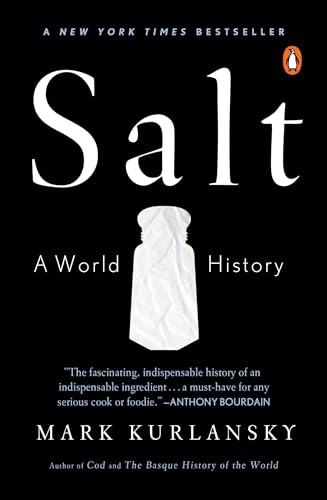
Inhaltsangabe
“Kurlansky finds the world in a grain of salt.” - New York Times Book Review
An unlikely world history from the bestselling author of Cod and The Basque History of the World
Best-selling author Mark Kurlansky turns his attention to a common household item with a long and intriguing history: salt. The only rock we eat, salt has shaped civilization from the very beginning, and its story is a glittering, often surprising part of the history of humankind. A substance so valuable it served as currency, salt has influenced the establishment of trade routes and cities, provoked and financed wars, secured empires, and inspired revolutions. Populated by colorful characters and filled with an unending series of fascinating details, Salt is a supremely entertaining, multi-layered masterpiece.
Die Inhaltsangabe kann sich auf eine andere Ausgabe dieses Titels beziehen.
Über die Autorin bzw. den Autor
Mark Kurlansky was born in Hartford, Connecticut. After receiving a BA in Theater from Butler University in 1970—and refusing to serve in the military—Kurlansky worked in New York as a playwright, having a number of off-off Broadway productions, and as a playwright-in-residence at Brooklyn College. He has worked many other jobs, including as a commercial fisherman, a dock worker, a paralegal, a cook, and a pastry chef. In the mid-1970s he turned to journalism, and from 1976 to 1991 he worked as a foreign correspondent for The International Herald Tribune, The Chicago Tribune, The Miami Herald, and The Philadelphia Inquirer. Based in Paris and then Mexico, he reported on Europe, West Africa, Southeast Asia, Central America, Latin America, and the Caribbean. His articles have appeared in a wide variety of newspapers and magazines, including The Philadelphia Inquirer, The Miami Herald, The Chicago Tribune, The Los Angeles Times, Time, The New York Times and many more. He has had 35 books published including fiction, nonfiction, and children's books. His books include Havana, Cod, Salt, Paper, The Basque History of the World, 1968, The Big Oyster, among other titles. He has received the Dayton Literary Peace Prize, Bon Appetit’s Food Writer of the Year Award, the James Beard Award, and the Glenfiddich Award. He lives in New York City.
Auszug. © Genehmigter Nachdruck. Alle Rechte vorbehalten.
Once I stood on the bank of a rice paddy in rural Sichuan Province, and a lean and aging Chinese peasant, wearing a faded forty-year-old blue jacket issued by the Mao government in the early years of the Revolution, stood knee deep in water and apropos of absolutely nothing shouted defiantly at me, "We Chinese invented many things!"
The Chinese are proud of their inventions. All Chinese leaders, including Mao Zedong, sooner or later give a speech listing the many Chinese firsts. Though rural China these days seems in need of a new round of inventions, it is irrefutably true that the Chinese originated many of the pivotal creations of history, including papermaking, printing, gunpowder, and the compass.
China is the oldest literate society still in existence, and its 4,000 years of written history begin as a history of inventions. It is no longer clear when legends were made into men and when living historic figures were turned into legends. Chinese history starts in the same manner as Old Testament history. In the Book of Genesis, first come the legends, the story of the Creation, mythical figures such as Adam and Eve and Noah, generations of people who may or may not have lived, and gradually the generations are followed to Abraham, the beginning of documented Hebrew history.
In Chinese history, first was Pangu, the creator, who made humans from parasites on his body. He died but was followed by wise rulers, who invented the things that made China the first civilization.Fuxi was first to domesticate animals. Apparently an enthusiast for domesticity, he is also credited with inventing marriage. Next came Shennong, who invented medicine, agriculture, and trade. He is credited with the plow and the hoe. Then came Huangdi, the Yellow Emperor, who invented writing, the bow and arrow, the cart, and ceramics. Several centuries after Huangdi came Emperor Yao, a wise ruler who passed over his unqualified son and named a modest sage, Shun, his successor. Shun chose his minister, Yu, to succeed him. In 2205 B.C., according to tradition, Yu founded the Xia dynasty, and this dynasty, which lasted until 1766 B.C., enters into documented history.
Chinese salt history begins with the mythical Huangdi, who invented writing, weaponry, and transportation. According to the legends, he also had the distinction of presiding over the first war ever fought over salt.
One of the earliest verifiable saltworks in prehistoric China was in the northern province of Shanxi. In this arid region of dry yellow earth and desert mountains is a lake of salty water, Lake Yuncheng. This area was known for constant warfare, and all of the wars were over control of the lake. Chinese historians are certain that by 6000 B.C., each year, when the lake's waters evaporated in the summer sun, people harvested the square crystals on the surface of the water, a system the Chinese referred to as "dragging and gathering." Human bones found around the lake have been dated much earlier, and some historians speculate that these inhabitants may also have gathered salt from the lake.
The earliest written record of salt production in China dates to around 800 B.C. and tells of production and trade of sea salt a millennium before, during the Xia dynasty. It is not known if the techniques described in this account were actually used during the Xia dynasty, but they were considered old ways by the time of this account, which describes putting ocean water in clay vessels and boiling it until reduced to pots of salt crystals. This was the technique that was spread through southern Europe by the Roman Empire, 1,000 years after the Chinese account was written.
About 1000 B.C., iron first came into use in China, though the first evidence of it being used in salt making is not until 450 B.C. by a man named Yi Dun. According to a passage written in 129 B.C., "Yi Dun rose to prominence by producing salt in pans." Yi Dun is believed to have made salt by boiling brine in iron pans, an innovation which would become one of the leading techniques for salt making for the next 2,000 years. The legend says that he worked with an ironmaster named Guo Zong and was also friendly with an enterprising wealthy bureaucrat named Fan Li. Fan Li is credited with inventing fish farming, which for centuries after was associated with salt-producing areas. The Chinese, like later Europeans, saw that salt and fish were partners. Many Chinese, including Mencius, the famous Confucian thinker who lived from 372 to 289 B.C., were said to have worked selling both fish and salt.
Throughout the long history of China, sprinkling salt directly on food has been a rarity. Usually it has been added during cooking by means of various condiments—salt-based sauces and pastes. The usual explanation is that salt was expensive and it was stretched by these condiments. A recurring idea throughout the ancient world from the Mediterranean to Southeast Asia, fish fermented in salt was one of the most popular salt condiments in ancient China. It was called jiang. But in China soybeans were added to ferment with the fish, and in time the fish was dropped altogether from the recipe and jiang became jiangyou, or, as it is called in the West, soy sauce.
Soy is a legume that produces beans, two or three in a two-inch-long furry pod. The beans can be yellow, green, brown, purple, black, or spotted, and Chinese cooking makes a great distinction among these varieties. Jiangyou is made from yellow beans, but other types are also fermented with salt to produce different pastes and condiments. In China, the earliest written mention of soy is in the sixth century B.C., describing the plant as a 700-year-old crop from the north. Soy was brought to Japan from China in the sixth century A.D. by Chinese Buddhist missionaries. Both the religion and the bean were successfully implanted. But the Japanese did not make soy sauce until the tenth century. Once they did learn, they called it shoyu and industrialized it and sold it around the world.
Though jiangyou and shoyu are pronounced very differently and appear to be very different words in Western writing, the two words are written with the same character in Japanese and Chinese. Mao's 1950s literacy campaign simplified the language to some 40,000 characters, but a pre-Mao character for the soy plant, su, depicts little roots at the bottom which revive the soil. Soy puts nutrients back into the soil and can restore fields that have been exhausted by other crops. The bean is so nutritious that a person could be sustained for a considerable period on nothing but water, soy, and salt.
The process by which the Chinese, and later the Japanese, fermented beans in earthen pots is today known as lactic acid fermentation, or, in more common jargon, pickling. Optimum lactic fermentation takes place between sixty-four and seventy-one degrees Fahrenheit, which in most of the world is an easily achieved environment.
As vegetables begin to rot, the sugars break down and produce lactic acid, which serves as a preservative. Theoretically, pickling can be accomplished without salt, but the carbohydrates and proteins in the vegetables tend to putrefy too quickly to be saved by the emerging lactic acid. Without salt, yeast forms, and the fermentation process leads to alcohol rather than pickles.
Between .8 and 1.5 percent of the vegetable's weight in salt holds off the rotting process until the lactic acid can take over. Excluding oxygen, either by sealing the jar or, more usually, by weighting the vegetables so that they remain immersed in liquid, is necessary for successful lactic fermentation.
The ancient Chinese pickled in earthen jars, which caused a white film called kahm yeast, harmless but unpleasant tasting, to form on the top. Every two weeks the cloth, board, and stone...
„Über diesen Titel“ kann sich auf eine andere Ausgabe dieses Titels beziehen.
Suchergebnisse für Salt: A World History

Beispielbild für diese ISBN
Salt: A World History
Verlag:
Penguin (Non-Classics) January 2003, 2003
ISBN 10: 0142001619
ISBN 13: 9780142001615
Neu
Paper Back
Anbieter: Eagle Eye Books, Decatur, GA, USA
Verkäuferbewertung 4 von 5 Sternen

Paper Back. Zustand: New. Artikel-Nr. 628200
Neu kaufen
EUR 16,90
EUR 3,45 Versand
Versand innerhalb von USA
Versand innerhalb von USA
Anzahl: 2 verfügbar
Beispielbild für diese ISBN
Salt: A World History
Anbieter: Revaluation Books, Exeter, Vereinigtes Königreich
Verkäuferbewertung 5 von 5 Sternen

Paperback. Zustand: Brand New. reprint edition. 498 pages. 7.75x5.00x1.00 inches. In Stock. Artikel-Nr. x-0142001619
Neu kaufen
EUR 20,89
EUR 11,69 Versand
Versand von Vereinigtes Königreich nach USA
Versand von Vereinigtes Königreich nach USA
Anzahl: 2 verfügbar
Beispielbild für diese ISBN
Salt: A World History
Anbieter: Kennys Bookstore, Olney, MD, USA
Verkäuferbewertung 5 von 5 Sternen
Zustand: New. 2003. Illustrated. Paperback. . . . . . Books ship from the US and Ireland. Artikel-Nr. V9780142001615
Neu kaufen
EUR 26,69
EUR 9,07 Versand
Versand innerhalb von USA
Versand innerhalb von USA
Anzahl: Mehr als 20 verfügbar
Beispielbild für diese ISBN
Salt: A World History
Anbieter: Infinity Books Japan, Tokyo, TKY, Japan
Verkäuferbewertung 2 von 5 Sternen

Paperback. Zustand: Good. Artikel-Nr. RWARE0000064962
Gebraucht kaufen
EUR 5,02
EUR 44,90 Versand
Versand von Japan nach USA
Versand von Japan nach USA
Anzahl: 1 verfügbar
Foto des Verkäufers
Salt : A World History
Anbieter: AHA-BUCH GmbH, Einbeck, Deutschland
Verkäuferbewertung 5 von 5 Sternen
Taschenbuch. Zustand: Neu. Neuware - NEW YORK TIMES BESTSELLER | THE BOOK BEHIND THE VIRAL TIKTOK One tiny rock. One epic history.'A must-have for any serious cook or foodie.'Anthony Bourdain'This is a 'wow!' book: roving, startling, engaging." Washington Post"Kurlansky finds the world in a grain of salt."New York Times Book ReviewAn unlikely world history from the bestselling author of Milk! and Cod You'll never look at salt the same way again. The only rock we eat, salt has shaped civilization from the very beginning, and its story is a glittering, often surprising part of the history of humankind. A substance so valuable it served as currency, salt has influenced the establishment of trade routes and cities, provoked and financed wars, secured empires, and inspired revolutions. Populated by colorful characters and filled with an unending series of fascinating details, Salt is a supremely entertaining, multi-layered masterpiece. Artikel-Nr. 9780142001615
Neu kaufen
EUR 22,00
EUR 30,50 Versand
Versand von Deutschland nach USA
Versand von Deutschland nach USA
Anzahl: 2 verfügbar
Foto des Verkäufers
Salt
Anbieter: moluna, Greven, Deutschland
Verkäuferbewertung 5 von 5 Sternen
Zustand: New. Mark Kurlansky is the New York Times bestselling author of many books, including Cheesecake, The Food of a Younger Land, Cod: A Biography of the Fish That Changed the World Salt: A World History 1968: The Year . Artikel-Nr. 897435173
Neu kaufen
EUR 19,44
EUR 48,99 Versand
Versand von Deutschland nach USA
Versand von Deutschland nach USA
Anzahl: Mehr als 20 verfügbar