
Verwandte Artikel zu The Art of Seduction
Inhaltsangabe
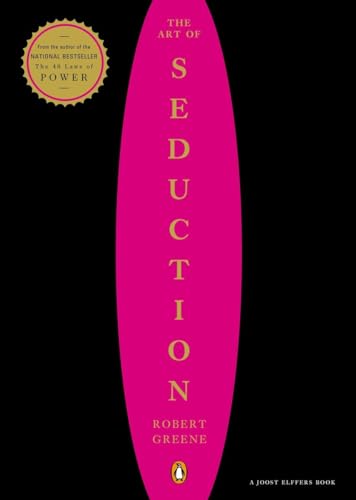
From the author of the multi-million copy bestseller The 48 Laws of Power and The Laws of Human Nature, a mesmerizing handbook on seduction: the most subtle and effective form of power
When raised to the level of art, seduction, an indirect and subtle form of power, has toppled empires, won elections and enslaved great minds. Immerse yourself in the twenty-four maneuvers and strategies of the seductive process, the ritual by which a seducer gains mastery over his target. Understand how to "Poeticize Your Presence," “Keep them in Suspense – What Comes Next” and “Master the Art of the Bold Move”. Every bit as essential as The 48 Laws of Power, The Art of Seduction is an indispensable primer of persuasion that reveals one of history's greatest weapons and the ultimate form of power.
Die Inhaltsangabe kann sich auf eine andere Ausgabe dieses Titels beziehen.
Über die Autorin bzw. den Autor
Robert Greene, the #1 New York Times bestselling author of The 48 Laws of Power, The 33 Strategies of War, The Art of Seduction, Mastery, and The Laws of Human Nature, is an internationally renowned expert on power strategies. He lives in Los Angeles.
Joost Elffers is the packaging genius behind Viking Studio's Secret Language series, Play with Your Food, and How Are You Peeling? He lives in New York City.
Auszug. © Genehmigter Nachdruck. Alle Rechte vorbehalten.
Keys to the Character
At first it may seem strange that a man who is clearly dishonest, disloyal, and has no interest in marriage would have any appeal to a woman. But throughout all of history, and in all cultures, this type has had a fatal effect. What the Rake offers is what society normally does not allow women: an affair of pure pleasure, an exciting brush with danger. A woman is often deeply oppressed by the role she is expected to play. She is supposed to be the tender, civilizing force in society, and to want commitment and lifelong loyalty. But often her marriages and relationships give her not romance and devotion but routine and an endlessly distracted mate. It remains an abiding female fantasy to meet a man who gives totally of himself, who lives for her, even if only for a while.
This dark, repressed side of female desire found expression in the legend of Don Juan. At first the legend was a male fantasy: the adventurous knight who could have any woman he wanted. But in the seventeenth and eighteenth centuries, Don Juan slowly evolved from the masculine adventurer to a more feminized version: a man who lived only for women. This evolution came from women’s interest in the story, and was a result of their frustrated desires. Marriage for them was a form of indentured servitude; but Don Juan offered pleasure for its own sake, desire with no strings attached. For the time he crossed your path, you were all he thought about. His desire for you was so powerful that he gave you no time to think or to worry about the consequences. He would come in the night, give you an unforgettable moment, and then vanish. He might have conquered a thousand women before you, but that only made him more interesting; better to be abandoned than undesired by such a man.
The great seducers do not offer the mild pleasures that society condones. They touch a person’s unconscious, those repressed desires that cry out for liberation. Do not imagine that women are the tender creatures that some people would like them to be. Like men, they are deeply attracted to the forbidden, the dangerous, even the slightly evil. (Don Juan ends by going to hell, and the word “rake” comes from “rakehell,” a man who rakes the coals of hell; the devilish component, clearly, is an important part of the fantasy) Always remember: if you are to play the Rake, you must convey a sense of risk and darkness, suggesting to your victim that she is participating in something rare and thrilling—a chance to play out her own rakish desires.
To play the Rake, the most obvious requirement is the ability to let yourself go, to draw a woman into the kind of purely sensual moment in which past and future lose meaning. You must be able to abandon yourself to the moment. (When the Rake Valmont—a character modeled after the Duke de Richelieu—in Laclos’ eighteenth-century novel Dangerous Liaisons writes letters that are obviously calculated to have a certain effect on his chosen victim, Madame de Tourvel, she sees right through them; but when his letters really do burn with passion, she begins to relent.) An added benefit of this quality is that it makes you seem unable to control yourself, a display of weakness that a woman enjoys. By abandoning yourself to the seduced, you make them feel that you exist for them alone—a feeling reflecting a truth, though a temporary one. Of the hundreds of women that Pablo Picasso, consummate rake, seduced over the years, most of them had the feeling that they were the only one he truly loved.
The Rake never worries about a woman’s resistance to him, or for that matter about any other obstacle in his path—a husband, a physical barrier. Resistance is only the spur to his desire, enflaming him all the more. When Picasso was seducing Françoise Gilot, in fact, he begged her to resist; he needed resistance to add to the thrill. In any case, an obstacle in your way gives you the opportunity to prove yourself, and the creativity you bring to matters of love. In the eleventh-century Japanese novel The Tale of Genji,by the court lady Murasaki Shikibu, the Rake Prince Niou is not disturbed by the sudden disappearance of Ukifune, the woman he loves. She has fled because although she is interested in the prince, she is in love with another man; but her absence allows the prince to go to extreme lengths to track her down. His sudden appearance to whisk her away to a house deep in the woods, and the gallantry he displays in doing so, overwhelm her. Remember : if no resistances or obstacles face you, you must create them. No seduction can proceed without them.
The Rake is an extreme personality. Impudent, sarcastic, and bitingly witty, he cares nothing for what anyone thinks. Paradoxically, this only makes him more seductive. In the courtlike atmosphere of studio-era Hollywood, when most of the actors behaved like dutiful sheep, the great Rake Errol Flynn stood out in his insolence. He defied the studio chiefs, engaged in the most extreme pranks, reveled in his reputation as Hollywood’s supreme seducer—all of which enhanced his popularity. The Rake needs a backdrop of convention—a stultified court, a humdrum marriage, a conservative culture—to shine, to be appreciated for the breath of fresh air he provides. Never worry about going too far: the Rake’s essence is that he goes further than anyone else.
When the Earl of Rochester, seventeenth-century England’s most notorious Rake and poet, abducted Elizabeth Malet, one of the most sought-after young ladies of the court, he was duly punished. But lo and behold, a few years later young Elizabeth, though wooed by the most eligible bachelors in the country, chose Rochester to be her husband. In demonstrating his audacious desire, he made himself stand out from the crowd.
Related to the Rake’s extremism is the sense of danger, taboo, perhaps even the hint of cruelty about him. This was the appeal of another poet Rake, one of the greatest in history: Lord Byron. Byron disliked any kind of convention, and happily played this up. When he had an affair with his half sister, who bore a child by him, he made sure that all of England knew about it. He could be uncommonly cruel, as he was to his wife. But all of this only made him that much more desirable. Danger and taboo appeal to a repressed side in women, who are supposed to represent a civilizing, moralizing force in culture. Just as a man may fall victim to the Siren through his desire to be free of his sense of masculine responsibility, a woman may succumb to the Rake through her yearning to be free of the constraints of virtue and decency. Indeed it is often the most virtuous woman who falls most deeply in love with the Rake.
Among the Rake’s most seductive qualities is his ability to make women want to reform him. How many thought they would be the one to tame Lord Byron; how many of Picasso’s women thought they would finally be the one with whom he would spend the rest of his life. You must exploit this tendency to the fullest. When caught red-handed in rakishness, fall back on your weakness—your desire to change, and your inability to do so. With so many women at your feet, what can you do? You are the one who is the victim. You need help. Women will jump at this opportunity; they are uncommonly indulgent of the Rake, for he is such a pleasant, dashing figure. The desire to reform him disguises the true nature of their desire, the secret thrill they get from him. When President Bill Clinton was clearly caught out as a Rake, it was women who rushed to his defense, finding every possible excuse for him. The fact that the Rake is so devoted to women, in his own strange way, makes him lovable and seductive to them.
Finally, a Rake’s greatest asset...
„Über diesen Titel“ kann sich auf eine andere Ausgabe dieses Titels beziehen.
Suchergebnisse für The Art of Seduction

Beispielbild für diese ISBN
The Art of Seduction
Verlag:
Penguin Books (edition Reprint), 2003
ISBN 10: 0142001198
ISBN 13: 9780142001196
Gebraucht
Paperback
Anbieter: BooksRun, Philadelphia, PA, USA
Verkäuferbewertung 5 von 5 Sternen

Paperback. Zustand: Fair. Reprint. The item might be beaten up but readable. May contain markings or highlighting, as well as stains, bent corners, or any other major defect, but the text is not obscured in any way. Artikel-Nr. 0142001198-7-1
Gebraucht kaufen
EUR 10,62
Versand gratis
Versand innerhalb von USA
Versand innerhalb von USA
Anzahl: 5 verfügbar
Beispielbild für diese ISBN
The Art of Seduction
Verlag:
Penguin Publishing Group, 2003
ISBN 10: 0142001198
ISBN 13: 9780142001196
Gebraucht
Softcover
Anbieter: Better World Books: West, Reno, NV, USA
Verkäuferbewertung 5 von 5 Sternen
Zustand: Good. Pages intact with minimal writing/highlighting. The binding may be loose and creased. Dust jackets/supplements are not included. Stock photo provided. Product includes identifying sticker. Better World Books: Buy Books. Do Good. Artikel-Nr. 302413-6
Gebraucht kaufen
EUR 12,38
Versand gratis
Versand innerhalb von USA
Versand innerhalb von USA
Anzahl: 1 verfügbar
Beispielbild für diese ISBN
The Art of Seduction
Verlag:
Penguin Publishing Group, 2003
ISBN 10: 0142001198
ISBN 13: 9780142001196
Gebraucht
Softcover
Anbieter: Better World Books, Mishawaka, IN, USA
Verkäuferbewertung 5 von 5 Sternen
Zustand: Very Good. Pages intact with possible writing/highlighting. Binding strong with minor wear. Dust jackets/supplements may not be included. Stock photo provided. Product includes identifying sticker. Better World Books: Buy Books. Do Good. Artikel-Nr. 302414-75
Gebraucht kaufen
EUR 12,38
Versand gratis
Versand innerhalb von USA
Versand innerhalb von USA
Anzahl: 1 verfügbar
Foto des Verkäufers
The Art of Seduction
Anbieter: Goodwill of Ventura and Santa Barbara Counties, Oxnard, CA, USA
Verkäuferbewertung 5 von 5 Sternen
Zustand: good. Good: The book has been read but is in good condition. It has very minimal damage to the cover, including scuff marks, but no holes or tears. The dust jacket for hard covers may not be included. The binding has minimal wear. The majority of pages are undamaged with minimal creasing or tearing, minimal pencil underlining of text, no highlighting of text, and no writing in the margins. There are no missing pages. See the seller's listing for full details and a description of any imperfections. Artikel-Nr. VSBV.0142001198.G
Gebraucht kaufen
EUR 8,96
EUR 4,44 Versand
Versand innerhalb von USA
Versand innerhalb von USA
Anzahl: 1 verfügbar
Beispielbild für diese ISBN
The Art of Seduction
Anbieter: Robinson Street Books, IOBA, Binghamton, NY, USA
Verkäuferbewertung 4 von 5 Sternen

Trade Paperbac. Zustand: Very Good. Prompt Shipment, shipped in Boxes, Tracking PROVIDEDSelf-Help & Relationships: Very Good trade paperback, clean pages, tips bumped, minor creasing, prompt shipping with tracking. Artikel-Nr. Roughroom30JM014
Gebraucht kaufen
EUR 20,63
EUR 8,45 Versand
Versand innerhalb von USA
Versand innerhalb von USA
Anzahl: 1 verfügbar
Beispielbild für diese ISBN
The Art of Seduction
Verlag:
Penguin (Non-Classics) October 2003, 2003
ISBN 10: 0142001198
ISBN 13: 9780142001196
Neu
Paper Back
Anbieter: Eagle Eye Books, Decatur, GA, USA
Verkäuferbewertung 4 von 5 Sternen
Paper Back. Zustand: New. Artikel-Nr. 696673
Neu kaufen
EUR 25,66
EUR 3,55 Versand
Versand innerhalb von USA
Versand innerhalb von USA
Anzahl: 1 verfügbar
Beispielbild für diese ISBN
The Art of Seduction
Anbieter: medimops, Berlin, Deutschland
Verkäuferbewertung 5 von 5 Sternen
Zustand: very good. Gut/Very good: Buch bzw. Schutzumschlag mit wenigen Gebrauchsspuren an Einband, Schutzumschlag oder Seiten. / Describes a book or dust jacket that does show some signs of wear on either the binding, dust jacket or pages. Artikel-Nr. M00142001198-V
Gebraucht kaufen
EUR 22,07
EUR 10,00 Versand
Versand von Deutschland nach USA
Versand von Deutschland nach USA
Anzahl: 1 verfügbar
Beispielbild für diese ISBN
The Art of Seduction
Anbieter: Revaluation Books, Exeter, Vereinigtes Königreich
Verkäuferbewertung 5 von 5 Sternen
Paperback. Zustand: Brand New. reprint edition. 496 pages. 9.25x6.50x1.25 inches. In Stock. Artikel-Nr. __0142001198
Neu kaufen
EUR 28,16
EUR 14,82 Versand
Versand von Vereinigtes Königreich nach USA
Versand von Vereinigtes Königreich nach USA
Anzahl: 2 verfügbar
Beispielbild für diese ISBN
The Art of Seduction
Anbieter: Kennys Bookstore, Olney, MD, USA
Verkäuferbewertung 5 von 5 Sternen
Zustand: New. 2003. Reprint. Paperback. . . . . . Books ship from the US and Ireland. Artikel-Nr. V9780142001196
Neu kaufen
EUR 35,13
EUR 9,34 Versand
Versand innerhalb von USA
Versand innerhalb von USA
Anzahl: Mehr als 20 verfügbar
Beispielbild für diese ISBN
The Art of Seduction
Anbieter: Majestic Books, Hounslow, Vereinigtes Königreich
Verkäuferbewertung 4 von 5 Sternen
Zustand: New. pp. 496. Artikel-Nr. 8236124
Neu kaufen
EUR 37,10
EUR 7,71 Versand
Versand von Vereinigtes Königreich nach USA
Versand von Vereinigtes Königreich nach USA
Anzahl: 3 verfügbar