
Verwandte Artikel zu Angle of Repose (Penguin Twentieth-Century Classics)
Inhaltsangabe
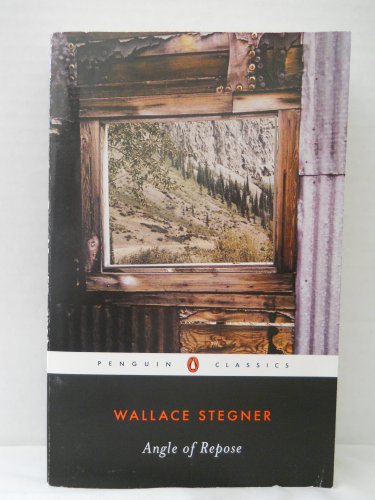
Stegner’s Pulitzer Prize-winning novel of personal, historical, and geographic discovery
Confined to a wheelchair, retired historian Lyman Ward sets out to write his grandparents' remarkable story, chronicling their days spent carving civilization into the surface of America's western frontier. But his research reveals even more about his own life than he's willing to admit. What emerges is an enthralling portrait of four generations in the life of an American family.
"Cause for celebration . . . A superb novel with an amplitude of scale and richness of detail altogether uncommon in contemporary fiction." —The Atlantic Monthly
"Brilliant . . . Two stories, past and present, merge to produce what important fiction must: a sense of the enchantment of life." —Los Angeles Times
This Penguin Classics edition features an introduction by Jackson J. Benson.
For more than sixty-five years, Penguin has been the leading publisher of classic literature in the English-speaking world. With more than 1,500 titles, Penguin Classics represents a global bookshelf of the best works throughout history and across genres and disciplines. Readers trust the series to provide authoritative texts enhanced by introductions and notes by distinguished scholars and contemporary authors, as well as up-to-date translations by award-winning translators.
Die Inhaltsangabe kann sich auf eine andere Ausgabe dieses Titels beziehen.
Über die Autorin bzw. den Autor
Wallace Stegner was born in 1909 in Lake Mills, Iowa. The son of Scandinavian immigrants, he traveled with his parents and brother all over the West-to North Dakota, Washington, Saskatchewan, Montana, and Wyoming-before settling in Salt Lake City in 1921. Many of the landscapes he encountered in his peripatetic youth figure largely in his work, as do characters based on his stern father and athletic, outgoing brother. Stegner received most of his education in Utah, graduating from the University in 1930. He furthered his education at the University of Iowa, where he received a master's and a doctoral degree. He married Mary Stuart Page in 1934, and for the next decade the couple followed Wallace's teaching career-to the University of Wisconsin, Harvard, and eventually to Stanford University, where he founded the creative writing program, and where he was to remain until his retirement in 1971. A number of his creative writing students have become some of today's most well respected writers, including Wendell Berry, Thomas McGuane, Raymond Carver, Edward Abbey, Robert Stone, and Larry McMurty.
Throughout his career and after, Stegner's literary output was tremendous. His first novel, Remembering Laughter, was published in 1937. By the time of his death in 1993 he had published some two dozen works of fiction, history, biography, and essays. Among his many literary prizes are the Pulitzer Prize for Angle of Repose (1971) and the National Book Award forThe Spectator Bird (1976). His collection of essays, Where the Bluebird Sings to the Lemonade Springs (1992), was nominated for the National Book Critics Circle award.
Although his fiction deals with many universal themes, Stegner is primarily recognized as a writer of the American West. Much of his literature deals with debunking myths of the West as a romantic country of heroes on horseback, and his passion for the terrain and its inhabitants have earned him the title 'The Dean of Western Letters'. He was one of the few true Men of Letters in this generation. An historian, essayist, short story writer and novelist, as well as a leading environmental writer. Although always connected in people's minds with the West, he had a long association with New England. Many short stories and one of his most successful novels, Crossing to Safety, are set in Vermont, where he had a summer home for many years. Another novel,The Spectator Bird, takes place in Denmark.
An early environmentalist, he actively championed the region's preservation and was instrumental-with his now-famous 'Wilderness Letter'-in the passage of the 1964 Wilderness Act. Honest and straightforward, educated yet unpretentious, cantankerous yet compassionate,Wallace Stegner was an enormous presence in the American literary landscape, a man who wrote and lived with ferocity, energy, and integrity.
Jackson J. Benson teaches American Literature at San Diego State University. His biography,The True Adventures of John Steinbeck, Writer, won the PEN USA West award for nonfiction. He lives in La Mesa, California.
Auszug. © Genehmigter Nachdruck. Alle Rechte vorbehalten.
Grass Valley
Now I believe they will leave me alone. Obviously Rodman came up hoping to find evidence of my incompetence--though how an incompetent could have got this place renovated, moved his library up, and got himself transported to it without arousing the suspicion of his watchful children, ought to be a hard one for Rodman to answer. I take some pride in the way I managed all that. And he went away this afternoon without a scrap of what he would call data.
So tonight I can sit here with the tape recorder whirring no more noisily than electrified time, and say into the microphone the place and date of a sort of beginning and a sort of return: Zodiac Cottage, Grass Valley, California, April 12, 1970.
Right there, I might say to Rodman, who doesn't believe in time, notice something: I started to establish the present and the present moved on. What I established is already buried under layers of tape. Before I can say I am, I was. Heraclitus and I, prophets of flux, know that the flux is composed of parts that imitate and repeat each other. Am or was, I am cumulative, too. I am everything I ever was, whatever you and Leah may think. I am much of what my parents and especially my grandparents were--inherited stature, coloring, brains, bones (that part unfortunate), plus transmitted prejudices, culture, scruples, likings, moralities, and moral errors that I defend as if they were personal and not familial.
Even places, especially this house whose air is thick with the past. My antecedents support me here as the old wistaria at the corner supports the house. Looking at its cables wrapped two or three times around the cottage, you would swear, and you could be right, that if they were cut the place would fall down.
Rodman, like most sociologists and most of his generation, was born without the sense of history. To him it is only an aborted social science. The world has changed, Pop, he tells me. The past isn't going to teach us anything about what we've got ahead of us. Maybe it did once, or seemed to. It doesn't any more.
Probably he thinks the blood vessels of my brain are as hardened as my cervical spine. They probably discuss me in bed. Out of his mind, going up there by himself . . . How can we, unless . . . helpless . . . roll his wheelchair off the porch who'd rescue him? Set himself afire lighting a cigar, who'd put him out? . . . Damned old independent mule-headed . . . worse than a baby. Never consider the trouble he makes for the people who have to look after him . . . House I grew up in, he says. Papers, he says, thing I've always wanted to do . . . All of Grandmother's papers, books, reminiscences, pictures, those hundreds of letters that came back from Augusta Hudson's daughter after Augusta died . . . A lot of Grandfather's relics, some of Father's, some of my own . . . Hundred year chronicle of the family. All right, fine. Why not give that stuff to the Historical Society and get a fat tax deduction? He could still work on it. Why box it all up, and himself too, in that old crooked house in the middle of twelve acres of land we could all make a good thing out of if he'd consent to sell? Why go off and play cobwebs like a character in a Southern novel, out where nobody can keep an eye on him?
They keep thinking of my good, in their terms. I don't blame them, I only resist them. Rodman will have to report to Leah that I have rigged the place to fit my needs and am getting along well. I have had Ed shut off the whole upstairs except for my bedroom and bath and this study. Downstairs we use only the kitchen and library and the veranda. Everything tidy and shipshape and orderly. No data.
So I may anticipate regular visits of inspection and solicitude while they wait for me to get a belly full of independence. They will look sharp for signs of senility and increasing pain--will they perhaps even hope for them? Meantime they will walk softly, speak quietly, rattle the oatbag gently, murmuring and moving closer until the arm can slide the rope over the stiff old neck and I can be led away to the old folks' pasture down in Menlo Park where the care is so good and there is so much to keep the inmates busy and happy. If I remain stubborn, the decision may eventually have to be made for me, perhaps by computer. Who could argue with a computer? Rodman will punch all his data onto cards and feed them into his machine and it will tell us all it is time.
I would have them understand that I am not just killing time during my slow petrifaction. I am neither dead nor inert. My head still works. Many things are unclear to me, including myself, and I want to sit and think. Who ever had a better opportunity? What if I can't turn my head? I can look in any direction by turning my wheelchair, and I choose to look back. Rodman to the contrary notwithstanding, that is the only direction we can learn from.
Increasingly, after my amputation and during the long time when I lay around feeling sorry for myself, I came to feel like the contour bird. I wanted to fly around the Sierra foothills backward, just looking. If there was no longer any sense in pretending to be interested in where I was going. I could consult where I've been. And I don't mean the Ellen business. I honestly believe this isn't that personal. The Lyman Ward who married Ellen Hammond and begot Rodman Ward and taught history and wrote certain books and monographs about the Western frontier, and suffered certain personal catastrophes and perhaps deserved them and survives them after a fashion and now sits talking to himself into a microphone--he doesn't matter that much any more. I would like to put him in a frame of reference and comparison. Fooling around in the papers my grandparents, especially my grandmother, left behind, I get glimpses of lives close to mine, related to mine in ways I recognize but don't completely comprehend. I'd like to live in their clothes a while, if only so I don't have to live in my own. Actually, as I look down my nose to where my left leg bends and my right leg stops, I realize that it isn't backward I want to go, but downward. I want to touch once more the ground I have been maimed away from.
In my mind I write letters to the newspapers, saying Dear Editor, As a modern man and a one-legged man, I can tell you that the conditions are similar. We have been cut off, the past has been ended and the family has broken up and the present is adrift in its wheelchair. I had a wife who after twenty-five years of marriage took on the coloration of the 1960s. I have a son who, though we are affectionate with each other, is no more my true son than if he breathed through gills. That is no gap between the generations, that is a gulf. The elements have changed, there are whole new orders of magnitude and kind. This present of 1970 is no more an extension of my grandparents' world, this West is no more a development of the West they helped build, than the sea over Santorin is an extension of that once-island of rock and olives. My wife turns out after a quarter of a century to be someone I never knew, my son starts all fresh from his own premises.
My grandparents had to live their way out of one world and into another, or into several others, making new out of old the way corals live their reef upward. I am on my grandparents' side. I believe in Time, as they did, and in the life chronological rather than in the life existential. We live in time and through it, we build our huts in its ruins, or used to, and we cannot afford all these abandonings.
And so on. The letters fade like conversation. If I spoke to Rodman in those terms, saying that my grandparents' lives seem to me organic and ours what? hydroponic? he would ask in derision what I meant. Define my terms. How do you measure the organic residue of a man or a generation? This is all metaphor. If you can't measure it,...
„Über diesen Titel“ kann sich auf eine andere Ausgabe dieses Titels beziehen.
Suchergebnisse für Angle of Repose (Penguin Twentieth-Century Classics)

Beispielbild für diese ISBN
Angle of Repose (Penguin Twentieth-Century Classics)
Anbieter: World of Books (was SecondSale), Montgomery, IL, USA
Verkäuferbewertung 5 von 5 Sternen

Zustand: Good. Item in good condition. Textbooks may not include supplemental items i.e. CDs, access codes etc. Artikel-Nr. 00109208239
Gebraucht kaufen
EUR 4,30
Versand gratis
Versand innerhalb von USA
Versand innerhalb von USA
Anzahl: 3 verfügbar
Beispielbild für diese ISBN
Angle of Repose (Penguin Twentieth-Century Classics)
Anbieter: World of Books (was SecondSale), Montgomery, IL, USA
Verkäuferbewertung 5 von 5 Sternen
Zustand: Acceptable. Item in acceptable condition! Textbooks may not include supplemental items i.e. CDs, access codes etc. Artikel-Nr. 00087952088
Gebraucht kaufen
EUR 4,30
Versand gratis
Versand innerhalb von USA
Versand innerhalb von USA
Anzahl: 5 verfügbar
Beispielbild für diese ISBN
Angle of Repose (Penguin Twentieth-Century Classics)
Verlag:
Penguin Classics (edition ), 2000
ISBN 10: 0141185473
ISBN 13: 9780141185477
Gebraucht
Paperback
Anbieter: BooksRun, Philadelphia, PA, USA
Verkäuferbewertung 5 von 5 Sternen
Paperback. Zustand: Fair. The item might be beaten up but readable. May contain markings or highlighting, as well as stains, bent corners, or any other major defect, but the text is not obscured in any way. Artikel-Nr. 0141185473-7-1
Gebraucht kaufen
EUR 4,79
Versand gratis
Versand innerhalb von USA
Versand innerhalb von USA
Anzahl: 1 verfügbar
Beispielbild für diese ISBN
Angle of Repose (Penguin Twentieth-Century Classics)
Anbieter: World of Books (was SecondSale), Montgomery, IL, USA
Verkäuferbewertung 5 von 5 Sternen
Zustand: Acceptable. Item in very good condition! Textbooks may not include supplemental items i.e. CDs, access codes etc. Artikel-Nr. 00076555147
Gebraucht kaufen
EUR 5,84
Versand gratis
Versand innerhalb von USA
Versand innerhalb von USA
Anzahl: 1 verfügbar
Beispielbild für diese ISBN
Angle of Repose (Penguin Twentieth-Century Classics)
Verlag:
Penguin Classics (edition ), 2000
ISBN 10: 0141185473
ISBN 13: 9780141185477
Gebraucht
Paperback
Anbieter: BooksRun, Philadelphia, PA, USA
Verkäuferbewertung 5 von 5 Sternen
Paperback. Zustand: Very Good. It's a well-cared-for item that has seen limited use. The item may show minor signs of wear. All the text is legible, with all pages included. It may have slight markings and/or highlighting. Artikel-Nr. 0141185473-11-22
Gebraucht kaufen
EUR 5,99
Versand gratis
Versand innerhalb von USA
Versand innerhalb von USA
Anzahl: 1 verfügbar
Beispielbild für diese ISBN
Angle of Repose (Penguin Twentieth-Century Classics)
Anbieter: Wonder Book, Frederick, MD, USA
Verkäuferbewertung 5 von 5 Sternen
Zustand: Very Good. Very Good condition. A copy that may have a few cosmetic defects. May also contain light spine creasing or a few markings such as an owner's name, short gifter's inscription or light stamp. Artikel-Nr. P05D-00062
Gebraucht kaufen
EUR 6,28
Versand gratis
Versand innerhalb von USA
Versand innerhalb von USA
Anzahl: 1 verfügbar
Beispielbild für diese ISBN
Angle of Repose (Penguin Twentieth-Century Classics)
Anbieter: Wonder Book, Frederick, MD, USA
Verkäuferbewertung 5 von 5 Sternen
Zustand: Good. Good condition. A copy that has been read but remains intact. May contain markings such as bookplates, stamps, limited notes and highlighting, or a few light stains. Artikel-Nr. E04B-03147
Gebraucht kaufen
EUR 6,28
Versand gratis
Versand innerhalb von USA
Versand innerhalb von USA
Anzahl: 2 verfügbar
Beispielbild für diese ISBN
Angle of Repose (Penguin Twentieth-Century Classics)
Anbieter: ThriftBooks-Dallas, Dallas, TX, USA
Verkäuferbewertung 5 von 5 Sternen
Paperback. Zustand: Good. No Jacket. Pages can have notes/highlighting. Spine may show signs of wear. ~ ThriftBooks: Read More, Spend Less. Artikel-Nr. G0141185473I3N00
Gebraucht kaufen
EUR 6,74
Versand gratis
Versand innerhalb von USA
Versand innerhalb von USA
Anzahl: 5 verfügbar
Beispielbild für diese ISBN
Angle of Repose (Penguin Twentieth-Century Classics)
Anbieter: ThriftBooks-Atlanta, AUSTELL, GA, USA
Verkäuferbewertung 5 von 5 Sternen
Paperback. Zustand: Good. No Jacket. Pages can have notes/highlighting. Spine may show signs of wear. ~ ThriftBooks: Read More, Spend Less. Artikel-Nr. G0141185473I3N00
Gebraucht kaufen
EUR 6,74
Versand gratis
Versand innerhalb von USA
Versand innerhalb von USA
Anzahl: 4 verfügbar
Beispielbild für diese ISBN
Angle of Repose (Penguin Twentieth-Century Classics)
Anbieter: ThriftBooks-Atlanta, AUSTELL, GA, USA
Verkäuferbewertung 5 von 5 Sternen
Paperback. Zustand: Fair. No Jacket. Readable copy. Pages may have considerable notes/highlighting. ~ ThriftBooks: Read More, Spend Less. Artikel-Nr. G0141185473I5N00
Gebraucht kaufen
EUR 6,74
Versand gratis
Versand innerhalb von USA
Versand innerhalb von USA
Anzahl: 1 verfügbar