
Verwandte Artikel zu A Room with a View (Penguin Classics): E.M. Forster
Inhaltsangabe
'My first intimation of the possibilities of fiction' Zadie Smith
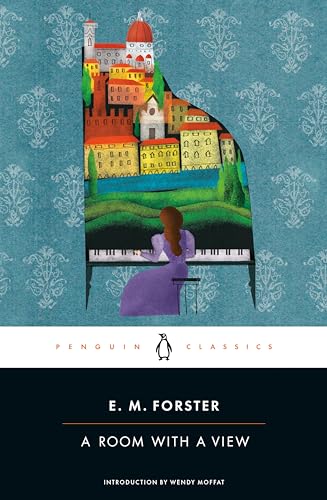
More than a love story, A Room with a View is a penetrating social comedy and a brilliant study of contrasts - in values, social class, and cultural perspectives - and the ingenuity of fate. Its heroine, Lucy Honeychurch, visits Italy with her prim cousin Charlotte as a chaperone, where she meets the unconventional, lower class Mr. Emerson and his son, George. Upon her return to England, Lucy becomes engaged to the supercilious Cecil Vyse, but finds herself increasingly torn between the expectations of the world in which she moves and the passionate yearnings of her heart.
With an Introduction by Malcolm Bradbury and Introduction And Suggestions For Further Reading by Wendy Moffat made in 2018
Die Inhaltsangabe kann sich auf eine andere Ausgabe dieses Titels beziehen.
Über die Autorin bzw. den Autor
Edward Morgan Forster was born in London in 1879. He wrote six novels, four of which appeared before the First World War, Where Angels Fear to Tread (1905), The Longest Journey (1907), A Room with a View (1908), and Howard’s End (1910). An interval of fourteen years elapsed before he published A Passage to India. Maurice, his novel on a homosexual theme, finished in 1914, was published posthumously in 1971.
Malcolm Bradbury was a novelist, critic, television dramatist and Emeritus Professor of American Studies at the University of East Anglia. He is author of the novels Eating People is Wrong (1959); Stepping Westward (1965); The History Man (1975); Rates of Exchange (1983) which was shortlisted for the Booker Prize; Cuts: A Very Short Novel (1987); and Doctor Criminale (1992). His critical works include The Modern American Novel (1984; revised edition, 1992); No, Not Bloomsbury (essays, 1987); The Modern world: Ten Great Writers (1988); From Puritanism to Post-modernism: A History of American Literature (with Richard Ruland, 1991).
Von der hinteren Coverseite
Visiting Florence with her cousin Charlotte as a chaperone, Lucy Honeychurch meets the unconventional, lower-class Mr Emerson and his son, George. Upon her return to England, Lucy becomes engaged to the supercilious Cecil Vyse, but she finds herself increasingly torn between the expectations of the world and the yearnings of her heart.
Auszug. © Genehmigter Nachdruck. Alle Rechte vorbehalten.
Chapter One
The Bertolini
The Signora had no business to do it," said Miss Bartlett, "no business at all. She promised us south rooms with a view close together, instead of which here are north rooms, looking into a courtyard, and a long way apart. Oh, Lucy!"
"And a Cockney, besides!" said Lucy, who had been further saddened by the Signora's unexpected accent. "It might be London." She looked at the two rows of English people who were sitting at the table; at the row of white bottles of water and red bottles of wine that ran between the English people; at the portraits of the late Queen and the late Poet Laureate that hung behind the English people, heavily framed; at the notice of the English church (Rev. Cuthbert Eager, M.A. Oxon.), that was the only other decoration of the wall. "Charlotte, don't you feel, too, that we might be in London? I can hardly believe that all kinds of other things are just outside. I suppose it is one's being so tired."
"This meat has surely been used for soup," said Miss Bartlett, laying down her fork.
"I want so to see the Arno. The rooms the Signora promised us in her letter would have looked over the Arno. The Signora had no business to do it at all. Oh, it is a shame!"
"Any nook does for me," Miss Bartlett continued; "but it does seem hard that you shouldn't have a view."
Lucy felt that she had been selfish. "Charlotte, you mustn't spoil me: of course, you must look over the Arno, too. I meant that. The first vacant room in the front-"
"You must have it," said Miss Bartlett, part of whose travelling expenses were paid by Lucy's mother-a piece of generosity to which she made many a tactful allusion.
"No, no. You must have it."
"I insist on it. Your mother would never forgive me, Lucy."
"She would never forgive me."
The ladies' voices grew animated and-if the sad truth be owned-a little peevish. They were tired, and under the guise of unselfishness they wrangled. Some of their neighbours interchanged glances, and one of them-one of the ill-bred people whom one does meet abroad-leant forward over the table and actually intruded into their argument. He said:
"I have a view, I have a view."
Miss Bartlett was startled. Generally at a pension people looked them over for a day or two before speaking, and often did not find out that they would "do" till they had gone. She knew that the intruder was ill-bred, even before she glanced at him. He was an old man, of heavy build, with a fair, shaven face and large eyes. There was something childish in those eyes, though it was not the childishness of senility. What exactly it was Miss Bartlett did not stop to consider, for her glance passed on to his clothes. These did not attract her. He was probably trying to become acquainted with them before they got into the swim. So she assumed a dazed expression when he spoke to her, and then said: "A view? Oh, a view! How delightful a view is!"
"This is my son," said the old man; "his name's George. He has a view too."
"Ah," said Miss Bartlett, repressing Lucy, who was about to speak.
"What I mean," he continued, "is that you can have our rooms, and we'll have yours. We'll change."
The better class of tourist was shocked at this, and sympathized with the new-comers. Miss Bartlett, in reply, opened her mouth as little as possible, and said:
"Thank you very much indeed; that is out of the question."
"Why?" said the old man, with both fists on the table.
"Because it is quite out of the question, thank you."
"You see, we don't like to take-" began Lucy.
Her cousin again repressed her.
"But why?" he persisted. "Women like looking at a view; men don't." And he thumped with his fists like a naughty child, and turned to his son, saying, "George, persuade them!"
"It's so obvious they should have the rooms," said the son. "There's nothing else to say
„Über diesen Titel“ kann sich auf eine andere Ausgabe dieses Titels beziehen.
Suchergebnisse für A Room with a View (Penguin Classics): E.M. Forster

Foto des Verkäufers
A Room with a View (Penguin Classics)
Anbieter: Dream Books Co., Denver, CO, USA
Verkäuferbewertung 5 von 5 Sternen

Zustand: acceptable. This copy has clearly been enjoyedâ"expect noticeable shelf wear and some minor creases to the cover. Binding is strong, and all pages are legible. May contain previous library markings or stamps. Artikel-Nr. 4EKGRJ00D3IQ_ns
Gebraucht kaufen
EUR 5,81
Versand gratis
Versand innerhalb von USA
Versand innerhalb von USA
Anzahl: 1 verfügbar
Beispielbild für diese ISBN
A Room with a View (Penguin Classics)
Anbieter: Wonder Book, Frederick, MD, USA
Verkäuferbewertung 5 von 5 Sternen
Zustand: Good. Good condition. A copy that has been read but remains intact. May contain markings such as bookplates, stamps, limited notes and highlighting, or a few light stains. Artikel-Nr. M11O-1344
Gebraucht kaufen
EUR 8,71
Versand gratis
Versand innerhalb von USA
Versand innerhalb von USA
Anzahl: 1 verfügbar
Beispielbild für diese ISBN
A Room with a View EM Forster
Anbieter: World of Books (was SecondSale), Montgomery, IL, USA
Verkäuferbewertung 5 von 5 Sternen
Zustand: Good. Item in good condition. Textbooks may not include supplemental items i.e. CDs, access codes etc. Artikel-Nr. 00108872669
Gebraucht kaufen
EUR 9,15
Versand gratis
Versand innerhalb von USA
Versand innerhalb von USA
Anzahl: 2 verfügbar
Beispielbild für diese ISBN
A Room with a View
Verlag:
Penguin Publishing Group, 2000
ISBN 10: 0141183292
ISBN 13: 9780141183299
Gebraucht
Softcover
Anbieter: Better World Books, Mishawaka, IN, USA
Verkäuferbewertung 5 von 5 Sternen
Zustand: Good. Pages intact with minimal writing/highlighting. The binding may be loose and creased. Dust jackets/supplements are not included. Stock photo provided. Product includes identifying sticker. Better World Books: Buy Books. Do Good. Artikel-Nr. GRP72351992
Gebraucht kaufen
EUR 11,49
Versand gratis
Versand innerhalb von USA
Versand innerhalb von USA
Anzahl: 2 verfügbar
Beispielbild für diese ISBN
A Room with a View
Verlag:
Penguin Publishing Group, 2000
ISBN 10: 0141183292
ISBN 13: 9780141183299
Gebraucht
Softcover
Anbieter: Better World Books Ltd, Dunfermline, Vereinigtes Königreich
Verkäuferbewertung 5 von 5 Sternen
Zustand: Very Good. Former library copy. Pages intact with possible writing/highlighting. Binding strong with minor wear. Dust jackets/supplements may not be included. Includes library markings. Stock photo provided. Product includes identifying sticker. Better World Books: Buy Books. Do Good. Artikel-Nr. GRP67641040
Gebraucht kaufen
EUR 6,20
EUR 5,83 Versand
Versand von Vereinigtes Königreich nach USA
Versand von Vereinigtes Königreich nach USA
Anzahl: 1 verfügbar
Beispielbild für diese ISBN
A Room with a View
Verlag:
Penguin Publishing Group, 2000
ISBN 10: 0141183292
ISBN 13: 9780141183299
Gebraucht
Softcover
Anbieter: Better World Books Ltd, Dunfermline, Vereinigtes Königreich
Verkäuferbewertung 5 von 5 Sternen
Zustand: Good. Former library copy. Pages intact with minimal writing/highlighting. The binding may be loose and creased. Dust jackets/supplements are not included. Includes library markings. Stock photo provided. Product includes identifying sticker. Better World Books: Buy Books. Do Good. Artikel-Nr. GRP18633082
Gebraucht kaufen
EUR 6,20
EUR 5,83 Versand
Versand von Vereinigtes Königreich nach USA
Versand von Vereinigtes Königreich nach USA
Anzahl: 3 verfügbar
Foto des Verkäufers
a-room-with-a-view
Anbieter: WeBuyBooks, Rossendale, LANCS, Vereinigtes Königreich
Verkäuferbewertung 5 von 5 Sternen
Zustand: Good. Most items will be dispatched the same or the next working day. A copy that has been read but remains in clean condition. All of the pages are intact and the cover is intact and the spine may show signs of wear. The book may have minor markings which are not specifically mentioned. Artikel-Nr. rev7784885993
Gebraucht kaufen
EUR 7,33
EUR 6,77 Versand
Versand von Vereinigtes Königreich nach USA
Versand von Vereinigtes Königreich nach USA
Anzahl: 1 verfügbar
Beispielbild für diese ISBN
A Room with a View
Anbieter: PBShop.store UK, Fairford, GLOS, Vereinigtes Königreich
Verkäuferbewertung 5 von 5 Sternen
PAP. Zustand: New. New Book. Shipped from UK. Established seller since 2000. Artikel-Nr. DB-9780141183299
Neu kaufen
EUR 12,94
EUR 3,84 Versand
Versand von Vereinigtes Königreich nach USA
Versand von Vereinigtes Königreich nach USA
Anzahl: 15 verfügbar
Beispielbild für diese ISBN
A Room with a View (Penguin Classics)
Verlag:
Penguin Classics 31/08/2000, 2000
ISBN 10: 0141183292
ISBN 13: 9780141183299
Gebraucht
Softcover
Anbieter: AwesomeBooks, Wallingford, Vereinigtes Königreich
Verkäuferbewertung 5 von 5 Sternen
Zustand: Very Good. This book is in very good condition and will be shipped within 24 hours of ordering. The cover may have some limited signs of wear but the pages are clean, intact and the spine remains undamaged. This book has clearly been well maintained and looked after thus far. Money back guarantee if you are not satisfied. See all our books here, order more than 1 book and get discounted shipping. . Artikel-Nr. 7719-9780141183299
Gebraucht kaufen
EUR 11,99
EUR 4,81 Versand
Versand von Vereinigtes Königreich nach USA
Versand von Vereinigtes Königreich nach USA
Anzahl: 1 verfügbar
Beispielbild für diese ISBN
A Room with a View: E.M. Forster (Penguin Classics)
Verlag:
Penguin Books Ltd, United Kingdom, London, 2000
ISBN 10: 0141183292
ISBN 13: 9780141183299
Gebraucht
Paperback
Anbieter: WorldofBooks, Goring-By-Sea, WS, Vereinigtes Königreich
Verkäuferbewertung 5 von 5 Sternen
Paperback. Zustand: Very Good. 'My first intimation of the possibilities of fiction' Zadie SmithMore than a love story, A Room with a View is a penetrating social comedy and a brilliant study of contrasts - in values, social class, and cultural perspectives - and the ingenuity of fate. Its heroine, Lucy Honeychurch, visits Italy with her prim cousin Charlotte as a chaperone, where she meets the unconventional, lower class Mr. Emerson and his son, George. Upon her return to England, Lucy becomes engaged to the supercilious Cecil Vyse, but finds herself increasingly torn between the expectations of the world in which she moves and the passionate yearnings of her heart.With an Introduction by Malcolm Bradbury. The book has been read, but is in excellent condition. Pages are intact and not marred by notes or highlighting. The spine remains undamaged. Artikel-Nr. GOR001286534
Gebraucht kaufen
EUR 12,50
EUR 6,53 Versand
Versand von Vereinigtes Königreich nach USA
Versand von Vereinigtes Königreich nach USA
Anzahl: 8 verfügbar