
Verwandte Artikel zu Life Class (The Life Class Trilogy, 1)
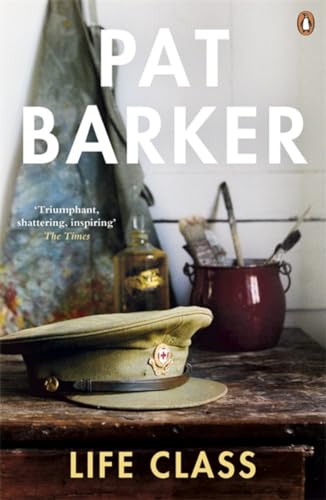
Inhaltsangabe
From the Booker Prize-winning and Women's Prize-shortlisted author of The Silence of the Girls
The first novel in Pat Barker's acclaimed 'Life Class' trilogy - an unforgettable story of art and war, from one of our greatest writers on war and the human heart
'Triumphant, inspiring, shattering' The Times
'Barker writes as brilliantly as ever... With great tenderness and insight she conveys a wartime world turned upside down' Independent on Sunday
'Masterly, gripping' Penelope Lively
'Extraordinarily powerful' Sunday Telegraph
Spring, 1914. The students at the Slade School of Art gather in Henry Tonks's studio for his life-drawing class. But for Paul Tarrant the class is troubling, underscoring his own uncertainty about making a mark on the world. When war breaks out and the army won't take Paul, he enlists in the Belgian Red Cross just as he and fellow student Elinor Brooke admit their feelings for one another. Amidst the devastation in Ypres, Paul comes to see the world anew - but have his experiences changed him completely?
The Life Class trilogy:
Life Class
Toby's Room
Noonday
Die Inhaltsangabe kann sich auf eine andere Ausgabe dieses Titels beziehen.
Über die Autorin bzw. den Autor
Pat Barker was born in Yorkshire and began her literary career in her forties, when she took a short writing course taught by Angela Carter. She has published sixteen novels, including her masterful Regeneration Trilogy which includes the Booker Prize-winning The Ghost Road. The Silence of the Girls was shortlisted for the Women's Prize for Fiction and won an Independent Bookshop Award 2019. The Women of Troy was a number one Sunday Times bestseller. The Voyage Home continues the series.
Auszug. © Genehmigter Nachdruck. Alle Rechte vorbehalten.
1
They’d been drawing for over half an hour. There was no sound except for the slurring of pencils on Michelet paper or the barely perceptible squeak of charcoal. At the center of the circle of students, close to the dais, a stove cast a barred red light onto the floor. The smell of burning coke mingled with other smells: sweat, hot cloth, cigar and tobacco smoke. Now and again you could hear the soft pop of lips inhaling and another plume of blue smoke would rise to join the pall that hung over the whole room.
Nobody spoke. You were not allowed to talk in the life class. In the Antiques Room, where they spent the mornings copying from casts of Classical and Renaissance sculpture, talking was permitted, and the students—a few of the women, in particular—chattered nonstop. Here, apart from the naked woman on the dais, the atmosphere was not unlike a men’s club. The women students had their own separate life class somewhere on the lower floor. Even the Slade, scandalously modern in most respects, segregated the sexes when the naked human body was on display.
Paul Tarrant, sitting on the back row, as far away from the stove as he could get, coughed discreetly into his handkerchief. He was still struggling to throw off the bronchitis that had plagued him all winter and the fumes irritated his lungs. He’d finished his drawing, or at least he’d reached the point where he knew that further work would only make matters worse. He leaned back and contemplated the page. Not one of his better efforts.
He knew, without turning to look, that Professor Tonks had entered the room. It was always like this with Tonks, the quiet entry. He seemed to insinuate himself into the room. You knew he’d arrived only when you saw the students sitting opposite straighten their shoulders or bend more anxiously over their drawings. Tonks was a dark planet whose presence could be deduced only by a deviation in the orbit of other bodies.
Paul risked a sidelong glance. Tonks, bent at the shoulders like a butcher’s hook, was scrutinizing a student’s drawing. He said something, too low to be heard. The student mumbled a reply and Tonks moved on. Another student, then another. He was working his way along the back row, passing quickly from drawing to drawing. Sugden brought him to a halt. Sugden was hopeless, among the worst in the class. Tonks always spent more time on the weaker students, which indicated a kindly disposition, perhaps, or would have done had he not left so many of them in tatters.
So far his progress had been quiet, but now suddenly he raised his voice.
“For God’s sake, man, look at that arm. It’s got no more bones in it than a sausage. Your pencil’s blunt, your easel’s wobbly, you’re working in your own light, and you seem to have no grasp of human anatomy at all. What is the point?”
Many of Tonks’s strictures related to the students’ ignorance of anatomy. “Is it a blancmange?” had been one of his comments on Paul’s early efforts. Tonks had trained as a surgeon and taught anatomy to medical students before Professor Browne invited him to join the staff at the Slade. His eye, honed in the dissecting room and the theater, detected every failure to convey what lay beneath the skin. “Look for the line,” he would say again and again. “Drawing is an explication of the form.” It was one of the catchphrases Slade students sometimes chanted to each other. Along with: “I thy God am a jealous God. Thou shalt have none other Tonks but me.”
There was no getting round Tonks’s opinion of your work. Tonks was the Slade.
Paul looked at his drawing. If he’d been dissatisfied before he was dismayed now. As Tonks drew closer, his drawing became mysteriously weaker. Not only had he failed to “explicate the form,” but he’d also tried to cover up the failure with all the techniques he’d learned before coming to the Slade: shading, cross–hatching, variations in tone, even, now and then, a little discreet smudging of the line. In the process, he’d produced the kind of drawing that at school—and even, later, in night classes—had evoked oohs and ahs of admiration. Once, not so long ago, he’d have been pleased with this work; now, he saw its deficiencies only too clearly. Not only was the drawing bad, it was bad in exactly the way Tonks most despised. More than just a failure, it was a dishonest failure.
He took a deep breath. A second later Tonks’s shadow fell across the page, though he immediately moved a little to one side so that the full awfulness could be revealed. A long pause. Then he said conversationally, as if he were really interested in the answer, “Is that really the best you can do?”
“Yes.”
“Then why do it?”
Why indeed? Paul made no reply and after a moment Tonks moved on. At last, from somewhere, a rush of anger. “If I knew how to draw I wouldn’t need to be here at all, would I?”
He’d shouted, though he hadn’t meant to. All around people were turning to stare at him. Without giving Tonks a chance to reply, he threw down his pencil and walked out.
The corridor, empty between classes, stretched ahead of him. Its walls seemed to throb with his anger. The heat of it kept him going all the way to the main entrance and out into the quad. There he stopped and looked around him. What was he doing, storming out like that in the middle of a session? It was asking for trouble. And yet he knew he couldn’t go back. Students were sitting in small circles on the grass, laughing and talking, but they were mainly medical students enjoying a break between lectures, and there was nobody he knew. He threaded his way between the groups and out through the iron gates into Gower Street. At first he started to walk towards Russell Square, the nearest green space, but that wasn’t far enough. He needed to get right away, to think about his future in unfamiliar surroundings, because although, in one sense, his spat with Tonks had been relatively trivial, he felt that it marked a crisis in his career.
If you could call it a career.
*
He’d been walking round and round the lake for over an hour. His shadow, hardly visible when he first entered the park, now trotted at his heels like a stunted child. Round and round the problem went: no talent, wasting my time, better leave now and get a job. Or would it be more sensible to wait till the end of the year? He’d always intended to spend two years at the Slade and it seemed a bit feeble to leave before the first year was over, but then what was the point of continuing when his work not only failed to improve but actually seemed to deteriorate from week to week? It wasn’t as if he had unlimited money. He had a legacy from his grandmother, a slum landlord of quite astonishing rapacity who, by skimping on repairs and bringing up her large family on bread and scrape, had salted away a great deal of money in the box under her bed. What would her advice have been?
—Have nowt to do with nancy–boy stuff like art, there’s no money in that, and if you’ve got tangled up in it, lad, get out as fast as you can.
She’d been horrified when he went to work as an orderly in a hospital; real men earned their living by their own sweat and blood.
This was getting him nowhere. He found a bench and sat down, feeling the heat heavy on his shoulder blades. Craning his neck, he looked up at the tops of the trees, dark against the pulsing sun. Everything was flooded in lemony light. After a while he straightened up and looked about him, and it was then that he...
„Über diesen Titel“ kann sich auf eine andere Ausgabe dieses Titels beziehen.
Suchergebnisse für Life Class (The Life Class Trilogy, 1)

Beispielbild für diese ISBN
Life Class
Anbieter: World of Books (was SecondSale), Montgomery, IL, USA
Verkäuferbewertung 5 von 5 Sternen

Paperback. Zustand: Very Good. Spring, 1914. The students at the Slade School of Art gather in Henry Tonks' studio for his life-drawing class. When war breaks out and the army won't take Paul, he enlists in the Belgian Red Cross. Amidst the devastation in Ypres, Paul comes to see the world anew - but have his experiences changed him completely? Artikel-Nr. 00054757932
Gebraucht kaufen
EUR 6,12
Versand gratis
Versand innerhalb von USA
Versand innerhalb von USA
Anzahl: 2 verfügbar
Beispielbild für diese ISBN
Life Class
Anbieter: World of Books (was SecondSale), Montgomery, IL, USA
Verkäuferbewertung 5 von 5 Sternen
Paperback. Zustand: Good. Spring, 1914. The students at the Slade School of Art gather in Henry Tonks' studio for his life-drawing class. When war breaks out and the army won't take Paul, he enlists in the Belgian Red Cross. Amidst the devastation in Ypres, Paul comes to see the world anew - but have his experiences changed him completely? Artikel-Nr. 00054810453
Gebraucht kaufen
EUR 6,12
Versand gratis
Versand innerhalb von USA
Versand innerhalb von USA
Anzahl: 4 verfügbar
Beispielbild für diese ISBN
Life Class
Anbieter: ThriftBooks-Dallas, Dallas, TX, USA
Verkäuferbewertung 5 von 5 Sternen
Paperback. Zustand: Very Good. No Jacket. May have limited writing in cover pages. Pages are unmarked. ~ ThriftBooks: Read More, Spend Less. Artikel-Nr. G0141019476I4N00
Gebraucht kaufen
EUR 6,12
Versand gratis
Versand innerhalb von USA
Versand innerhalb von USA
Anzahl: 1 verfügbar
Beispielbild für diese ISBN
Life Class
Anbieter: World of Books (was SecondSale), Montgomery, IL, USA
Verkäuferbewertung 5 von 5 Sternen
Paperback. Zustand: Fair. Spring, 1914. The students at the Slade School of Art gather in Henry Tonks' studio for his life-drawing class. When war breaks out and the army won't take Paul, he enlists in the Belgian Red Cross. Amidst the devastation in Ypres, Paul comes to see the world anew - but have his experiences changed him completely? Artikel-Nr. 00057420841
Gebraucht kaufen
EUR 6,14
Versand gratis
Versand innerhalb von USA
Versand innerhalb von USA
Anzahl: 1 verfügbar
Beispielbild für diese ISBN
Life Class
Anbieter: Better World Books, Mishawaka, IN, USA
Verkäuferbewertung 5 von 5 Sternen
Zustand: Good. Pages intact with minimal writing/highlighting. The binding may be loose and creased. Dust jackets/supplements are not included. Stock photo provided. Product includes identifying sticker. Better World Books: Buy Books. Do Good. Artikel-Nr. GRP8943132
Gebraucht kaufen
EUR 6,57
Versand gratis
Versand innerhalb von USA
Versand innerhalb von USA
Anzahl: 1 verfügbar
Beispielbild für diese ISBN
Life Class
Anbieter: Better World Books, Mishawaka, IN, USA
Verkäuferbewertung 5 von 5 Sternen
Zustand: Good. Former library copy. Pages intact with minimal writing/highlighting. The binding may be loose and creased. Dust jackets/supplements are not included. Includes library markings. Stock photo provided. Product includes identifying sticker. Better World Books: Buy Books. Do Good. Artikel-Nr. GRP10112070
Gebraucht kaufen
EUR 6,57
Versand gratis
Versand innerhalb von USA
Versand innerhalb von USA
Anzahl: 1 verfügbar
Beispielbild für diese ISBN
Life Class
Anbieter: Better World Books: West, Reno, NV, USA
Verkäuferbewertung 5 von 5 Sternen
Zustand: Very Good. Pages intact with possible writing/highlighting. Binding strong with minor wear. Dust jackets/supplements may not be included. Stock photo provided. Product includes identifying sticker. Better World Books: Buy Books. Do Good. Artikel-Nr. 2003936-6
Gebraucht kaufen
EUR 6,57
Versand gratis
Versand innerhalb von USA
Versand innerhalb von USA
Anzahl: 1 verfügbar
Foto des Verkäufers
Life Class: 1 (The Life Class Trilogy, 1)
Anbieter: WeBuyBooks, Rossendale, LANCS, Vereinigtes Königreich
Verkäuferbewertung 5 von 5 Sternen
paperback. Zustand: Good. Most items will be dispatched the same or the next working day. A copy that has been read but remains in clean condition. All of the pages are intact and the cover is intact and the spine may show signs of wear. The book may have minor markings which are not specifically mentioned. Artikel-Nr. rev8486063498
Gebraucht kaufen
EUR 1,40
EUR 6,05 Versand
Versand von Vereinigtes Königreich nach USA
Versand von Vereinigtes Königreich nach USA
Anzahl: 7 verfügbar
Foto des Verkäufers
Life Class: 1 (The Life Class Trilogy, 1)
Anbieter: WeBuyBooks, Rossendale, LANCS, Vereinigtes Königreich
Verkäuferbewertung 5 von 5 Sternen
paperback. Zustand: Very Good. Most items will be dispatched the same or the next working day. A copy that has been read, but is in excellent condition. Pages are intact and not marred by notes or highlighting. The spine remains undamaged. Artikel-Nr. rev7528636348
Gebraucht kaufen
EUR 1,40
EUR 6,05 Versand
Versand von Vereinigtes Königreich nach USA
Versand von Vereinigtes Königreich nach USA
Anzahl: 3 verfügbar
Beispielbild für diese ISBN
Life Class: 1 (The Life Class Trilogy, 1)
Anbieter: AwesomeBooks, Wallingford, Vereinigtes Königreich
Verkäuferbewertung 5 von 5 Sternen
paperback. Zustand: Very Good. Life Class: 1 (The Life Class Trilogy, 1) This book is in very good condition and will be shipped within 24 hours of ordering. The cover may have some limited signs of wear but the pages are clean, intact and the spine remains undamaged. This book has clearly been well maintained and looked after thus far. Money back guarantee if you are not satisfied. See all our books here, order more than 1 book and get discounted shipping. Artikel-Nr. 7719-9780141019475
Gebraucht kaufen
EUR 2,86
EUR 4,86 Versand
Versand von Vereinigtes Königreich nach USA
Versand von Vereinigtes Königreich nach USA
Anzahl: 2 verfügbar