
Verwandte Artikel zu King Lear
Inhaltsangabe
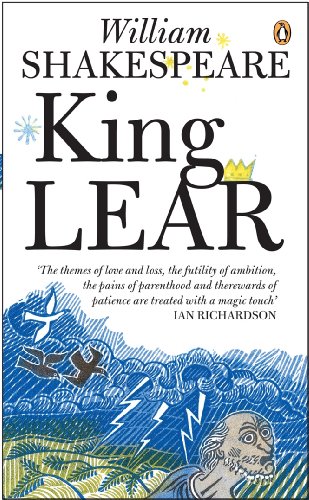
A moving tragedy of political intrigue and family strife, William Shakespeare's King Lear is edited by George Hunter, with an introduction by Kiernan Ryan in Penguin Shakespeare.
'How sharper than a serpent's tooth it is to have a thankless child!'
The ageing King Lear, tired of office, decides to split his kingdom between his three daughters, Goneril, Regan and Cordelia; but the decision to allot their share based on the love they express for him proves to be a terrible mistake. When Cordelia refuses to take part in her father's charade, she is banished, leaving the king dependent on her manipulative and untrustworthy sisters. In the scheming and recriminations that follow, not only does the king's own sanity crumble, but the stability of the realm itself is also threatened. Cast out into the wilderness with a wise Fool and a cunning madman, it is only after losing what he values most that Lear understands the depth of his folly.
This book contains a general introduction to Shakespeare's life and Elizabethan theatre, a separate introduction to King Lear, a chronology, suggestions for further reading, an essay discussing performance options on both stage and screen, and a commentary.
William Shakespeare (1564-1616) was born to John Shakespeare and Mary Arden some time in late April 1564 in Stratford-upon-Avon. He wrote about 38 plays (the precise number is uncertain), many of which are regarded as the most exceptional works of drama ever produced, including Romeo and Juliet (1595), Henry V (1599), Hamlet (1601), Othello (1604), King Lear (1606) and Macbeth (1606), as well as a collection of 154 sonnets, which number among the most profound and influential love-poetry in English.
If you enjoyed King Lear, you might like Othello, also available in Penguin Shakespeare.
'The themes of love and loss, the futility of ambition, the pains of parenthood and the rewards of patience are treated with a magic touch'
Ian Richardson
Die Inhaltsangabe kann sich auf eine andere Ausgabe dieses Titels beziehen.
Über die Autorin bzw. den Autor
William Shakespeare (1564-1616) was born to John Shakespeare and mother Mary Arden some time in late April 1564 in Stratford-upon-Avon. He wrote about 38 plays (the precise number is uncertain), a collection of sonnets and a variety of other poems.
Stanley Wells is Emeritus Professor of the University of Birmingham and Chairman of the Shakespeare Birthplace Trust.
Kiernan Ryan is Professor of English at Royal Holloway, University of London, and a Fellow of New Hall, University of Cambridge. He is the author of Shakespeare (3rd edn, 2002) and the editor of King Lear: Contemporary Critical Essays (1992) and Shakespeare: The Last Plays (1999).
Auszug. © Genehmigter Nachdruck. Alle Rechte vorbehalten.
Chapter One
Act 1 Scene 1 running scene 1
Enter Kent, Gloucester and Edmund
KENT I thought the king had more affected the Duke of Albany than Cornwall.
GLOUCESTER It did always seem so to us: but now in the division of the kingdom it appears not which of the dukes he values most, for qualities are so weighed that curiosity in neither can make choice of either's moiety.
KENT Is not this your son, my lord?
GLOUCESTER His breeding, sir, hath been at my charge. I have so often blushed to acknowledge him that now I am brazed to't.
KENT I cannot conceive you.
GLOUCESTER Sir, this young fellow's mother could; whereupon she grew round-wombed and had indeed, sir, a son for her cradle ere she had a husband for her bed. Do you smell a fault?
KENT I cannot wish the fault undone, the issue of it being so proper.
GLOUCESTER But I have a son, sir, by order of law, some year elder than this, who yet is no dearer in my account, though this knave came something saucily to the world before he was sent for: yet was his mother fair, there was good sport at his making and the whoreson must be acknowledged.- Do you know this noble gentleman, Edmund?
EDMUND No, my lord.
GLOUCESTER My lord of Kent: remember him hereafter as my honourable friend.
EDMUND My services to your lordship.
KENT I must love you, and sue to know you better.
EDMUND Sir, I shall study deserving.
GLOUCESTER He hath been out nine years, and away he shall again. The king is coming.
Sennet. Enter [one bearing a coronet, then] King Lear, Cornwall, Albany, Goneril, Regan, Cordelia and Attendants
LEAR Attend the lords of France and Burgundy, Gloucester.
GLOUCESTER I shall, my lord. Exit
LEAR Meantime we shall express our darker purpose.
Give me the map there. Kent or an Attendant gives Lear a map
Know that we have divided
In three our kingdom, and 'tis our fast intent
To shake all cares and business from our age,
Conferring them on younger strengths while we
Unburdened crawl toward death. Our son of
Cornwall,
And you our no less loving son of Albany,
We have this hour a constant will to publish
Our daughters' several dowers, that future strife
May be prevented now. The princes, France and
Burgundy,
Great rivals in our youngest daughter's love,
Long in our court have made their amorous sojourn
And here are to be answered. Tell me, my
daughters -
Since now we will divest us both of rule,
Interest of territory, cares of state -
Which of you shall we say doth love us most,
That we our largest bounty may extend
Where nature doth with merit challenge? Goneril,
Our eldest born, speak first.
GONERIL Sir, I love you more than word can wield the matter,
Dearer than eyesight, space and liberty,
Beyond what can be valued rich or rare,
No less than life, with grace, health, beauty, honour:
As much as child e'er loved or father found:
A love that makes breath poor and speech unable:
Beyond all manner of so much I love you.
CORDELIA What shall Cordelia speak? Love and be silent. Aside
LEAR Of all these bounds, even from this line to this, Points With shadowy forests and with champaigns riched, to the map
With plenteous rivers and wide-skirted meads,
We make thee lady. To thine and Albany's issues
Be this perpetual.- What says our second daughter?
Our dearest Regan, wife of Cornwall?
REGAN I am made of that self-mettle as my sister,
And prize me at her worth. In my true heart,
I find she names my very deed of love:
Only she comes too short, that I profess
Myself an enemy to all other joys
Which the most precious square of sense professes,
And find I am alone felicitate
In your dear highness' love.
CORDELIA Then poor Cordelia: Aside
And yet not so, since I am sure my love's
More ponderous than my tongue.
LEAR To thee and thine hereditary ever
Remain this ample third of our fair kingdom,
No less in space, validity and pleasure
Than that conferred on Goneril.- Now, our joy, To Cordelia
Although our last and least, to whose young love
The vines of France and milk of Burgundy
Strive to be interessed, what can you say to draw
A third more opulent than your sisters'? Speak.
CORDELIA Nothing, my lord.
LEAR Nothing?
CORDELIA Nothing.
LEAR Nothing will come of nothing: speak again.
CORDELIA Unhappy that I am, I cannot heave
My heart into my mouth: I love your majesty
According to my bond, no more nor less.
LEAR How, how, Cordelia? Mend your speech a little,
Lest you may mar your fortunes.
CORDELIA Good my lord,
You have begot me, bred me, loved me:
I return those duties back as are right fit,
Obey you, love you and most honour you.
Why have my sisters husbands if they say
They love you all? Happily when I shall wed,
That lord whose hand must take my plight shall
carry
Half my love with him, half my care and duty:
Sure I shall never marry like my sisters.
LEAR But goes thy heart with this?
CORDELIA Ay, my good lord.
LEAR So young and so untender?
CORDELIA So young, my lord, and true.
LEAR Let it be so: thy truth then be thy dower,
For by the sacred radiance of the sun,
The mysteries of Hecate and the night,
By all the operation of the orbs
From whom we do exist and cease to be,
Here I disclaim all my paternal care,
Propinquity and property of blood,
And as a stranger to my heart and me
Hold thee from this for ever. The barbarous Scythian,
Or he that makes his generation messes
To gorge his appetite, shall to my bosom
Be as well neighboured, pitied and relieved
As thou my sometime daughter.
KENT Good my liege-
LEAR Peace, Kent:
Come not between the dragon and his wrath.
I loved her most, and thought to set my rest
On her kind nursery.- Hence, and avoid my sight!- To
So be my grave my peace, as here I give Cordelia
Her father's heart from her. Call France. Who stirs?
Call Burgundy.- Cornwall and Albany,
[Exit Attendant]
With my two daughters' dowers digest the third.
Let pride, which she calls plainness, marry her.
I do invest you jointly with my power,
Pre-eminence, and all the large effects
That troop with majesty. Ourself by monthly course,
With reservation of an hundred knights
By you to be sustained, shall our abode
Make with you by due turn: only we shall retain
The name and all th'addition to a king: the sway,
Revenue, execution of the rest,
Belovèd sons, be yours, which to confirm,
This coronet part between you. Gives them coronet to break in half
KENT Royal Lear,
Whom I have ever honoured as my king,
Loved as my father, as my master followed,
As my great patron thought on in my prayers-
LEAR The bow is bent and drawn, make from the shaft.
KENT Let it fall rather, though the fork invade
The region of my heart: be Kent unmannerly
When Lear is mad. What wouldst thou do, old man?
Think'st thou that duty shall have dread to speak
When power to flattery bows? To plainness honour's
bound
When majesty falls to folly. Reserve thy state,
And in thy best consideration check
This hideous rashness. Answer my life my
judgement:
Thy youngest daughter does not love thee least,
Nor are those empty-hearted...
„Über diesen Titel“ kann sich auf eine andere Ausgabe dieses Titels beziehen.
Suchergebnisse für King Lear

Beispielbild für diese ISBN
King Lear
Anbieter: World of Books (was SecondSale), Montgomery, IL, USA
Verkäuferbewertung 5 von 5 Sternen

Zustand: Very Good. An ageing king makes a capricious decision to divide his realm among his three daughters according to the love they express for him. When the youngest daughter refuses to take part in this charade, she is banished, leaving the king dependent on her manipulative and untrustworthy sisters. Artikel-Nr. 00104704576
Gebraucht kaufen
EUR 5,73
Versand gratis
Versand innerhalb von USA
Versand innerhalb von USA
Anzahl: 1 verfügbar
Beispielbild für diese ISBN
King Lear
Anbieter: ThriftBooks-Dallas, Dallas, TX, USA
Verkäuferbewertung 5 von 5 Sternen
Unknown. Zustand: Very Good. No Jacket. May have limited writing in cover pages. Pages are unmarked. ~ ThriftBooks: Read More, Spend Less. Artikel-Nr. G0141012293I4N00
Gebraucht kaufen
EUR 7,05
Versand gratis
Versand innerhalb von USA
Versand innerhalb von USA
Anzahl: 1 verfügbar
Beispielbild für diese ISBN
King Lear
Anbieter: ThriftBooks-Dallas, Dallas, TX, USA
Verkäuferbewertung 5 von 5 Sternen
Unknown. Zustand: Very Good. No Jacket. Former library book; May have limited writing in cover pages. Pages are unmarked. ~ ThriftBooks: Read More, Spend Less. Artikel-Nr. G0141012293I4N10
Gebraucht kaufen
EUR 7,05
Versand gratis
Versand innerhalb von USA
Versand innerhalb von USA
Anzahl: 1 verfügbar
Foto des Verkäufers
King Lear
Anbieter: WeBuyBooks, Rossendale, LANCS, Vereinigtes Königreich
Verkäuferbewertung 5 von 5 Sternen
Paperback. Zustand: Good. Most items will be dispatched the same or the next working day. A copy that has been read but remains in clean condition. All of the pages are intact and the cover is intact and the spine may show signs of wear. The book may have minor markings which are not specifically mentioned. Artikel-Nr. rev7795051804
Gebraucht kaufen
EUR 1,35
EUR 6,20 Versand
Versand von Vereinigtes Königreich nach USA
Versand von Vereinigtes Königreich nach USA
Anzahl: 1 verfügbar
Beispielbild für diese ISBN
King Lear
Anbieter: AwesomeBooks, Wallingford, Vereinigtes Königreich
Verkäuferbewertung 5 von 5 Sternen
Mass Market Paperback. Zustand: Very Good. King Lear This book is in very good condition and will be shipped within 24 hours of ordering. The cover may have some limited signs of wear but the pages are clean, intact and the spine remains undamaged. This book has clearly been well maintained and looked after thus far. Money back guarantee if you are not satisfied. See all our books here, order more than 1 book and get discounted shipping. Artikel-Nr. 7719-9780141012292
Gebraucht kaufen
EUR 3,18
EUR 4,92 Versand
Versand von Vereinigtes Königreich nach USA
Versand von Vereinigtes Königreich nach USA
Anzahl: 2 verfügbar
Beispielbild für diese ISBN
King Lear
Anbieter: WorldofBooks, Goring-By-Sea, WS, Vereinigtes Königreich
Verkäuferbewertung 5 von 5 Sternen
Paperback. Zustand: Very Good. The book has been read, but is in excellent condition. Pages are intact and not marred by notes or highlighting. The spine remains undamaged. Artikel-Nr. GOR001271332
Gebraucht kaufen
EUR 3,13
EUR 6,69 Versand
Versand von Vereinigtes Königreich nach USA
Versand von Vereinigtes Königreich nach USA
Anzahl: 6 verfügbar
Beispielbild für diese ISBN
King Lear
Anbieter: Better World Books Ltd, Dunfermline, Vereinigtes Königreich
Verkäuferbewertung 5 von 5 Sternen
Zustand: Very Good. New Ed. Former library copy. Pages intact with possible writing/highlighting. Binding strong with minor wear. Dust jackets/supplements may not be included. Includes library markings. Stock photo provided. Product includes identifying sticker. Better World Books: Buy Books. Do Good. Artikel-Nr. GRP77086011
Gebraucht kaufen
EUR 5,73
EUR 5,97 Versand
Versand von Vereinigtes Königreich nach USA
Versand von Vereinigtes Königreich nach USA
Anzahl: 1 verfügbar
Beispielbild für diese ISBN
King Lear
Anbieter: Better World Books Ltd, Dunfermline, Vereinigtes Königreich
Verkäuferbewertung 5 von 5 Sternen
Zustand: Good. New Ed. Former library copy. Pages intact with minimal writing/highlighting. The binding may be loose and creased. Dust jackets/supplements are not included. Includes library markings. Stock photo provided. Product includes identifying sticker. Better World Books: Buy Books. Do Good. Artikel-Nr. GRP11296795
Gebraucht kaufen
EUR 5,73
EUR 5,97 Versand
Versand von Vereinigtes Königreich nach USA
Versand von Vereinigtes Königreich nach USA
Anzahl: 1 verfügbar
Beispielbild für diese ISBN
King Lear
Anbieter: Bahamut Media, Reading, Vereinigtes Königreich
Verkäuferbewertung 4 von 5 Sternen

Mass Market Paperback. Zustand: Very Good. This book is in very good condition and will be shipped within 24 hours of ordering. The cover may have some limited signs of wear but the pages are clean, intact and the spine remains undamaged. This book has clearly been well maintained and looked after thus far. Money back guarantee if you are not satisfied. See all our books here, order more than 1 book and get discounted shipping. Artikel-Nr. 6545-9780141012292
Gebraucht kaufen
EUR 3,38
EUR 8,34 Versand
Versand von Vereinigtes Königreich nach USA
Versand von Vereinigtes Königreich nach USA
Anzahl: 2 verfügbar
Beispielbild für diese ISBN
King Lear
Anbieter: medimops, Berlin, Deutschland
Verkäuferbewertung 5 von 5 Sternen
Zustand: good. Befriedigend/Good: Durchschnittlich erhaltenes Buch bzw. Schutzumschlag mit Gebrauchsspuren, aber vollständigen Seiten. / Describes the average WORN book or dust jacket that has all the pages present. Artikel-Nr. M00141012293-G
Gebraucht kaufen
EUR 4,37
EUR 10,00 Versand
Versand von Deutschland nach USA
Versand von Deutschland nach USA
Anzahl: 3 verfügbar