
Verwandte Artikel zu Meditations: Marcus Aurelius (Penguin Classics)
Inhaltsangabe
'Their icy blasts are refreshing and restorative. They tell you the worst. And having heard the worst, you feel less bad' Blake Morrison
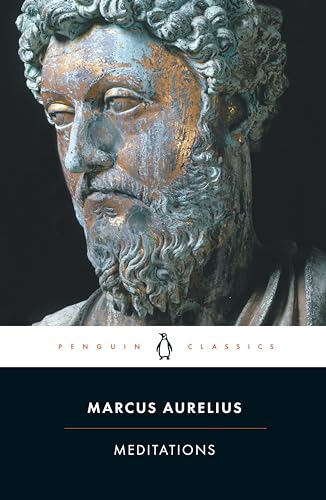
Written in Greek by the only Roman emperor who was also a philosopher, without any intention of publication, the Meditations of Marcus Aurelius offer a remarkable series of challenging spiritual reflections and exercises developed as the emperor struggled to understand himself and make sense of the universe. While the Meditations were composed to provide personal consolation and encouragement, Marcus Aurelius also created one of the greatest of all works of philosophy: a timeless collection that has been consulted and admired by statesmen, thinkers and readers throughout the centuries.
Translated with notes by MARTIN HAMMOND with an Introduction by DISKIN CLAY
Die Inhaltsangabe kann sich auf eine andere Ausgabe dieses Titels beziehen.
Über die Autorin bzw. den Autor
Marcus Aelius Aurelius Antoninus, 121-180. was adopted by the emperor Antoninus Pius and succeeded him in 161, (as joint emperor with adoptive brother Lucius Verus). He ruled alone from 169. He spent much of his reign in putting down variou rebellions, and was a persecutor of Christians. His fame rest, above all, on his Meditations, a series of reflections, strongly influenced by Epictetus, which represent a Stoic outlook on life. He died in 180 and was succeed by his natural son, thus ending the period of the adoptive emperors.
Diskin Clay is Professor of Classical Studies at Duke University and has published widely in the area of Ancient Greek Philosophy.
Martin Hammond is Head Master of Tonbridge School and has translated Homer's Iliad for Penguin Classics.
Von der hinteren Coverseite
A series of spiritual exercises filled with wisdom, practical guidance, and profound understanding of human behavior, Marcus Aurelius's "Meditations remains one of the greatest works of spiritual and ethical reflection ever written. Marcus's insights and advice--on everything from living in the world to coping with adversity and interacting with others--have made the "Meditations required reading for statesmen and philosophers alike, while generations of ordinary readers have responded to the straightforward intimacy of his style.
In Gregory Hays's new translation--the first in a generation--Marcus's thoughts speak with a new immediacy: never before have they been so directly and powerfully presented.
"From the Trade Paperback edition.
Auszug. © Genehmigter Nachdruck. Alle Rechte vorbehalten.
Book 1
Debts and Lessons
1. My grandfather Verus
Character and self-control.
2. My father (from my own memories and
his reputation)
Integrity and manliness.
3. My mother
Her reverence for the divine, her generosity, her inability not only to do wrong but even to conceive of doing it. And the simple way she lived-not in the least like the rich.
4. My great-grandfather
To avoid the public schools, to hire good private teachers, and to accept the resulting costs as money well-spent.
5. My first teacher
Not to support this side or that in chariot-racing, this fighter or that in the games. To put up with discomfort and not make demands. To do my own work, mind my own business, and have no time for slanderers.
6. Diognetus
Not to waste time on nonsense. Not to be taken in by conjurors and hoodoo artists with their talk about incantations and exorcism and all the rest of it. Not to be obsessed with quail-fighting or other crazes like that. To hear unwelcome truths. To practice philosophy, and to study with Baccheius, and then with Tandasis and Marcianus. To write dialogues as a student. To choose the Greek lifestyle-the camp-bed and the cloak.
7. Rusticus
The recognition that I needed to train and discipline my character.
Not to be sidetracked by my interest in rhetoric. Not to write treatises on abstract questions, or deliver moralizing little sermons, or compose imaginary descriptions of The Simple Life or The Man Who Lives Only for Others. To steer clear of oratory, poetry and belles lettres.
Not to dress up just to stroll around the house, or things like that. To write straightforward letters (like the one he sent my mother from Sinuessa). And to behave in a conciliatory way when people who have angered or annoyed us want to make up.
To read attentively-not to be satisfied with "just getting the gist of it." And not to fall for every smooth talker.
And for introducing me to Epictetus's lectures-and loaning me his own copy.
8. Apollonius
Independence and unvarying reliability, and to pay attention to nothing, no matter how fleetingly, except the logos. And to be the same in all circumstances-intense pain, the loss of a child, chronic illness. And to see clearly, from his example, that a man can show both strength and flexibility.
His patience in teaching. And to have seen someone who clearly viewed his expertise and ability as a teacher as the humblest of virtues.
And to have learned how to accept favors from friends without losing your self-respect or appearing ungrateful.
9. Sextus
Kindness.
An example of fatherly authority in the home. What it means to live as nature requires.
Gravity without airs.
To show intuitive sympathy for friends, tolerance to amateurs and sloppy thinkers. His ability to get along with everyone: sharing his company was the highest of compliments, and the opportunity an honor for those around him.
To investigate and analyze, with understanding and logic, the principles we ought to live by.
Not to display anger or other emotions. To be free of passion and yet full of love.
To praise without bombast; to display expertise without pretension.
10. The literary critic Alexander
Not to be constantly correcting people, and in particular not to jump on them whenever they make an error of usage or a grammatical mistake or mispronounce something, but just answer their question or add another example, or debate the issue itself (not their phrasing), or make some other contribution to the discussion-and casually insert the correct expression.
11. Fronto
To recognize the malice, cunning and hypocrisy that power produces, and the peculiar ruthlessness often shown by people from "good families."
12. Alexander the Platonist
Not to be constantly telling people (or writing them) that I'm too busy, unless I really am. Similarly, not to be always ducking my responsibilities to the people around me because of "pressing business."
13. Catulus
Not to shrug off a friend's resentment-even unjustified resentment-but try to put things right.
To show your teachers ungrudging respect (the Domitius and Athenodotus story), and your children unfeigned love.
14. [My brother] Severus
To love my family, truth and justice. It was through him that I encountered Thrasea, Helvidius, Cato, Dion and Brutus, and conceived of a society of equal laws, governed by equality of status and of speech, and of rulers who respect the liberty of their subjects above all else.
And from him as well, to be steady and consistent in valuing philosophy.
And to help others and be eager to share, not to be a pessimist, and never to doubt your friends' affection for you. And that when people incurred his disapproval, they always knew it. And that his friends never had to speculate about his attitude to anything: it was always clear.
15. Maximus
Self-control and resistance to distractions.
Optimism in adversity-especially illness.
A personality in balance: dignity and grace together.
Doing your job without whining.
Other people's certainty that what he said was what he thought, and what he did was done without malice.
Never taken aback or apprehensive. Neither rash nor hesitant-or bewildered, or at a loss. Not obsequious-but not aggressive or paranoid either.
Generosity, charity, honesty.
The sense he gave of staying on the path rather than being kept on it.
That no one could ever have felt patronized by him-or in a position to patronize him.
A sense of humor.
16. My adopted father
Compassion. Unwavering adherence to decisions, once he'd reached them. Indifference to superficial honors. Hard work. Persistence.
Listening to anyone who could contribute to the public good.
His dogged determination to treat people as they deserved.
A sense of when to push and when to back off.
Putting a stop to the pursuit of boys.
His altruism. Not expecting his friends to keep him entertained at dinner or to travel with him (unless they wanted to). And anyone who had to stay behind to take care of something always found him the same when he returned.
His searching questions at meetings. A kind of single-mindedness, almost, never content with first impressions, or breaking off the discussion prematurely.
His constancy to friends-never getting fed up with them, or playing favorites.
Self-reliance, always. And cheerfulness.
And his advance planning (well in advance) and his discreet attention to even minor things.
His restrictions on acclamations-and all attempts to flatter him.
His constant devotion to the empire's needs. His stewardship of the treasury. His willingness to take responsibility-and blame-for both.
His attitude to the gods: no superstitiousness. And his attitude to men: no demagoguery, no currying favor, no pandering. Always sober, always steady, and never vulgar or a prey to fads.
The way he handled the material comforts that fortune had supplied him in such abundance-without arrogance and without apology. If they were there, he took advantage of them. If not, he didn't miss them.
No one ever called him glib, or shameless, or pedantic. They saw him for what he was: a man tested by life, accomplished, unswayed by flattery, qualified to govern both himself and them.
His respect for people who practiced philosophy-at least, those who were sincere about it. But without denigrating the others-or listening to them.
His ability to feel...
„Über diesen Titel“ kann sich auf eine andere Ausgabe dieses Titels beziehen.
Suchergebnisse für Meditations: Marcus Aurelius (Penguin Classics)

Beispielbild für diese ISBN
Meditations
Anbieter: World of Books (was SecondSale), Montgomery, IL, USA
Verkäuferbewertung 5 von 5 Sternen

Paperback. Zustand: Good. Written in Greek by an intellectual Roman emperor without any intention of publication, the Meditations of Marcus Aurelius (AD 121-180) offer a wide range of fascinating spiritual reflections and exercises developed as the leader struggled to understand himself and make sense of the universe. Spanning from doubt and despair to conviction and exaltation, they cover such diverse topics as the question of virtue, human rationality, the nature of the gods and Aurelius's own emotions. But while the Meditations were composed to provide personal consolation, in developing his beliefs Marcus also created one of the greatest of all works of philosophy: a series of wise and practical aphorisms that have been consulted and admired by statesmen, thinkers and ordinary readers for almost two thousand years. Artikel-Nr. CIN0140449337G
Gebraucht kaufen
EUR 5,50
Versand gratis
Versand innerhalb von USA
Versand innerhalb von USA
Anzahl: 2 verfügbar
Beispielbild für diese ISBN
Meditations
Anbieter: World of Books (was SecondSale), Montgomery, IL, USA
Verkäuferbewertung 5 von 5 Sternen
Paperback. Zustand: Very Good. Written in Greek by an intellectual Roman emperor without any intention of publication, the Meditations of Marcus Aurelius (AD 121-180) offer a wide range of fascinating spiritual reflections and exercises developed as the leader struggled to understand himself and make sense of the universe. Spanning from doubt and despair to conviction and exaltation, they cover such diverse topics as the question of virtue, human rationality, the nature of the gods and Aurelius's own emotions. But while the Meditations were composed to provide personal consolation, in developing his beliefs Marcus also created one of the greatest of all works of philosophy: a series of wise and practical aphorisms that have been consulted and admired by statesmen, thinkers and ordinary readers for almost two thousand years. Artikel-Nr. CIN0140449337VG
Gebraucht kaufen
EUR 5,50
Versand gratis
Versand innerhalb von USA
Versand innerhalb von USA
Anzahl: 2 verfügbar
Beispielbild für diese ISBN
Meditations
Anbieter: World of Books (was SecondSale), Montgomery, IL, USA
Verkäuferbewertung 5 von 5 Sternen
Paperback. Zustand: Fair. Written in Greek by an intellectual Roman emperor without any intention of publication, the Meditations of Marcus Aurelius (AD 121-180) offer a wide range of fascinating spiritual reflections and exercises developed as the leader struggled to understand himself and make sense of the universe. Spanning from doubt and despair to conviction and exaltation, they cover such diverse topics as the question of virtue, human rationality, the nature of the gods and Aurelius's own emotions. But while the Meditations were composed to provide personal consolation, in developing his beliefs Marcus also created one of the greatest of all works of philosophy: a series of wise and practical aphorisms that have been consulted and admired by statesmen, thinkers and ordinary readers for almost two thousand years. Artikel-Nr. CIN0140449337A
Gebraucht kaufen
EUR 5,50
Versand gratis
Versand innerhalb von USA
Versand innerhalb von USA
Anzahl: 1 verfügbar
Beispielbild für diese ISBN
Meditations (Penguin Classics)
Anbieter: Housing Works Online Bookstore, New York, NY, USA
Verkäuferbewertung 5 von 5 Sternen
Paperback. Zustand: Good. Artikel-Nr. mon-ug-0140449337
Gebraucht kaufen
EUR 6,10
EUR 3,55 Versand
Versand innerhalb von USA
Versand innerhalb von USA
Anzahl: 1 verfügbar
Beispielbild für diese ISBN
Meditations
Verlag:
Penguin Publishing Group, 2006
ISBN 10: 0140449337
ISBN 13: 9780140449334
Gebraucht
Softcover
Anbieter: Better World Books, Mishawaka, IN, USA
Verkäuferbewertung 5 von 5 Sternen
Zustand: Good. Pages intact with minimal writing/highlighting. The binding may be loose and creased. Dust jackets/supplements are not included. Stock photo provided. Product includes identifying sticker. Better World Books: Buy Books. Do Good. Artikel-Nr. 4254085-6
Gebraucht kaufen
EUR 11,13
Versand gratis
Versand innerhalb von USA
Versand innerhalb von USA
Anzahl: 1 verfügbar
Beispielbild für diese ISBN
Meditations (Penguin Classics)
Anbieter: Majestic Books, Hounslow, Vereinigtes Königreich
Verkäuferbewertung 4 von 5 Sternen

Zustand: New. pp. 304. Artikel-Nr. 8235014
Neu kaufen
EUR 8,19
EUR 7,69 Versand
Versand von Vereinigtes Königreich nach USA
Versand von Vereinigtes Königreich nach USA
Anzahl: 1 verfügbar
Beispielbild für diese ISBN
Meditations
Anbieter: PBShop.store UK, Fairford, GLOS, Vereinigtes Königreich
Verkäuferbewertung 5 von 5 Sternen
PAP. Zustand: New. New Book. Shipped from UK. Established seller since 2000. Artikel-Nr. L2-9780140449334
Neu kaufen
EUR 12,66
EUR 3,89 Versand
Versand von Vereinigtes Königreich nach USA
Versand von Vereinigtes Königreich nach USA
Anzahl: 5 verfügbar
Beispielbild für diese ISBN
Meditations (Penguin Classics)
Verlag:
Penguin Classics October 2006, 2006
ISBN 10: 0140449337
ISBN 13: 9780140449334
Neu
New Trade
Anbieter: Editions Book Store, Kannapolis, NC, USA
Verkäuferbewertung 4 von 5 Sternen
New Trade. Zustand: New. Brand New copy. Artikel-Nr. 104968
Neu kaufen
EUR 11,02
EUR 5,80 Versand
Versand innerhalb von USA
Versand innerhalb von USA
Anzahl: 1 verfügbar
Beispielbild für diese ISBN
Meditations: Marcus Aurelius (Penguin Classics)
Anbieter: Kennys Bookstore, Olney, MD, USA
Verkäuferbewertung 5 von 5 Sternen
Zustand: New. 2006. paperback. A series of reflections, strongly influenced by Epictetus, which represent a Stoic outlook on life. It offers a range of fascinating spiritual reflections and exercises developed as the leader struggled to understand himself and make sense of the universe. Editor(s): Hammond, Martin. Translator(s): Hammond, Martin. Num Pages: 304 pages. BIC Classification: HPCA; HRAB1. Category: (G) General (US: Trade). Dimension: 197 x 130 x 19. Weight in Grams: 226. . . . . Books ship from the US and Ireland. Artikel-Nr. 9780140449334
Neu kaufen
EUR 11,74
EUR 9,36 Versand
Versand innerhalb von USA
Versand innerhalb von USA
Anzahl: 3 verfügbar
Beispielbild für diese ISBN
Meditations
Anbieter: Revaluation Books, Exeter, Vereinigtes Königreich
Verkäuferbewertung 5 von 5 Sternen
Paperback. Zustand: Brand New. annotated edition. 304 pages. 7.75x5.25x0.75 inches. In Stock. Artikel-Nr. __0140449337
Neu kaufen
EUR 11,41
EUR 11,84 Versand
Versand von Vereinigtes Königreich nach USA
Versand von Vereinigtes Königreich nach USA
Anzahl: 1 verfügbar