
Verwandte Artikel zu The Count of Monte Cristo: Translated and with an Introducti...
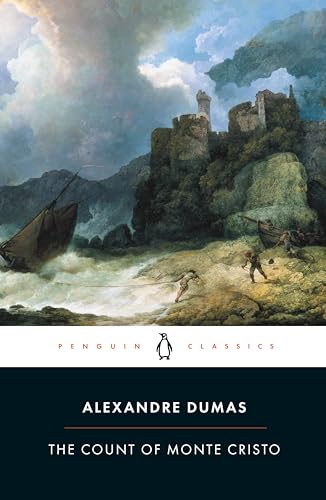
The Count of Monte Cristo: Translated and with an Introduction and Notes by Robin Russ (Penguin Classics) - Softcover
Inhaltsangabe
One of the grandest tales of adventure, Alexandre Dumas’s epic novel of revenge, perseverance, lost love, and self-invention—now a PBS Masterpiece miniseries starring Sam Claflin and Jeremy Irons
“My desert island book . . . No matter how many times I revisit it, I find new lines to appreciate, new narrative corners to explore.”—V. E. Schwab, The New York Times Book Review
Thrown in prison for a crime he has not committed, Edmond Dantès is confined to the grim fortress of the Château d’If. There he learns of a great hoard of treasure hidden on the Isle of Monte Cristo and he becomes determined not only to escape, but also to use the treasure to plot the destruction of the three men responsible for his incarceration.
Robin Buss’s lively translation is complete and unabridged, and remains faithful to the style of Dumas’s original. This edition includes an introduction, chronology, explanatory notes, and suggestions for further reading.
Penguin Classics is the leading publisher of classic literature in the English-speaking world, representing a global bookshelf of the best works throughout history and across genres and disciplines. Readers trust the series to provide authoritative texts enhanced by introductions and notes by distinguished scholars and contemporary authors, as well as up-to-date translations by award-winning translators.
Die Inhaltsangabe kann sich auf eine andere Ausgabe dieses Titels beziehen.
Über die Autorin bzw. den Autor
Alexandre Dumas (1802–1870) was the son of Napoleon’s famous general Dumas. A prolific author, his body of work includes a number of popular classics, including The Three Musketeers and The Man in the Iron Mask.
Robin Buss (1939–2006) was a writer and translator who worked for the Independent on Sunday and as television critic for the Times Educational Supplement. He was also the translator of a number of volumes for Penguin Classics.
Auszug. © Genehmigter Nachdruck. Alle Rechte vorbehalten.
The Count of Monte Cristo
By Alexandre DumasPenguin Books
Copyright ©2003 Alexandre DumasAll right reserved.
ISBN: 0140449264
Chapter One
Chapter I
ON FEBRUARY 24, 1815, the watchtower at Marseilles signaled the arrival of the three-master Pharaon, coming from Smyrna, Trieste and Naples.
The quay was soon covered with the usual crowd of curious onlookers, for the arrival of a ship is always a great event in Marseilles, especially when, like the Pharaon, it has been built, rigged and laden in the city and belongs to a local shipowner.
Meanwhile the vessel was approaching the harbor under topsails, jib and foresail, but so slowly and with such an air of melancholy that the onlookers, instinctively sensing misfortune, began to wonder what accident could have happened on board. However, the experienced seamen among them saw that if there had been an accident, it could not have happened to the ship herself, for she had every appearance of being under perfect control. Standing beside the pilot, who was preparing to steer the Pharaon through the narrow entrance of the harbor, was a young man who, with vigilant eyes and rapid gestures, watched every movement of the ship and repeated each of the pilot's orders.
The vague anxiety hovering over the crowd affected one man so much that he could not wait until the ship entered the harbor: he leaped into a small boat and ordered the boatman to row him out to meet the Pharaon.
When he saw this man coming toward him, the young sailor left his post beside the pilot and walked over to the side of the ship, holding his hat in his hand. He was a tall, slender young man, no more than twenty years old, with dark eyes and hair as black as ebony. His whole manner gave evidence of that calmness and resolution peculiar to those who have been accustomed to facing danger ever since their childhood.
"Ah, it's you, Dantès!" cried the man in the boat. "What's happened? Why does everything look so gloomy on board?"
"A great misfortune, Monsieur Morrel!" replied the young man. "We lost our brave Captain Leclère off Civitavecchia."
"What about the cargo?" asked the shipowner eagerly.
"It arrived safely, Monsieur Morrel, and I think you'll be satisfied on that score, but poor Captain Leclère-"
"What happened to him?" asked the shipowner, visibly relieved.
"He died of brain fever, in horrible agony. He's now at rest off the Isle of II Giglio, sewed up in his hammock with one cannon ball at his head and another at his feet." The young man smiled sadly and added, "How ironic-he waged war against the English for ten long years and then died in his bed like anyone else."
"Well, we're all mortal," said the shipowner, "and the old must make way for the young, otherwise there would be no promotion."
As they were passing the Round Tower, the young sailor called out, "Make ready to lower topsails, foresail and jib!" The order was executed as smartly as on board a man-of-war. "Lower away and brail all!" At this last order all the sails were lowered and the ship's speed became almost imperceptible.
"And now, if you'd like to come aboard, Monsieur Morrel," said Dantès, seeing the shipowner's impatience, "you can talk to your purser, Monsieur Danglars, who's just coming out of his cabin. He can give you all the information you want. As for myself, I must look after the anchoring and dress the ship in mourning."
The shipowner did not wait to be invited twice. He grasped the line which Dantès threw to him and, with an agility that would have done credit to a sailor, climbed up the ladder attached to the ship's side. Dantès returned to his duties, while Danglars came out to meet Monsieur Morrel. The purser was a man of twenty-five or twenty-six with a rather melancholy face, obsequious to his superiors and arrogant to his subordinates. He was as much disliked by the crew as Edmond Dantès was liked by them.
"Well, Monsieur Morrel," said Danglars, "I suppose you've heard about our misfortune."
"Yes, I have. Poor Captain Leclère! He was a brave and honorable man."
"And an excellent seaman, too, grown old between the sky and the water, as a man should be when he's entrusted with the interests of such an important firm as Morrel and Son."
"But," said the shipowner, watching Dantès preparing to drop anchor, "it seems to me a man doesn't have to be old to do his work well, Danglars. Our friend Edmond there doesn't look as though he needs advice from anyone."
"Yes," said Danglars, casting Dantès a glance full of hatred, "he's young and he has no doubts about anything. As soon as the captain was dead he took command without consulting anyone, and he made us lose a day and a half at the Isle of Elba instead of coming straight back to Marseilles."
"As for taking command," said the shipowner, "it was his duty as first mate, but he was wrong to waste a day and a half at the Isle of Elba, unless the ship needed some sort of repairs."
"The ship was as sound as I am and as I hope you are, Monsieur Morrel. Wasting that day and a half was nothing but a whim of his; he just wanted to go ashore for a while, that's all."
"Dantès," said Morrel, turning toward the young man, "come here, please."
"Excuse me, sir, I'll be with you in a moment," said Dantès. Then, turning to the crew, he called out, "Let go!" The anchor dropped immediately and the chain rattled noisily. Dantès walked over to Morrel.
"I wanted to ask you why you stopped at the Isle of Elba."
"It was to carry out an order from Captain Leclère. As he was dying he gave me a package to deliver to Marshal Bertrand there."
"Did you see him, Edmond?"
"Yes."
Morrel looked around and drew Dantès off to one side. "How is the emperor?" he asked eagerly.
"He's well, as far as I could tell. He came into the marshal's room while I was there."
"Did you talk to him?"
"No, he talked to me," said Dantès, smiling.
"What did he say?"
"He asked me about the ship, when it had left for Marseilles, what route it had taken and what cargo it was carrying. I think that if the ship had been empty and I had been its owner he would have tried to buy it from me, but I told him I was only the first mate and that it belonged to the firm of Morrel and Son. 'I know that firm,' he said. 'The Morrels have been shipowners for generations and there was a Morrel in my regiment when I was garrisoned at Valence.' "
"That's true!" exclaimed Morrel, delighted. "It was Policar Morrel, my uncle. He later became a captain." Then, giving Dantès a friendly tap on the shoulder, he said, "You were quite right to follow Captain Leclère's instructions and stop at the Isle of Elba, although you might get into trouble if it became known that you gave the marshal a package and spoke to the emperor."
"How could it get me into trouble?" asked Dantès. "I don't even know what was in the package, and the emperor only asked me the same questions he would have asked any other newcomer. But excuse me for a moment, sir; I see the health and customs officers coming on board."
Danglars stepped up as the young man walked away. "Well," he said, "he seems to have given you some good reasons for his stopover."
"He gave me excellent reasons, Monsieur Danglars."
"That's good; it's always painful to see a friend fail to do his duty."
"Dantès did his duty well," replied the shipowner. "It was Captain Leclère, who ordered the stopover."
"Speaking of Captain Leclère, didn't Dantès give you a letter from him?"
"No. Was there one?"
"I thought Captain Leclère gave him a letter along with the package."
"What package, Danglars?"
"Why, the one Dantès delivered to the Isle of Elba."
"How do you know he delivered a package there?"
Danglars flushed. "The captain's door was ajar when I was passing by," he said, "and I saw him give Dantès a package and a letter."
"He didn't say anything to me about it, but if he has the letter I'm sure he'll give it to me."
Danglars was silent for a moment, then he said, "Monsieur Morrel, please don't mention it to Dantès; I must have been mistaken."
Just then Dantès returned and Danglars walked away.
"Well, Dantès, have you finished now?"
"Yes, sir."
"Then will you come to dinner with us?"
"Please excuse me, Monsieur Morrel, but I think I owe my first visit to my father. Just the same, I'm grateful for the honor of your invitation."
"You're right, Dantès. You're a good son. But we'll be expecting you after you've visited your father."
"Excuse me again, Monsieur Morrel, but after that first visit there's another one that's equally important to me."
"Oh, yes; I was forgetting that there's someone who must be waiting for you as impatiently as your father-the beautiful Mercédès. You're a lucky man, Edmond, and you have a very pretty mistress."
"She's not my mistress, sir," said the young sailor gravely. "She's my fiancée."
"That's sometimes the same thing," said Morrel, laughing.
"Not with us, sir," replied Dantès.
"Well, I won't keep you any longer; you've taken care of my affairs so well that I want to give you as much time as possible to take care of your own. Do you have anything else to tell me?"
"No."
"Didn't Captain Leclère give you a letter for me before he died?"
"He was unable to write, sir. But that reminds me that I must ask you for two weeks' leave."
"To get married?"
"First of all; and then to go to Paris."
"Very well, take as long as you like, Dantès. It will take at least six weeks to unload the cargo, and we won't be ready to put to sea again before another three months or so. But in three months you'll have to be here. The Pharaon," continued the shipowner, patting the young sailor on the shoulder, "can't leave without her captain."
"Without her captain!" cried Dantès, his eyes flashing with joy. "Do you really intend to make me captain of the Pharaon?"
"If I were alone, my dear Dantès, I'd shake your hand and say, 'It's done.' But I have a partner, and you know the Italian proverb, 'He who has a partner has a master.' The thing is at least half done, though, since you already have one vote out of two. Leave it to me to get you the other one; I'll do my best."
"Oh, Monsieur Morrel!" cried Dantès, grasping the ship-owner's hand with tears in his eyes. "I thank you in the name of my father and of Mercédès."
"That's all right, Edmond. Go see your father, go see Mercedes, then come back to see me."
"Don't you want me to take you ashore?"
"No, thanks; I'll stay on board and look over the accounts with Danglars. Were you satisfied with him during the trip?"
"That depends on how you mean the question, sir. If you're asking me if I was satisfied with him as a comrade, the answer is no; I think he's disliked me ever since the day we had a little quarrel and I was foolish enough to suggest that we stop for ten minutes at the Isle of Monte Cristo to settle it, a suggestion which I was wrong to make and which he was right to refuse. But if you're speaking of him as a purser, I think there's nothing to be said against him and that you'll be quite satisfied with the way he's done his work."
"If you were captain of the Pharaon, would you be glad to keep him?"
"Whether I'm captain or first mate, Monsieur Morrel," replied Dantès. "I'll always have great respect for those who have the confidence of my shipowners."
"Good, good, Dantès! I see you're a fine young man in every way. But don't let me hold you back any longer-I can see how anxious you are to leave."
"May I take your skiff?"
"Certainly."
"Good-bye, Monsieur Morrel, and thank you from the bottom of my heart."
The young sailor leaped into the skiff and sat down in the stern, giving orders to be rowed to the Canebière. Smiling, the shipowner watched him until he saw him jump ashore, after which he was immediately swallowed up in the crowd. When he turned around, Morrel saw Danglars standing behind him, also following the young sailor's movements. But there was a great difference in the expression of the two men as they both watched Edmond Dantès.
-
From the Paperback edition.
Continues...
Excerpted from The Count of Monte Cristoby Alexandre Dumas Copyright ©2003 by Alexandre Dumas. Excerpted by permission.
All rights reserved. No part of this excerpt may be reproduced or reprinted without permission in writing from the publisher.
Excerpts are provided by Dial-A-Book Inc. solely for the personal use of visitors to this web site.
„Über diesen Titel“ kann sich auf eine andere Ausgabe dieses Titels beziehen.
Suchergebnisse für The Count of Monte Cristo: Translated and with an Introducti...

Beispielbild für diese ISBN
The Count of Monte Cristo
Anbieter: PBShop.store UK, Fairford, GLOS, Vereinigtes Königreich
Verkäuferbewertung 5 von 5 Sternen

PAP. Zustand: New. New Book. Shipped from UK. Established seller since 2000. Artikel-Nr. GB-9780140449266
Neu kaufen
EUR 13,70
EUR 6,85 Versand
Versand von Vereinigtes Königreich nach USA
Versand von Vereinigtes Königreich nach USA
Anzahl: 15 verfügbar
Beispielbild für diese ISBN
Count of Monte Cristo
Anbieter: Magers and Quinn Booksellers, Minneapolis, MN, USA
Verkäuferbewertung 5 von 5 Sternen
paperback. Zustand: New. Brand New. Artikel-Nr. 604983
Neu kaufen
EUR 17,66
EUR 3,52 Versand
Versand innerhalb von USA
Versand innerhalb von USA
Anzahl: 6 verfügbar
Beispielbild für diese ISBN
The Count of Monte Cristo
Anbieter: Majestic Books, Hounslow, Vereinigtes Königreich
Verkäuferbewertung 4 von 5 Sternen

Zustand: New. pp. xxviii + 1276. Artikel-Nr. 8235017
Neu kaufen
EUR 17,22
EUR 7,58 Versand
Versand von Vereinigtes Königreich nach USA
Versand von Vereinigtes Königreich nach USA
Anzahl: 3 verfügbar
Beispielbild für diese ISBN
The Count of Monte Cristo
Anbieter: Roundabout Books, Greenfield, MA, USA
Verkäuferbewertung 4 von 5 Sternen
paperback. Zustand: New. New from the publisher. Artikel-Nr. 1694023
Beispielbild für diese ISBN
The Count of Monte Cristo
Anbieter: Revaluation Books, Exeter, Vereinigtes Königreich
Verkäuferbewertung 5 von 5 Sternen
Paperback. Zustand: Brand New. reissue edition. 1312 pages. 7.75x5.25x2.25 inches. In Stock. Artikel-Nr. __0140449264
Neu kaufen
EUR 19,11
EUR 14,58 Versand
Versand von Vereinigtes Königreich nach USA
Versand von Vereinigtes Königreich nach USA
Anzahl: 1 verfügbar
Beispielbild für diese ISBN
The Count of Monte Cristo (Penguin Classics)
Anbieter: Ria Christie Collections, Uxbridge, Vereinigtes Königreich
Verkäuferbewertung 5 von 5 Sternen
Zustand: New. In English. Artikel-Nr. ria9780140449266_new
Neu kaufen
EUR 16,43
EUR 17,43 Versand
Versand von Vereinigtes Königreich nach USA
Versand von Vereinigtes Königreich nach USA
Anzahl: Mehr als 20 verfügbar
Beispielbild für diese ISBN
The Count of Monte Cristo
Anbieter: Revaluation Books, Exeter, Vereinigtes Königreich
Verkäuferbewertung 5 von 5 Sternen
Paperback. Zustand: Brand New. reissue edition. 1312 pages. 7.75x5.25x2.25 inches. In Stock. Artikel-Nr. xr0140449264
Neu kaufen
EUR 25,08
EUR 14,58 Versand
Versand von Vereinigtes Königreich nach USA
Versand von Vereinigtes Königreich nach USA
Anzahl: 2 verfügbar
Beispielbild für diese ISBN
The Count of Monte Cristo
Anbieter: Revaluation Books, Exeter, Vereinigtes Königreich
Verkäuferbewertung 5 von 5 Sternen
Paperback. Zustand: Brand New. reissue edition. 1312 pages. 7.75x5.25x2.25 inches. In Stock. Artikel-Nr. xi0140449264
Neu kaufen
EUR 25,08
EUR 14,58 Versand
Versand von Vereinigtes Königreich nach USA
Versand von Vereinigtes Königreich nach USA
Anzahl: 2 verfügbar
Foto des Verkäufers
The Count of Monte Cristo
Anbieter: Imosver, PONTECALDELAS, PO, Spanien
Verkäuferbewertung 5 von 5 Sternen
Zustand: Nuevo. The Count of Monte Cristo editado por Penguin. Artikel-Nr. 0010445759
Neu kaufen
EUR 15,20
EUR 28,60 Versand
Versand von Spanien nach USA
Versand von Spanien nach USA
Anzahl: 5 verfügbar
Foto des Verkäufers
The Count of Monte Cristo
Verlag:
Penguin Books Ltd (UK) Mär 2003, 2003
ISBN 10: 0140449264
ISBN 13: 9780140449266
Neu
Taschenbuch
Anbieter: AHA-BUCH GmbH, Einbeck, Deutschland
Verkäuferbewertung 5 von 5 Sternen
Taschenbuch. Zustand: Neu. Neuware - One of the grandest tales of adventure, Alexandre Dumas s epic novel of revenge, perseverance, lost love, and self-invention now a PBS Masterpiece miniseries starring Sam Claflin and Jeremy Irons My desert island book . . . No matter how many times I revisit it, I find new lines to appreciate, new narrative corners to explore. V. E. Schwab, The New York Times Book ReviewThrown in prison for a crime he has not committed, Edmond Dantès is confined to the grim fortress of the Château d If. There he learns of a great hoard of treasure hidden on the Isle of Monte Cristo and he becomes determined not only to escape, but also to use the treasure to plot the destruction of the three men responsible for his incarceration.Robin Buss s lively translation is complete and unabridged, and remains faithful to the style of Dumas s original. This edition includes an introduction, chronology, explanatory notes, and suggestions for further reading.Penguin Classics is the leading publisher of classic literature in the English-speaking world, representing a global bookshelf of the best works throughout history and across genres and disciplines. Readers trust the series to provide authoritative texts enhanced by introductions and notes by distinguished scholars and contemporary authors, as well as up-to-date translations by award-winning translators. Artikel-Nr. 9780140449266
Neu kaufen
EUR 14,17
EUR 35,00 Versand
Versand von Deutschland nach USA
Versand von Deutschland nach USA
Anzahl: 1 verfügbar