
Verwandte Artikel zu The Civilization of the Renaissance in Italy (Penguin...
Inhaltsangabe
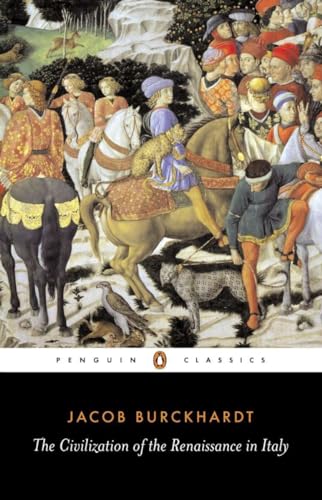
For nineteenth-century Swiss historian Jacob Burckhardt, the Italian Renaissance was nothing less than the beginning of the modern world - a world in which flourishing individualism and the competition for fame radically transformed science, the arts, and politics. In this landmark work he depicts the Italian city-states of Florence, Venice and Rome as providing the seeds of a new form of society, and traces the rise of the creative individual, from Dante to Michelangelo. A fascinating description of an era of cultural transition, this nineteenth-century masterpiece was to become the most influential interpretation of the Italian Renaissance, and anticipated ideas such as Nietzsche's concept of the 'Ubermensch' in its portrayal of an age of genius.
Die Inhaltsangabe kann sich auf eine andere Ausgabe dieses Titels beziehen.
Über die Autorin bzw. den Autor
Jacob Burckhardt (1818-1897) intended to join the Church, but lost his faith while studying theology. Thereafter he studied history at the University of Basel, gaining his doctorate in 1843 and becoming a lecturer. He moved to the Zurich Polytechnic as Professor of Architecture and History in 1855, which is where he wrote The Civilization of the Renaissance in Italy. In 1858 he returned to Basel, where he lived for his work as a teacher at the University.
Peter Burke is Reader in Cultural History, University of Cambridge, and Fellow of Emmanuel College. He has published widely on the Renaissance and cultural history.
Peter Murray was Emeritus Professor of the History of Art at the University of London. He taught at the Courtauld Institute from 1949-1967 and was subsequently chair of Art History at Birkbeck College. He published widely on the architecture of the Renaissance. He died in 1992.
Auszug. © Genehmigter Nachdruck. Alle Rechte vorbehalten.
Introduction
This work bears the title of an essay in the strictest sense of the word. No one is more conscious than the writer with what limited means and strength he has addressed himself to a task so arduous. And even if he could look with greater confidence upon his own researches, he would hardly thereby feel more assured of the approval of competent judges. To each eye, perhaps, the outlines of a given civilization present a different picture; and in treating of a civilization which is the mother of our own, and whose influence is still at work among us, it is unavoidable that individual judgement and feeling should tell every moment both on the writer and on the reader. In the wide ocean upon which we venture, the possible ways and directions are many; and the same studies which have served for this work might easily, in other hands, not only receive a wholly different treatment and application, but lead also to essentially different conclusions. Such indeed is the importance of the subject that it still calls for fresh investigation, and may be studied with advantage from the most varied points of view. Meanwhile we are content if a patient hearing is granted us, and if this book be taken and judged as a whole. It is the most serious difficulty of the history of civilization that a great intellectual process must be broken up into single, and often into what seem arbitrary categories, in order to be in any way intelligible. It was formerly our intention to fill up the gaps in this book by a special work on the “Art of the Renaissance”—an intention, however, which we have been able to fulfill only in part.1
*1. Burckhardt’s History of Architecture and Decoration of the Italian Renaissance was first printed in 1867. His Notes on Renaissance Sculpture were posthumously published in 1934, as a part of Vol. XIII of his Collected Works. Of his intended History of Renaissance Painting three chapters only were finished: “The Art Collectors,” “The Altar-piece,” “The Portrait”; in fact, three very fine essays, published in 1898, a year after the author’s death.
The struggle between the Popes and the Hohenstaufen left Italy in a political condition which differed essentially from that of other countries of the West. While in France, Spain and England the feudal system was so organized that, at the close of its existence, it was naturally transformed into a unified monarchy, and while in Germany it helped to maintain, at least outwardly, the unity of the empire, Italy had shaken it off almost entirely. The Emperors of the fourteenth century, even in the most favourable case, were no longer received and respected as feudal lords, but as possible leaders and supporters of powers already in existence; while the Papacy, with its creatures and allies, was strong enough to hinder national unity in the future, but not strong enough itself to bring about that unity. Between the two lay a multitude of political units—republics and despots—in part of long standing, in part of recent origin, whose existence was founded simply on their power to maintain it. In them for the first time we detect the modern political spirit of Europe, surrendered freely to its own instincts, often displaying the worst features of an unbridled egotism, outraging every right, and killing every germ of a healthier culture. But, wherever this vicious tendency is overcome or in any way compensated, a new fact appears in history—the State as the outcome of reflection and calculation, the State as a work of art. This new life displays itself in a hundred forms, both in the republican and in the despotic States, and determines their inward constitution, no less than their foreign policy. We shall limit ourselves to the consideration of the completer and more clearly defined type, which is offered by the despotic States.
The internal condition of the despotically governed States had a memorable counterpart in the Norman Empire of Lower Italy and Sicily, after its transformation by the Emperor Frederick II. Bred amid treason and peril in the neighbourhood of the Saracens, Frederick, the first ruler of the modern type who sat upon a throne, had early accustomed himself to a thoroughly objective treatment of affairs.
2. The rulers and their dependants were together called “lo stato,” and this name afterwards acquired the meaning of the collective existence of a territory. acquaintance with the internal condition and administration of the Saracenic States was close and intimate; and the mortal struggle in which he was engaged with the Papacy compelled him, no less than his adversaries, to bring into the field all the resources at his command. Frederick’s measures (especially after the year 1231) are aimed at the complete destruction of the feudal State, at the transformation of the people into a multitude destitute of will and of the means of resistance, but profitable in the utmost degree to the exchequer. He centralized, in a manner hitherto unknown in the West, the whole judicial and political administration. No office was henceforth to be filled by popular election, under penalty of the devastation of the offending district and of the enslavement of its inhabitants. The taxes, based on a comprehensive assessment, and distributed in accordance with Mohammedan usages, were collected by those cruel and vexatious methods without which, it is true, it is impossible to obtain any money from Orientals. Here, in short, we find, not a people, but simply a disciplined multitude of subjects; who were forbidden, for example, to marry out of the country without special permission, and under no circumstances were allowed to study abroad. The University of Naples was the first we know of to restrict the freedom of study, while the East, in these respects at all events, left its youth unfettered. It was after the examples of Mohammedan rules that Frederick traded on his own account in all parts of the Mediterranean, reserving to himself the monopoly of many commodities, and restricting in various ways the commerce of his subjects. The Fatimite Caliphs, with all their esoteric unbelief, were, at least in their earlier history, tolerant of all the differences in the religious faith of their people; Frederick, on the other hand, crowned his system of government by a religious inquisition, which will seem the more reprehensible when we remember that in the persons of the heretics he was persecuting the representatives of a free municipal life. Lastly, the internal police, and the kernel of the army for foreign service, was composed of Saracens who had been brought over from Sicily to Nocera and Lucera—men who were deaf to the cry of misery and careless of the ban of the Church. At a later period the subjects, by whom the use of weapons had long been forgotten, were passive witnesses of the fall of Manfred and of the seizure of the government by Charles of Anjou; the latter continued to use the system which he found already at work.
At the side of the centralizing Emperor appeared a usurper of the most peculiar kind; his vicar and son-in-law, Ezzelino da Romano. He stands as the representative of no system of government or administration, for all his activity was wasted in struggles for supremacy in the eastern part of Upper Italy; but as a political type he was a figure of no less importance for the future than his imperial protector Frederick. The conquests and usurpations which had hitherto taken place in the Middle Ages rested on real or pretended inheritance and other such claims, or else were effected against unbelievers and ex-communicated persons. Here for the first time the attempt was openly made to found a throne by wholesale murder and endless barbarities, by the adoption, in short, of any means with a view to nothing but the end pursued. None of...
„Über diesen Titel“ kann sich auf eine andere Ausgabe dieses Titels beziehen.
Suchergebnisse für The Civilization of the Renaissance in Italy (Penguin...

Beispielbild für diese ISBN
The Civilization of the Renaissance in Italy
Anbieter: World of Books (was SecondSale), Montgomery, IL, USA
Verkäuferbewertung 5 von 5 Sternen

Paperback. Zustand: Fair. For nineteenth-century Swiss historian Jacob Burckhardt, the Italian Renaissance was nothing less than the beginning of the modern world - a world in which flourishing individualism and the competition for fame radically transformed science, the arts, and politics. In this landmark work he depicts the Italian city-states of Florence, Venice and Rome as providing the seeds of a new form of society, and traces the rise of the creative individual, from Dante to Michelangelo. A fascinating description of an era of cultural transition, this nineteenth-century masterpiece was to become the most influential interpretation of the Italian Renaissance, and anticipated ideas such as Nietzsche's concept of the 'Ubermensch' in its portrayal of an age of genius. Artikel-Nr. 00103338434
Gebraucht kaufen
EUR 5,27
Versand gratis
Versand innerhalb von USA
Versand innerhalb von USA
Anzahl: 1 verfügbar
Beispielbild für diese ISBN
The Civilization of the Renaissance in Italy
Verlag:
Penguin Publishing Group, 1990
ISBN 10: 014044534X
ISBN 13: 9780140445343
Gebraucht
Softcover
Anbieter: Better World Books, Mishawaka, IN, USA
Verkäuferbewertung 5 von 5 Sternen
Zustand: Good. Pages intact with minimal writing/highlighting. The binding may be loose and creased. Dust jackets/supplements are not included. Stock photo provided. Product includes identifying sticker. Better World Books: Buy Books. Do Good. Artikel-Nr. 300054-6
Gebraucht kaufen
EUR 6,54
Versand gratis
Versand innerhalb von USA
Versand innerhalb von USA
Anzahl: 4 verfügbar
Beispielbild für diese ISBN
The Civilization of the Renaissance in Italy
Anbieter: ThriftBooks-Dallas, Dallas, TX, USA
Verkäuferbewertung 5 von 5 Sternen
Paperback. Zustand: Very Good. No Jacket. May have limited writing in cover pages. Pages are unmarked. ~ ThriftBooks: Read More, Spend Less. Artikel-Nr. G014044534XI4N00
Gebraucht kaufen
EUR 7,22
Versand gratis
Versand innerhalb von USA
Versand innerhalb von USA
Anzahl: 1 verfügbar
Beispielbild für diese ISBN
The Civilization of the Renaissance in Italy
Anbieter: ThriftBooks-Phoenix, Phoenix, AZ, USA
Verkäuferbewertung 5 von 5 Sternen
Paperback. Zustand: Fair. No Jacket. Readable copy. Pages may have considerable notes/highlighting. ~ ThriftBooks: Read More, Spend Less. Artikel-Nr. G014044534XI5N00
Gebraucht kaufen
EUR 7,22
Versand gratis
Versand innerhalb von USA
Versand innerhalb von USA
Anzahl: 1 verfügbar
Beispielbild für diese ISBN
The Civilization of the Renaissance in Italy
Anbieter: ThriftBooks-Dallas, Dallas, TX, USA
Verkäuferbewertung 5 von 5 Sternen
Paperback. Zustand: Fair. No Jacket. Readable copy. Pages may have considerable notes/highlighting. ~ ThriftBooks: Read More, Spend Less. Artikel-Nr. G014044534XI5N00
Gebraucht kaufen
EUR 7,22
Versand gratis
Versand innerhalb von USA
Versand innerhalb von USA
Anzahl: 2 verfügbar
Beispielbild für diese ISBN
The Civilization of the Renaissance in Italy
Anbieter: ThriftBooks-Reno, Reno, NV, USA
Verkäuferbewertung 5 von 5 Sternen
Paperback. Zustand: Fair. No Jacket. Readable copy. Pages may have considerable notes/highlighting. ~ ThriftBooks: Read More, Spend Less. Artikel-Nr. G014044534XI5N00
Gebraucht kaufen
EUR 7,22
Versand gratis
Versand innerhalb von USA
Versand innerhalb von USA
Anzahl: 1 verfügbar
Beispielbild für diese ISBN
The Civilization of the Renaissance in Italy
Anbieter: ThriftBooks-Atlanta, AUSTELL, GA, USA
Verkäuferbewertung 5 von 5 Sternen
Paperback. Zustand: Fair. No Jacket. Readable copy. Pages may have considerable notes/highlighting. ~ ThriftBooks: Read More, Spend Less. Artikel-Nr. G014044534XI5N00
Gebraucht kaufen
EUR 7,22
Versand gratis
Versand innerhalb von USA
Versand innerhalb von USA
Anzahl: 2 verfügbar
Beispielbild für diese ISBN
The Civilization of the Renaissance in Italy
Anbieter: ThriftBooks-Reno, Reno, NV, USA
Verkäuferbewertung 5 von 5 Sternen
Paperback. Zustand: Good. No Jacket. Pages can have notes/highlighting. Spine may show signs of wear. ~ ThriftBooks: Read More, Spend Less. Artikel-Nr. G014044534XI3N00
Gebraucht kaufen
EUR 7,22
Versand gratis
Versand innerhalb von USA
Versand innerhalb von USA
Anzahl: 1 verfügbar
Beispielbild für diese ISBN
The Civilization of the Renaissance in Italy
Anbieter: ThriftBooks-Atlanta, AUSTELL, GA, USA
Verkäuferbewertung 5 von 5 Sternen
Paperback. Zustand: Good. No Jacket. Pages can have notes/highlighting. Spine may show signs of wear. ~ ThriftBooks: Read More, Spend Less. Artikel-Nr. G014044534XI3N00
Gebraucht kaufen
EUR 7,22
Versand gratis
Versand innerhalb von USA
Versand innerhalb von USA
Anzahl: 1 verfügbar
Beispielbild für diese ISBN
The Civilization of the Renaissance in Italy (Penguin Classics)
Anbieter: Wonder Book, Frederick, MD, USA
Verkäuferbewertung 5 von 5 Sternen
Zustand: Good. Good condition. A copy that has been read but remains intact. May contain markings such as bookplates, stamps, limited notes and highlighting, or a few light stains. Artikel-Nr. A15B-02728
Gebraucht kaufen
EUR 7,31
Versand gratis
Versand innerhalb von USA
Versand innerhalb von USA
Anzahl: 3 verfügbar