
Verwandte Artikel zu The Divine Comedy: Purgatory
Inhaltsangabe
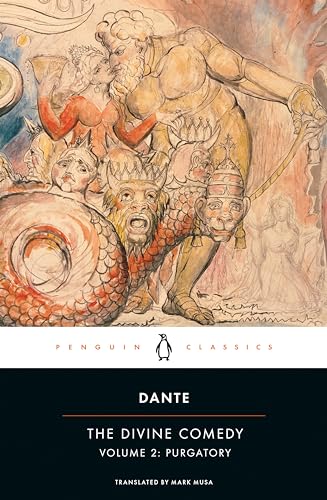
Beginning with Dante's liberation from Hell, Purgatory relates his ascent, accompanied by Virgil, of the Mount of Purgatory - a mountain of nine levels, formed from rock forced upwards when God threw Satan into depths of the earth. As he travels through the first seven levels, Dante observes the sinners who are waiting for their release into Paradise, and through these encounters he is himself transformed into a stronger and better man. For it is only when he has learned from each of these levels that he can ascend to the gateway to Heaven: the Garden of Eden. The second part of one of the greatest epic poems, Purgatory is an enthralling Christian allegory of sin, redemption and ultimate enlightenment.
Die Inhaltsangabe kann sich auf eine andere Ausgabe dieses Titels beziehen.
Über die Autorin bzw. den Autor
Dante Alighieri was born in Florence in 1265 and belonged to a noble but impoverished family. He met Beatrice, who was to be his muse, in 1274, and when she died in 1290 he sought distraction in philosophy and theology, and wrote La Vita Nuova. He worked on the Divine Comedy from 1308 until near the time of his death in Ravenna in 1321.
Auszug. © Genehmigter Nachdruck. Alle Rechte vorbehalten.
Purgatory
By Dante AlighieriPenguin Books
Copyright ©1985 Dante AlighieriAll right reserved.
ISBN: 0140444424
Foreword
If a poem is not forgotten as soon as the circumstances of its origin, it beginsat once to evolve an existence of its own, in minds and lives, and then even inwords, that its singular maker could never have imagined. The poem that survivesthe receding particulars of a given age and place soon becomes a shiftingkaleidoscope of perceptions, each of them in turn provisional and subject totime and change, and increasingly foreign to those horizons of human historythat fostered the original images and references.
Over the years of trying to approach Dante through the words he left and some ofthose written about him, I have come to wonder what his very name means now, andto whom. Toward the end of the Purgatorio, in which the journeyrepeatedly brings the pilgrim to reunions with poets, memories and projectionsof poets, the recurring names of poets, Beatrice, at a moment of unfathomableloss and exposure, calls the poem's narrator and protagonist by name, "Dante,"and the utterance of it is unaccountably startling and humbling. Even though itis spoken by that Beatrice who has been the sense and magnet of the whole poemand, as he has come to imagine it, of his life, and though it is heard at thetop of the mountain of Purgatory, with the terrible journey done and theprospect of eternal joy ahead, the sound of his name at that moment is not atall reassuring. Would it ever be? And who would it reassure? There was, andthere is, first of all, Dante the narrator. And there was Dante the man livingand suffering in time, and at once we can see that there is a distinction, adivision, between them. And then there was, and there is, Dante therepresentation of Everyman, of a brief period in the history of Italy and ofFlorence, of a philosophical position, a political allegiance ? the list isindeterminate. Sometimes he seems to be all of them at once, and sometimesparticular aspects occupy the foreground.
The commentaries date back into his own lifetime ? indeed, he begins themhimself, with the Vita Nuova ? and the exegetes recognized from thebeginning, whether they approved or not, the importance of the poem, the work,the vision, as they tried to arrive at some fixed significance in those words,in a later time when the words themselves were not quite the same.
Any reader of Dante now is in debt to generations of scholars working forcenturies to illuminate the unknown by means of the known. Any translator sharesthat enormous debt. A translation, on the other hand, is seldom likely to be ofmuch interest to scholars, who presumably sustain themselves directly upon theinexhaustible original. A translation is made for the general reader of its owntime and language, a person who, it is presumed, cannot read, or is certainlynot on familiar terms with, the original, and may scarcely know it except byreputation.
It is hazardous to generalize even about the general reader, who is nobody inparticular and is encountered only as an exception. But my impression is thatmost readers at present whose first language is English probably think of Danteas the author of one work, The Divine Comedy, of a date vaguely medieval,its subject a journey through Hell. The whole poem, for many, has come to beknown by the Inferno alone, the first of the three utterly distinctsections of the work, the first of the three states of the psyche that Dante sethimself to explore and portray.
There are surely many reasons for this predilection, if that is the word, forthe Inferno. Some of them must come from the human sensibility'simmediate recognition of perennial aspects of its own nature. In the language ofmodern psychology the Inferno portrays the locked, unalterable ego, formafter form of it, the self and its despair forever inseparable. The terrors andpain, the absence of any hope, are the ground of the drama of theInferno, its nightmare grip upon the reader, its awful authority, and thefeeling, even among the secular, that it is depicting something in the humanmakeup that cannot, with real assurance, be denied. That authority, with theassistance of a succession of haunting illustrations of the Inferno, hasmade moments and elements of that part of the journey familiar and disturbingimages which remain current even in our scattered and evanescentculture.
The literary presence of the Inferno in English has been renewed inrecent years. In 1991 Daniel Halpern asked a number of contemporary poets toprovide translations of cantos of the Inferno which would eventuallycomprise a complete translation of the first part of the Commedia.Seamus Heaney had already published fine versions of sections from several ofthe cantos, including part of canto 3 in Seeing Things (1991), and heended up doing the opening cantos. When Halpern asked me to contribute to theproject, I replied chiefly with misgivings, to begin with. I had been trying toread Dante, and reading about him, since I was a student, carrying one volume oranother of the bilingual Temple Classics edition ? pocket-sized books ? withme wherever I went. I had read parts, at least, of the best-known translationsof the Commedia: Henry Francis Cary's because it came with the GustaveDoré illustrations and was in the house when I was a child; Longfellow'sdespite a late-adolescent resistance to nineteenth-century poetic conventions;Laurence Binyon's at the recommendation of Ezra Pound, although he seemed to meterribly tangled; John Ciardi's toward which I had other reservations. Thecloser I got to feeling that I was beginning to "know" a line or a passage,having the words by memory, repeating some stumbling approximation of the soundsand cadence, pondering what I had been able to glimpse of the rings of sense,the more certain I became that ? beyond the ordinary and obvious impossibilityof translating poetry or anything else ? the translation of Dante had adimension of impossibility of its own. I had even lectured on Dante anddemonstrated the impossibility of translating him, taking a single line from theintroductory first canto, examining it wordby word:
Tant' ê amara che poco ê più morte
indicating the sounds of the words, their primary meanings, implications in thecontext of the poem and in the circumstances and life of the narrator, the soundof the line insofar as I could simulate it and those present could repeat italoud and begin to hear its disturbing mantric tone. How could that, then,really be translated? It could not, of course. It could not be anything else. Itcould not be the original in other words, in another language. I presented theclassical objection to translation with multiplied emphasis. Translation ofpoetry is an enterprise that is always in certain respects impossible, and yeton occasion it has produced something new, something else, of value, andsometimes, on the other side of a sea change, it has brought up poetry again.
Halpern did not dispute my objections, but he told me which poets he was askingto contribute to the project. He asked me which cantos I would like to do if Idecided to try any myself. I thought, in spite of what I had said, of thepassage at the end of canto 26, where Odysseus, adrift in a two-pointed flame inthe abyss of Hell, tells Virgil "where he went to die" after his return toIthaca. Odysseus recounts his own speech to "that small company by whom I hadnot been deserted," exhorting them to sail with him past the horizons of theknown world to the unpeopled side of the earth, in order...
„Über diesen Titel“ kann sich auf eine andere Ausgabe dieses Titels beziehen.
Suchergebnisse für The Divine Comedy: Purgatory

Beispielbild für diese ISBN
The Divine Comedy: Purgatory
Anbieter: World of Books (was SecondSale), Montgomery, IL, USA
Verkäuferbewertung 5 von 5 Sternen

Paperback. Zustand: Very Good. Beginning with Dante's liberation from Hell, Purgatory relates his ascent, accompanied by Virgil, of the Mount of Purgatory - a mountain of nine levels, formed from rock forced upwards when God threw Satan into depths of the earth. As he travels through the first seven levels, Dante observes the sinners who are waiting for their release into Paradise, and through these encounters he is himself transformed into a stronger and better man. For it is only when he has learned from each of these levels that he can ascend to the gateway to Heaven: the Garden of Eden. The second part of one of the greatest epic poems, Purgatory is an enthralling Christian allegory of sin, redemption and ultimate enlightenment. Artikel-Nr. 00108373999
Gebraucht kaufen
EUR 5,06
Versand gratis
Versand innerhalb von USA
Versand innerhalb von USA
Anzahl: 3 verfügbar
Beispielbild für diese ISBN
The Divine Comedy: Purgatory
Anbieter: World of Books (was SecondSale), Montgomery, IL, USA
Verkäuferbewertung 5 von 5 Sternen
Paperback. Zustand: Good. Beginning with Dante's liberation from Hell, Purgatory relates his ascent, accompanied by Virgil, of the Mount of Purgatory - a mountain of nine levels, formed from rock forced upwards when God threw Satan into depths of the earth. As he travels through the first seven levels, Dante observes the sinners who are waiting for their release into Paradise, and through these encounters he is himself transformed into a stronger and better man. For it is only when he has learned from each of these levels that he can ascend to the gateway to Heaven: the Garden of Eden. The second part of one of the greatest epic poems, Purgatory is an enthralling Christian allegory of sin, redemption and ultimate enlightenment. Artikel-Nr. 00110518352
Gebraucht kaufen
EUR 5,06
Versand gratis
Versand innerhalb von USA
Versand innerhalb von USA
Anzahl: 4 verfügbar
Beispielbild für diese ISBN
Purgatory
Anbieter: ThriftBooks-Phoenix, Phoenix, AZ, USA
Verkäuferbewertung 5 von 5 Sternen
Paperback. Zustand: Good. No Jacket. Pages can have notes/highlighting. Spine may show signs of wear. ~ ThriftBooks: Read More, Spend Less. Artikel-Nr. G0140444424I3N00
Gebraucht kaufen
EUR 6,71
Versand gratis
Versand innerhalb von USA
Versand innerhalb von USA
Anzahl: 1 verfügbar
Beispielbild für diese ISBN
Purgatory
Anbieter: ThriftBooks-Reno, Reno, NV, USA
Verkäuferbewertung 5 von 5 Sternen
Paperback. Zustand: Fair. No Jacket. Readable copy. Pages may have considerable notes/highlighting. ~ ThriftBooks: Read More, Spend Less. Artikel-Nr. G0140444424I5N00
Gebraucht kaufen
EUR 6,71
Versand gratis
Versand innerhalb von USA
Versand innerhalb von USA
Anzahl: 1 verfügbar
Beispielbild für diese ISBN
Purgatory
Anbieter: ThriftBooks-Dallas, Dallas, TX, USA
Verkäuferbewertung 5 von 5 Sternen
Paperback. Zustand: Good. No Jacket. Pages can have notes/highlighting. Spine may show signs of wear. ~ ThriftBooks: Read More, Spend Less. Artikel-Nr. G0140444424I3N00
Gebraucht kaufen
EUR 6,71
Versand gratis
Versand innerhalb von USA
Versand innerhalb von USA
Anzahl: 1 verfügbar
Beispielbild für diese ISBN
Purgatory
Anbieter: ThriftBooks-Atlanta, AUSTELL, GA, USA
Verkäuferbewertung 5 von 5 Sternen
Paperback. Zustand: Fair. No Jacket. Readable copy. Pages may have considerable notes/highlighting. ~ ThriftBooks: Read More, Spend Less. Artikel-Nr. G0140444424I5N00
Gebraucht kaufen
EUR 6,71
Versand gratis
Versand innerhalb von USA
Versand innerhalb von USA
Anzahl: 1 verfügbar
Beispielbild für diese ISBN
Purgatory
Anbieter: ThriftBooks-Dallas, Dallas, TX, USA
Verkäuferbewertung 5 von 5 Sternen
Paperback. Zustand: Fair. No Jacket. Readable copy. Pages may have considerable notes/highlighting. ~ ThriftBooks: Read More, Spend Less. Artikel-Nr. G0140444424I5N00
Gebraucht kaufen
EUR 6,71
Versand gratis
Versand innerhalb von USA
Versand innerhalb von USA
Anzahl: 1 verfügbar
Beispielbild für diese ISBN
Purgatory
Anbieter: ThriftBooks-Reno, Reno, NV, USA
Verkäuferbewertung 5 von 5 Sternen
Paperback. Zustand: Good. No Jacket. Pages can have notes/highlighting. Spine may show signs of wear. ~ ThriftBooks: Read More, Spend Less. Artikel-Nr. G0140444424I3N00
Gebraucht kaufen
EUR 6,71
Versand gratis
Versand innerhalb von USA
Versand innerhalb von USA
Anzahl: 1 verfügbar
Beispielbild für diese ISBN
Purgatory
Anbieter: ThriftBooks-Phoenix, Phoenix, AZ, USA
Verkäuferbewertung 5 von 5 Sternen
Paperback. Zustand: Fair. No Jacket. Readable copy. Pages may have considerable notes/highlighting. ~ ThriftBooks: Read More, Spend Less. Artikel-Nr. G0140444424I5N00
Gebraucht kaufen
EUR 6,71
Versand gratis
Versand innerhalb von USA
Versand innerhalb von USA
Anzahl: 1 verfügbar
Beispielbild für diese ISBN
Purgatory
Anbieter: ThriftBooks-Atlanta, AUSTELL, GA, USA
Verkäuferbewertung 5 von 5 Sternen
Paperback. Zustand: Very Good. No Jacket. May have limited writing in cover pages. Pages are unmarked. ~ ThriftBooks: Read More, Spend Less. Artikel-Nr. G0140444424I4N00
Gebraucht kaufen
EUR 6,71
Versand gratis
Versand innerhalb von USA
Versand innerhalb von USA
Anzahl: 1 verfügbar