
Verwandte Artikel zu The Analects (Penguin Classics)
Inhaltsangabe
'The Master said, "If a man sets his heart on benevolence, he will be free from evil"'
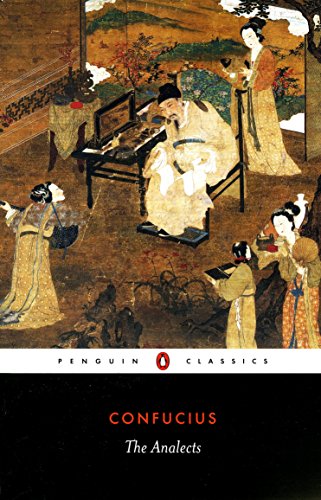
The Analects are a collection of Confucius's sayings brought together by his pupils shortly after his death in 497 BC. Together they express a philosophy, or a moral code, by which Confucius believed everyone should live. Upholding the ideals of wisdom, self-knowledge, courage and love of one's fellow man, he argued that the pursuit of virtue should be every individual's supreme goal. And, while following the Way, or the truth, might not result in immediate or material gain, Confucius showed that it could nevertheless bring its own powerful and lasting spiritual rewards.
Translated with an Introduction and Notes by D. C. Lau
Die Inhaltsangabe kann sich auf eine andere Ausgabe dieses Titels beziehen.
Über die Autorin bzw. den Autor
Confucius [551-479 BC], though of noble descent, was born in humble circumstances. He believed that politics is only an extension of morals, and spent ten years travelling through the various states of China spreading his ideas. When he realised that there was no way of converting the feudal rulers to his way of thinking he returned to Lu and spent the rest of his life there teaching his pupils.
D.C Lau has held a number of professorships in the field of Chinese language and literature.
Auszug. © Genehmigter Nachdruck. Alle Rechte vorbehalten.
Preface
The Analects is the single most important book in the history of China. Yet for the uninitiated, this fact is hard to grasp because the principal figure in the book, Confucius, is often seen to be responding to a question, offering a comment, or just thinking aloud. He refrained from “putting forth theories,” the Analects says, and “did not think that he must be right.” His approach is personal, so that even when a simple fellow asks him a question, Confucius has “to knock at both sides [of the question] until everything has been considered.”
In the introduction to his translation of Montaigne’s essays, Donald Frame tells us, “Montaigne resists definition. . . . Yet this very difficulty points to one answer: that the book is the man.” Perhaps the same is true of Confucius and the Analects, but the Analects is not a record of what Confucius wrote, only of what he said. It is, in hindsight, the way Confucius represented himself to the world, though he never intended for that to happen, since it was his disciples and generations of disciples following them who compiled the book. How then did such a work end up being the central point of reference for scholars, thinkers, rulers, political counselors, and just about anyone in the last twenty-five hundred years of Chinese history? And how did Confucius’ voice become a source of authority for the Chinese, even for the leaders of the present Communist government? Through a combination of hard work and chance, one might say.
In the years right after his death in 479 BC, competitive interpretations of what Confucius had taught helped to keep his name and his ideas alive. Then, in the next two hundred years, two followers, Mencius and Xunzi, took his teachings in different directions, and between them much ground was covered, from the self to society and nature. These men’s disquisitions on man’s inborn dispositions, on his private and public duties, on what is fair and what is misguided judgment, and on the many moral conundrums of life could seem like a long stretch from what Confucius had originally put forth, but the world had changed by their time. People demanded more from the wise and learned because there were more variables in human relationships and in one’s relation to the state. Also, more contenders had entered the field—but Mencius and Xunzi were not just eyeing the opposition. They had to be ready, of course, to spar with the quickest and most discerning minds of their day, but, more important, they were looking to satisfy their yearning for knowledge. In the course of their endeavor, Confucius would grow in name and stature.
Imperial patronage in the Han dynasty, after China became a unified country in the second century BC, helped Confucius secure a permanent place within China’s institutions. Bureaucracy, law, education, social organization, and ritual practice—all stood on principles that bore the influence of Confucius’ assumptions and beliefs. This, however, does not mean that Confucius’ teachings did not go through periods of decline. The longest of these lasted nearly seven hundred years, from the beginning of the Six Dynasties (220–589) to the end of the Tang dynasty (618–906), during which time Buddhism, a foreign religion, captivated the Chinese imagination and the Chinese, in turn, shaped the foreign religion to look like their own. It was in response to the imminent threat of losing their cultural distinction that the Chinese in the beginning of the Song dynasty (960–1279) saw a need to revive Confucian teachings. The movement unfolded gradually, and by the end of that dynasty nearly everything was being addressed by this new Confucianism, from the arcane to the practical, from metaphysics to spiritual cultivation, from scholarship to learning and education, from the selection of officials to principles of government.
The Confucian counselors in the next dynasty, the Yuan (1279–1368), managed to persuade their Mongol rulers to tighten the focus of the civil service examinations, limiting them to four books from the Confucian canon and a set of commentaries sanctioned by the imperial court. The Analects was one of these Four Books. In a society where, for most men, succeeding in the examinations—and thus securing a government post—was the only avenue to raising one’s social standing, what this meant was that the Analects, along with the three related texts, became a fixture in the studies of all those who were able to get an education. These hopeful aspirants would memorize the text when they were very young and then return to it repeatedly almost as a daily exercise. In time, the book would have helped them to shape their views and might even have helped them to find a moral anchor. But the story of the Analects does not end there. If competition against a foreign religion fueled the Confucian revival in the Song, disagreements within the tradition about how to read the Analects kept the book alive, and the man who started it all vigorous and relevant, until today.
Most of the translations in English, however, do not reflect this rich tradition in reading the Analects. Instead, they tend to favor one commentary, Zhu Xi’s from the twelfth century, that had become standard through five hundred years of imperial support and the only interpretation the state would accept in the civil service examinations. My work follows a different approach. I relied on the scholars from the last three hundred years—scholars who put research before ideology—to show me the competing interpretations and the possibilities of understanding a word, a sentence, or a passage, and my translation is what I arrived at after I had considered the range of choices before me. My hope, of course, is to recover some of the ambiguities and nuances in what Confucius says, which are often lost if one comes to trust a single voice or a single vision.
• • •
In the introduction to this translation, I offer a brief account of Confucius’ life and some guidance about how to read the Analects. I also explain why one would need traditional commentaries to make sense of this book and how I have tried to handle the bulk of this knowledge and scholarship from the last two thousand years. A chronology of China’s dynastic history follows the introduction.
Very few chapters, called “Books” in the translation, have a prefatory synopsis, because often there is no thread to bind the ideas together in any given section; therefore, unless there is a good reason to suggest one, I have refrained from providing a synopsis lest it become an obstacle, a limitation or misdirection, to reading. Glossaries of names and terms carry the same risk, I feel, and so my approach is to provide in the commentary a thorough description of a name or a term when it first appears in the text, and then to gloss it each time it shows up again. This is my attempt to think aloud about the character of, say, a disciple like Zigong or Zilu and about what Confucius means by ren (humaneness) or ming (destiny). My hope is that by the end of the book the reader will have come to his or her own conclusion about a given person or idea. I have, however, drawn together, in Appendix 1, an index of the disciples of Confucius and of historical individuals that appear in the Analects; in Appendix 2, an index of terms and of topics; and, in Appendix 3, an index of Chinese scholars and thinkers cited in the commentaries. I have also included, following my English translation, the Chinese text of the Analects, because more and more readers in the West have shown an...
„Über diesen Titel“ kann sich auf eine andere Ausgabe dieses Titels beziehen.
Suchergebnisse für The Analects (Penguin Classics)

Beispielbild für diese ISBN
The Analects (Penguin Classics)
Anbieter: Wonder Book, Frederick, MD, USA
Verkäuferbewertung 5 von 5 Sternen

Zustand: Good. Good condition. With remainder mark. A copy that has been read but remains intact. May contain markings such as bookplates, stamps, limited notes and highlighting, or a few light stains. Artikel-Nr. H13N-00018
Gebraucht kaufen
EUR 6,40
Versand gratis
Versand innerhalb von USA
Versand innerhalb von USA
Anzahl: 1 verfügbar
Beispielbild für diese ISBN
The Analects (Penguin Classics)
Anbieter: Wonder Book, Frederick, MD, USA
Verkäuferbewertung 5 von 5 Sternen
Zustand: Good. Good condition. A copy that has been read but remains intact. May contain markings such as bookplates, stamps, limited notes and highlighting, or a few light stains. Artikel-Nr. L21H-03530
Gebraucht kaufen
EUR 6,40
Versand gratis
Versand innerhalb von USA
Versand innerhalb von USA
Anzahl: 3 verfügbar
Beispielbild für diese ISBN
The Analects
Verlag:
Penguin Publishing Group, 1979
ISBN 10: 0140443487
ISBN 13: 9780140443486
Gebraucht
Softcover
Anbieter: Better World Books: West, Reno, NV, USA
Verkäuferbewertung 5 von 5 Sternen
Zustand: Good. Former library copy. Pages intact with minimal writing/highlighting. The binding may be loose and creased. Dust jackets/supplements are not included. Includes library markings. Stock photo provided. Product includes identifying sticker. Better World Books: Buy Books. Do Good. Artikel-Nr. 4739878-6
Gebraucht kaufen
EUR 6,54
Versand gratis
Versand innerhalb von USA
Versand innerhalb von USA
Anzahl: 1 verfügbar
Beispielbild für diese ISBN
The Analects
Verlag:
Penguin Publishing Group, 1979
ISBN 10: 0140443487
ISBN 13: 9780140443486
Gebraucht
Softcover
Anbieter: Better World Books: West, Reno, NV, USA
Verkäuferbewertung 5 von 5 Sternen
Zustand: Good. Pages intact with minimal writing/highlighting. The binding may be loose and creased. Dust jackets/supplements are not included. Stock photo provided. Product includes identifying sticker. Better World Books: Buy Books. Do Good. Artikel-Nr. 3127799-75
Gebraucht kaufen
EUR 6,54
Versand gratis
Versand innerhalb von USA
Versand innerhalb von USA
Anzahl: 7 verfügbar
Beispielbild für diese ISBN
The Analects
Verlag:
Penguin Publishing Group, 1979
ISBN 10: 0140443487
ISBN 13: 9780140443486
Gebraucht
Softcover
Anbieter: Better World Books, Mishawaka, IN, USA
Verkäuferbewertung 5 von 5 Sternen
Zustand: Good. Pages intact with minimal writing/highlighting. The binding may be loose and creased. Dust jackets/supplements are not included. Stock photo provided. Product includes identifying sticker. Better World Books: Buy Books. Do Good. Artikel-Nr. 3127799-75
Gebraucht kaufen
EUR 6,54
Versand gratis
Versand innerhalb von USA
Versand innerhalb von USA
Anzahl: Mehr als 20 verfügbar
Beispielbild für diese ISBN
The Analects
Anbieter: ThriftBooks-Reno, Reno, NV, USA
Verkäuferbewertung 5 von 5 Sternen
Paperback. Zustand: Fair. No Jacket. Readable copy. Pages may have considerable notes/highlighting. ~ ThriftBooks: Read More, Spend Less. Artikel-Nr. G0140443487I5N00
Gebraucht kaufen
EUR 6,94
Versand gratis
Versand innerhalb von USA
Versand innerhalb von USA
Anzahl: 3 verfügbar
Beispielbild für diese ISBN
The Analects
Anbieter: ThriftBooks-Dallas, Dallas, TX, USA
Verkäuferbewertung 5 von 5 Sternen
Paperback. Zustand: Fair. No Jacket. Readable copy. Pages may have considerable notes/highlighting. ~ ThriftBooks: Read More, Spend Less. Artikel-Nr. G0140443487I5N00
Gebraucht kaufen
EUR 6,94
Versand gratis
Versand innerhalb von USA
Versand innerhalb von USA
Anzahl: 4 verfügbar
Beispielbild für diese ISBN
The Analects
Anbieter: ThriftBooks-Phoenix, Phoenix, AZ, USA
Verkäuferbewertung 5 von 5 Sternen
Paperback. Zustand: Fair. No Jacket. Readable copy. Pages may have considerable notes/highlighting. ~ ThriftBooks: Read More, Spend Less. Artikel-Nr. G0140443487I5N00
Gebraucht kaufen
EUR 6,94
Versand gratis
Versand innerhalb von USA
Versand innerhalb von USA
Anzahl: 3 verfügbar
Beispielbild für diese ISBN
The Analects
Anbieter: ThriftBooks-Atlanta, AUSTELL, GA, USA
Verkäuferbewertung 5 von 5 Sternen
Paperback. Zustand: Fair. No Jacket. Readable copy. Pages may have considerable notes/highlighting. ~ ThriftBooks: Read More, Spend Less. Artikel-Nr. G0140443487I5N00
Gebraucht kaufen
EUR 6,94
Versand gratis
Versand innerhalb von USA
Versand innerhalb von USA
Anzahl: 4 verfügbar
Beispielbild für diese ISBN
The Analects
Anbieter: ThriftBooks-Dallas, Dallas, TX, USA
Verkäuferbewertung 5 von 5 Sternen
Paperback. Zustand: Good. No Jacket. Pages can have notes/highlighting. Spine may show signs of wear. ~ ThriftBooks: Read More, Spend Less. Artikel-Nr. G0140443487I3N00
Gebraucht kaufen
EUR 6,94
Versand gratis
Versand innerhalb von USA
Versand innerhalb von USA
Anzahl: 1 verfügbar