
Verwandte Artikel zu The Oresteia: Agamemnon, The Libation Bearers, The...
Inhaltsangabe
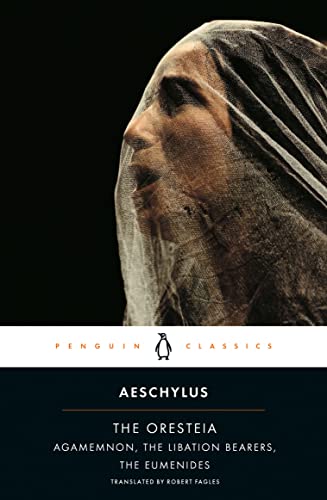
The only trilogy in Greek drama that survives from antiquity, Aeschylus' The Oresteia is translated by Robert fagles with an introduction, notes and glossary written in collaboration with W.B. Stanford in Penguin Classics.
In the Oresteia Aeschylus addressed the bloody chain of murder and revenge within the royal family of Argos. As they move from darkness to light, from rage to self-governance, from primitive ritual to civilized institution, their spirit of struggle and regeneration becomes an everlasting song of celebration. In Agamemnon, a king's decision to sacrifice his daughter and turn the tide of war inflicts lasting damage on his family, culminating in a terrible act of retribution; The Libation Bearers deals with the aftermath of Clytemnestra's regicide, as her son Orestes sets out to avenge his father's death; and in The Eumenides, Orestes is tormented by supernatural powers that can never be appeased. Forming an elegant and subtle discourse on the emergence of Athenian democracy out of a period of chaos and destruction, The Oresteia is a compelling tragedy of the tensions between our obligations to our families and the laws that bind us together as a society.
Aeschylus (525-456 BC) was born near Athens. He wrote more than seventy plays, of which seven have survived, all translated for Penguin Classics: The Supplicants, The Persians, Seven Against Thebes, Prometheus Bound, Agamemnon, The Libation Bearers and The Eumenides.
If you enjoyed The Oresteia, you might like Euripides' Medea and Other Plays, also available in Penguin Classics.
'Conveys more vividly and powerfully than any of the ten competitors I have consulted the eternal power of this masterpiece ... a triumph'
Bernard Levin
'How satisfying to read at last a modern translation which is rooted in Greek feeling and Greek thought ... both the stature and the profound instinctive genius of Aeschylus are recognised'
Mary Renault, author of The King Must Die
Die Inhaltsangabe kann sich auf eine andere Ausgabe dieses Titels beziehen.
Über die Autorin bzw. den Autor
Aeschylus was born of noble family near Athens in 525 BC. He took part in the Persian Wars, adn his epitahp represents him as fighting at Marathon. He wrote more than seventy plays, of which only seven have survived.
Von der hinteren Coverseite
This book is a play that has been translated into English. 'The Oresteia'
Auszug. © Genehmigter Nachdruck. Alle Rechte vorbehalten.
Table of Contents
THE ORESTEIA AGAMEMNON, THE LIBATION BEARERS, THE EUMENIDES
Title Page
Copyright Page
Foreword
Acknowledgements
AGAMEMNON
THE LIBATION BEARERS
THE EUMENIDES
THE GENEALOGY OF ORESTES
SELECT BIBLIOGRAPHY
NOTES
GLOSSARY
FOR THE BEST IN PAPERBACKS, LOOK FOR THE
PENGUIN CLASSICS
THE ORESTEIA AGAMEMNON, THE LIBATION BEARERS, THE EUMENIDES
AESCHYLUS was born of a noble family at Eleusis near Athens in 525 B.C. He took part in the Persian Wars and his epitaph, said to have been written by himself, represents him as fighting at Marathon. At some time in his life he appears to have been prosecuted for divulging the Eleusinian mysteries, but he apparently proved himself innocent. Aeschylus wrote more than seventy plays, of which seven have survived: The Suppliants, The Persians, Seven Against Thebes, Prometheus Bound, Agamemnon, The Libation Bearers, and The Eumenides. (All are translated for Penguin Classics.) He visited Syracuse more than once at the invitation of Hieron I and he died at Gela in Sicily in 456 B.C. Aeschylus was recognized as a classic writer soon after his death, and special privileges were decreed for his plays.
ROBERT FAGLES is Arthur W. Marks ’19 Professor of Comparative Literature, Emeritus, at Princeton University. He is the recipient of the 1997 PEN/Ralph Manheim Medal for Translation and a 1996 Academy Award in Literature from the American Academy of Arts and Letters. Fagles has been elected to the Academy, the American Academy of Arts and Sciences, and the American Philosophical Society. He has translated the poems of Bacchylides. His translations of Sophocles’ Three Theban Plays, Aeschylus’ Oresteia (nominated for a National Book Award) and Homer’s Iliad (winner of the 1991 Harold Morton Landon Translation Award by The Academy of American Poets, an award from The Translation Center of Columbia University, and the New Jersey Humanities Book Award) are published in Penguin Classics. His original poetry and his translations have appeared in many journals and reviews, as well as in his book of poems, I, Vincent: Poems from the Pictures of Van Gogh. Mr. Fagles was one of the associate editors of Maynard Mack’s Twickenham Edition of Alexander Pope’s Iliad and Odyssey, and, with George Steiner, edited Homer : A Collection of Critical Essays. Mr. Fagles’ most recent work is a translation of Homer’s Odyssey, available from Penguin.
The late W B. STANFORD was Senior Fellow of Trinity College Dublin and Regius Professor of Greek at Dublin University, where he became Chancellor. His several works include the acclaimed Ulysses Theme, definitive editions of Homer’s Odyssey, Sophocles’ Ajax and Aristophanes’ Frogs, Aeschylus in His Style, pioneering studies of metaphor and ambiguity in Greek poetry, and The Sound of Greek, Greek Tragedy and the Emotions, and with J.V. Luce, The Quest for Ulysses. Stanford served as representative of Dublin University in the Senate of the Irish Republic from 1948 to 1969 and as chairman of the Dublin Institute for Advanced Studies beginning in 1972.
PENGUIN BOOKS
Published by the Penguin Group
Penguin Group (USA) Inc., 375 Hudson Street, New York, New York 10014, U.S.A.
Penguin Group (Canada), 90 Eglinton Avenue East, Suite 700, Toronto,
Ontario, Canada M4P 2Y3 (a division of Pearson Penguin Canada Inc.)
Penguin Books Ltd, 80 Strand, London WC2R 0RL, England
Penguin Ireland, 25 St Stephen’s Green, Dublin 2, Ireland (a division of Penguin Books Ltd)
Penguin Group (Australia), 250 Camberwell Road, Camberwell,
Victoria 3124, Australia (a division of Pearson Australia Group Pty Ltd)
Penguin Books India Pvt Ltd, 11 Community Centre, Panchsheel Park,
New Delhi - 110 017, India
Penguin Group (NZ), 67 Apollo Drive, Mairangi Bay, Auckland 1311,
New Zealand (a division of Pearson New Zealand Ltd)
Penguin Books (South Africa) (Pty) Ltd, 24 Sturdee Avenue, Rosebank,
Johannesburg 2196, South Africa
Penguin Books Ltd, Registered Offices: 80 Strand, London WC2R 0RL, England
First published in the United States of America by
Viking Penguin Inc. 1975
First published in England by
Wildwood House Ltd 1976
Published in the Penguin Classics 1977
Reprinted with revisions 1979
All rights reserved
LIBRARY OF CONGRESS CATALOGING IN PUBLICATION DATA
Aeschylus.
The Oresteia.
Bibliography: p.
I. Fagles, Robert. II. Title.
PA3827.A7F.01 83-17421
eISBN : 978-1-101-04263-2
All dramatic, motion picture, radio, television, and other rights in this translation are fully protected by all signatories to the Universal Copyright Convention, and no public or private performances—professional or amateur—may be given without written permission of the copyright owners. All inquiries shall be addressed to the copyright owners c/o Georges Borchardt, Inc., 136 East 57th Street, New York, New York 10022.
Illustrations by Sylvia Allman
The scanning, uploading and distribution of this book via the Internet or via any other means without the permission of the publisher is illegal and punishable by law. Please purchase only authorized electronic editions, and do not participate in or encourage electronic piracy of copyrighted materials. Your support of the author’s rights is appreciated.
FOREWORD
My thanks to Aeschylus for his companionship, his rigours and his kindness. I found him a burly, eloquent ghost, with more human decency and strength than I could hope to equal. As I tried to approach him, I remembered what they said of the ghost of Hamlet’s father: ‘We do it wrong, being so majestical, To offer it the show of violence.’ Translation has its violent moments, and I suppose it must. It begins with attraction, then a kind of attack, and it ends, if you are lucky, with a strong impersonation of your author. Whatever the end, at any rate, it is meant to be a thing of love and homage. So in thanking that proud old spirit, I would also ask for his forbearance, if he should ever hear what I have written in his name.
Now it is time to let this version of the Oresteia speak for itself, without apologies or statements of principle (petards that will probably hoist the writing later). A translator’s best hope, I think, and still the hardest to achieve, is Dryden’s hope that his author will speak the living language of the day. And not in a way that caters to its limits, one might add, but that gives its life and fibre something of a stretching in the process. In translating Aeschylus I have also tried to suggest the responsion of his choral poetry - the paired, isometric stanzas that form the dialectic dance and singing of his plays in Greek - but I have done so flexibly. and using English rhythms. The translation has its leanings, too, yet they are loyal to Aeschylus, at least as I perceive him, and loyal to the modem grain as well. There is a kinship between the Oresteia and ourselves; a mutual need to recognize the fragility of our culture, to restore some reverence for the Great Mother and her works, and especially to embrace the Furies within ourselves, persuading them, perhaps, to invigorate our lives. I hope this kinship can be felt in the English text and supported by the...
„Über diesen Titel“ kann sich auf eine andere Ausgabe dieses Titels beziehen.
Suchergebnisse für The Oresteia: Agamemnon, The Libation Bearers, The...

Beispielbild für diese ISBN
The Oresteia: Agamemnon; The Libation Bearers; The Eumenides (Penguin Classics)
Verlag:
Penguin Classics (edition Bilingual), 1984
ISBN 10: 0140443339
ISBN 13: 9780140443332
Gebraucht
Paperback
Anbieter: BooksRun, Philadelphia, PA, USA
Verkäuferbewertung 5 von 5 Sternen

Paperback. Zustand: Fair. Bilingual. The item might be beaten up but readable. May contain markings or highlighting, as well as stains, bent corners, or any other major defect, but the text is not obscured in any way. Artikel-Nr. 0140443339-7-1
Gebraucht kaufen
EUR 5,39
Versand gratis
Versand innerhalb von USA
Versand innerhalb von USA
Anzahl: 3 verfügbar
Beispielbild für diese ISBN
The Oresteia: Agamemnon, The Libation Bearers, The Eumenides
Anbieter: World of Books (was SecondSale), Montgomery, IL, USA
Verkäuferbewertung 5 von 5 Sternen
Paperback. Zustand: Good. A king's decision to sacrifice his daughter and turn the tide of war inflicts lasting damage on his family, culminating in a terrible act of retribution. Artikel-Nr. 00108591793
Gebraucht kaufen
EUR 5,58
Versand gratis
Versand innerhalb von USA
Versand innerhalb von USA
Anzahl: Mehr als 20 verfügbar
Beispielbild für diese ISBN
The Oresteia: Agamemnon, The Libation Bearers, The Eumenides
Anbieter: World of Books (was SecondSale), Montgomery, IL, USA
Verkäuferbewertung 5 von 5 Sternen
Paperback. Zustand: Fair. A king's decision to sacrifice his daughter and turn the tide of war inflicts lasting damage on his family, culminating in a terrible act of retribution. Artikel-Nr. 00103113947
Gebraucht kaufen
EUR 5,58
Versand gratis
Versand innerhalb von USA
Versand innerhalb von USA
Anzahl: Mehr als 20 verfügbar
Beispielbild für diese ISBN
The Oresteia: Agamemnon, The Libation Bearers, The Eumenides
Anbieter: World of Books (was SecondSale), Montgomery, IL, USA
Verkäuferbewertung 5 von 5 Sternen
Paperback. Zustand: Very Good. A king's decision to sacrifice his daughter and turn the tide of war inflicts lasting damage on his family, culminating in a terrible act of retribution. Artikel-Nr. 00109786888
Gebraucht kaufen
EUR 5,58
Versand gratis
Versand innerhalb von USA
Versand innerhalb von USA
Anzahl: 1 verfügbar
Beispielbild für diese ISBN
The Oresteia: Agamemnon; The Libation Bearers; The Eumenides (Penguin Classics)
Verlag:
Penguin Classics (edition Bilingual), 1984
ISBN 10: 0140443339
ISBN 13: 9780140443332
Gebraucht
Paperback
Anbieter: BooksRun, Philadelphia, PA, USA
Verkäuferbewertung 5 von 5 Sternen
Paperback. Zustand: Very Good. Bilingual. It's a well-cared-for item that has seen limited use. The item may show minor signs of wear. All the text is legible, with all pages included. It may have slight markings and/or highlighting. Artikel-Nr. 0140443339-11-1
Gebraucht kaufen
EUR 5,85
Versand gratis
Versand innerhalb von USA
Versand innerhalb von USA
Anzahl: 3 verfügbar
Beispielbild für diese ISBN
The Oresteia: Agamemnon; The Libation Bearers; The Eumenides (Penguin Classics)
Verlag:
Penguin Classics (edition Bilingual), 1984
ISBN 10: 0140443339
ISBN 13: 9780140443332
Gebraucht
Paperback
Anbieter: BooksRun, Philadelphia, PA, USA
Verkäuferbewertung 5 von 5 Sternen
Paperback. Zustand: Very Good. Bilingual. It's a well-cared-for item that has seen limited use. The item may show minor signs of wear. All the text is legible, with all pages included. It may have slight markings and/or highlighting. Artikel-Nr. 0140443339-8-1
Gebraucht kaufen
EUR 5,94
Versand gratis
Versand innerhalb von USA
Versand innerhalb von USA
Anzahl: 2 verfügbar
Beispielbild für diese ISBN
The Oresteia: Agamemnon; The Libation Bearers; The Eumenides (Penguin Classics)
Verlag:
Penguin Classics (edition Bilingual), 1984
ISBN 10: 0140443339
ISBN 13: 9780140443332
Gebraucht
Paperback
Anbieter: BooksRun, Philadelphia, PA, USA
Verkäuferbewertung 5 von 5 Sternen
Paperback. Zustand: Fair. Bilingual. The item might be beaten up but readable. May contain markings or highlighting, as well as stains, bent corners, or any other major defect, but the text is not obscured in any way. Artikel-Nr. 0140443339-7-1-13
Gebraucht kaufen
EUR 5,97
Versand gratis
Versand innerhalb von USA
Versand innerhalb von USA
Anzahl: 2 verfügbar
Beispielbild für diese ISBN
The Oresteia
Anbieter: ThriftBooks-Phoenix, Phoenix, AZ, USA
Verkäuferbewertung 5 von 5 Sternen
Paperback. Zustand: Fair. No Jacket. Former library book; Readable copy. Pages may have considerable notes/highlighting. ~ ThriftBooks: Read More, Spend Less. Artikel-Nr. G0140443339I5N10
Gebraucht kaufen
EUR 5,99
Versand gratis
Versand innerhalb von USA
Versand innerhalb von USA
Anzahl: 1 verfügbar
Beispielbild für diese ISBN
The Oresteia
Anbieter: ThriftBooks-Reno, Reno, NV, USA
Verkäuferbewertung 5 von 5 Sternen
Paperback. Zustand: Fair. No Jacket. Readable copy. Pages may have considerable notes/highlighting. ~ ThriftBooks: Read More, Spend Less. Artikel-Nr. G0140443339I5N00
Gebraucht kaufen
EUR 5,99
Versand gratis
Versand innerhalb von USA
Versand innerhalb von USA
Anzahl: 14 verfügbar
Beispielbild für diese ISBN
The Oresteia
Anbieter: ThriftBooks-Phoenix, Phoenix, AZ, USA
Verkäuferbewertung 5 von 5 Sternen
Paperback. Zustand: Fair. No Jacket. Readable copy. Pages may have considerable notes/highlighting. ~ ThriftBooks: Read More, Spend Less. Artikel-Nr. G0140443339I5N00
Gebraucht kaufen
EUR 5,99
Versand gratis
Versand innerhalb von USA
Versand innerhalb von USA
Anzahl: 14 verfügbar