
Verwandte Artikel zu A Study in Scarlet: With Introduction by Iain Sinclair....
A Study in Scarlet: With Introduction by Iain Sinclair. Notes by Ed Glinert (Penguin Classics) - Softcover
Inhaltsangabe
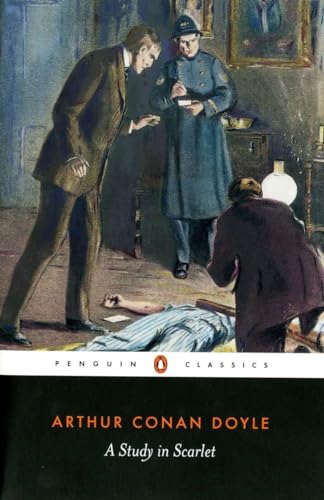
Sir Arthur Conan Doyle's A Study in Scarlet is the literary debut of the world's most famous fictional detective, Sherlock Holmes, introduced by Iain Sinclair with notes by Ed Glinert in Penguin Classics.
Convalescing in London after a disastrous experience of war in Afghanistan, Dr John Watson finds himself sharing rooms with his enigmatic new acquaintance, Sherlock Holmes. But their quiet bachelor life at 221B Baker Street is soon interrupted by the grisly discovery of a dead man in a grimy 'ill-omened' house in south-east London, his face contorted by an expression of horror and hatred such as Watson has never seen before. On the wall, the word rache - German for 'revenge' - is written in blood, yet there are no wounds on the victim or signs of a struggle. Watson's head is in a whirl, but the formidable Holmes relishes this challenge to his deductive powers, and so begins their famous investigative partnership.
In his introduction, Iain Sinclair discusses the links between Sherlock Holmes mysteries and the Jack the Ripper murders, Conan Doyle's narrative style and his depiction of London. This edition also includes further reading, a chronology and notes.
Sir Arthur Conan Doyle (1859-1930) was born in Edinburgh where he qualified as a doctor, but it was his writing which brought him fame, with the creation of Sherlock Holmes, the first scientific detective. He was also a social reformer who used his investigative skills to prove the innocence of individuals.
Iain Sinclair is the author of Downriver (winner of the James Tait Black Memorial Prize and the Encore Award), and his latest book Ghost Milk: Calling Time on the Grand Project is published by Penguin.
Ed Glinert writes a regular column for Time Out magazine, and is the author of The Literary Guide to London. Glinert's latest book, The London Compendium, is published by Penguin.
If you liked A Study in Scarlet you might enjoy The Hound of the Baskervilles, also available in Penguin Classics.
Die Inhaltsangabe kann sich auf eine andere Ausgabe dieses Titels beziehen.
Über die Autorin bzw. den Autor
Sir Arthur Conan Doyle (1859-1930) was born in Edinburgh where he qualified as a doctor, but it was his writing which brought him fame, with the creation of Sherlock Holmes, the first scientific detective. He was also a convert to spiritualism and a social reformer who used his investigative skills to prove the innocence of individuals.
Iain Sinclair is the author of Crash, Lights Out for the Territory and, with Rachel Lichtenstein, Rodinsky's Room. He is a regular broadcaster and interviewer.
Ed Glinert is the author of A Literary Guide to London.
Auszug. © Genehmigter Nachdruck. Alle Rechte vorbehalten.
CHAPTER I
Mr. Sherlock Holmes
In the year 1878 I took my degree of Doctor of Medicine of the University of London, and proceeded to Netley to go through the course prescribed for surgeons in the army. Having completed my studies there, I was duly attached to the Fifth Northumberland Fusiliers as Assistant Surgeon. The regiment was stationed in India at the time, and before I could join it, the second Afghan war had broken out. On landing at Bombay, I learned that my corps had advanced through the passes, and was already deep in the enemy’s country. I followed, however, with many other officers who were in the same situation as myself, and succeeded in reaching Candahar in safety, where I found my regiment, and at once entered upon my new duties.
The campaign brought honours and promotion to many, but for me it had nothing but misfortune and disaster. I was removed from my brigade and attached to the Berkshires,with whom I served at the fatal battle of Maiwand. There I was struck on the shoulder by a Jezail bullet, which shattered the bone and grazed the subclavian artery. I should have fallen into the hands of the murderous Ghazis had it not been for the devotion and courage shown by Murray, my orderly, who threw me across a pack-horse, and succeeded in bringing me safely to the British lines.
Worn with pain, and weak from the prolonged hardships which I had undergone, I was removed, with a great train of wounded sufferers, to the base hospital at Peshawur. Here I rallied, and had already improved so far as to be able to walk about the wards, and even to bask a little upon the verandah, when I was struck down by enteric fever, that curse of our Indian possessions. For months my life was despaired of, and when at last I came to myself and became convalescent, I was so weak and emaciated that a medical board determined that not a day should be lost in sending me back to England. I was despatched, accordingly, in the troopship Orontes, and landed a month later on Portsmouth jetty, with my health irretrievably ruined, but with permission from a paternal government to spend the next nine months in attempting to improve it.
I had neither kith nor kin in England, and was therefore as free as air—or as free as an income of eleven shillings and sixpence a day will permit a man to be. Under such circumstances I naturally gravitated to London, that great cesspool into which all the loungers and idlers of the Empire are irresistibly drained. There I stayed for some time at a private hotel in the Strand, leading a comfortless, meaningless existence, and spending such money as I had, considerably more freely than I ought. So alarming did the state of my finances become, that I soon realized that I must either leave the metropolis and rusticate somewhere in the country, or that I must make a complete alteration in my style of living. Choosing the latter alternative, I began by making up my mind to leave the hotel, and to take up my quarters in some less pretentious and less expensive domicile.
On the very day that I had come to this conclusion, I was standing at the Criterion Bar, when some one tapped me on the shoulder, and turning round I recognized young Stamford, who had been a dresser under me at Barts. The sight of a friendly face in the great wilderness of London is a pleasant thing indeed to a lonely man. In old days Stamford had never been a particular crony of mine, but now I hailed him with enthusiasm, and he, in his turn, appeared to be delighted to see me. In the exuberance of my joy, I asked him to lunch with me at the Holborn, and we started off together in a hansom.
“Whatever have you been doing with yourself, Watson?” he asked in undisguised wonder, as we rattled through the crowded London streets. “You are as thin as a lath and as brown as a nut.”
I gave him a short sketch of my adventures, and had hardly concluded it by the time that we reached our destination.
“Poor devil!” he said, commiseratingly, after he had listened to my misfortunes. “What are you up to now?”
“Looking for lodgings,” I answered. “Trying to solve the problem as to whether it is possible to get comfortable rooms at a reasonable price.”
“That’s a strange thing,” remarked my companion, “you are the second man to-day that has used that expression to me.”
“And who was the first?” I asked.
“A fellow who is working at the chemical laboratory up at the hospital. He was bemoaning himself this morning because he could not get some one to go halves with him in some nice rooms which he had found, and which were too much for his purse.”
“By Jove!” I cried; “if he really wants some one to share the rooms and the expense, I am the very man for him. I should prefer having a partner to being alone.”
Young Stamford looked rather strangely at me over his wine glass. “You don’t know Sherlock Holmes yet,” he said; “perhaps you would not care for him as a constant companion.”
“Why, what is there against him?”
“Oh, I didn’t say there was anything against him. He is a little queer in his ideas—an enthusiast in some branches of science. As far as I know he is a decent fellow enough.”
“A medical student, I suppose?” said I.
“No—I have no idea what he intends to go in for. I believe he is well up in anatomy, and he is a first-class chemist; but, as far as I know, he has never taken out any systematic medical classes. His studies are very desultory and eccentric, but he has amassed a lot of out-of-the-way knowledge which would astonish his professors.”
“Did you never ask him what he was going in for?” I asked.
“No; he is not a man that it is easy to draw out, though he can be communicative enough when the fancy seizes him.”
“I should like to meet him,” I said. “If I am to lodge with any one, I should prefer a man of studious and quiet habits. I am not strong enough yet to stand much noise or excitement. I had enough of both in Afghanistan to last me for the remainder of my natural existence. How could I meet this friend of yours?”
“He is sure to be at the laboratory,” returned my companion. “He either avoids the place for weeks, or else he works there from morning till night. If you like, we will drive round together after luncheon.”
“Certainly,” I answered, and the conversation drifted away into other channels.
As we made our way to the hospital after leaving the Holborn, Stamford gave me a few more particulars about the gentleman whom I proposed to take as a fellow-lodger.
“You mustn’t blame me if you don’t get on with him,” he said; “I know nothing more of him than I have learned from meeting him occasionally in the laboratory. You proposed this arrangement, so you must not hold me responsible.”
“If we don’t get on it will be easy to part company,” I answered. “It seems to me, Stamford,” I added, looking hard at my companion, “that you have some reason for washing your hands of the matter. Is this fellow’s temper so formidable, or what is it? Don’t be mealy-mouthed about it.”
“It is not easy to express the inexpressible,” he answered with a laugh. “Holmes is a little too scientific for my tastes—it approaches to cold-bloodedness. I could imagine his giving a friend a little pinch of the latest vegetable alkaloid,15 not out of malevolence, you understand, but simply out of a spirit of inquiry in order to have an accurate idea of the effects. To do...
„Über diesen Titel“ kann sich auf eine andere Ausgabe dieses Titels beziehen.
Suchergebnisse für A Study in Scarlet: With Introduction by Iain Sinclair....

Beispielbild für diese ISBN
A Study in Scarlet (Penguin Classics)
Verlag:
Penguin Classics (edition ), 2001
ISBN 10: 0140439080
ISBN 13: 9780140439083
Gebraucht
Paperback
Anbieter: BooksRun, Philadelphia, PA, USA
Verkäuferbewertung 5 von 5 Sternen

Paperback. Zustand: Fair. The item might be beaten up but readable. May contain markings or highlighting, as well as stains, bent corners, or any other major defect, but the text is not obscured in any way. Artikel-Nr. 0140439080-7-1
Gebraucht kaufen
EUR 4,90
Versand gratis
Versand innerhalb von USA
Versand innerhalb von USA
Anzahl: 1 verfügbar
Beispielbild für diese ISBN
A Study in Scarlet
Anbieter: ThriftBooks-Dallas, Dallas, TX, USA
Verkäuferbewertung 5 von 5 Sternen
Paperback. Zustand: Fair. No Jacket. Readable copy. Pages may have considerable notes/highlighting. ~ ThriftBooks: Read More, Spend Less. Artikel-Nr. G0140439080I5N00
Gebraucht kaufen
EUR 6,34
Versand gratis
Versand innerhalb von USA
Versand innerhalb von USA
Anzahl: 1 verfügbar
Beispielbild für diese ISBN
A Study in Scarlet
Verlag:
Penguin Publishing Group, 2001
ISBN 10: 0140439080
ISBN 13: 9780140439083
Gebraucht
Softcover
Anbieter: Better World Books, Mishawaka, IN, USA
Verkäuferbewertung 5 von 5 Sternen
Zustand: Good. New Ed. Former library copy. Pages intact with minimal writing/highlighting. The binding may be loose and creased. Dust jackets/supplements are not included. Includes library markings. Stock photo provided. Product includes identifying sticker. Better World Books: Buy Books. Do Good. Artikel-Nr. GRP38116350
Gebraucht kaufen
EUR 6,56
Versand gratis
Versand innerhalb von USA
Versand innerhalb von USA
Anzahl: 2 verfügbar
Beispielbild für diese ISBN
A Study in Scarlet
Verlag:
Penguin Publishing Group, 2001
ISBN 10: 0140439080
ISBN 13: 9780140439083
Gebraucht
Softcover
Anbieter: Better World Books, Mishawaka, IN, USA
Verkäuferbewertung 5 von 5 Sternen
Zustand: Good. New Ed. Pages intact with minimal writing/highlighting. The binding may be loose and creased. Dust jackets/supplements are not included. Stock photo provided. Product includes identifying sticker. Better World Books: Buy Books. Do Good. Artikel-Nr. GRP97520590
Gebraucht kaufen
EUR 6,56
Versand gratis
Versand innerhalb von USA
Versand innerhalb von USA
Anzahl: 3 verfügbar
Beispielbild für diese ISBN
A Study in Scarlet
Anbieter: World of Books (was SecondSale), Montgomery, IL, USA
Verkäuferbewertung 5 von 5 Sternen
Paperback. Zustand: Fair. Convalescing in London after a disastrous experience of war in Afghanistan, Dr John Watson finds himself sharing rooms with his enigmatic new acquaintance, Sherlock Holmes. But their quiet bachelor life at 221B Baker Street is soon interrupted by the grisly discovery of a dead man in a grimy 'ill-omened' house in south-east London, his face contorted by an expression of horror and hatred such as Watson has never seen before. On the wall, the word rache - German for 'revenge' - is written in blood, yet there are no wounds on the victim or signs of a struggle. Watson's head is in a whirl, but the formidable Holmes relishes this challenge to his deductive powers, and so begins their famous investigative partnership. Artikel-Nr. 00105269232
Gebraucht kaufen
EUR 7,78
Versand gratis
Versand innerhalb von USA
Versand innerhalb von USA
Anzahl: 1 verfügbar
Beispielbild für diese ISBN
A Study in Scarlet
Verlag:
Penguin Publishing Group, 2001
ISBN 10: 0140439080
ISBN 13: 9780140439083
Gebraucht
Softcover
Anbieter: Better World Books Ltd, Dunfermline, Vereinigtes Königreich
Verkäuferbewertung 5 von 5 Sternen
Zustand: Good. New Ed. Pages intact with minimal writing/highlighting. The binding may be loose and creased. Dust jackets/supplements are not included. Stock photo provided. Product includes identifying sticker. Better World Books: Buy Books. Do Good. Artikel-Nr. GRP97520590
Gebraucht kaufen
EUR 5,78
EUR 5,90 Versand
Versand von Vereinigtes Königreich nach USA
Versand von Vereinigtes Königreich nach USA
Anzahl: 1 verfügbar
Beispielbild für diese ISBN
A Study in Scarlet (Penguin Classics)
Anbieter: Reuseabook, Gloucester, GLOS, Vereinigtes Königreich
Verkäuferbewertung 5 von 5 Sternen
Paperback. Zustand: Used; Good. Dispatched, from the UK, within 48 hours of ordering. This book is in good condition but will show signs of previous ownership. Please expect some creasing to the spine and/or minor damage to the cover. Artikel-Nr. CHL3906262
Gebraucht kaufen
EUR 5,72
EUR 8,26 Versand
Versand von Vereinigtes Königreich nach USA
Versand von Vereinigtes Königreich nach USA
Anzahl: 1 verfügbar
Beispielbild für diese ISBN
A Study in Scarlet
Anbieter: Majestic Books, Hounslow, Vereinigtes Königreich
Verkäuferbewertung 4 von 5 Sternen

Zustand: New. pp. xxix + 143. Artikel-Nr. 8238838
Neu kaufen
EUR 7,77
EUR 7,67 Versand
Versand von Vereinigtes Königreich nach USA
Versand von Vereinigtes Königreich nach USA
Anzahl: 10 verfügbar
Beispielbild für diese ISBN
A Study in Scarlet
Anbieter: PBShop.store UK, Fairford, GLOS, Vereinigtes Königreich
Verkäuferbewertung 5 von 5 Sternen
PAP. Zustand: New. New Book. Shipped from UK. Established seller since 2000. Artikel-Nr. GB-9780140439083
Neu kaufen
EUR 12,20
EUR 3,88 Versand
Versand von Vereinigtes Königreich nach USA
Versand von Vereinigtes Königreich nach USA
Anzahl: 15 verfügbar
Beispielbild für diese ISBN
A Study in Scarlet (Penguin Classics)
Anbieter: Kennys Bookstore, Olney, MD, USA
Verkäuferbewertung 5 von 5 Sternen
Zustand: New. Convalescing in London after a disastrous experience of war in Afghanistan, Dr John Watson finds himself sharing rooms with his enigmatic new acquaintance, Sherlock Holmes. But their quiet bachelor life at 221B Baker Street is soon interrupted by the grisly discovery of a dead man in a grimy 'ill-omened' house in south-east London. Num Pages: 176 pages. BIC Classification: FFC. Category: (G) General (US: Trade). Dimension: 196 x 129 x 12. Weight in Grams: 136. 2001. Paperback. . . . . Books ship from the US and Ireland. Artikel-Nr. 9780140439083
Neu kaufen
EUR 11,87
EUR 9,36 Versand
Versand innerhalb von USA
Versand innerhalb von USA
Anzahl: 3 verfügbar