Inhaltsangabe
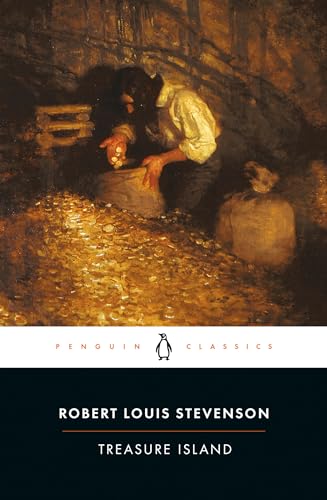
The quintessential adventure story that first established pirates in the popular imagination, Robert Louis Stevenson's Treasure Island is edited with an introduction by John Seelye in Penguin Classics.
When a mysterious sailor dies in sinister circumstances at the Admiral Benbow inn, young Jim Hawkins stumbles across a treasure map among the dead man's possessions. But Jim soon becomes only too aware that he is not the only one who knows of the map's existence, and his bravery and cunning are tested to the full when, with his friends Squire Trelawney and Dr Livesey, he sets sail in the Hispaniola to track down the treasure. With its swift-moving plot and memorably drawn characters - Blind Pew and Black Dog, the castaway Ben Gunn and the charming but dangerous Long John Silver - Stevenson's tale of pirates, treachery and heroism was an immediate success when it was first published in 1883 and has retained its place as one of the greatest of all adventure stories.
In his introduction John Seelye examines Stevenson's life and influences and the novel's place within adventure fiction. This edition also includes Stevenson's essay on the composition of Treasure Island.
Robert Louis Stevenson (1850-1894) was born in Edinburgh, the son of a prosperous civil engineer. Although he began his career as an essayist and travel writer, the success of Treasure Island (1883) and Kidnapped (1886) established his reputation as a writer of tales of action and adventure. Stevenson's Calvinist upbringing lent him a preoccupation with predestination and a fascination with the presence of evil, themes he explored in The Strange Case of Dr Jekyll and Mr Hyde (1886), and The Master of Ballantrae (1893).
If you enjoyed Treasure Island, you might like Daniel Defoe's Robinson Crusoe, also available in Penguin Classics.
Die Inhaltsangabe kann sich auf eine andere Ausgabe dieses Titels beziehen.
Über die Autorin bzw. den Autor
Robert Louis Stevenson was born in Edinburgh in 1850. The son of a prosperous civil engineer, he was expected to follow the family profession but was finally allowed to study law at Edinburgh University. Stevenson reacted forcibly against the Presbyterianism of both his city's professional classes and his devout parents, but the influence of Calvinism on his childhood informed the fascination with evil that is so powerfully explored in Dr Jekyll and Mr Hyde. Stevenson suffered from a severe respiratory disease from his twenties onwards, leading him to settle in the gentle climate of Samoa with his American wife, Fanny Osbourne.
Von der hinteren Coverseite
The quintessential adventure story that first established pirates in the popular imagination, Robert Louis Stevenson's Treasure Island is edited with an introduction by John Seelye in Penguin Classics.
When a mysterious sailor dies in sinister circumstances at the Admiral Benbow inn, young Jim Hawkins stumbles across a treasure map among the dead man's possessions. But Jim soon becomes only too aware that he is not the only one who knows of the map's existence, and his bravery and cunning are tested to the full when, with his friends Squire Trelawney and Dr Livesey, he sets sail in the Hispaniola to track down the treasure. With its swift-moving plot and memorably drawn characters - Blind Pew and Black Dog, the castaway Ben Gunn and the charming but dangerous Long John Silver - Stevenson's tale of pirates, treachery and heroism was an immediate success when it was first published in 1883 and has retained its place as one of the greatest of all adventure stories.
In his introduction John Seelye examines Stevenson's life and influences and the novel's place within adventure fiction. This edition also includes Stevenson's essay on the composition of Treasure Island
Aus dem Klappentext
The quintessential adventure story that first established pirates in the popular imagination, Robert Louis Stevenson's Treasure Island is edited with an introduction by John Seelye in Penguin Classics.
When a mysterious sailor dies in sinister circumstances at the Admiral Benbow inn, young Jim Hawkins stumbles across a treasure map among the dead man's possessions. But Jim soon becomes only too aware that he is not the only one who knows of the map's existence, and his bravery and cunning are tested to the full when, with his friends Squire Trelawney and Dr Livesey, he sets sail in the Hispaniola to track down the treasure. With its swift-moving plot and memorably drawn characters - Blind Pew and Black Dog, the castaway Ben Gunn and the charming but dangerous Long John Silver - Stevenson's tale of pirates, treachery and heroism was an immediate success when it was first published in 1883 and has retained its place as one of the greatest of all adventure stories.
In his introduction John Seelye examines Stevenson's life and influences and the novel's place within adventure fiction. This edition also includes Stevenson's essay on the composition of Treasure Island.
Robert Louis Stevenson (1850-1894) was born in Edinburgh, the son of a prosperous civil engineer. Although he began his career as an essayist and travel writer, the success of Treasure Island (1883) and Kidnapped (1886) established his reputation as a writer of tales of action and adventure. Stevenson's Calvinist upbringing lent him a preoccupation with predestination and a fascination with the presence of evil, themes he explored in The Strange Case of Dr Jekyll and Mr Hyde (1886), and The Master of Ballantrae (1893).
Auszug. © Genehmigter Nachdruck. Alle Rechte vorbehalten.
Chapter I
The Old Sea Dog at the "Admiral Benbow"
Squire Trelawney, Dr. Livesey, and the rest of these gentlemen having asked me to write down the whole particulars about Treasure Island, from the beginning to the end, keeping nothing back but the bearings of the island, and that only because there is still treasure not yet lifted, I take up my pen in the year of grace 17-, and go back to the time when my father kept the "Admiral Benbow" inn, and the brown old seaman, with the sabre cut, first took up his lodging under our roof.
I remember him as if it were yesterday, as he came plodding to the inn door, his sea-chest following behind him in a hand-barrow; a tall, strong, heavy, nut-brown man; his tarry pigtail falling over the shoulders of his soiled blue coat; his hands ragged and scarred, with black, broken nails; and the sabre cut across one cheek, a dirty, livid white. I remember him looking round the cove and whistling to himself as he did so, and then breaking out in that old sea-song that he sang so often afterwards:-
"Fifteen men on the dead man's chest-
Yo-ho-ho, and a bottle of rum!"
in the high, old tottering voice that seemed to have been tuned and broken at the capstan bars. Then he rapped on the door with a bit of stick like a handspike that he carried, and when my father appeared, called roughly for a glass of rum. This, when it was brought to him, he drank slowly, like a connoisseur, lingering on the taste, and still looking about him at the cliffs and up at our signboard.
"This is a handy cove," says he, at length; "and a pleasant sittyated grog-shop. Much company, mate?"
My father told him no, very little company, the more was the pity.
"Well, then," said he, "this is the berth for me. Here you, matey," he cried to the man who trundled the barrow; "bring up alongside and help up my chest. I'll stay here a bit," he continued. "I'm a plain man; rum and bacon and eggs is what I want, and that head up there for to watch ships off. What you mought call me? You mought call me captain. Oh, I see what you're at-there;" and he threw down three or four gold pieces on the threshold. "You can tell me when I've worked through that," says he, looking as fierce as a commander.
And, indeed, bad as his clothes were, and coarsely as he spoke, he had none of the appearance of a man who sailed before the mast; but seemed like a mate or skipper, accustomed to be obeyed or to strike. The man who came with the barrow told us the mail had set him down the morning before at the "Royal George;" that he had inquired what inns there were along the coast, and hearing ours well spoken of, I suppose, and described as lonely, had chosen it from the others for his place of residence. And that was all we could learn of our guest.
He was a very silent man by custom. All day he hung round the cove, or upon the cliffs, with a brass telescope; all evening he sat in a corner of the parlour next the fire, and drank rum and water very strong. Mostly he would not speak when spoken to; only look up sudden and fierce, and blow through his nose like a fog-horn; and we and the people who came about our house soon learned to let him be. Every day, when he came back from his stroll, he would ask if any seafaring men had gone by along the road? At first we thought it was the want of company of his own kind that made him ask this question; but at last we began to see he was desirous to avoid them. When a seaman put up at the "Admiral Benbow" (as now and then some did, making by the coast road for Bristol), he would look in at him through the curtained door before he entered the parlour; and he was always sure to be as silent as a mouse when any such was present. For me, at least, there was no secret about the matter; for I was, in a way, a sharer in his alarms. He had taken me aside one day, and promised me a silver fourpenny on the first of every month if I would only keep my "weather-eye open for a seafaring man with one leg," and let him know the moment he appeared. Often enough, when the first of the month came round, and I applied to him for my wage, he would only blow through his nose at me, and stare me down; but before the week was out he was sure to think better of it, bring me my fourpenny piece, and repeat his orders to look out for "the seafaring man with one leg."
How that personage haunted my dreams, I need scarcely tell you. On stormy nights, when the wind shook the four corners of the house, and the surf roared along the cove and up the cliffs, I would see him in a thousand forms, and with a thousand diabolical expressions. Now the leg would be cut off at the knee, now at the hip; now he was a monstrous kind of a creature who had never had but the one leg, and that in the middle of his body. To see him leap and run and pursue me over hedge and ditch was the worst of nightmares. And altogether I paid pretty dear for my monthly fourpenny piece, in the shape of these abominable fancies.
But though I was so terrified by the idea of the seafaring man with one leg, I was far less afraid of the captain himself than anybody else who knew him. There were nights when he took a deal more rum and water than his head would carry; and then he would sometimes sit and sing his wicked, old, wild sea-songs, minding nobody; but sometimes he would call for glasses round, and force all the trembling company to listen to his stories or bear a chorus to his singing. Often I have heard the house shaking with "Yo-ho-ho, and a bottle of rum;" all the neighbours joining in for dear life, with the fear of death upon them, and each singing louder than the other, to avoid remark. For in these fits he was the most over-riding companion ever known; he would slap his hand on the table for silence all round; he would fly up in a passion of anger at a question, or sometimes because none was put, and so he judged the company was not following his story. Nor would he allow any one to leave the inn till he had drunk himself sleepy and reeled off to bed.
His stories were what frightened people worst of all. Dreadful stories they were; about hanging, and walking the plank, and storms at sea, and the Dry Tortugas, and wild deeds and places on the Spanish Main. By his own account he must have lived his life among some of the wickedest men that God ever allowed upon the sea; and the language in which he told these stories shocked our plain country people almost as much as the crimes that he described. My father was always saying the inn would be ruined, for people would soon cease coming there to be tyrannised over and put down, and sent shivering to their beds; but I really believe his presence did us good. People were frightened at the time, but on looking back they rather liked it; it was a fine excitement in a quiet country life; and there was even a party of the younger men who pretended to admire him, calling him a "true sea-dog," and a "real old salt," and such like names, and saying there was the sort of man that made England terrible at sea.
In one way, indeed, he bade fair to ruin us; for he kept on staying week after week, and at last month after month, so that all the money had been long exhausted, and still my father never plucked up the heart to insist on having more. If ever he mentioned it, the captain blew through his nose so loudly, that you might say he roared, and stared my poor father out of the room. I have seen him wringing his hands after such a rebuff, and I am sure the annoyance and the terror he lived in must have greatly hastened his early and unhappy death.
All the time he lived with us the captain made no change whatever in his dress but to buy some stockings from a hawker. One of the...
„Über diesen Titel“ kann sich auf eine andere Ausgabe dieses Titels beziehen.
Weitere beliebte Ausgaben desselben Titels

Suchergebnisse für Treasure Island (Penguin Classics)

Beispielbild für diese ISBN
Treasure Island (Penguin Classics)
Verlag:
Penguin Classics (edition ), 1999
ISBN 10: 0140437681
ISBN 13: 9780140437683
Gebraucht
Paperback
Anbieter: BooksRun, Philadelphia, PA, USA
Verkäuferbewertung 5 von 5 Sternen

Paperback. Zustand: Fair. The item might be beaten up but readable. May contain markings or highlighting, as well as stains, bent corners, or any other major defect, but the text is not obscured in any way. Artikel-Nr. 0140437681-7-1
Gebraucht kaufen
EUR 4,82
Versand gratis
Versand innerhalb von USA
Versand innerhalb von USA
Anzahl: 1 verfügbar
Foto des Verkäufers
Treasure Island (Penguin Classics)
Anbieter: Dream Books Co., Denver, CO, USA
Verkäuferbewertung 5 von 5 Sternen
Zustand: acceptable. This copy has clearly been enjoyedâ"expect noticeable shelf wear and some minor creases to the cover. Binding is strong, and all pages are legible. May contain previous library markings or stamps. Artikel-Nr. DBV.0140437681.A
Gebraucht kaufen
EUR 4,98
Versand gratis
Versand innerhalb von USA
Versand innerhalb von USA
Anzahl: 1 verfügbar
Beispielbild für diese ISBN
Treasure Island (Penguin Classics)
Anbieter: Wonder Book, Frederick, MD, USA
Verkäuferbewertung 5 von 5 Sternen
Zustand: Good. Good condition. A copy that has been read but remains intact. May contain markings such as bookplates, stamps, limited notes and highlighting, or a few light stains. Artikel-Nr. D01A-02797
Gebraucht kaufen
EUR 5,31
Versand gratis
Versand innerhalb von USA
Versand innerhalb von USA
Anzahl: 1 verfügbar
Beispielbild für diese ISBN
Treasure Island
Anbieter: ThriftBooks-Phoenix, Phoenix, AZ, USA
Verkäuferbewertung 5 von 5 Sternen
Paperback. Zustand: Good. No Jacket. Pages can have notes/highlighting. Spine may show signs of wear. ~ ThriftBooks: Read More, Spend Less. Artikel-Nr. G0140437681I3N00
Gebraucht kaufen
EUR 5,66
Versand gratis
Versand innerhalb von USA
Versand innerhalb von USA
Anzahl: 2 verfügbar
Beispielbild für diese ISBN
Treasure Island
Anbieter: ThriftBooks-Reno, Reno, NV, USA
Verkäuferbewertung 5 von 5 Sternen
Paperback. Zustand: Very Good. No Jacket. May have limited writing in cover pages. Pages are unmarked. ~ ThriftBooks: Read More, Spend Less. Artikel-Nr. G0140437681I4N00
Gebraucht kaufen
EUR 5,97
Versand gratis
Versand innerhalb von USA
Versand innerhalb von USA
Anzahl: 1 verfügbar
Beispielbild für diese ISBN
Treasure Island
Anbieter: ThriftBooks-Atlanta, AUSTELL, GA, USA
Verkäuferbewertung 5 von 5 Sternen
Paperback. Zustand: Good. No Jacket. Former library book; Pages can have notes/highlighting. Spine may show signs of wear. ~ ThriftBooks: Read More, Spend Less. Artikel-Nr. G0140437681I3N10
Gebraucht kaufen
EUR 5,97
Versand gratis
Versand innerhalb von USA
Versand innerhalb von USA
Anzahl: 1 verfügbar
Beispielbild für diese ISBN
Treasure Island
Anbieter: ThriftBooks-Reno, Reno, NV, USA
Verkäuferbewertung 5 von 5 Sternen
Paperback. Zustand: Good. No Jacket. Pages can have notes/highlighting. Spine may show signs of wear. ~ ThriftBooks: Read More, Spend Less. Artikel-Nr. G0140437681I3N00
Gebraucht kaufen
EUR 5,97
Versand gratis
Versand innerhalb von USA
Versand innerhalb von USA
Anzahl: 3 verfügbar
Beispielbild für diese ISBN
Treasure Island
Anbieter: ThriftBooks-Dallas, Dallas, TX, USA
Verkäuferbewertung 5 von 5 Sternen
Paperback. Zustand: Good. No Jacket. Former library book; Pages can have notes/highlighting. Spine may show signs of wear. ~ ThriftBooks: Read More, Spend Less. Artikel-Nr. G0140437681I3N10
Gebraucht kaufen
EUR 5,97
Versand gratis
Versand innerhalb von USA
Versand innerhalb von USA
Anzahl: 1 verfügbar
Beispielbild für diese ISBN
Treasure Island
Anbieter: ThriftBooks-Dallas, Dallas, TX, USA
Verkäuferbewertung 5 von 5 Sternen
Paperback. Zustand: Good. No Jacket. Pages can have notes/highlighting. Spine may show signs of wear. ~ ThriftBooks: Read More, Spend Less. Artikel-Nr. G0140437681I3N00
Gebraucht kaufen
EUR 5,97
Versand gratis
Versand innerhalb von USA
Versand innerhalb von USA
Anzahl: 3 verfügbar
Beispielbild für diese ISBN
Treasure Island
Anbieter: ThriftBooks-Reno, Reno, NV, USA
Verkäuferbewertung 5 von 5 Sternen
Paperback. Zustand: Fair. No Jacket. Readable copy. Pages may have considerable notes/highlighting. ~ ThriftBooks: Read More, Spend Less. Artikel-Nr. G0140437681I5N00
Gebraucht kaufen
EUR 5,97
Versand gratis
Versand innerhalb von USA
Versand innerhalb von USA
Anzahl: 1 verfügbar