
Verwandte Artikel zu How the Other Half Lives: Studies Among the Tenements...
How the Other Half Lives: Studies Among the Tenements of New York (Penguin Classics) - Softcover
Buch 30 von 36: Bedford Series in History & Culture (Paperback)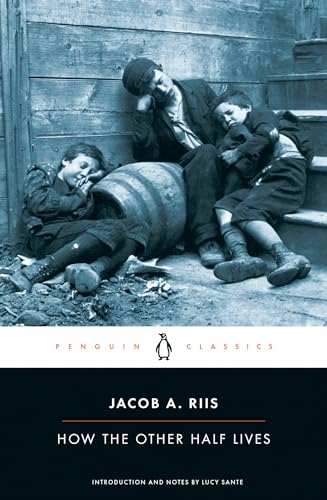
Inhaltsangabe
Published in 1890, Jacob Riis's remarkable study of the horrendous living conditions of the poor in New York City had an immediate impact on society, inspiring reforms that affected the lives of millions of people. Riis takes the reader on a tour of New York's slums, bringing to life the various ethnic groups - Italians, Jews, 'Bohemians', Blacks and Chinese - in vivid descriptions of their habits and traditions. Cataloguing the effects of poverty, alcohol and lack of education, Riis pioneered the style of crusading journalism that continues today.
Die Inhaltsangabe kann sich auf eine andere Ausgabe dieses Titels beziehen.
Über die Autorin bzw. den Autor
Jacob A. Riis (1849-1914) was a Danish immigrant in the United States who worked as a reporter for various New York reporters.
Luc Sante lives in Brooklyn, New York.
Auszug. © Genehmigter Nachdruck. Alle Rechte vorbehalten.
List of Illustrations
Introduction by Luc Sante
Suggestions for Further Reading
A Note on the Text
How the Other Half Lives
Preface
Introduction
1 Genesis of the Tenement
2 The Awakening
3 The Mixed Crowd
4 The Down Town Back-alleys
5 The Italian in New York
6 The Bend
7 A Raid on the Stale-beer Dives
8 The Cheap Lodging-houses
9 Chinatown
10 Jewtown
11 The Sweaters of Jewtown
12 The Bohemians — Tenement-house Cigarmaking
13 The Color Line in New York
14 The Common Herd
15 The Problem of the Children
16 Waifs of the City’s Slums
17 The Street Arab
18 The Reign of Rum
19 The Harvest of Tares
20 The Working Girls of New York
21 Pauperism in the Tenements
22 The Wrecks and the Waste
23 The Man with the Knife
24 What Has Been Done
25 How the Case Stands
Appendix
Explanatory Notes
PENGUIN CLASSICS
HOW THE OTHER HALF LIVES
Jacob A. Riis (1849–1914) was the first reformer to effectively convey to a wide public the unacceptable nature of living conditions endured by the urban poor. His use of the relatively new medium of photography brought an unprecedented power to his message.
In 1870 Riis, born in Ribe, Denmark, arrived in New York as a Danish immigrant, one among thousands of the poor, friendless, and unskilled. Like so many, he frequently spent nights in police station lodging houses, the shelters of last resort in late nineteenth-century New York. He soon left the city to work at an assortment of rural jobs, but returned in 1877 to find steady employment as a police reporter for the Tribune (1877–88) and, later, the Evening Sun (1888–99). New York’s police headquarters was then on Mulberry Street, in the heart of the Lower East Side slum district. As Riis’s familiarity with the neighborhood’s squalid living conditions deepened, he began to employ his journalistic skills to convey his revulsion to the public.
For ten years (1877–87) Riis wrote and lectured stressing his view that the poor were victims rather than makers of their fate, a concept then emerging among social reformers. However, despite his considerable rhetorical skills and instructional use of statistics, architectural plans, and maps, Riis was unable to communicate the elemental shock he felt on his nightly sorties through the worst slums. It was the 1887 invention of flash photography — which allowed photographs to be taken in the darkest tenements — that provided Riis with a powerful new resource. Initially employing amateur and professional photographers, and later on his own, Riis photographed the horrors of slum life specifically to shift prevailing public opinion from passive acceptance to a realization that such living conditions must be improved.
Armed with this visual evidence, Riis added “magic lantern” slide shows to his lectures. Local newspapers reported that his viewers moaned, shuddered, fainted, even talked to the photographs he projected, reacting to the slides not as images but as a virtual reality that transported the New York slum world directly into the lecture hall. Riis’s predominantly middle-class audiences may never have experienced slum life, but they immediately understood it as a severe and intolerable threat to human dignity. But for Riis, even the verisimilitude of photography, made doubly powerful by the novelty of the medium, was not enough. At times he manipulated his subjects in an attempt to heighten the impact of his pictures. In some of his photographs, for example, young boys huddle over a ventilation grate as though it is their only refuge against the cold. But some of the boys can be seen smiling slyly at the camera. They know the picture is posed.
Once technical methods were developed for printing photographs with integrated text, Riis condensed his magic lantern shows into a series of half-tone photographic illustrations (together with line drawings) for his first book, How the Other Half Lives (1890). Its runaway success proved that he had captured the public’s interest in the everyday life of the urban poor. Many publications followed in the wake of this path-breaking book, each incorporating the rapidly improving technology of photographic reproduction. As his reputation continued to grow nationally, Riis became a major influence in launching tenement housing reform, improving sanitary conditions, creating public parks and playgrounds, and documenting the need for more schools.
The thirty photographs reproduced in this Penguin Classics edition are drawn from The Jacob A. Riis Collection at the Museum of the City of New York. (Statement by Leslie Nolan, Curator, Prints & Photographs, reprinted courtesy of the Museum of the City of New York.)
Luc Sante was born in Verviers, Belgium, and emigrated to the United States as a child. He has lived in New York City since 1972. He is the author of Low Life: Lures and Snares of Old New York (1991), Evidence (1992), and The Factory of Facts (1998). He has also worked as a book, film, art, and photography critic for many publications.
HOW THE OTHER HALF LIVES
Studies Among the Tenements
of New York
------------------------------
JACOB A. RIIS
WITH AN INTRODUCTION AND NOTES BY
LUC SANTE
LIST OF ILLUSTRATIONS
PHOTOGRAPHS
All photographs are part of the Jacob A. Riis Collection of the Museum of the City of New York. The Collection’s catalog numbers appear in parentheses following the captions.
Hell’s Kitchen and Sebastopol (#115)
The Ashbarrel of Old (#112)
Upstairs in Blindman’s Alley (#192)
Gotham Court (#24)
An Old Rear-Tenement in Roosevelt Street (#97)
In the Home of an Italian Rag-picker, Jersey Street (#157)
The Mulberry Bend (#114)
Bandits’ Roost (#101)
Bottle Alley (#109)
Lodgers in a Crowded Bayard Street Tenement — “Five Cents a Spot” (#155)
An All-Night Two-Cent Restaurant in “The Bend” (#104)
The Tramp (#91)
Bunks in a Seven-Cent Lodging House, Pell Street (#28)
Smoking Opium in a Joint (#F)
“The Official Organ of Chinatown”: Telephone Pole with Notices Stuck On (#260)
“Knee-pants” at Forty-Five Cents a Dozen — a Ludlow Street Sweater’s Shop (#149)
Bohemian Cigarmakers at Work in Their Tenement (#147)
A Black-and-Tan Dive in “Africa” (#163)
In Poverty Gap, West Twenty-Fourth St. An English Coal-Heaver’s Home (#154)
Prayer Time in the Nursery, Five Points House of Industry (#124)
Street Arabs, Mulberry Street, Retreat in Church Corner (#122)
“Didn’t Live Nowhere” (#DE)
Street Arabs at Night, Mulberry Street (#123)
Getting Ready for Supper in the Newsboys’ Lodging House (#165)
A Downtown “Morgue” (#162)
Typical Toughs (From the Rogues’ Gallery) (#6-s)
A Growler Gang in Session (#140)
Hunting River Thieves (#144)
Sewing and Starving in an Elizabeth Street Attic (#146)
A Flat in the Pauper Barracks, West Thirty-Eighth Street, with All Its Furniture (#151)
ILLUSTRATIONS
Tenement of 1863, for twelve families on each flat
Tenement of the old style. Birth of the air-shaft
At the cradle of the tenement. Doorway of an old-fashioned dwelling on Cherry Hill
Woman at well
Opium pipe
A tramp’s nest in Ludlow...
„Über diesen Titel“ kann sich auf eine andere Ausgabe dieses Titels beziehen.
Suchergebnisse für How the Other Half Lives: Studies Among the Tenements...

Beispielbild für diese ISBN
How the Other Half Lives: Studies Among the Tenements of New York
Verlag:
Penguin Classics (edition Reprint), 1997
ISBN 10: 0140436790
ISBN 13: 9780140436792
Gebraucht
Paperback
Anbieter: BooksRun, Philadelphia, PA, USA
Verkäuferbewertung 5 von 5 Sternen

Paperback. Zustand: Very Good. Reprint. It's a well-cared-for item that has seen limited use. The item may show minor signs of wear. All the text is legible, with all pages included. It may have slight markings and/or highlighting. Artikel-Nr. 0140436790-11-1
Gebraucht kaufen
EUR 4,34
Versand gratis
Versand innerhalb von USA
Versand innerhalb von USA
Anzahl: 1 verfügbar
Foto des Verkäufers
How the Other Half Lives: Studies Among the Tenements of New York
Anbieter: Dream Books Co., Denver, CO, USA
Verkäuferbewertung 5 von 5 Sternen
Zustand: good. Gently used with minimal wear on the corners and cover. A few pages may contain light highlighting or writing, but the text remains fully legible. Dust jacket may be missing, and supplemental materials like CDs or codes may not be included. May be ex-library with library markings. Ships promptly! Artikel-Nr. DBV.0140436790.G
Gebraucht kaufen
EUR 5,81
Versand gratis
Versand innerhalb von USA
Versand innerhalb von USA
Anzahl: 1 verfügbar
Beispielbild für diese ISBN
How the Other Half Lives
Anbieter: ThriftBooks-Reno, Reno, NV, USA
Verkäuferbewertung 5 von 5 Sternen
Paperback. Zustand: Fair. No Jacket. Readable copy. Pages may have considerable notes/highlighting. ~ ThriftBooks: Read More, Spend Less. Artikel-Nr. G0140436790I5N00
Gebraucht kaufen
EUR 6,31
Versand gratis
Versand innerhalb von USA
Versand innerhalb von USA
Anzahl: 2 verfügbar
Beispielbild für diese ISBN
How the Other Half Lives
Anbieter: ThriftBooks-Atlanta, AUSTELL, GA, USA
Verkäuferbewertung 5 von 5 Sternen
Paperback. Zustand: Good. No Jacket. Pages can have notes/highlighting. Spine may show signs of wear. ~ ThriftBooks: Read More, Spend Less. Artikel-Nr. G0140436790I3N00
Gebraucht kaufen
EUR 6,31
Versand gratis
Versand innerhalb von USA
Versand innerhalb von USA
Anzahl: 1 verfügbar
Beispielbild für diese ISBN
How the Other Half Lives
Anbieter: ThriftBooks-Dallas, Dallas, TX, USA
Verkäuferbewertung 5 von 5 Sternen
Paperback. Zustand: Good. No Jacket. Pages can have notes/highlighting. Spine may show signs of wear. ~ ThriftBooks: Read More, Spend Less. Artikel-Nr. G0140436790I3N00
Gebraucht kaufen
EUR 6,31
Versand gratis
Versand innerhalb von USA
Versand innerhalb von USA
Anzahl: 2 verfügbar
Beispielbild für diese ISBN
How the Other Half Lives
Anbieter: ThriftBooks-Atlanta, AUSTELL, GA, USA
Verkäuferbewertung 5 von 5 Sternen
Paperback. Zustand: Good. No Jacket. Former library book; Pages can have notes/highlighting. Spine may show signs of wear. ~ ThriftBooks: Read More, Spend Less. Artikel-Nr. G0140436790I3N10
Gebraucht kaufen
EUR 6,31
Versand gratis
Versand innerhalb von USA
Versand innerhalb von USA
Anzahl: 1 verfügbar
Beispielbild für diese ISBN
How the Other Half Lives
Anbieter: ThriftBooks-Dallas, Dallas, TX, USA
Verkäuferbewertung 5 von 5 Sternen
Paperback. Zustand: Fair. No Jacket. Readable copy. Pages may have considerable notes/highlighting. ~ ThriftBooks: Read More, Spend Less. Artikel-Nr. G0140436790I5N00
Gebraucht kaufen
EUR 6,31
Versand gratis
Versand innerhalb von USA
Versand innerhalb von USA
Anzahl: 2 verfügbar
Beispielbild für diese ISBN
How the Other Half Lives
Anbieter: ThriftBooks-Reno, Reno, NV, USA
Verkäuferbewertung 5 von 5 Sternen
Paperback. Zustand: Good. No Jacket. Pages can have notes/highlighting. Spine may show signs of wear. ~ ThriftBooks: Read More, Spend Less. Artikel-Nr. G0140436790I3N00
Gebraucht kaufen
EUR 6,31
Versand gratis
Versand innerhalb von USA
Versand innerhalb von USA
Anzahl: 1 verfügbar
Beispielbild für diese ISBN
How the Other Half Lives
Anbieter: ThriftBooks-Phoenix, Phoenix, AZ, USA
Verkäuferbewertung 5 von 5 Sternen
Paperback. Zustand: Good. No Jacket. Pages can have notes/highlighting. Spine may show signs of wear. ~ ThriftBooks: Read More, Spend Less. Artikel-Nr. G0140436790I3N00
Gebraucht kaufen
EUR 6,31
Versand gratis
Versand innerhalb von USA
Versand innerhalb von USA
Anzahl: 1 verfügbar
Beispielbild für diese ISBN
How the Other Half Lives
Anbieter: ThriftBooks-Atlanta, AUSTELL, GA, USA
Verkäuferbewertung 5 von 5 Sternen
Paperback. Zustand: Fair. No Jacket. Readable copy. Pages may have considerable notes/highlighting. ~ ThriftBooks: Read More, Spend Less. Artikel-Nr. G0140436790I5N00
Gebraucht kaufen
EUR 6,31
Versand gratis
Versand innerhalb von USA
Versand innerhalb von USA
Anzahl: 2 verfügbar