
Verwandte Artikel zu Flatland: A Romance in Many Dimensions (Penguin Classics)
Inhaltsangabe
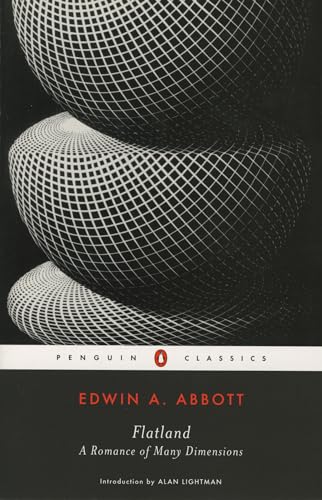
A 'romance of many dimensions' that has fascinated generations of readers with its clever blend of social satire and mathematical theory, the Penguin Classics edition of Edwin A. Abbott's Flatland introduction by Alan Lightman.
A work that continues to pose provocative questions about perception and reality, Flatland is a brilliant parody of Victorian society where all existence is limited to length and breadth - its inhabitants unable even to imagine a third dimension. The amiable narrator, A Square, provides an overview of this fantastic world - its physics and metaphysics, its history, customs and religious beliefs. But when a strange visitor mysteriously appears and transports the incredulous Flatlander to the Land of Three Dimensions, his world view is forever shattered.
Written more than a century ago, Flatland conceals within its brilliant parody of Victorian society speculations about the universe that resonate in Einstein's theory of relativity as well as the current 'string-theory' of nature.
Edwin A. Abbott (1838-1926) was a leading scholar and theologian of the Victorian era.
If you enjoyed Flatland you may like H.G. Wells's The Sleeper Awakes, also available in Penguin Classics.
Die Inhaltsangabe kann sich auf eine andere Ausgabe dieses Titels beziehen.
Über die Autorin bzw. den Autor
Edwin A. Abbott (1838-1926) was a leading scholar and theologian of the Victorian era.
Alan Lightman, the author of 'Einstein's Dream' and other books, is an astrophysicist and the Director of the Writing Program at M.I.T.
Von der hinteren Coverseite
A work that poses provocative questions about perception and reality. It is a parody of Victorian society where all existence is limited to length and breadth - its inhabitants unable even to imagine a third dimension. It provides an overview of this world - its physics and metaphysics, its history, customs and religious beliefs.
Auszug. © Genehmigter Nachdruck. Alle Rechte vorbehalten.
FLATLAND
A Romance of Many Dimensions
------------------------------
BY A. SQUARE
(EDWIN A. ABBOTT)
WITH ILLUSTRATIONS BY THE AUTHOR
AND
AN INTRODUCTION BY ALAN LIGHTMAN
PENGUIN BOOKS
INTRODUCTION
In the summer of 1973, I went on a camping trip in Sequoia National Park. I was a graduate student in physics at the time, and my two companions were also physicists. Carved out of granite by retreating glaciers, Sequoia National Park lies in the southern end of the great Sierra Nevada mountain range of California and is most famous for its giant sequoia trees, which attain heights of several hundred feet and ages of two thousand years. In Sequoia, one’s senses are overwhelmed. The land tilts and swerves from the ancient shifting of subterranean faults, snow-covered mountains jut into space, shady forests suddenly give way to bright meadows.
During this barrage of sensation, in which it seemed to me that every cubic inch of the world was filled to its maximum capacity, one of my fellow campers, John Schwarz, was at work formulating a new theory of nature—a theory that required seven additional dimensions beyond the usual three. Schwarz’s pioneering calculations, called “string theory” and later extended by other theoretical physicists, are now regarded as the best attempt to develop a quantum theory of gravity and to unify all the forces of nature. For technical reasons, such a theory demands more than length, width, and breadth. Fortunately, the extra dimensions are curled up in such tiny circles that they cannot be experienced by macroscopic creatures who are already strained by a mere three.
Almost a century before that excursion into the sequoias of California, in 1884, there quietly appeared in England a little book titled Flatland, which invited its readers to consider the outrageous possibility of four dimensions and more. Flatland slyly accomplished this suggestion by portraying the highly limited life of a world of only two dimensions, whose inhabitants cannot imagine, and do not want to imagine, a third dimension. In Flatland, all existence and experience is confined to a plane. Nothing has thickness. People come in the shape of triangles, squares, pentagons, and so on, the greater the number of sides, the higher the status. Since all geometrical shapes appear as straight lines when viewed edge on—and edge on is the only possibility in Flatland—inhabitants must feel each other’s angles for proper recognition. Interiors of closed figures are invisible. Rain slides across the world plane from the north; consequently each house is oriented so that its “roof” side faces that direction.
The author of this extended fable was the Reverend Edwin Abbott Abbott, born in 1838, educated at St. John’s in Cambridge, and ordained in 1862. Abbott was a classicist, Bible scholar, and, from 1865 to 1889, headmaster of the great City of London School, which he himself had attended before university. Abbott came from a line of headmasters, his father, Edwin Abbott, having been headmaster of the Philological School, Marylebone.
In the edition of the British Dictionary of National Biography for persons who died in the period of 1922 to 1930, no reference is made to Flatland, A Romance of Many Dimensions (1884). Abbott is indeed celebrated as a writer, with special notice of his school primer How to Write Clearly (1872), his literary criticism such as Shakespearean Grammar (1870), and his many theological writings such as Philochristus (1878), Onesimus: Memoirs of a Disciple of Paul (1882), and Johannine Grammar (1906). But his greatest achievement, from the vantage of a few years after his death, was as a teacher. Although frail and delicate in physique, he could keep discipline without effort, for he had the presence of a commander and “the mark of the spiritual leader in that he could impart to others something of the virtue that was in him. He was aflame with intellectual energy: without driving or overtaxing his pupils, he made intellectual effort a kind of religion for them.” A number of his students, including H. H. Asquith, went on to Cambridge and Oxford and became leading men of letters and government, of which he was most proud.
Today, Abbott is remembered principally as the author of the little book not even mentioned in the D.N.B. None of Abbott’s now forgotten other forty books hint at anything nearly so imaginative as Flatland. Although Flatland contains the same moralizing and didactic tone that runs through all of Abbott’s writing, the fable manages to break out of its period with the inspiration and eternal meaning of a classic.
In its mathematical underpinnings, fancifulness, and wit, one cannot resist comparing Abbott’s fable to Lewis Carroll’s Alice in Wonderland, published only twenty years earlier. Both Abbott and Carroll came out of the English school system, both excelled in the classics, both lent their particularly mathematical and logical minds to the invention of imaginary worlds for the amusement of their readers. Abbott’s book is far more pedantic, its geometrical and moral lessons more overt. Although a great deal has been read into Carroll’s two Alice books, any didacticism, if it exists at all, is well hidden. Perhaps a closer comparison to Flatland would be the Russian-born physicist George Gamow’s Mr. Tompkins books: Mr. Tompkins in Wonderland (1940) and Mr. Tompkins Explores the Atom (1945). In these books, Gamow creates fantastic worlds in which his hero Mr. C.G.H. Tompkins, “a little clerk of a big city bank,” travels at speeds close to the speed of light, or shrinks to the size of subatomic particles. Gamow’s explicit purpose is to popularize relativity and quantum theory; he succeeds also in demonstrating the extreme limitation of human sensory perceptions and all intuitive notions of the natural world based on those perceptions. All of these books, including my own Einstein’s Dreams, constitute a literary tradition in which a fantasy world created by some physical or mathematical conceit invites the reader to ponder philosophical questions in the actual world of human existence.
Flatland is divided into two halves. The first half bristles with the portrait of what today can only be described as a repulsively elitist and sexist society. Priests, who are circles, are the highest class and administrate the two-dimensional realm. Everyone aspires to having the highest number of sides, approaching the exalted circles, and the children of aristocrats are actually fractured to increase their number of corners. Tradesmen and soldiers, among the lowest classes, with a scant three or four sides to themselves, are barely human. Women are not even worthy of three sides. They are one-sided figures—straight lines, in other words—and they must be constantly avoided or handled gingerly so that their two extremely sharp ends will not puncture incautious males in the vicinity. Women talk too much and are so dumb that they aren’t even aware of their wretched status at the bottom of the social hierarchy. Occasionally, they go on a berserk rampage and massacre hundreds of males, a practice that is accepted as keeping the population of the lower classes in check (and might have been applauded by a two-dimensional Thomas Malthus).
This description of society is conveyed earnestly by the narrator of the fable, a two-dimensional inhabitant of Flatland. At first, one has the uneasy feeling that the narrator stands for Abbott and his...
„Über diesen Titel“ kann sich auf eine andere Ausgabe dieses Titels beziehen.
Suchergebnisse für Flatland: A Romance in Many Dimensions (Penguin Classics)

Beispielbild für diese ISBN
Flatland: A Romance of Many Dimensions (Penguin Classics)
Anbieter: World of Books (was SecondSale), Montgomery, IL, USA
Verkäuferbewertung 5 von 5 Sternen

Zustand: Good. Good condition ex-library book with usual library markings and stickers. Artikel-Nr. 00108708655
Gebraucht kaufen
EUR 4,12
Versand gratis
Versand innerhalb von USA
Versand innerhalb von USA
Anzahl: 1 verfügbar
Beispielbild für diese ISBN
Flatland: A Romance in Many Dimensions
Anbieter: ThriftBooks-Reno, Reno, NV, USA
Verkäuferbewertung 5 von 5 Sternen
Paperback. Zustand: Good. No Jacket. Pages can have notes/highlighting. Spine may show signs of wear. ~ ThriftBooks: Read More, Spend Less. Artikel-Nr. G014043531XI3N00
Gebraucht kaufen
EUR 5,92
Versand gratis
Versand innerhalb von USA
Versand innerhalb von USA
Anzahl: 1 verfügbar
Beispielbild für diese ISBN
Flatland: A Romance in Many Dimensions
Anbieter: ThriftBooks-Dallas, Dallas, TX, USA
Verkäuferbewertung 5 von 5 Sternen
Paperback. Zustand: Good. No Jacket. Pages can have notes/highlighting. Spine may show signs of wear. ~ ThriftBooks: Read More, Spend Less. Artikel-Nr. G014043531XI3N00
Gebraucht kaufen
EUR 6,01
Versand gratis
Versand innerhalb von USA
Versand innerhalb von USA
Anzahl: 1 verfügbar
Beispielbild für diese ISBN
Flatland: A Romance in Many Dimensions
Anbieter: ThriftBooks-Atlanta, AUSTELL, GA, USA
Verkäuferbewertung 5 von 5 Sternen
Paperback. Zustand: Good. No Jacket. Pages can have notes/highlighting. Spine may show signs of wear. ~ ThriftBooks: Read More, Spend Less. Artikel-Nr. G014043531XI3N00
Gebraucht kaufen
EUR 6,01
Versand gratis
Versand innerhalb von USA
Versand innerhalb von USA
Anzahl: 1 verfügbar
Beispielbild für diese ISBN
Flatland: A Romance of Many Dimensions (Penguin Classics)
Anbieter: World of Books (was SecondSale), Montgomery, IL, USA
Verkäuferbewertung 5 von 5 Sternen
Zustand: Acceptable. Item in acceptable condition! Textbooks may not include supplemental items i.e. CDs, access codes etc. Artikel-Nr. 00108861718
Gebraucht kaufen
EUR 7,17
Versand gratis
Versand innerhalb von USA
Versand innerhalb von USA
Anzahl: 1 verfügbar
Beispielbild für diese ISBN
Flatland: A Romance of Many Dimensions (Penguin Classics)
Anbieter: Books From California, Simi Valley, CA, USA
Verkäuferbewertung 4 von 5 Sternen

paperback. Zustand: Very Good. Artikel-Nr. mon0003809216
Gebraucht kaufen
EUR 4,48
EUR 4,29 Versand
Versand innerhalb von USA
Versand innerhalb von USA
Anzahl: 2 verfügbar
Beispielbild für diese ISBN
Flatland: A Romance of Many Dimensions (Penguin Classics)
Anbieter: Books From California, Simi Valley, CA, USA
Verkäuferbewertung 4 von 5 Sternen
paperback. Zustand: Fine. Artikel-Nr. mon0003865690
Gebraucht kaufen
EUR 4,56
EUR 4,29 Versand
Versand innerhalb von USA
Versand innerhalb von USA
Anzahl: 1 verfügbar
Beispielbild für diese ISBN
Flatland
Anbieter: PBShop.store UK, Fairford, GLOS, Vereinigtes Königreich
Verkäuferbewertung 5 von 5 Sternen
PAP. Zustand: New. New Book. Shipped from UK. Established seller since 2000. Artikel-Nr. IB-9780140435313
Neu kaufen
EUR 13,81
EUR 3,83 Versand
Versand von Vereinigtes Königreich nach USA
Versand von Vereinigtes Königreich nach USA
Anzahl: 15 verfügbar
Beispielbild für diese ISBN
Flatland
Anbieter: Majestic Books, Hounslow, Vereinigtes Königreich
Verkäuferbewertung 4 von 5 Sternen
Zustand: New. pp. 144. Artikel-Nr. 8238681
Neu kaufen
EUR 10,34
EUR 7,57 Versand
Versand von Vereinigtes Königreich nach USA
Versand von Vereinigtes Königreich nach USA
Anzahl: 10 verfügbar
Beispielbild für diese ISBN
Flatland: A Romance in Many Dimensions (Penguin Classics)
Anbieter: medimops, Berlin, Deutschland
Verkäuferbewertung 5 von 5 Sternen
Zustand: good. Befriedigend/Good: Durchschnittlich erhaltenes Buch bzw. Schutzumschlag mit Gebrauchsspuren, aber vollständigen Seiten. / Describes the average WORN book or dust jacket that has all the pages present. Artikel-Nr. M0014043531X-G
Gebraucht kaufen
EUR 8,95
EUR 10,00 Versand
Versand von Deutschland nach USA
Versand von Deutschland nach USA
Anzahl: 2 verfügbar