
Verwandte Artikel zu Zero: The Biography of a Dangerous Idea
Inhaltsangabe
Popular math at its most entertaining and enlightening. "Zero is really something"-Washington Post
A New York Times Notable Book.
The Babylonians invented it, the Greeks banned it, the Hindus worshiped it, and the Church used it to fend off heretics. Now it threatens the foundations of modern physics. For centuries the power of zero savored of the demonic; once harnessed, it became the most important tool in mathematics. For zero, infinity's twin, is not like other numbers. It is both nothing and everything.
In Zero, Science Journalist Charles Seife follows this innocent-looking number from its birth as an Eastern philosophical concept to its struggle for acceptance in Europe, its rise and transcendence in the West, and its ever-present threat to modern physics. Here are the legendary thinkers—from Pythagoras to Newton to Heisenberg, from the Kabalists to today's astrophysicists—who have tried to understand it and whose clashes shook the foundations of philosophy, science, mathematics, and religion. Zero has pitted East against West and faith against reason, and its intransigence persists in the dark core of a black hole and the brilliant flash of the Big Bang. Today, zero lies at the heart of one of the biggest scientific controversies of all time: the quest for a theory of everything.
Die Inhaltsangabe kann sich auf eine andere Ausgabe dieses Titels beziehen.
Über die Autorin bzw. den Autor
Charles Seife is the author of five previous books, including Proofiness and Virtual Unreality. He has written for a wide variety of publications, including The New York Times, Wired, New Scientist, Science, Scientific American, and The Economist. He is a professor of journalism at New York University and lives in New York City.
Auszug. © Genehmigter Nachdruck. Alle Rechte vorbehalten.
Zero hit the USS Yorktown like a torpedo.
On September 21, 1997, while cruising off the coast of Virginia, the billion-dollar missile cruiser shuddered to a halt. Yorktown was dead in the water.
Warships are designed to withstand the strike of a torpedo or the blast of a mine. Thought it was armored against weapons, nobody had thought to defend the Yorktown from zero. It was a grave mistake.
...
Praise for Zero
“Mathematicians, contrary to popular misconception, are often the most lucid of writers (Bertrand Russell won a Nobel Prize not in mathematics but in literature), and Seife is a welcome example. He writes with an understated charm that takes account of human fear, the mistakes of geniuses and the mind’s grandest ambitions.”
—Atlanta Journal Constitution
“Zero emerges as a daunting intellectual riddle in this fascinating chronicle. With remarkable economy, Seife urges his readers to peer through the zero down into the abyss of absolute emptiness and out into the infinite expanse of space. . . . Deftly and surely, Seife recounts the historical debates, then swiftly rolls the zero right up to the present day, where he plunges through its perilous opening down into the voracious maw of a black hole, and then out into the deep freeze of an ever cooling cosmos. A must read for every armchair physicist.”
—Booklist (starred review)
“His narrative . . . shifts smoothly from history and philosophy to science and technology, and his prose displays a gift for making complex ideas clear.”
—The Dallas Morning News
“Seife keeps the tone as light as his subject matter is deep. By book’s end, no reader will dispute Seife’s claim that zero is among the most fertile—and therefore most dangerous—ideas that humanity has devised. . . . Seife’s prose provides readers who struggled through math and science courses a clear window for seeing both the powerful techniques of calculus and the conundrums of modern physics. . . . In doing so . . . this entertaining and enlightening book reveals one of the roots of humanity’s deepest uncertainties and greatest insights.”
—Publishers Weekly (starred review)
“Even innumerates . . . can appreciate the intricate web of conceptual connections Seife illuminates.”
—Boston Globe
“The greater part of this book tells a fascinating human story with skill and wit . . . we come to appreciate the surprising depth and richness of ‘simple’ concepts such as zero and infinity—and their remarkable links to the religion and culture of earlier civilizations and to present-day science.”
—The Philadelphia Inquirer
“Seife . . . recounts his story as an accomplished science journalist, standing on the outside to bring clarity to complex ideas. . . . the crisp explanations are refreshing . . . straightforward and bright.”
—The New York Times
“Seife has a talent for making the most ball-busting of modern theories . . . seem fairly lucid and common sensical.”
—Salon
ABOUT THE AUTHOR
Charles Seife is the author of four previous books, including Proofiness, Sun in a Bottle and Zero, which won the PEN/Martha Albrand Award for first nonfiction book, and was named a New York Times Notable Book. His work has appeared in such publications as The New York Times, New Scientist, Scientific American, The Economist, and Wired. He lives in New York City and is a professor of journalism at New York University.
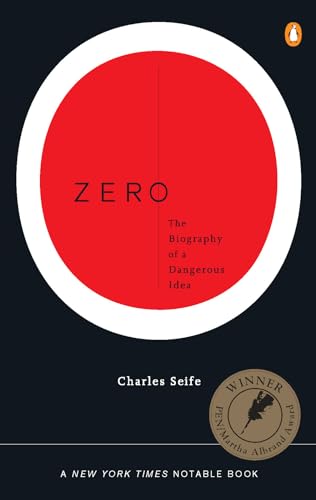
ZERO
The Biography of a Dangerous Idea
[CHARLES SEIFE]
Drawings by Matt Zimet
Chapter 0 Null and Void
Zero hit the USS Yorktown like a torpedo.
On September 21, 1997, while cruising off the coast of Virginia, the billion-dollar missile cruiser shuddered to a halt. Yorktown was dead in the water.
Warships are designed to withstand the strike of a torpedo or the blast of a mine. Though it was armored against weapons, nobody had thought to defend the Yorktown from zero. It was a grave mistake.
The Yorktown’s computers had just received new software that was controlling the engines. Unfortunately, nobody had spotted the time bomb lurking in the code, a zero that engineers were supposed to remove while installing the software. But for one reason or another, the zero was overlooked, and it stayed hidden in the code. Hidden, that is, until the software called it into memory—and choked.
When the Yorktown’s computer system tried to divide by zero, 80,000 horsepower instantly became worthless. It took nearly three hours to attach emergency controls to the engines, and the Yorktown then limped into port. Engineers spent two days getting rid of the zero, repairing the engines, and putting the Yorktown back into fighting trim.
No other number can do such damage. Computer failures like the one that struck the Yorktown are just a faint shadow of the power of zero. Cultures girded themselves against zero, and philosophies crumbled under its influence, for zero is different from the other numbers. It provides a glimpse of the ineffable and the infinite. This is why it has been feared and hated—and outlawed.
This is the story of zero, from its birth in ancient times to its growth and nourishment in the East, its struggle for acceptance in Europe, its ascendance in the West, and its ever-present threat to modern physics. It is the story of the people who battled over the meaning of the mysterious number—the scholars and mystics, the scientists and clergymen—who each tried to understand zero. It is the story of the Western world’s attempts to shield itself unsuccessfully (and sometimes violently) from an Eastern idea. And it is a history of the paradoxes posed by an innocent-looking number, rattling even this century’s brightest minds and threatening to unravel the whole framework of scientific thought.
Zero is powerful because it is infinity’s twin. They are equal and opposite, yin and yang. They are equally paradoxical and troubling. The biggest questions in science and religion are about nothingness and eternity, the void and the infinite, zero and infinity. The clashes over zero were the battles that shook the foundations of philosophy, of science, of mathematics, and of religion. Underneath every revolution lay a zero—and an infinity.
Zero was at the heart of the battle between East and West. Zero was at the center of the struggle between religion and science. Zero became the language of nature and the most important tool in mathematics. And the most profound problems in physics—the dark core of a black hole and the brilliant flash of the big bang—are struggles to defeat zero.
Yet through all its history, despite the rejection and the exile, zero has always defeated those who opposed it. Humanity could never force zero to fit its philosophies. Instead, zero shaped humanity’s view of the universe—and of God.
Chapter 1 Nothing Doing
[THE ORIGIN OF ZERO]
There was neither non-existence nor existence then; there was neither the realm of space nor the sky which is beyond. What stirred? Where?
—THE RIG VEDA
The story of zero is an ancient...
„Über diesen Titel“ kann sich auf eine andere Ausgabe dieses Titels beziehen.
Suchergebnisse für Zero: The Biography of a Dangerous Idea

Beispielbild für diese ISBN
Zero: The Biography of a Dangerous Idea
Verlag:
Penguin Random House Australia, 2000
ISBN 10: 0140296476
ISBN 13: 9780140296471
Gebraucht
Paperback
Anbieter: World of Books (was SecondSale), Montgomery, IL, USA
Verkäuferbewertung 5 von 5 Sternen

Paperback. Zustand: Fair. A New York Times Notable Book. The Babylonians invented it, the Greeks banned it, the Hindus worshiped it, and the Church used it to fend off heretics. Now it threatens the foundations of modern physics. For centuries the power of zero savored of the demonic; once harnessed, it became the most important tool in mathematics. For zero, infinity's twin, is not like other numbers. It is both nothing and everything. In Zero, Science Journalist Charles Seife follows this innocent-looking number from its birth as an Eastern philosophical concept to its struggle for acceptance in Europe, its rise and transcendence in the West, and its ever-present threat to modern physics. Here are the legendary thinkers--from Pythagoras to Newton to Heisenberg, from the Kabalists to today's astrophysicists--who have tried to understand it and whose clashes shook the foundations of philosophy, science, mathematics, and religion. Zero has pitted East against West and faith against reason, and its intransigence persists in the dark core of a black hole and the brilliant flash of the Big Bang. Today, zero lies at the heart of one of the biggest scientific controversies of all time: the quest for a theory of everything. Artikel-Nr. 00108145649
Gebraucht kaufen
EUR 4,03
Versand gratis
Versand innerhalb von USA
Versand innerhalb von USA
Anzahl: 5 verfügbar
Beispielbild für diese ISBN
Zero: The Biography of a Dangerous Idea
Verlag:
Penguin Random House Australia, 2000
ISBN 10: 0140296476
ISBN 13: 9780140296471
Gebraucht
Paperback
Anbieter: World of Books (was SecondSale), Montgomery, IL, USA
Verkäuferbewertung 5 von 5 Sternen
Paperback. Zustand: Good. A New York Times Notable Book. The Babylonians invented it, the Greeks banned it, the Hindus worshiped it, and the Church used it to fend off heretics. Now it threatens the foundations of modern physics. For centuries the power of zero savored of the demonic; once harnessed, it became the most important tool in mathematics. For zero, infinity's twin, is not like other numbers. It is both nothing and everything. In Zero, Science Journalist Charles Seife follows this innocent-looking number from its birth as an Eastern philosophical concept to its struggle for acceptance in Europe, its rise and transcendence in the West, and its ever-present threat to modern physics. Here are the legendary thinkers--from Pythagoras to Newton to Heisenberg, from the Kabalists to today's astrophysicists--who have tried to understand it and whose clashes shook the foundations of philosophy, science, mathematics, and religion. Zero has pitted East against West and faith against reason, and its intransigence persists in the dark core of a black hole and the brilliant flash of the Big Bang. Today, zero lies at the heart of one of the biggest scientific controversies of all time: the quest for a theory of everything. Artikel-Nr. 00103288090
Gebraucht kaufen
EUR 4,03
Versand gratis
Versand innerhalb von USA
Versand innerhalb von USA
Anzahl: Mehr als 20 verfügbar
Beispielbild für diese ISBN
Zero: The Biography of a Dangerous Idea
Verlag:
Penguin Random House Australia, 2000
ISBN 10: 0140296476
ISBN 13: 9780140296471
Gebraucht
Paperback
Anbieter: World of Books (was SecondSale), Montgomery, IL, USA
Verkäuferbewertung 5 von 5 Sternen
Paperback. Zustand: Very Good. A New York Times Notable Book. The Babylonians invented it, the Greeks banned it, the Hindus worshiped it, and the Church used it to fend off heretics. Now it threatens the foundations of modern physics. For centuries the power of zero savored of the demonic; once harnessed, it became the most important tool in mathematics. For zero, infinity's twin, is not like other numbers. It is both nothing and everything. In Zero, Science Journalist Charles Seife follows this innocent-looking number from its birth as an Eastern philosophical concept to its struggle for acceptance in Europe, its rise and transcendence in the West, and its ever-present threat to modern physics. Here are the legendary thinkers--from Pythagoras to Newton to Heisenberg, from the Kabalists to today's astrophysicists--who have tried to understand it and whose clashes shook the foundations of philosophy, science, mathematics, and religion. Zero has pitted East against West and faith against reason, and its intransigence persists in the dark core of a black hole and the brilliant flash of the Big Bang. Today, zero lies at the heart of one of the biggest scientific controversies of all time: the quest for a theory of everything. Artikel-Nr. 00110393049
Gebraucht kaufen
EUR 4,03
Versand gratis
Versand innerhalb von USA
Versand innerhalb von USA
Anzahl: 1 verfügbar
Beispielbild für diese ISBN
Zero: The Biography of a Dangerous Idea
Verlag:
Penguin Books (edition ), 2000
ISBN 10: 0140296476
ISBN 13: 9780140296471
Gebraucht
Paperback
Anbieter: BooksRun, Philadelphia, PA, USA
Verkäuferbewertung 5 von 5 Sternen
Paperback. Zustand: Fair. The item might be beaten up but readable. May contain markings or highlighting, as well as stains, bent corners, or any other major defect, but the text is not obscured in any way. Artikel-Nr. 0140296476-7-1-13
Gebraucht kaufen
EUR 4,50
Versand gratis
Versand innerhalb von USA
Versand innerhalb von USA
Anzahl: 1 verfügbar
Foto des Verkäufers
Zero: The Biography of a Dangerous Idea
Anbieter: Dream Books Co., Denver, CO, USA
Verkäuferbewertung 5 von 5 Sternen
Zustand: acceptable. This copy has clearly been enjoyedâ"expect noticeable shelf wear and some minor creases to the cover. Binding is strong, and all pages are legible. May contain previous library markings or stamps. Artikel-Nr. 4EKGRJ006LM5_ns
Gebraucht kaufen
EUR 5,06
Versand gratis
Versand innerhalb von USA
Versand innerhalb von USA
Anzahl: 3 verfügbar
Beispielbild für diese ISBN
Zero: The Biography of a Dangerous Idea
Verlag:
Penguin Books (edition ), 2000
ISBN 10: 0140296476
ISBN 13: 9780140296471
Gebraucht
Paperback
Anbieter: BooksRun, Philadelphia, PA, USA
Verkäuferbewertung 5 von 5 Sternen
Paperback. Zustand: Very Good. It's a well-cared-for item that has seen limited use. The item may show minor signs of wear. All the text is legible, with all pages included. It may have slight markings and/or highlighting. Artikel-Nr. 0140296476-11-1
Gebraucht kaufen
EUR 5,17
Versand gratis
Versand innerhalb von USA
Versand innerhalb von USA
Anzahl: 1 verfügbar
Beispielbild für diese ISBN
Zero: The Biography of a Dangerous Idea
Anbieter: ThriftBooks-Dallas, Dallas, TX, USA
Verkäuferbewertung 5 von 5 Sternen
Paperback. Zustand: Good. No Jacket. Pages can have notes/highlighting. Spine may show signs of wear. ~ ThriftBooks: Read More, Spend Less. Artikel-Nr. G0140296476I3N00
Gebraucht kaufen
EUR 6,12
Versand gratis
Versand innerhalb von USA
Versand innerhalb von USA
Anzahl: 2 verfügbar
Beispielbild für diese ISBN
Zero: The Biography of a Dangerous Idea
Anbieter: ThriftBooks-Reno, Reno, NV, USA
Verkäuferbewertung 5 von 5 Sternen
Paperback. Zustand: Fair. No Jacket. Readable copy. Pages may have considerable notes/highlighting. ~ ThriftBooks: Read More, Spend Less. Artikel-Nr. G0140296476I5N00
Gebraucht kaufen
EUR 6,12
Versand gratis
Versand innerhalb von USA
Versand innerhalb von USA
Anzahl: 5 verfügbar
Beispielbild für diese ISBN
Zero: The Biography of a Dangerous Idea
Anbieter: ThriftBooks-Dallas, Dallas, TX, USA
Verkäuferbewertung 5 von 5 Sternen
Paperback. Zustand: Fair. No Jacket. Former library book; Readable copy. Pages may have considerable notes/highlighting. ~ ThriftBooks: Read More, Spend Less. Artikel-Nr. G0140296476I5N10
Gebraucht kaufen
EUR 6,12
Versand gratis
Versand innerhalb von USA
Versand innerhalb von USA
Anzahl: 1 verfügbar
Beispielbild für diese ISBN
Zero: The Biography of a Dangerous Idea
Anbieter: ThriftBooks-Atlanta, AUSTELL, GA, USA
Verkäuferbewertung 5 von 5 Sternen
Paperback. Zustand: Good. No Jacket. Pages can have notes/highlighting. Spine may show signs of wear. ~ ThriftBooks: Read More, Spend Less. Artikel-Nr. G0140296476I3N00
Gebraucht kaufen
EUR 6,12
Versand gratis
Versand innerhalb von USA
Versand innerhalb von USA
Anzahl: 2 verfügbar