
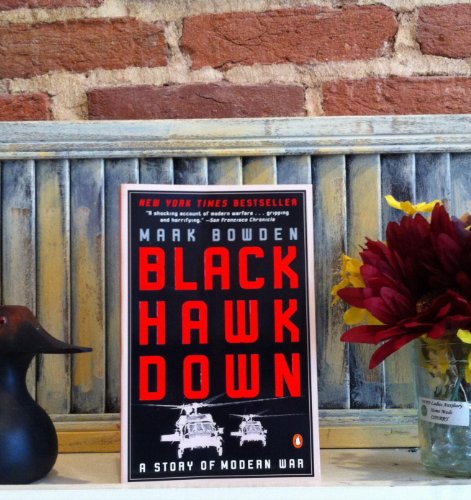
Verwandte Artikel zu Black Hawk Down: A Story of Modern War
Inhaltsangabe
Black Hawk Down drops you into a crowded marketplace in the heart of Mogadishu, Somalia with the U.S. Special Forces - and puts you in the middle of the most intense firefight American soldiers have fought since the Vietnam War.
Die Inhaltsangabe kann sich auf eine andere Ausgabe dieses Titels beziehen.
Über die Autorin bzw. den Autor
Mark Bowden has been a reporter at The Philadelphia Inquirer for nineteen years.
Auszug. © Genehmigter Nachdruck. Alle Rechte vorbehalten.
Black Hawk Down
A Story of Modern WarBy Mark BowdenPenguin Books
Copyright © 2000 Mark BowdenAll right reserved.
ISBN: 0140288503
Chapter One
At liftoff, Matt Eversmann said a Hail Mary. He was curled into a seatbetween two helicopter crew chiefs, the knees of his long legs up to hisshoulders. Before him, jammed on both sides of the Black Hawk helicopter,was his "chalk," twelve young men in flak vests over tan desertcamouflage fatigues.
He knew their faces so well they were like brothers. The olderguys on this crew, like Eversmann, a staff sergeant with five years in atage twenty-six, had lived and trained together for years. Some had comeup together through basic training, jump school, and Ranger school. Theyhad traveled the world, to Korea, Thailand, Central America ... theyknew each other better than most brothers did. They'd been drunk together,gotten into fights, slept on forest floors, jumped out of airplanes,climbed mountains, shot down foaming rivers with their hearts in theirthroats, baked and frozen and starved together, passed countless boredhours, teased one another endlessly about girlfriends or lack of same,driven out in the middle of the night from Fort Benning to retrieveeach other from some diner or strip club out on Victory Drive after gettingdrunk and falling asleep or pissing off some barkeep. Through allthose things, they had been training for a moment like this. It was thefirst time the lanky sergeant had been put in charge, and he was nervousabout it.
Pray for us sinners, now, and at the hour of our death, amen.
It was midafternoon, October 3, 1993. Eversmann's Chalk Four waspart of a force of U.S. Army Rangers and Delta Force operators who wereabout to drop in uninvited on a gathering of Habr Gidr clan leaders inthe heart of Mogadishu, Somalia. This ragged clan, led by warlordMohamed Farrah Aidid, had picked a fight with the United States ofAmerica, and it was, without a doubt, going down. Today's targets weretwo of Aidid's lieutenants. They would be arrested and imprisoned witha growing number of the belligerent clan's bosses on an island off thesouthern Somali coast city of Kismayo. Chalk Four's piece of thissnatch-and-grab was simple. Each of the four Ranger chalks had a corner of theblock around the target house. Eversmann's would rope down to thenorthwest corner and set up a blocking position. With Rangers on allfour corners, no one would enter the zone where Delta was working,and no one would leave.
They had done this dozens of times without difficulty, in practiceand on the task force's six previous missions. The pattern was clear inEversmann's mind. He knew which way to move when he hit the ground,where his soldiers would be. Those out of the left side of the bird wouldassemble on the left side of the street. Those out of the right side wouldassemble right. Then they would peel off in both directions, with themedics and the youngest guys in the middle. Private First Class ToddBlackburn was the baby on Eversmann's bird, a kid fresh out of Floridahigh school who had not yet even been to Ranger school. He'd needwatching. Sergeant Scott Galentine was older but also inexperiencedhere in Mog. He was a replacement, just in from Benning. The burdenof responsibility for these young Rangers weighed heavily on Eversmann.This time out they were his.
As chalk leader, he was handed headphones when he took his frontseat. They were bulky and had a mouthpiece and were connected by along black cord to a plug on the ceiling. He took his helmet off and settledthe phones over his ears.
One of the crew chiefs tapped his shoulder.
"Matt, be sure you remember to take those off before you leave,"he said, pointing to the cord.
Then they had stewed on the hot tarmac for what seemed an hour,breathing the pungent diesel fumes and oozing sweat under their bodyarmor and gear, fingering their weapons anxiously, every man figuringthis mission would probably be scratched before they got off the ground.That's how it usually went. There were twenty false alarms for everyreal mission. Back when they'd arrived in Mog five weeks earlier, theywere so flush with excitement that cheers went up from Black Hawk toBlack Hawk every time they boarded the birds. Now spin-ups like thiswere routine and usually amounted to nothing.
Waiting for the code word for launch, which today was "Irene,"they were a formidable sum of men and machines. There were four ofthe amazing AH-6 Little Birds, two-seat bubble-front attack helicoptersthat could fly just about anywhere. The Little Birds were loadedwith rockets this time, a first. Two would make the initial sweep overthe target and two more would help with rear security. There were fourMH-6 Little Birds with benches mounted on both sides for deliveringthe spearhead of the assault force, Delta's C Squadron, one of threeoperational elements in the army's top secret commando unit. Followingthis strike force were eight of the elongated troop-carrying BlackHawks: two carrying Delta assaulters and their ground command, fourfor delivering the Rangers (Company B, 3rd Battalion of the army's 75thInfantry, the Ranger Regiment out of Fort Benning, Georgia), one carryinga crack CSAR (Combat Search and Rescue) team, and one to fly thetwo mission commanders--Lieutenant Colonel Tom Matthews, whowas coordinating the pilots of the 160th SOAR (Special Operations AviationRegiment out of Fort Campbell, Kentucky); and Delta LieutenantColonel Gary Harrell, who had responsibility for the men on the ground.The ground convoy, which was lined up and idling out by the front gate,consisted of nine wide-body Humvees and three five-ton trucks. Thetrucks would be used to haul the prisoners and assault forces out. TheHumvees were filled with Rangers, Delta operators, and four membersof SEAL (Sea, Air, Land) Team Six, part of the navy's special forcesbranch. Counting the three surveillance birds and the spy plane highoverhead, there were nineteen aircraft, twelve vehicles, and about 160men. It was an eager armada on a taut rope.
There were signs this one would go. The commander of Task ForceRanger, Major General William F. Garrison, had come out to see themoff. He had never done that before. A tall, slender, gray-haired man indesert fatigues with half an unlit cigar jutting from the corner of hismouth, Garrison had walked from chopper to chopper and then stoopeddown by each Humvee.
"Be careful," he said in his Texas drawl.
Then he'd move on to the next man.
"Good luck."
Then the next.
"Be careful."
The swell of all those revving engines made the earth tremble andtheir pulses race. It was stirring to be part of it, the cocked fist of America'smilitary might. Woe to whatever stood in their way. Bristling with grenadesand ammo, gripping the steel of their automatic weapons, theirhearts pounding under their flak vests, they waited with a heady mix ofhope and dread. They ran through last-minute mental checklists, sayingprayers, triple-checking weapons, rehearsing their precise tacticalchoreography, performing little rituals ... whatever it was that preparedthem for battle. They all knew this mission might get hairy. It was anaudacious daylight thrust into the "Black Sea," the very heart of HabrGidr territory in central Mogadishu and warlord Aidid's stronghold.Their...
„Über diesen Titel“ kann sich auf eine andere Ausgabe dieses Titels beziehen.
Suchergebnisse für Black Hawk Down: A Story of Modern War

Beispielbild für diese ISBN
Black Hawk Down
Anbieter: World of Books (was SecondSale), Montgomery, IL, USA
Verkäuferbewertung 5 von 5 Sternen

Paperback. Zustand: Fair. Already a classic of war reporting and now reissued as a Grove Press paperback, Black Hawk Down is Mark Bowden's brilliant account of the longest sustained firefight involving American troops since the Vietnam War. On October 3, 1993, about a hundred elite U.S. soldiers were dropped by helicopter into the teeming market in the heart of Mogadishu, Somalia. Their mission was to abduct two top lieutenants of a Somali warlord and return to base. It was supposed to take an hour. Instead, they found themselves pinned down through a long and terrible night fighting against thousands of heavily-armed Somalis. The following morning, eighteen Americans were dead and more than seventy had been badly wounded.Drawing on interviews from both sides, army records, audiotapes, and videos (some of the material is still classified), Bowden's minute-by-minute narrative is one of the most exciting accounts of modern combat ever written--a riveting story that captures the heroism, courage, and brutality of battle. Artikel-Nr. 00086570870
Gebraucht kaufen
EUR 4,53
Versand gratis
Versand innerhalb von USA
Versand innerhalb von USA
Anzahl: 16 verfügbar
Beispielbild für diese ISBN
Black Hawk Down
Anbieter: World of Books (was SecondSale), Montgomery, IL, USA
Verkäuferbewertung 5 von 5 Sternen
Paperback. Zustand: Good. Already a classic of war reporting and now reissued as a Grove Press paperback, Black Hawk Down is Mark Bowden's brilliant account of the longest sustained firefight involving American troops since the Vietnam War. On October 3, 1993, about a hundred elite U.S. soldiers were dropped by helicopter into the teeming market in the heart of Mogadishu, Somalia. Their mission was to abduct two top lieutenants of a Somali warlord and return to base. It was supposed to take an hour. Instead, they found themselves pinned down through a long and terrible night fighting against thousands of heavily-armed Somalis. The following morning, eighteen Americans were dead and more than seventy had been badly wounded.Drawing on interviews from both sides, army records, audiotapes, and videos (some of the material is still classified), Bowden's minute-by-minute narrative is one of the most exciting accounts of modern combat ever written--a riveting story that captures the heroism, courage, and brutality of battle. Artikel-Nr. 00107215998
Gebraucht kaufen
EUR 4,53
Versand gratis
Versand innerhalb von USA
Versand innerhalb von USA
Anzahl: 1 verfügbar
Beispielbild für diese ISBN
Black Hawk Down: A Story of Modern War
Verlag:
Penguin Books (edition First Edition), 2000
ISBN 10: 0140288503
ISBN 13: 9780140288506
Gebraucht
Paperback
Erstausgabe
Anbieter: BooksRun, Philadelphia, PA, USA
Verkäuferbewertung 5 von 5 Sternen
Paperback. Zustand: Fair. First Edition. The item might be beaten up but readable. May contain markings or highlighting, as well as stains, bent corners, or any other major defect, but the text is not obscured in any way. Artikel-Nr. 0140288503-7-1
Gebraucht kaufen
EUR 4,81
Versand gratis
Versand innerhalb von USA
Versand innerhalb von USA
Anzahl: 1 verfügbar
Beispielbild für diese ISBN
Black Hawk Down: A Story of Modern War
Verlag:
Penguin Books (edition First Edition), 2000
ISBN 10: 0140288503
ISBN 13: 9780140288506
Gebraucht
Paperback
Erstausgabe
Anbieter: BooksRun, Philadelphia, PA, USA
Verkäuferbewertung 5 von 5 Sternen
Paperback. Zustand: Fair. First Edition. The item might be beaten up but readable. May contain markings or highlighting, as well as stains, bent corners, or any other major defect, but the text is not obscured in any way. Artikel-Nr. 0140288503-7-18
Gebraucht kaufen
EUR 5,37
Versand gratis
Versand innerhalb von USA
Versand innerhalb von USA
Anzahl: 2 verfügbar
Beispielbild für diese ISBN
Black Hawk Down: A Story of Modern War
Anbieter: ThriftBooks-Reno, Reno, NV, USA
Verkäuferbewertung 5 von 5 Sternen
Paperback. Zustand: Good. No Jacket. Pages can have notes/highlighting. Spine may show signs of wear. ~ ThriftBooks: Read More, Spend Less. Artikel-Nr. G0140288503I3N00
Gebraucht kaufen
EUR 6,00
Versand gratis
Versand innerhalb von USA
Versand innerhalb von USA
Anzahl: 6 verfügbar
Beispielbild für diese ISBN
Black Hawk Down: A Story of Modern War
Anbieter: ThriftBooks-Phoenix, Phoenix, AZ, USA
Verkäuferbewertung 5 von 5 Sternen
Paperback. Zustand: Good. No Jacket. Pages can have notes/highlighting. Spine may show signs of wear. ~ ThriftBooks: Read More, Spend Less. Artikel-Nr. G0140288503I3N00
Gebraucht kaufen
EUR 6,00
Versand gratis
Versand innerhalb von USA
Versand innerhalb von USA
Anzahl: 6 verfügbar
Beispielbild für diese ISBN
Black Hawk Down: A Story of Modern War
Anbieter: ThriftBooks-Dallas, Dallas, TX, USA
Verkäuferbewertung 5 von 5 Sternen
Paperback. Zustand: Good. No Jacket. Missing dust jacket; Pages can have notes/highlighting. Spine may show signs of wear. ~ ThriftBooks: Read More, Spend Less. Artikel-Nr. G0140288503I3N01
Gebraucht kaufen
EUR 6,02
Versand gratis
Versand innerhalb von USA
Versand innerhalb von USA
Anzahl: 1 verfügbar
Beispielbild für diese ISBN
Black Hawk Down: A Story of Modern War
Anbieter: ThriftBooks-Atlanta, AUSTELL, GA, USA
Verkäuferbewertung 5 von 5 Sternen
Paperback. Zustand: Good. No Jacket. Missing dust jacket; Pages can have notes/highlighting. Spine may show signs of wear. ~ ThriftBooks: Read More, Spend Less. Artikel-Nr. G0140288503I3N01
Gebraucht kaufen
EUR 6,02
Versand gratis
Versand innerhalb von USA
Versand innerhalb von USA
Anzahl: 1 verfügbar
Beispielbild für diese ISBN
Black Hawk Down: A Story of Modern War
Anbieter: ThriftBooks-Atlanta, AUSTELL, GA, USA
Verkäuferbewertung 5 von 5 Sternen
Paperback. Zustand: Good. No Jacket. Pages can have notes/highlighting. Spine may show signs of wear. ~ ThriftBooks: Read More, Spend Less. Artikel-Nr. G0140288503I3N00
Gebraucht kaufen
EUR 6,02
Versand gratis
Versand innerhalb von USA
Versand innerhalb von USA
Anzahl: 7 verfügbar
Beispielbild für diese ISBN
Black Hawk Down: A Story of Modern War
Anbieter: ThriftBooks-Dallas, Dallas, TX, USA
Verkäuferbewertung 5 von 5 Sternen
Paperback. Zustand: Good. No Jacket. Pages can have notes/highlighting. Spine may show signs of wear. ~ ThriftBooks: Read More, Spend Less. Artikel-Nr. G0140288503I3N00
Gebraucht kaufen
EUR 6,02
Versand gratis
Versand innerhalb von USA
Versand innerhalb von USA
Anzahl: 7 verfügbar