
Verwandte Artikel zu Cod: A Biography of the Fish that Changed the World
Inhaltsangabe
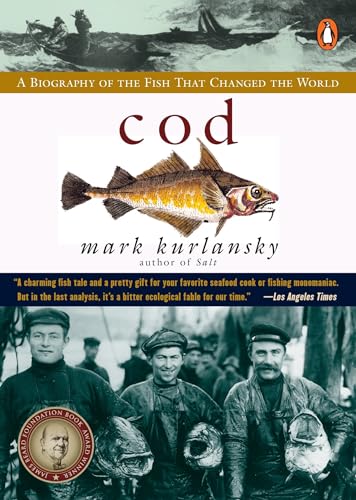
“A charming fish tale and a pretty gift for your favorite seafood cook or fishing monomaniac. But in the last analysis, it’s a bitter ecological fable for our time.” –Los Angeles Times
An unexpected, energetic look at world history via the humble cod fish from the bestselling author of Salt and The Basque History of the World
Cod is the biography of a single species of fish, but it may as well be a world history with this humble fish as its recurring main character. Cod, it turns out, is the reason Europeans set sail across the Atlantic, and it is the only reason they could. What did the Vikings eat in icy Greenland and on the five expeditions to America recorded in the Icelandic sagas? Cod, frozen and dried in the frosty air, then broken into pieces and eaten like hardtack. What was the staple of the medieval diet? Cod again, sold salted by the Basques, an enigmatic people with a mysterious, unlimited supply of cod. As we make our way through the centuries of cod history, we also find a delicious legacy of recipes, and the tragic story of environmental failure, of depleted fishing stocks where once their numbers were legendary. In this lovely, thoughtful history, Mark Kurlansky ponders the question: Is the fish that changed the world forever changed by the world's folly?
“Every once in a while a writer of particular skill takes a fresh, seemingly improbable idea and turns out a book of pure delight. Such is the case of Mark Kurlansky and the codfish.” –David McCullough
Die Inhaltsangabe kann sich auf eine andere Ausgabe dieses Titels beziehen.
Über die Autorin bzw. den Autor
Mark Kurlansky was born in Hartford, Connecticut. After receiving a BA in Theater from Butler University in 1970—and refusing to serve in the military—Kurlansky worked in New York as a playwright, having a number of off-off Broadway productions, and as a playwright-in-residence at Brooklyn College. He has worked many other jobs, including as a commercial fisherman, a dock worker, a paralegal, a cook, and a pastry chef. In the mid-1970s he turned to journalism, and from 1976 to 1991 he worked as a foreign correspondent for The International Herald Tribune, The Chicago Tribune, The Miami Herald, and The Philadelphia Inquirer. Based in Paris and then Mexico, he reported on Europe, West Africa, Southeast Asia, Central America, Latin America, and the Caribbean. His articles have appeared in a wide variety of newspapers and magazines, including The Philadelphia Inquirer, The Miami Herald, The Chicago Tribune, The Los Angeles Times, Time, The New York Times and many more. He has had 35 books published including fiction, nonfiction, and children's books. His books include Havana, Cod, Salt, Paper, The Basque History of the World, 1968, The Big Oyster, among other titles. He has received the Dayton Literary Peace Prize, Bon Appetit’s Food Writer of the Year Award, the James Beard Award, and the Glenfiddich Award. He lives in New York City.
Auszug. © Genehmigter Nachdruck. Alle Rechte vorbehalten.
1: The Race to Codlandia
He said it must be Friday, the day he could not sell anything except servings of a fish known in Castile as pollock or in Andalusia as salt cod.
—Miguel de Cervantes,
Don Quixote, 1605-1616
A medieval fisherman is said to have hauled up a three-foot-long cod, which was common enough at the time. And the fact that the cod could talk was not especially surprising. But what was astonishing was that it spoke an unknown language. It spoke Basque.
This Basque folktale shows not only the Basque attachment to their orphan language, indecipherable to the rest of the world, but also their tie to the Atlantic cod, Gadus morhua, a fish that has never been found in Basque or even Spanish waters.
The Basques are enigmatic. They have lived in what is now the northwest corner of Spain and a nick of the French southwest for longer than history records, and not only is the origin of their language unknown, but the origin of the people themselves remains a mystery also. According to one theory, these rosy-cheeked, dark-haired, long-nosed people were the original Iberians, driven by invaders to this mountainous corner between the Pyrenees, the Cantabrian Sierra, and the Bay of Biscay. Or they may be indigenous to this area.
They graze sheep on impossibly steep, green slopes of mountains that are thrilling in their rare, rugged beauty. They sing their own songs and write their own literature in their own language, Euskera. Possibly Europe's oldest living language, Euskera is one of only four European languages--along with Estonian, Finnish, and Hungarian--not in the Indo-European family. They also have their own sports, most notably jai alai, and even their own hat, the Basque beret, which is bigger than any other beret.
Though their lands currently reside in three provinces of France and four of Spain, Basques have always insisted that they have a country, and they call it Euskadi. All the powerful peoples around them--the Celts and Romans, the royal houses of Aquitaine, Navarra, Aragon, and Castile; later Spanish and French monarchies, dictatorships, and republics--have tried to subdue and assimilate them, and all have failed. In the 1960s, at a time when their ancient language was only whispered, having been outlawed by the dictator Francisco Franco, they secretly modernized it to broaden its usage, and today, with only 800,000 Basque speakers in the world, almost 1,000 titles a year are published in Euskera, nearly a third by Basque writers and the rest translations.
"Nire aitaren etxea / defendituko dut. / Otsoen kontra" (I will defend / the house of my father. / Against the wolves) are the opening lines of a famous poem in modern Euskera by Gabriel Aresti, one of the fathers of the modernized tongue. Basques have been able to maintain this stubborn independence, despite repression and wars, because they have managed to preserve a strong economy throughout the centuries. Not only are Basques shepherds, but they are also a seafaring people, noted for their successes in commerce. During the Middle Ages, when Europeans ate great quantities of whale meat, the Basques traveled to distant unknown waters and brought back whale. They were able to travel such distances because they had found huge schools of cod and salted their catch, giving them a nutritious food supply that would not spoil on long voyages.
Basques were not the first to cure cod. Centuries earlier, the Vikings had traveled from Norway to Iceland to Greenland to Canada, and it is not a coincidence that this is the exact range of the Atlantic cod. In the tenth century, Thorwald and his wayward son, Eirik the Red, having been thrown out of Norway for murder, traveled to Iceland, where they killed more people and were again expelled. About the year 985, they put to sea from the black lava shore of Iceland with a small crew on a little open ship. Even in midsummer, when the days are almost without nightfall, the sea there is gray and kicks up whitecaps. But with sails and oars, the small band made it to a land of glaciers and rocks, where the water was treacherous with icebergs that glowed robin's-egg blue. In the spring and summer, chunks broke off the glaciers, crashed into the sea with a sound like thunder that echoed in the fiords, and sent out huge waves. Eirik, hoping to colonize this land, tried to enhance its appeal by naming it Greenland.
Almost 1,000 years later, New England whalers would sing: "Oh, Greenland is a barren place / a place that bears no green / Where there's ice and snow / and the whale fishes blow / But daylight's seldom seen."
Eirik colonized this inhospitable land and then tried to push on to new discoveries. But he injured his foot and had to be left behind. His son, Leifur, later known as Leif Eiriksson, sailed on to a place he called Stoneland, which was probably the rocky, barren Labrador coast. "I saw not one cartload of earth, though I landed many places," Jacques Cartier would write of this coast six centuries later. From there, Leif's men turned south to "Woodland" and then "Vineland." The identity of these places is not certain. Woodland could have been Newfoundland, Nova Scotia, or Maine, all three of which are wooded. But in Vineland they found wild grapes, which no one else has discovered in any of these places.
The remains of a Viking camp have been found in Newfoundland. It is perhaps in that gentler land that the Vikings were greeted by inhabitants they found so violent and hostile that they deemed settlement impossible, a striking assessment to come from a people who had been regularly banished for the habit of murdering people. More than 500 years later the Beothuk tribe of Newfoundland would prevent John Cabot from exploring beyond crossbow range of his ship. The Beothuk apparently did not misjudge Europeans, since soon after Cabot, they were enslaved by the Portuguese, driven inland, hunted by the French and English, and exterminated in a matter of decades.
How did the Vikings survive in greenless Greenland and earthless Stoneland? How did they have enough provisions to push on to Woodland and Vineland, where they dared not go inland to gather food, and yet they still had enough food to get back? What did these Norsemen eat on the five expeditions to America between 985 and 1011 that have been recorded in the Icelandic sagas? They were able to travel to all these distant, barren shores because they had learned to preserve codfish by hanging it in the frosty winter air until it lost four-fifths of its weight and became a durable woodlike plank. They could break off pieces and chew them, eating it like hardtack. Even earlier than Eirik's day, in the ninth century, Norsemen had already established plants for processing dried cod in Iceland and Norway and were trading the surplus in northern Europe.
The Basques, unlike the Vikings, had salt, and because fish that was salted before drying lasted longer, the Basques could travel even farther than the Vikings. They had another advantage: The more durable a product, the easier it is to trade. By the year 1000, the Basques had greatly expanded the cod markets to a truly international trade that reached far from the cod's northern habitat.
In the Mediterranean world, where there were not only salt deposits but a strong enough sun to dry sea salt, salting to preserve food was not a new idea. In preclassical times, Egyptians and Romans had salted fish and developed a thriving trade. Salted meats were popular, and Roman Gaul had been famous for salted and smoked hams. Before they turned to cod, the Basques had sometimes salted whale meat; salt whale was found to be good with peas, and the most prized part of the whale, the tongue, was also often salted.
Until the twentieth-century refrigerator, spoiled food had been a chronic curse and severely limited trade in many products, especially fish. When the...
„Über diesen Titel“ kann sich auf eine andere Ausgabe dieses Titels beziehen.
Suchergebnisse für Cod: A Biography of the Fish that Changed the World

Beispielbild für diese ISBN
Cod: A Biography of the Fish t
Anbieter: World of Books (was SecondSale), Montgomery, IL, USA
Verkäuferbewertung 5 von 5 Sternen

Zustand: Good. Item in good condition. Textbooks may not include supplemental items i.e. CDs, access codes etc. Artikel-Nr. 00107123311
Gebraucht kaufen
EUR 4,34
Versand gratis
Versand innerhalb von USA
Versand innerhalb von USA
Anzahl: Mehr als 20 verfügbar
Beispielbild für diese ISBN
Cod: A Biography of the Fish t
Anbieter: World of Books (was SecondSale), Montgomery, IL, USA
Verkäuferbewertung 5 von 5 Sternen
Zustand: Acceptable. Item in acceptable condition! Textbooks may not include supplemental items i.e. CDs, access codes etc. Artikel-Nr. 00093476083
Gebraucht kaufen
EUR 4,34
Versand gratis
Versand innerhalb von USA
Versand innerhalb von USA
Anzahl: Mehr als 20 verfügbar
Foto des Verkäufers
Cod: A Biography of the Fish that Changed the World
Anbieter: Dream Books Co., Denver, CO, USA
Verkäuferbewertung 5 von 5 Sternen
Zustand: acceptable. This copy has clearly been enjoyedâ"expect noticeable shelf wear and some minor creases to the cover. Binding is strong, and all pages are legible. May contain previous library markings or stamps. Artikel-Nr. DBV.0140275010.A
Gebraucht kaufen
EUR 4,35
Versand gratis
Versand innerhalb von USA
Versand innerhalb von USA
Anzahl: 3 verfügbar
Beispielbild für diese ISBN
Cod: A Biography of the Fish that Changed the World
Verlag:
Penguin Books (edition 1), 1998
ISBN 10: 0140275010
ISBN 13: 9780140275018
Gebraucht
Paperback
Anbieter: BooksRun, Philadelphia, PA, USA
Verkäuferbewertung 5 von 5 Sternen
Paperback. Zustand: Very Good. 1. It's a well-cared-for item that has seen limited use. The item may show minor signs of wear. All the text is legible, with all pages included. It may have slight markings and/or highlighting. Artikel-Nr. 0140275010-11-1
Gebraucht kaufen
EUR 4,70
Versand gratis
Versand innerhalb von USA
Versand innerhalb von USA
Anzahl: 2 verfügbar
Foto des Verkäufers
Cod: A Biography of the Fish that Changed the World
Anbieter: Dream Books Co., Denver, CO, USA
Verkäuferbewertung 5 von 5 Sternen
Zustand: good. Gently used with minimal wear on the corners and cover. A few pages may contain light highlighting or writing, but the text remains fully legible. Dust jacket may be missing, and supplemental materials like CDs or codes may not be included. May be ex-library with library markings. Ships promptly! Artikel-Nr. DBV.0140275010.G
Gebraucht kaufen
EUR 4,88
Versand gratis
Versand innerhalb von USA
Versand innerhalb von USA
Anzahl: 1 verfügbar
Beispielbild für diese ISBN
Cod: A Biography of the Fish that Changed the World
Anbieter: ThriftBooks-Reno, Reno, NV, USA
Verkäuferbewertung 5 von 5 Sternen
Paperback. Zustand: Good. No Jacket. Pages can have notes/highlighting. Spine may show signs of wear. ~ ThriftBooks: Read More, Spend Less. Artikel-Nr. G0140275010I3N00
Gebraucht kaufen
EUR 5,74
Versand gratis
Versand innerhalb von USA
Versand innerhalb von USA
Anzahl: 3 verfügbar
Beispielbild für diese ISBN
Cod: A Biography of the Fish that Changed the World
Anbieter: ThriftBooks-Phoenix, Phoenix, AZ, USA
Verkäuferbewertung 5 von 5 Sternen
Paperback. Zustand: Good. No Jacket. Pages can have notes/highlighting. Spine may show signs of wear. ~ ThriftBooks: Read More, Spend Less. Artikel-Nr. G0140275010I3N00
Gebraucht kaufen
EUR 5,74
Versand gratis
Versand innerhalb von USA
Versand innerhalb von USA
Anzahl: 2 verfügbar
Beispielbild für diese ISBN
Cod: A Biography of the Fish that Changed the World
Anbieter: ThriftBooks-Atlanta, AUSTELL, GA, USA
Verkäuferbewertung 5 von 5 Sternen
Paperback. Zustand: Fair. No Jacket. Readable copy. Pages may have considerable notes/highlighting. ~ ThriftBooks: Read More, Spend Less. Artikel-Nr. G0140275010I5N00
Gebraucht kaufen
EUR 5,74
Versand gratis
Versand innerhalb von USA
Versand innerhalb von USA
Anzahl: 5 verfügbar
Beispielbild für diese ISBN
Cod: A Biography of the Fish that Changed the World
Anbieter: ThriftBooks-Phoenix, Phoenix, AZ, USA
Verkäuferbewertung 5 von 5 Sternen
Paperback. Zustand: Fair. No Jacket. Former library book; Readable copy. Pages may have considerable notes/highlighting. ~ ThriftBooks: Read More, Spend Less. Artikel-Nr. G0140275010I5N10
Gebraucht kaufen
EUR 5,74
Versand gratis
Versand innerhalb von USA
Versand innerhalb von USA
Anzahl: 1 verfügbar
Beispielbild für diese ISBN
Cod: A Biography of the Fish that Changed the World
Anbieter: ThriftBooks-Phoenix, Phoenix, AZ, USA
Verkäuferbewertung 5 von 5 Sternen
Paperback. Zustand: Fair. No Jacket. Readable copy. Pages may have considerable notes/highlighting. ~ ThriftBooks: Read More, Spend Less. Artikel-Nr. G0140275010I5N00
Gebraucht kaufen
EUR 5,74
Versand gratis
Versand innerhalb von USA
Versand innerhalb von USA
Anzahl: 4 verfügbar