
Verwandte Artikel zu Eleanor Roosevelt: The Defining Years:Volume Two 1933-1938:...
Eleanor Roosevelt: The Defining Years:Volume Two 1933-1938: The Defining Years, 1933-1938 (Eleanor Roosevelt, 1933-1938, Band 2) - Softcover
Buch 2 von 3: Eleanor Roosevelt, 1933-1938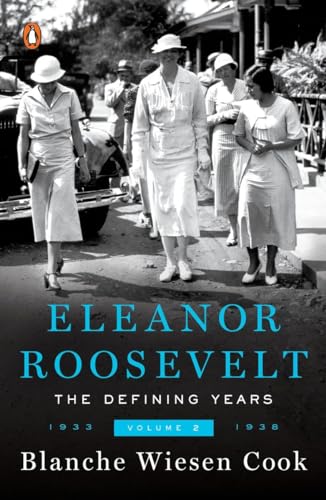
Inhaltsangabe
The central volume in the definitive biography of America's most important First Lady. "Engrossing" (Boston Globe).
The captivating second volume of this Eleanor Roosevelt biography covers tumultuous era of the Great Depression, the New Deal, and the gathering storms of World War II, the years of the Roosevelts' greatest challenges and finest achievements. In her remarkably engaging narrative, Cook gives us the complete Eleanor Roosevelt—an adventurous, romantic woman, a devoted wife and mother, and a visionary policymaker and social activist who often took unpopular stands, counter to her husband's policies, especially on issues such as racial justice and women's rights. A biography of scholarship and daring, it is a book for all readers of American history.
Die Inhaltsangabe kann sich auf eine andere Ausgabe dieses Titels beziehen.
Über die Autorin bzw. den Autor
Blanche Wiesen Cook is Distinguished Professor of History at John Jay College and the Graduate Center, City University of New York. She is the author of Eleanor Roosevelt, Volume One: 1884-1933 and Eleanor Roosevelt, Volume Three: 193801962, Crystal Eastman on Women and Revolution and The Declassified Eisenhower, and is a former vice-president for research at the American Historical Association.
Von der hinteren Coverseite
THE BIOGRAPHY OF AMERICA'S MOST COMPELLING, CHARISMATIC, AND VISIONARY FIRST LADY
Feminists, historians, politicians, and critics everywhere have praised Blanche Wiesen Cook's Eleanor Roosevelt as the definitive portrait of the towering female figure of the twentieth century. In her long-awaited second volume, Cook delves into the monumental era of the Great Depression, the New Deal, and the gathering storms of World War II -- the years of the Roosevelts' greatest challenges and achievements. Cook gives us the complete Eleanor Roosevelt -- a visionary policy-maker and social activist, a loyal wife, a devoted mother, and a woman who courted romance and adventure. She wrote, she published, she traveled, she lobbied, she joined grassroots organizations and radical communities with a zeal that sparked controversy everywhere.
Intimate, sympathetic, and acute, this is an unparalleled portrait of a woman whose life was filled with passionate commitment and who struggled for personal fulfillment. It is a biography of vibrant scholarship and daring, a book for all readers of American history and politics, and, finally, a book for everyone who cares about a decent future for all people.
Auszug. © Genehmigter Nachdruck. Alle Rechte vorbehalten.
Eleanor Roosevelt (Volume 2)
Volume II, the Defining Years, 1933-1938By Blanche Wiesen CookPenguin Books
Copyright © 2000 Blanche Wiesen CookAll right reserved.
ISBN: 0140178945
Chapter One
Becoming First Lady
* * *
After the election of November 1932, ER worried that her talentswould not be used; that she would become a shut-in, a congenial hostess inthe political shadows politically sidelined. In the months before FDR'sinauguration on 4 March 1933, newspaper headlines broadcast thevictories of fascism and tyranny in Europe and Asia as well as the intensifyingagonies of America's worst economic depression. In that bitter climate, ER facedher return to Washington with a burst of activity that defied her sense ofdread. Officially limited to social tasks, she felt at first burdened anddefiant. Her great friend Lorena Hickok was so impressed by ER's initialdistress that she titled her subsequent biography EleanorRoosevelt: Reluctant First Lady.
ER wanted above all to be a player on the political team that worked tomatch FDR's campaign promises with significant deeds. To counter her fearthat she would instead be forced into a life of political confinement somewherein the shadows, a prisoner to the presidency, she plunged into the politicalfray. With the women activists of the Democratic Party, ER spent hourspreparing lists of notable candidates for every level of government work. Shewrote columns, stunned radio audiences, created endless controversy. TheFirst Lady-elect was in the news almost every day?upsetting the complacent,encouraging people to imagine new liberal efforts to confront the Depression,which since October 1929 had plunged fifteen million unemployed and destituteAmericans into despair.
It had been twelve years since ER's last sojourn in Washington, that smallungenerous town that had been for her filled with ragged memories. Thereas a child when her Uncle Theodore was president she had felt shy, lonely,outcast. There as a young matron when her husband was Woodrow Wilson'sassistant secretary of the navy, she had felt humiliated, isolated. Betrayed byher husband's affair with Lucy Mercer, her friend and social secretary, she hadsuffered the loneliest time of her adult life.
She returned to that place that fed on gossip and power, a changedwoman. Surrounded by loyal friends, she was devoted to her work, and feltsecure in her life. During the 1920s, the Roosevelts had reconsecrated theirpartnership and created their own political bases. FDR refortified hispolio-ravaged body, and ER repaired her heart; they both moved beyond theaffair that had threatened their marriage.
While Eleanor and Franklin rebuilt their private lives, the world theyhad grown up in, the world they knew, disintegrated. The punitive Treaty ofVersailles, which ended World War I and redrew the map of Europe, in additionto war debts and dizzying inflation, inflamed German nationalism andspurred popular movements dedicated to the demise of old ruling classes.Fascism and communism took hold as monarchies dissolved, empires collapsed,capitalism wobbled. While uncollected political and economic debtsleft over from the World War haunted and poisoned international relations,the wounds of Eleanor Roosevelt's earlier time in Washington marked hermemories, and influenced her path.
After 1920, ER had carefully crafted a life that suited her needs. Like herUncle Theodore, she was an activist?delighted to be on the move, amongpeople, dealing directly with causes and crises. Never idle, she enjoyed manycareers and was all in a day teacher, editor, columnist, and radio commentator.Her primary circle included her business and living partners Nancy Cook,Marion Dickerman, and Caroline O'Day. With Cook and Dickerman, ERshared a home two miles from the "big house" at Hyde Park along a smallriver called the Val-Kill. With O'Day, they co-owned the Todhunter School,the Val-Kill crafts factory, and the Women's Democratic News (WDN), amonthly newsletter.
ER had resigned as editor and taken her name off the masthead as one ofthe four publishers when FDR was elected governor of New York in November1928, but she had continued to write its unsigned editorials and attendpolicy meetings.
In February 1933, ER publicly returned to the WDN with a monthlycolumn called "Passing Thoughts of Mrs. Franklin D. Roosevelt." She was toreplace Elisabeth Marbury, who had regularly reported from Washington andhad died suddenly of a heart attack on 22 January at the age of seventy-seven.Eager to be back in print for attribution, ER's first column was in part atribute to Marbury, a Democratic Party stalwart and worldly raconteur.
Also in this first column, ER promised to provide "some pictures of thevarious activities that I imagine fall to the lot of every President's wife,"and announced that she was free to disagree?even with her husband.
Like the country and his closest advisers, ER did not know actually whatFDR intended to do as president. His priorities were unclear, since he hadcampaigned as both ardent liberal and fiscal conservative: He would balancethe budget, and decrease taxes. Now, ER stated her own liberal goals for theadministration: She disapproved of lowering taxes in the face of so many urgentsocial needs and wanted relief policies extended to provide work andnew training for the unemployed.
In both her February column and her unsigned editorial, she emphasizedthe need for more public spending. She lamented recent talk about curtailing"some of these services." More services were needed, and "we will have to payfor [them] through taxes and our people might just as well face this fact...."
Her views did not coincide with FDR's initial strategy, and he demandedspace in the March issue to answer his wife and defend his first legislativeacts. Between his mother and his wife, FDR was accustomed tooutspoken opinionated women. But he did expect public unity on politicallyvolatile issues. In the future ER would try to be morecircumspect; this would be his only editorial rejoinder.
ER's views on international matters also departed from FDR's strategy.She deplored America's "isolationist" policies and considered economicnationalism dangerous. She wanted the United States to forgive theentire international debt, in order to end the worldwide depression and therising tide of bitterness that threatened world peace. Her internationalism hadbecome increasingly unpopular among politicians. ER worked most closely on theseissues with her first feminist friends, Esther Lape and Elizabeth Read, who,through the American Foundation, campaigned for the World Court and nowalso promoted U.S. recognition of the Soviet Union.
ERs intimate circle also included Molly Dewson, who directed theWomen's Committee of the Democratic Party; Earl Miller, her personal squireand champion; Louis Howe, the only close friend the Roosevelts shared;and Malvina (Tommy) Thompson, her hardworking secretary and personalassistant.
Born in the Bronx to an Irish mother and English father, MalvinaThompson was ER's mainstay from the time she spotted her in a Red Crosssecretarial pool in 1917. She worked on every campaign after 1920, and becameER's personal secretary and administrator....
„Über diesen Titel“ kann sich auf eine andere Ausgabe dieses Titels beziehen.
Suchergebnisse für Eleanor Roosevelt: The Defining Years:Volume Two 1933-1938:...

Beispielbild für diese ISBN
Eleanor Roosevelt, Volume 2: The Defining Years, 1933-1938
Anbieter: World of Books (was SecondSale), Montgomery, IL, USA
Verkäuferbewertung 5 von 5 Sternen

Paperback. Zustand: Very Good. The central volume in the definitive biography of America's most important First Lady. "Engrossing" (Boston Globe). The captivating second volume of this Eleanor Roosevelt biography covers tumultuous era of the Great Depression, the New Deal, and the gathering storms of World War II, the years of the Roosevelts' greatest challenges and finest achievements. In her remarkably engaging narrative, Cook gives us the complete Eleanor Roosevelt--an adventurous, romantic woman, a devoted wife and mother, and a visionary policymaker and social activist who often took unpopular stands, counter to her husband's policies, especially on issues such as racial justice and women's rights. A biography of scholarship and daring, it is a book for all readers of American history. Artikel-Nr. 00108784329
Gebraucht kaufen
EUR 3,87
Versand gratis
Versand innerhalb von USA
Versand innerhalb von USA
Anzahl: 3 verfügbar
Beispielbild für diese ISBN
Eleanor Roosevelt, Volume 2: The Defining Years, 1933-1938
Anbieter: World of Books (was SecondSale), Montgomery, IL, USA
Verkäuferbewertung 5 von 5 Sternen
Paperback. Zustand: Good. The central volume in the definitive biography of America's most important First Lady. "Engrossing" (Boston Globe). The captivating second volume of this Eleanor Roosevelt biography covers tumultuous era of the Great Depression, the New Deal, and the gathering storms of World War II, the years of the Roosevelts' greatest challenges and finest achievements. In her remarkably engaging narrative, Cook gives us the complete Eleanor Roosevelt--an adventurous, romantic woman, a devoted wife and mother, and a visionary policymaker and social activist who often took unpopular stands, counter to her husband's policies, especially on issues such as racial justice and women's rights. A biography of scholarship and daring, it is a book for all readers of American history. Artikel-Nr. 00098553464
Gebraucht kaufen
EUR 3,87
Versand gratis
Versand innerhalb von USA
Versand innerhalb von USA
Anzahl: 19 verfügbar
Beispielbild für diese ISBN
Eleanor Roosevelt, Volume 2: The Defining Years, 1933-1938
Anbieter: World of Books (was SecondSale), Montgomery, IL, USA
Verkäuferbewertung 5 von 5 Sternen
Paperback. Zustand: Fair. The central volume in the definitive biography of America's most important First Lady. "Engrossing" (Boston Globe). The captivating second volume of this Eleanor Roosevelt biography covers tumultuous era of the Great Depression, the New Deal, and the gathering storms of World War II, the years of the Roosevelts' greatest challenges and finest achievements. In her remarkably engaging narrative, Cook gives us the complete Eleanor Roosevelt--an adventurous, romantic woman, a devoted wife and mother, and a visionary policymaker and social activist who often took unpopular stands, counter to her husband's policies, especially on issues such as racial justice and women's rights. A biography of scholarship and daring, it is a book for all readers of American history. Artikel-Nr. 00105493971
Gebraucht kaufen
EUR 3,87
Versand gratis
Versand innerhalb von USA
Versand innerhalb von USA
Anzahl: 7 verfügbar
Beispielbild für diese ISBN
Eleanor Roosevelt : Volume 2 , The Defining Years, 1933-1938
Verlag:
Penguin Publishing Group (edition Reissue), 2000
ISBN 10: 0140178945
ISBN 13: 9780140178944
Gebraucht
Paperback
Anbieter: BooksRun, Philadelphia, PA, USA
Verkäuferbewertung 5 von 5 Sternen
Paperback. Zustand: Very Good. Reissue. It's a well-cared-for item that has seen limited use. The item may show minor signs of wear. All the text is legible, with all pages included. It may have slight markings and/or highlighting. Artikel-Nr. 0140178945-11-1
Gebraucht kaufen
EUR 5,66
Versand gratis
Versand innerhalb von USA
Versand innerhalb von USA
Anzahl: 1 verfügbar
Beispielbild für diese ISBN
Eleanor Roosevelt : Volume 2 , The Defining Years, 1933-1938
Verlag:
Penguin Publishing Group, 2000
ISBN 10: 0140178945
ISBN 13: 9780140178944
Gebraucht
Softcover
Anbieter: Wonder Book, Frederick, MD, USA
Verkäuferbewertung 5 von 5 Sternen
Zustand: Good. Good condition. Volume 2. A copy that has been read but remains intact. May contain markings such as bookplates, stamps, limited notes and highlighting, or a few light stains. Artikel-Nr. U03O-00883
Gebraucht kaufen
EUR 6,41
Versand gratis
Versand innerhalb von USA
Versand innerhalb von USA
Anzahl: 3 verfügbar
Beispielbild für diese ISBN
Eleanor Roosevelt : Volume 2 , The Defining Years, 1933-1938
Verlag:
Penguin Publishing Group, 2000
ISBN 10: 0140178945
ISBN 13: 9780140178944
Gebraucht
Softcover
Anbieter: Wonder Book, Frederick, MD, USA
Verkäuferbewertung 5 von 5 Sternen
Zustand: Good. Good condition. Volume 2 A copy that has been read but remains intact. May contain markings such as bookplates, stamps, limited notes and highlighting, or a few light stains. Artikel-Nr. A13D-00588
Gebraucht kaufen
EUR 6,41
Versand gratis
Versand innerhalb von USA
Versand innerhalb von USA
Anzahl: 1 verfügbar
Beispielbild für diese ISBN
Eleanor Roosevelt : Volume 2 , The Defining Years, 1933-1938
Verlag:
Penguin Publishing Group (edition Reissue), 2000
ISBN 10: 0140178945
ISBN 13: 9780140178944
Gebraucht
Paperback
Anbieter: BooksRun, Philadelphia, PA, USA
Verkäuferbewertung 5 von 5 Sternen
Paperback. Zustand: Fair. Reissue. The item might be beaten up but readable. May contain markings or highlighting, as well as stains, bent corners, or any other major defect, but the text is not obscured in any way. Artikel-Nr. 0140178945-7-18
Gebraucht kaufen
EUR 6,66
Versand gratis
Versand innerhalb von USA
Versand innerhalb von USA
Anzahl: 1 verfügbar
Beispielbild für diese ISBN
Eleanor Roosevelt, Volume 2 Vol. II : The Defining Years, 1933-1938
Verlag:
Penguin Publishing Group, 2000
ISBN 10: 0140178945
ISBN 13: 9780140178944
Gebraucht
Softcover
Anbieter: Better World Books, Mishawaka, IN, USA
Verkäuferbewertung 5 von 5 Sternen
Zustand: Good. Reissue. Former library copy. Pages intact with minimal writing/highlighting. The binding may be loose and creased. Dust jackets/supplements are not included. Includes library markings. Stock photo provided. Product includes identifying sticker. Better World Books: Buy Books. Do Good. Artikel-Nr. 7744561-6
Gebraucht kaufen
EUR 6,73
Versand gratis
Versand innerhalb von USA
Versand innerhalb von USA
Anzahl: 1 verfügbar
Beispielbild für diese ISBN
Eleanor Roosevelt, Volume 2 Vol. II : The Defining Years, 1933-1938
Verlag:
Penguin Publishing Group, 2000
ISBN 10: 0140178945
ISBN 13: 9780140178944
Gebraucht
Softcover
Anbieter: Better World Books, Mishawaka, IN, USA
Verkäuferbewertung 5 von 5 Sternen
Zustand: Good. Reissue. Pages intact with minimal writing/highlighting. The binding may be loose and creased. Dust jackets/supplements are not included. Stock photo provided. Product includes identifying sticker. Better World Books: Buy Books. Do Good. Artikel-Nr. 297022-6
Gebraucht kaufen
EUR 6,73
Versand gratis
Versand innerhalb von USA
Versand innerhalb von USA
Anzahl: 2 verfügbar
Beispielbild für diese ISBN
Eleanor Roosevelt, Volume 2: The Defining Years, 1933-1938
Verlag:
Penguin Publishing Group, 2000
ISBN 10: 0140178945
ISBN 13: 9780140178944
Gebraucht
Paperback
Anbieter: ThriftBooks-Reno, Reno, NV, USA
Verkäuferbewertung 5 von 5 Sternen
Paperback. Zustand: Very Good. No Jacket. May have limited writing in cover pages. Pages are unmarked. ~ ThriftBooks: Read More, Spend Less. Artikel-Nr. G0140178945I4N00
Gebraucht kaufen
EUR 6,78
Versand gratis
Versand innerhalb von USA
Versand innerhalb von USA
Anzahl: 1 verfügbar