Inhaltsangabe
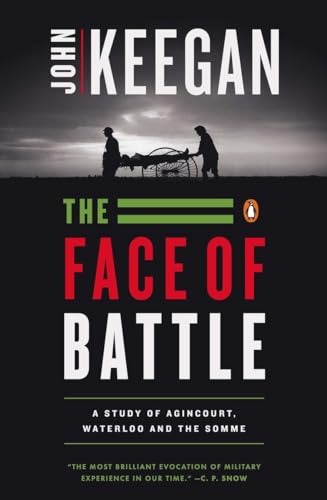
John Keegan's groundbreaking portrayal of the common soldier in the heat of battle -- a masterpiece that explores the physical and mental aspects of warfare
The Face of Battle is military history from the battlefield: a look at the direct experience of individuals at the "point of maximum danger." Without the myth-making elements of rhetoric and xenophobia, and breaking away from the stylized format of battle descriptions, John Keegan has written what is probably the definitive model for military historians. And in his scrupulous reassessment of three battles representative of three different time periods, he manages to convey what the experience of combat meant for the participants, whether they were facing the arrow cloud at the battle of Agincourt, the musket balls at Waterloo, or the steel rain of the Somme.
The Face of Battle is a companion volume to John Keegan's classic study of the individual soldier, The Mask of Command: together they form a masterpiece of military and human history.
Die Inhaltsangabe kann sich auf eine andere Ausgabe dieses Titels beziehen.
Über die Autorin bzw. den Autor
Sir John Desmond Patrick Keegan (1934–2012), was one of the most distinguished contemporary military historians and was for many years the senior lecturer at Sandhurst (the British Royal Military Academy) and the defense editor of the Daily Telegraph (London). Keegan was the author of numerous books including The Face of Battle, The Mask of Command, The Price of Admiralty, Six Armies in Normandy, and The Second World War, and was a fellow at the Royal Society of Literature.
Auszug. © Genehmigter Nachdruck. Alle Rechte vorbehalten.
PENGUIN BOOKS
THE FACE OF BATTLE
John Keegan was for many years Senior Lecturer at the Royal Military Academy at Sandhurst. He is the author of many books on military history, including The Book of War, The Mask of Command, The Price of Admiralty, The First World War, The Second World War, and A History of Warfare. He is a Fellow of the Royal Society of Literature.
John Keegan
The Face of Battle
Penguin Books
List of Illustrations
between pages 192 and 193
1 Skull of a Swedish soldier killed in 1361
2 The effect of archery on cavalry at short range, 1356
3 A ‘wall of bodies’ of the dead and wounded, fifteenth century
4 Men-at-arms at the mercy of archers, fifteenth century
5 A square of Highlanders receiving cavalry at Waterloo
6 Scotland for Ever: Waterloo
7 A German attack on a British line of ‘scrapes’, autumn 1914
8 Russians charging a German or Austrian trench, autumn 1914
9 A French counter-attack at Dien Bien Phu, spring 1954
List of Maps
1 Agincourt, 25 October 1415
2 Waterloo, 18 June 1815
3 The Somme, 1 July 1916
4 Relative positions of the battles
Acknowledgements
This book has been written chiefly from printed sources, some of which are listed in the bibliography. But I have also derived much information and many ideas from colleagues, pupils and friends (it is one of the pleasures of teaching at Sandhurst that these categories overlap), in particular from the following serving or retired soldiers: Brigadier Peter Young, D.S.O., M.C., Brigadier D. W. V. P. O’Flaherty, D.S.O., Major-General A. H. Farrar-Hockley, D.S.O., M.B.E., M.C., Colonel E. M. P. Hardy, Lieutenant-Colonel Michael Barclay, Royal Scots Dragoon Guards, Lieutenant-Colonel Jeremy Reilly, D.S.O., Royal Regiment of Fusiliers, Major Charles Messenger, Royal Tank Regiment, Major Michael Dewar, Royal Green Jackets, Captain Terence Johnston, Coldstream Guards, Lieutenant Timothy Weeks, Light Infantry, and Lieutenant Hugh Willing, Royal Green Jackets; from the following members of the Sandhurst academic staff: Dr Christopher Duffy, Dr Richard Holmes, Dr Gwynne Dyer, Dr John Sweetman, Mr David Chandler, Mr Peter Vigor and Mr William McElwee; from our homologues at the École spéciale militaire de St-Cyr, Lieutenant-Colonel Michel Camus, Légion étrangère, and Commandant Marc Neuville, Chasseurs à pied; from Major-General Alastair Maclennan, O.B.E., of the Royal Army Medical College, Mr A. S. Till, F.R.C.S., of the United Oxford Hospitals, Dr John Cule, Dr H. Bleckwenn of Osnabruck and Dr. T. F. Everett, my father-in-law, who died before this book was finished; from Dr M. Haisman and Dr M. Allnut of the Army Personnel Research Establishment; from Mr Michael Howard, Professor Richard Cobb, Professor Geoffrey Best, Mr Harmut Pogge von Strandmann and Brigadier Shelford Bidwell. I also corresponded fruitfully with Professor Bernard Bergonzi and Dr C. T.
Allmand. Brigadier Young, Mr Howard and Mr Chandler were kind enough to give permission for extracts from their books to be used for purposes which do not do justice to their quality. I owe special debts of gratitude to Mr Barrie Pitt and Mr Derek Anyan. Mr Anthony Sheil, Mr Alan Williams and Mr David Machin have been unfailingly encouraging; I hope I have not disappointed them. It is a pleasure to thank Lieutenant-Colonel Alan Shepperd, M.B.E., the Librarian (and creator) of the Central Library, R.M.A. Sandhurst, and his friendly, helpful and efficient staff for all their help; Mr R. W. Meadows is particularly to be thanked for procuring books through the inter-library loan service. I am also grateful to Mr Kenneth White, of the Staff College Library, and to the staff of the London Library. Mrs Valerie Horsfield typed much of the manuscript and has my thanks. My wife Susanne would have typed it all, had I not insisted that her hands were already overfull with her own writing and the care of four children; and were the title and subject of this book not so inappropriate, I would have dedicated it to her, for all she has done.
JOHN KEEGAN
Royal Military Academy, Sandhurst
10 December 1974
1 Old, Unhappy, Far-off Things*
A Little Learning
I have not been in a battle; not near one, nor heard one from afar, nor seen the aftermath. I have questioned people who have been in battle–my father and father-in-law among them; have walked over battlefields, here in England, in Belgium, in France and in America; have often turned up small relics of the fighting–a slab of German 5.9 howitzer shell on the roadside by Polygon Wood at Ypres, a rusted anti-tank projectile in the orchard hedge at Gavrus in Normandy, left there in June 1944 by some highlander of the 2nd Argyll and Sutherlands; and have sometimes brought my more portable finds home with me (a Minié bullet from Shiloh and a shrapnel ball from Hill 60 lie among the cotton-reels in a painted papier-mâché box on my drawing-room mantelpiece). I have read about battles, of course, have talked about battles, have been lectured about battles and, in the last four or five years, have watched battles in progress, or apparently in progress, on the television screen. I have seen a good deal of other, earlier battles of this century on newsreel, some of them convincingly authentic, as well as much dramatized feature film and countless static images of battle: photographs and paintings and sculpture of a varying degree of realism. But I have never been in a battle. And I grow increasingly convinced that I have very little idea of what a battle can be like.
Neither of these statements and none of this experience is in the least remarkable. For very, very few Europeans of my generation–I was born in 1934–have learned at first hand that knowledge of battle which marked the lives of millions of their fathers and grandfathers. Indeed, apart from the four or five thousand Frenchmen who, with their German, Spanish and Slav comrades of the Foreign Legion, survived Dien Bien Phu, and the slightly larger contingents of Britons who took part in the campaign in central Korea in 1950–51, I cannot identify any group of people, under forty, in the Old World, who have been through a battle as combatants. My use of the words ‘battle’ and ‘combatants’ will indicate that I am making some fairly careful exceptions to this generalization, most obviously in the case of all those continental Europeans who were children during the Second World War and over whose homes the tide of battle flowed, often more than once, between 1939 and 1945; but also in the case of the thousands of British and French soldiers who carried arms in Africa and South-East Asia during the era of decolonization, to whose number I ought to add the Portuguese conscripts still campaigning in Mozambique and Angola, and the British regulars policing the cities and countryside of Ulster.
The first group exclude themselves from my generalization because none of them was old enough to have had combatant experience of the Second World War; the second because their experience of soldiering, though often dangerous and sometimes violent–perhaps very violent if they were French and served in Algeria–was not an experience in and of battle. For there is a fundamental difference between the sort of sporadic, small-scale fighting which is the small change of soldiering and the sort we characterize as a battle. A battle must obey the dramatic unities of time, place and action. And although battles in modern wars have tended to obey the first two of those unities less and less exactly, becoming increasingly protracted and geographically extensive as...
„Über diesen Titel“ kann sich auf eine andere Ausgabe dieses Titels beziehen.
Weitere beliebte Ausgaben desselben Titels

Suchergebnisse für The Face of Battle: A Study of Agincourt, Waterloo,...

Foto des Verkäufers
The Face of Battle: A Study of Agincourt, Waterloo, and the Somme
Anbieter: Dream Books Co., Denver, CO, USA
Verkäuferbewertung 5 von 5 Sternen

Zustand: acceptable. This copy has clearly been enjoyedâ"expect noticeable shelf wear and some minor creases to the cover. Binding is strong, and all pages are legible. May contain previous library markings or stamps. Artikel-Nr. DBV.0140048979.A
Beispielbild für diese ISBN
The Face of Battle: A Study of Agincourt, Waterloo, and the Somme
Verlag:
Penguin Books (edition Later Printing (28th)), 1983
ISBN 10: 0140048979
ISBN 13: 9780140048971
Gebraucht
Paperback
Anbieter: BooksRun, Philadelphia, PA, USA
Verkäuferbewertung 5 von 5 Sternen
Paperback. Zustand: Fair. Later Printing (28th). The item might be beaten up but readable. May contain markings or highlighting, as well as stains, bent corners, or any other major defect, but the text is not obscured in any way. Artikel-Nr. 0140048979-7-1
Foto des Verkäufers
The Face of Battle: A Study of Agincourt, Waterloo, and the Somme
Anbieter: Dream Books Co., Denver, CO, USA
Verkäuferbewertung 5 von 5 Sternen
Zustand: good. Gently used with minimal wear on the corners and cover. A few pages may contain light highlighting or writing, but the text remains fully legible. Dust jacket may be missing, and supplemental materials like CDs or codes may not be included. May be ex-library with library markings. Ships promptly! Artikel-Nr. DBV.0140048979.G
Beispielbild für diese ISBN
The Face of Battle
Anbieter: Wonder Book, Frederick, MD, USA
Verkäuferbewertung 5 von 5 Sternen
Zustand: Very Good. Very Good condition. A copy that may have a few cosmetic defects. May also contain light spine creasing or a few markings such as an owner's name, short gifter's inscription or light stamp. Artikel-Nr. H04A-03536
Beispielbild für diese ISBN
The Face of Battle
Anbieter: Wonder Book, Frederick, MD, USA
Verkäuferbewertung 5 von 5 Sternen
Zustand: Good. Good condition. A copy that has been read but remains intact. May contain markings such as bookplates, stamps, limited notes and highlighting, or a few light stains. Bundled media such as CDs, DVDs, floppy disks or access codes may not be included. Artikel-Nr. E12O-00258
Beispielbild für diese ISBN
The Face of Battle
Anbieter: ThriftBooks-Atlanta, AUSTELL, GA, USA
Verkäuferbewertung 5 von 5 Sternen
Paperback. Zustand: Very Good. No Jacket. May have limited writing in cover pages. Pages are unmarked. ~ ThriftBooks: Read More, Spend Less. Artikel-Nr. G0140048979I4N00
Beispielbild für diese ISBN
The Face of Battle
Anbieter: ThriftBooks-Phoenix, Phoenix, AZ, USA
Verkäuferbewertung 5 von 5 Sternen
Paperback. Zustand: Good. No Jacket. Pages can have notes/highlighting. Spine may show signs of wear. ~ ThriftBooks: Read More, Spend Less. Artikel-Nr. G0140048979I3N00
Beispielbild für diese ISBN
The Face of Battle
Anbieter: ThriftBooks-Reno, Reno, NV, USA
Verkäuferbewertung 5 von 5 Sternen
Paperback. Zustand: Good. No Jacket. Missing dust jacket; Pages can have notes/highlighting. Spine may show signs of wear. ~ ThriftBooks: Read More, Spend Less. Artikel-Nr. G0140048979I3N01
Beispielbild für diese ISBN
The Face of Battle
Anbieter: ThriftBooks-Dallas, Dallas, TX, USA
Verkäuferbewertung 5 von 5 Sternen
Paperback. Zustand: Good. No Jacket. Pages can have notes/highlighting. Spine may show signs of wear. ~ ThriftBooks: Read More, Spend Less. Artikel-Nr. G0140048979I3N00
Beispielbild für diese ISBN
The Face of Battle
Anbieter: ThriftBooks-Atlanta, AUSTELL, GA, USA
Verkäuferbewertung 5 von 5 Sternen
Paperback. Zustand: Good. No Jacket. Pages can have notes/highlighting. Spine may show signs of wear. ~ ThriftBooks: Read More, Spend Less. Artikel-Nr. G0140048979I3N00