
Verwandte Artikel zu Nutritional Epigenomics: Volume 14 (Translational Epigenetic...
Nutritional Epigenomics: Volume 14 (Translational Epigenetics, Volume 14) - Softcover
Buch 20 von 39: Translational Epigenetics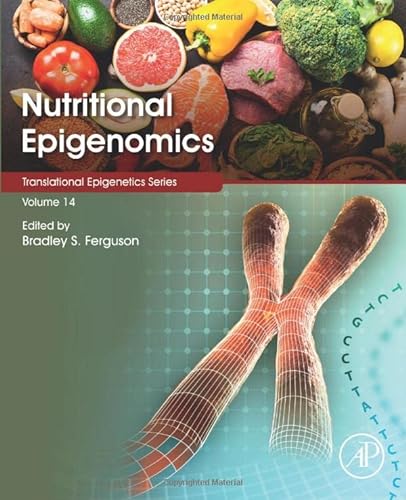
Inhaltsangabe
Nutritional Epigenomics offers a comprehensive overview of nutritional epigenomics as a mode of study, along with nutrition’s role in the epigenomic regulation of disease, health and developmental processes. Here, an expert team of international contributors introduces readers to nutritional epigenomic regulators of gene expression, our diet’s role in epigenomic regulation of disease and disease inheritance, caloric restriction and exercise as they relate to recent epigenomic findings, and the influence of nutritional epigenomics over circadian rhythms, aging and longevity, and fetal health and development, among other processes. Disease specific chapters address metabolic disease (obesity and diabetes), cancer, and neurodegeneration, among other disorders.
Diet-gut microbiome interactions in the epigenomic regulation of disease are also discussed, as is the role of micronutrients and milk miRNAs in epigenetic regulation. Finally, chapter authors examine ongoing discussions of race and ethnicity in the social-epigenomic regulation of health and disease.
Die Inhaltsangabe kann sich auf eine andere Ausgabe dieses Titels beziehen.
Über die Autorin bzw. den Autor
Bradley S. Ferguson is an Associate Professor of Nutrition at the University of Nevada, Reno, Nevada. His lab adopts integrative, translational research approaches that encompass bioinformatics, in vitro cell culture, and in vivo animal models to elucidate dietary food components that act as epigenetic modifiers, as well as the role of dietary epigenetic modifiers on pathological cardiac signaling, gene expression, and remodeling. He also seeks to understand how sarcomere protein acetylation links metabolic disease (obesity and diabetes) to pathological cardiac remodeling and skeletal muscle dysfunction. Dr. Ferguson has published his findings across a wide range of peer-reviewed journals, including Scientific Reports, Journal of Animal Science, American Journal of Physiology, Cell Reports, PNAS, and the Journal of Molecular and Cellular Cardiology.
Von der hinteren Coverseite
Over the last decade, interest in diet-gene interactions has led researchers to examine epigenomic reprogramming and nutritional intervention in the treatment and prevention of disease. These studies, in part assisted with technological advances in epigenomic sequencing, have increased our understanding of diet’s influence over epigenetic regulation in aging, fetal growth and development, transgenerational inheritance, and circadian rhythm, in addition to health and disease.
Nutritional Epigenomics offers a comprehensive overview of nutritional epigenomics as a mode of study, and current understanding of nutrition’s role in epigenomic regulation of disease, health, and developmental processes. Here, an expert team of international contributors introduces readers to nutritional epigenomic regulators of gene expression, our diet’s role in epigenomic regulation of disease and disease inheritance, caloric restriction and exercise as they relate to recent epigenomic findings, and the influence of nutritional epigenomics over circadian rhythms, aging and longevity, and fetal health and development among other processes. Disease specific chapters address metabolic disease (obesity and diabetes), cancer, and neurodegeneration among other disorders. Diet-gut microbiome interactions in the epigenomic regulation of disease are discussed as well, as are the role of micronutrients and milk miRNAs in epigenetic regulation. Finally, chapter authors also examine ongoing discussions of race and ethnicity in the social-epigenomic regulation of health and disease.
Throughout Nutritional Epigenomics, close attention is paid not only to recent findings of translational significance, but epigenomic approaches, technologies, and modes of analysis to enable future epigenomic studies
„Über diesen Titel“ kann sich auf eine andere Ausgabe dieses Titels beziehen.
Suchergebnisse für Nutritional Epigenomics: Volume 14 (Translational Epigenetic...

Beispielbild für diese ISBN
Nutritional Epigenomics: Volume 14 (Translational Epigenetics, Volume 14)
Anbieter: Studibuch, Stuttgart, Deutschland
Verkäuferbewertung 5 von 5 Sternen

paperback. Zustand: Gut. 478 Seiten; 9780128168431.3 Gewicht in Gramm: 1. Artikel-Nr. 1244014
Gebraucht kaufen
EUR 97,47
EUR 62,30 Versand
Versand von Deutschland nach USA
Versand von Deutschland nach USA
Anzahl: 1 verfügbar
Beispielbild für diese ISBN
Nutritional Epigenomics (Volume 14) (Translational Epigenetics (Volume 14))
Anbieter: Revaluation Books, Exeter, Vereinigtes Königreich
Verkäuferbewertung 5 von 5 Sternen
Paperback. Zustand: Brand New. 488 pages. 9.25x7.50x1.22 inches. In Stock. Artikel-Nr. 0128168439
Neu kaufen
EUR 225,12
EUR 14,82 Versand
Versand von Vereinigtes Königreich nach USA
Versand von Vereinigtes Königreich nach USA
Anzahl: 1 verfügbar
Beispielbild für diese ISBN
Nutritional Epigenomics: Volume 14 (Translational Epigenetics, Volume 14) Ferguson
Anbieter: BUCHSERVICE / ANTIQUARIAT Lars Lutzer, Wahlstedt, Deutschland
Verkäuferbewertung 5 von 5 Sternen
Zustand: gut. 2019. Nutritional Epigenomics: Volume 14 (Translational Epigenetics, Volume 14) In englischer Sprache. pages. Artikel-Nr. BN502434
Gebraucht kaufen
EUR 499,90
EUR 39,95 Versand
Versand von Deutschland nach USA
Versand von Deutschland nach USA
Anzahl: 1 verfügbar