
Verwandte Artikel zu Ion Channel Regulation (Volume 33) (Advances in Second...
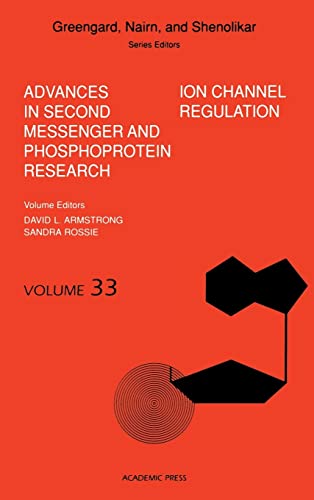
Ion Channel Regulation (Volume 33) (Advances in Second Messenger and Phosphoprotein Research, Volume 33) - Hardcover
Inhaltsangabe
Volume 33 reviews the current understanding of ion channel regulation by signal transduction pathways. Ion channels are no longer viewed simply as the voltage-gated resistors of biophysicists or the ligand-gated receptors of biochemists. They have been transformed during the past 20 years into signaling proteins that regulate every aspect of cell physiology. In addition to the voltage-gated channels, which provide the ionic currents to generate and spread neuronal activity, and the calcium ions to trigger synaptic transmission, hormonal secretion, and muscle contraction, new gene families of ion channel proteins regulate cell migration, cell cycle progression, apoptosis, and gene transcription, as well as electrical excitability. Even the genome of the lowly roundworm Caenorhabditis elegans encodes almost 100 distinct genes for potassium-selective channels alone. Most of these new channel proteins are insensitive to membrane potential, yet in humans, mutations in these genes disrupt development and increase individual susceptibility to debilitating and lethal diseases.How do cells regulate the activity of these channels? How might we restore their normal function? In Ion Channel Regulation, many of the experts who pioneered these discoveries provide detailed summaries of our current understanding of the molecular mechanisms that control ion channel activity.
Die Inhaltsangabe kann sich auf eine andere Ausgabe dieses Titels beziehen.
Über die Autorin bzw. den Autor
Angus C. Nairn is currently Associate Professor at The Rockefeller University. He has published a large number of papers concerned with the structure and regulation of protein kinases and phosphatases involved in signal transduction, particularly with respect to signalling by calcium.
Von der hinteren Coverseite
Volume 33 reviews our current understanding of ion channel regulation by signal transduction pathways. Ion channels are no longer viewed simply as the voltage-gated resistors of biophysicists or the ligand-gated receptors of biochemists. They have been transformed during the past 20 years into signaling proteins that regulate every aspect of cell physiology. In addition to the voltage-gated channels, which provide the ionic currents to generate and spread neuronal activity, and the calcium ions to trigger synaptic transmission, hormonal secretion, and muscle contraction, new gene families of ion channel proteins regulate cell migration, cell cycle progression, apoptosis, and gene transcription, as well as electrical excitability. Even the genome of the lowly roundworm Caenorhabditis elegans encodes almost 100 distinct genes for potassium-selective channels alone. Most of these new channel proteins are insensitive to membrane potential, yet in humans, mutations in these genes disrupt development and increase individual susceptibility to debilitating and lethal diseases.
How do cells regulate the activity of these channels? How might we restore their normal function? In Ion Channel Regulation, many of the experts who pioneered these discoveries provide detailed summaries of our current understanding of the molecular mechanisms that control ion channel activity. Written specifically to introduce non-electrophysiologists to ion channels as proteins and to introduce electrophysiologists to signal transduction pathways, Ion Channel Regulation represents a unique professional summary of an important and exciting field and will attract and instruct anyone interested in cell signaling through second messengers and phosphoproteins.
„Über diesen Titel“ kann sich auf eine andere Ausgabe dieses Titels beziehen.
Suchergebnisse für Ion Channel Regulation (Volume 33) (Advances in Second...

Beispielbild für diese ISBN
Ion Channel Regulation (Volume 33) (Advances in Second Messenger and Phosphoprotein Research, Volume 33)
Anbieter: Books From California, Simi Valley, CA, USA
Verkäuferbewertung 4 von 5 Sternen

hardcover. Zustand: Good. Ex-library copy, with the usual markings/stickers/stamping present. Cover boards are slightly bowing/bending. Pages are slightly worn. Preliminary pages may have a few markings; otherwise, interiors are intact with unmarked text/pictures. Good reading copy! Artikel-Nr. mon0004208841
Gebraucht kaufen
EUR 8,95
EUR 4,40 Versand
Versand innerhalb von USA
Versand innerhalb von USA
Anzahl: 1 verfügbar
Beispielbild für diese ISBN
Ion Channel Regulation. (= Advances in Second Messenger and Phosphoprotein Research, Vol. 33).
Verlag:
San Diego etc.: Academic Press, 1999
ISBN 10: 0120361337
ISBN 13: 9780120361335
Gebraucht
Hardcover
Anbieter: Antiquariat Thomas Haker GmbH & Co. KG, Berlin, Deutschland
Verkäuferbewertung 5 von 5 Sternen

Hardcover/Pappeinband. Zustand: Gut. 318 pages. Good. Ex-library with usual library markings. Clean pages without underlinings or remarks. Sprache: Englisch Gewicht in Gramm: 710. Artikel-Nr. 791248
Gebraucht kaufen
EUR 6,60
EUR 20,00 Versand
Versand von Deutschland nach USA
Versand von Deutschland nach USA
Anzahl: 1 verfügbar
Foto des Verkäufers
Ion Channel Regulation.
Verlag:
Academic Press. San Diego & London., 1999
ISBN 10: 0120361337
ISBN 13: 9780120361335
Gebraucht
Hardcover
Anbieter: avelibro OHG, Dinkelscherben, Deutschland
Verkäuferbewertung 5 von 5 Sternen
Zustand: Gut. XX, 318 P. Inside with the usual library stamps and inscriptions, partially crossed out, otherwise in very clean condition. English Language. Advances in Second Messenger and Phosphoprotein Research. Volume 33. Part I: Protein Phosphorylation./ Part II: Closely Associated Proteins./ Part III: Second Messengers.; - With Illustr. deu B12-01-02C|235|15017BB Sprache: Deutsch Gewicht in Gramm: 444 23,5 x 15,5 cm. Original Hardboard. Good condition. Artikel-Nr. 16572
Gebraucht kaufen
EUR 17,00
EUR 10,00 Versand
Versand von Deutschland nach USA
Versand von Deutschland nach USA
Anzahl: 1 verfügbar