
Inhaltsangabe
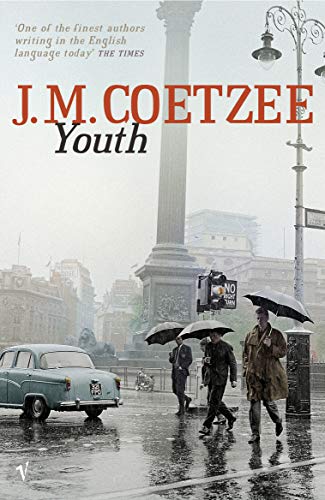
Youth's narrator, a student in 1950s South Africa, has long been plotting an escape from his native country. Studying mathematics, reading poetry, saving money, he tries to ensure that when he arrives in the real world he will be prepared to experience life to its full intensity, and transform it into art. Arriving at last in London, however, he finds neither poetry nor romance. Instead he succumbs to the monotony of life as a computer programmer, from which random, loveless affairs offer no relief. Devoid of inspiration, he stops writing and begins a dark pilgrimage in which he is continually tested and continually found wanting.
Set against the background of the 1960s, Youth is a remarkable portrait of a consciousness turning in on itself. J. M. Coetzee explores a young man's struggle to find his way in the world with tenderness and a fierce clarity.
Die Inhaltsangabe kann sich auf eine andere Ausgabe dieses Titels beziehen.
Über die Autorin bzw. den Autor
J.M. Coetzee’s work includes Waiting for the Barbarians, Life & Times of Michael K, Boyhood, Youth, Disgrace, Summertime, The Childhood of Jesus and, most recently, The Schooldays of Jesus. He was the first author to win the Booker Prize twice and was awarded the Nobel Prize in Literature in 2003.
Auszug. © Genehmigter Nachdruck. Alle Rechte vorbehalten.
ONE
He lives in a one-room flat near Mowbray railway station, for which he pays eleven guineas a month. On the last working day of each month he catches the train in to the city, to Loop Street, where A. & B. Levy, property agents, have their brass plate and tiny office. To Mr B. Levy, younger of the Levy brothers, he hands the envelope with the rent. Mr Levy pours the money out onto his cluttered desk and counts it. Grunting and sweating, he writes a receipt. 'Voilà, young man!' he says, and passes it over with a flourish.
He is at pains not to be late with the rent because he is in the flat under false pretences. When he signed the lease and paid A. & B. Levy the deposit, he gave his occupation not as 'Student' but as 'Library Assistant,' with the university library as his work address.
It is not a lie, not entirely. From Monday to Friday it is his job to man the reading room during evening hours. It is a job that the regular librarians, women for the most part, prefer not to do because the campus, up on the mountainside, is too bleak and lonely at night. Even he feels a chill down his spine as he unlocks the back door and gropes his way down a pitch-dark corridor to the mains switch. It would be all too easy for some evildoer to hide in the stacks when the staff go home at five o'clock, then rifle the empty offices and wait in the dark to waylay him, the night assistant, for his keys.
Few students make use of the evening opening; few are even aware of it. There is little for him to do. The ten shillings per evening he earns is easy money.
Sometimes he imagines a beautiful girl in a white dress wandering into the reading room and lingering distractedly after closing time; he imagines showing her over the mysteries of the bindery and cataloguing room, then emerging with her into the starry night. It never happens.
Working in the library is not his only employment. On Wednesday afternoons he assists with first-year tutorials in the Mathematics Department (three pounds a week); on Fridays he conducts the diploma students in drama through selected comedies of Shakespeare (two pounds ten); and in the late afternoons he is employed by a cram school in Rondebosch to coach dummies for their Matriculation exams (three shillings an hour). During vacations he works for the Municipality (Division of Public Housing) extracting statistical data from household surveys. All in all, when he adds up the monies, he is comfortably off -- comfortably enough to pay his rent and university fees and keep body and soul together and even save a little. He may only be nineteen but he is on his own feet, dependent on no one.
The needs of the body he treats as a matter of simple common sense. Every Sunday he boils up marrowbones and beans and celery to make a big pot of soup, enough to last the week. On Fridays he visits Salt River market for a box of apples or guavas or whatever fruit is in season. Every morning the milkman leaves a pint of milk on his doorstep. When he has a surplus of milk he hangs it over the sink in an old nylon stocking and turns it into cheese. For the rest he buys bread at the corner shop. It is a diet Rousseau would approve of, or Plato. As for clothes, he has a good jacket and trousers to wear to lectures. Otherwise he makes old clothes last.
He is proving something: that each man is an island; that you don't need parents.
Some evenings, trudging along the Main Road in raincoat and shorts and sandals, his hair plastered flat by the rain, lit up by the headlights of passing cars, he has a sense of how odd he looks. Not eccentric (there is some distinction in looking eccentric), just odd. He grinds his teeth in chagrin and walks faster.
He is slim and looselimbed, yet at the same time flabby. He would like to be attractive but he knows he is not. There is something essential he lacks, some definition of feature. Something of the baby still lingers in him. How long before he will cease to be a baby? What will cure him of babyhood, make him into a man?
What will cure him, if it were to arrive, will be love. He may not believe in God but he does believe in love and the powers of love. The beloved, the destined one, will see at once through the odd and even dull exterior he presents to the fire that burns within him. Meanwhile, being dull and odd-looking are part of a purgatory he must pass through in order to emerge, one day, into the light: the light of love, the light of art. For he will be an artist, that has long been settled. If for the time being he must be obscure and ridiculous, that is because it is the lot of the artist to suffer obscurity and ridicule until the day when he is revealed in his true powers and the scoffers and mockers fall silent.
His sandals cost two shillings and sixpence a pair. They are of rubber, and are made somewhere in Africa, Nyasaland perhaps. When they get wet they do not grip the sole of the foot. In the Cape winter it rains for weeks on end. Walking along the Main Road in the rain, he sometimes has to stop to recapture a sandal that has slipped free. At such moments he can see the fat burghers of Cape Town chuckling as they pass in the comfort of their cars. Laugh! he thinks. Soon I will be gone!
He has a best friend, Paul, who like him is studying mathematics. Paul is tall and dark and in the midst of an affair with an older woman, a woman named Elinor Laurier, small and blonde and beautiful in a quick, birdlike way. Paul complains about Elinor's unpredictable moods, about the demands she makes on him. Nevertheless, he is envious of Paul. If he had a beautiful, worldly-wise mistress who smoked with a cigarette-holder and spoke French, he would soon be transformed, even transfigured, he is sure.
Elinor and her twin sister were born in England; they were brought to South Africa at the age of fifteen, after the War. Their mother, according to Paul, according to Elinor, used to play the girls off against each other, giving love and approval first to the one, then to the other, confusing them, keeping them dependent on her. Elinor, the stronger of the two, retained her sanity, though she still cries in her sleep and keeps a teddy-bear in a drawer. Her sister, however, was for a while crazy enough to be locked up. She is still under therapy, as she struggles with the ghost of the dead old woman.
Elinor teaches in a language school in the city. Since taking up with her, Paul has been absorbed into her set, a set of artists and intellectuals who live in the Gardens, wear black sweaters and jeans and rope sandals, drink rough red wine and smoke Gauloises, quote Camus and García Lorca, listen to progressive jazz. One of them plays the Spanish guitar and can be persuaded to do an imitation of cante hondo. Not having proper jobs, they stay up all night and sleep until noon. They hate the Nationalists but are not political. If they had the money, they say, they would leave benighted South Africa and move for good to Montmartre or the Balearic Islands.
Paul and Elinor take him along to one of their get-togethers, held in a bungalow on Clifton beach. Elinor's sister, the unstable one he has been told about, is among the company. According to Paul, she is having an affair with the owner of the bungalow, a florid-faced man who writes for the Cape Times.
The sister's name is Jacqueline. She is taller than Elinor, not as fine-featured but beautiful nonetheless. She is full of nervous energy, chain-smokes, gesticulates when she talks. He gets on with her. She is less caustic than Elinor, for which he is relieved. Caustic people make him uneasy. He suspects they pass witticisms about him when his back is turned.
Jacqueline suggests a walk on the beach. Hand in hand (how did that happen?) in the moonlight, they stroll the length of the beach. In a secluded space among the rocks...
„Über diesen Titel“ kann sich auf eine andere Ausgabe dieses Titels beziehen.
Weitere beliebte Ausgaben desselben Titels

Suchergebnisse für Youth

Beispielbild für diese ISBN
Youth
Anbieter: World of Books (was SecondSale), Montgomery, IL, USA
Verkäuferbewertung 5 von 5 Sternen

Zustand: Acceptable. Item in acceptable condition! Textbooks may not include supplemental items i.e. CDs, access codes etc. Artikel-Nr. 00102658227
Gebraucht kaufen
EUR 3,99
Versand gratis
Versand innerhalb von USA
Versand innerhalb von USA
Anzahl: 1 verfügbar
Beispielbild für diese ISBN
Youth
Anbieter: World of Books (was SecondSale), Montgomery, IL, USA
Verkäuferbewertung 5 von 5 Sternen
Zustand: Good. Item in good condition. Textbooks may not include supplemental items i.e. CDs, access codes etc. Artikel-Nr. 00089167971
Gebraucht kaufen
EUR 3,99
Versand gratis
Versand innerhalb von USA
Versand innerhalb von USA
Anzahl: 1 verfügbar
Beispielbild für diese ISBN
Youth
Anbieter: ThriftBooks-Dallas, Dallas, TX, USA
Verkäuferbewertung 5 von 5 Sternen
Paperback. Zustand: Very Good. No Jacket. May have limited writing in cover pages. Pages are unmarked. ~ ThriftBooks: Read More, Spend Less. Artikel-Nr. G0099433621I4N00
Gebraucht kaufen
EUR 5,72
Versand gratis
Versand innerhalb von USA
Versand innerhalb von USA
Anzahl: 1 verfügbar
Beispielbild für diese ISBN
Youth
Anbieter: ThriftBooks-Atlanta, AUSTELL, GA, USA
Verkäuferbewertung 5 von 5 Sternen
Paperback. Zustand: Very Good. No Jacket. May have limited writing in cover pages. Pages are unmarked. ~ ThriftBooks: Read More, Spend Less. Artikel-Nr. G0099433621I4N00
Gebraucht kaufen
EUR 5,72
Versand gratis
Versand innerhalb von USA
Versand innerhalb von USA
Anzahl: 1 verfügbar
Beispielbild für diese ISBN
Youth
Anbieter: Better World Books, Mishawaka, IN, USA
Verkäuferbewertung 5 von 5 Sternen
Zustand: Good. Pages intact with minimal writing/highlighting. The binding may be loose and creased. Dust jackets/supplements are not included. Stock photo provided. Product includes identifying sticker. Better World Books: Buy Books. Do Good. Artikel-Nr. GRP70474387
Gebraucht kaufen
EUR 6,18
Versand gratis
Versand innerhalb von USA
Versand innerhalb von USA
Anzahl: 1 verfügbar
Beispielbild für diese ISBN
Youth
Anbieter: Better World Books: West, Reno, NV, USA
Verkäuferbewertung 5 von 5 Sternen
Zustand: Very Good. Pages intact with possible writing/highlighting. Binding strong with minor wear. Dust jackets/supplements may not be included. Stock photo provided. Product includes identifying sticker. Better World Books: Buy Books. Do Good. Artikel-Nr. 3105608-6
Gebraucht kaufen
EUR 6,18
Versand gratis
Versand innerhalb von USA
Versand innerhalb von USA
Anzahl: 1 verfügbar
Beispielbild für diese ISBN
Youth
Anbieter: Better World Books, Mishawaka, IN, USA
Verkäuferbewertung 5 von 5 Sternen
Zustand: Good. Former library copy. Pages intact with minimal writing/highlighting. The binding may be loose and creased. Dust jackets/supplements are not included. Includes library markings. Stock photo provided. Product includes identifying sticker. Better World Books: Buy Books. Do Good. Artikel-Nr. GRP14132142
Gebraucht kaufen
EUR 6,18
Versand gratis
Versand innerhalb von USA
Versand innerhalb von USA
Anzahl: 1 verfügbar
Foto des Verkäufers
Youth
Anbieter: WeBuyBooks, Rossendale, LANCS, Vereinigtes Königreich
Verkäuferbewertung 5 von 5 Sternen
Zustand: Good. Most items will be dispatched the same or the next working day. A copy that has been read but remains in clean condition. All of the pages are intact and the cover is intact and the spine may show signs of wear. The book may have minor markings which are not specifically mentioned. Artikel-Nr. rev9014626428
Gebraucht kaufen
EUR 1,18
EUR 5,54 Versand
Versand von Vereinigtes Königreich nach USA
Versand von Vereinigtes Königreich nach USA
Anzahl: 1 verfügbar
Beispielbild für diese ISBN
Youth
Verlag:
Vintage Publishing, United Kingdom, London, 2003
ISBN 10: 0099433621
ISBN 13: 9780099433620
Gebraucht
Paperback
Anbieter: WorldofBooks, Goring-By-Sea, WS, Vereinigtes Königreich
Verkäuferbewertung 5 von 5 Sternen
Paperback. Zustand: Good. Youth's narrator, a student in 1950s South Africa, has long been plotting an escape from his native country. Studying mathematics, reading poetry, saving money, he tries to ensure that when he arrives in the real world he will be prepared to experience life to its full intensity, and transform it into art. Arriving at last in London, however, he finds neither poetry nor romance. Instead he succumbs to the monotony of life as a computer programmer, from which random, loveless affairs offer no relief. Devoid of inspiration, he stops writing and begins a dark pilgrimage in which he is continually tested and continually found wanting. Set against the background of the 1960s, Youth is a remarkable portrait of a consciousness turning in on itself. J. M. Coetzee explores a young man's struggle to find his way in the world with tenderness and a fierce clarity. The book has been read but remains in clean condition. All pages are intact and the cover is intact. Some minor wear to the spine. Artikel-Nr. GOR001489180
Gebraucht kaufen
EUR 0,86
EUR 6,49 Versand
Versand von Vereinigtes Königreich nach USA
Versand von Vereinigtes Königreich nach USA
Anzahl: 1 verfügbar
Beispielbild für diese ISBN
Youth
Anbieter: AwesomeBooks, Wallingford, Vereinigtes Königreich
Verkäuferbewertung 5 von 5 Sternen
paperback. Zustand: Very Good. Youth This book is in very good condition and will be shipped within 24 hours of ordering. The cover may have some limited signs of wear but the pages are clean, intact and the spine remains undamaged. This book has clearly been well maintained and looked after thus far. Money back guarantee if you are not satisfied. See all our books here, order more than 1 book and get discounted shipping. Artikel-Nr. 7719-9780099433620
Gebraucht kaufen
EUR 3,49
EUR 4,77 Versand
Versand von Vereinigtes Königreich nach USA
Versand von Vereinigtes Königreich nach USA
Anzahl: 2 verfügbar