
Verwandte Artikel zu The Bronte Myth
Inhaltsangabe
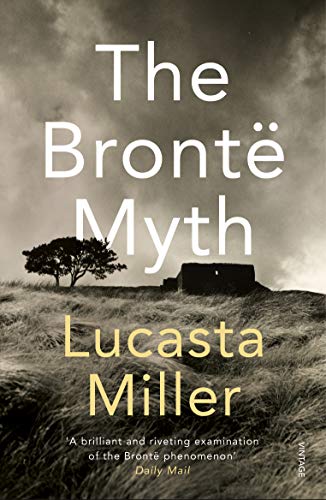
A fascinating and wonderfully readable deconstruction of the countless myths that have grown up around the Brontës.
Since 1857, hardly a year has gone by without some sort of Bronte 'biography' appearing. These range from pious accounts in Victorian conduct books to Freudian pyschobiographies, from plays, films and ballets to tourist brochures and images on tea-towels, from sensation-seeking penny-a-liners to meticulous works of sober scholarship. Each generation has rewritten the Brontes to reflect changing attitudes - towards the role of the woman writer, towards sexuality, towards the very concept of personality.
The Bronte Myth gives vigorous new life to our understanding of the novelists and their culture and Lucasta Miller reveals as much about the impossible art of biography as she does about the Brontes themselves.
WITH A NEW INTRODUCTION FROM THE AUTHOR
Die Inhaltsangabe kann sich auf eine andere Ausgabe dieses Titels beziehen.
Über die Autorin bzw. den Autor
Lucasta Miller is a biographer and critic, whose articles have appeared in a wide number of publications, especially the Guardian. She is the author of two previous books on nineteenth-century literature, The Brontë Myth and L.E.L.: the Lost Life and Mysterious Death of the 'Female Byron', and is currently an Honorary Research Associate at University College, London and a Royal Literary Fund Fellow.
Auszug. © Genehmigter Nachdruck. Alle Rechte vorbehalten.
CHAPTER ONE
To Be for Ever Known
If the twenty-year-old Charlotte Brontë had been told that she would one day be a household name, that her picture would hang in a future National Portrait Gallery, and that pilgrims would travel to Haworth on her account from as far away as Japan, she would have been delighted but not altogether surprised. The image of the Brontës presented in Charlotte’s own “Biographical Notice” of her sisters casts them as “unobtrusive women” shunning fame. Yet Charlotte’s early ambition was not merely to write but “to be for ever known.”
By the time she died, at the age of nearly thirty-nine, in 1855, she had indeed become a celebrity. Two years later, with the publication of Elizabeth Gaskell’s The Life of Charlotte Brontë, she became a legend. Yet her journey from private individual to public persona was less straightforward than her naive twenty-year-old self might have hoped. Instead of a triumphant progress out of obscurity into the “light & glory” of literary renown, she would have to travel a tortuous route, characterized as much by evasion and self-effacement as by self-exposure.
She soon realized that, as a woman writing in an age in which “authoresses” were “liable to be looked upon with prejudice,” it was expedient to disguise herself under a male-sounding pseudonym if she was to make her work public. In her novels, that pseudonym would give her the freedom to use her own emotional life as the basis of her art, allowing her to revolutionize the imaginative presentation of women’s inner lives. She was so uninhibited in her portrayal of the female psyche that her heroines shocked many of her contemporaries and were accused of unwomanly assertion, morbid passion, and anti-Christian individualism.
So when her pseudonym began to slip and her real identity became known in literary circles, Charlotte had to seek out a new sort of protective “veil” to distract attention from the unacceptable elements of her fiction and deflect attacks on her personal morality. She found this shield in her social persona as the modest spinster daughter of a country parson, disingenuously insisting to those she met on the literary circuit that she bore no more than a fleeting external resemblance to the rebellious Jane Eyre. Unlike the French novelist George Sand (1804–76), who wore men’s clothes and took a stream of high-profile lovers, Charlotte never sought a bohemian lifestyle. Sand’s novels, with their frank portrayal of female desire, may have influenced her writing. But Charlotte the clergyman’s daughter was not prepared to sacrifice her respectability. She was well aware that she lived in a society where “publicity . . . for a woman . . . is degrading if it is not glorious” and where the line between celebrity and notoriety was perilously thin.
If Charlotte Brontë was her own mythologizer, she invented two distinct and conflicting myths, the second designed to deflect attention from the first. One was the positive myth of female self-creation embodied by her autobiographical heroines, Jane Eyre and Lucy Snowe, who forge their own sense of selfhood in conflict with their social environment. The other, which eventually inspired the saintly heroine of Elizabeth Gaskell’s Life of Charlotte Brontë, was a quiet and trembling creature, reared in total seclusion, a martyr to duty, and a model of Victorian femininity, whose sins against convention, if she had unwittingly committed any, could be explained away by her isolated upbringing and the sufferings she had endured. Both had their elements of truth in aspects of Charlotte Brontë’s private character, but both were imaginative constructs, consciously developed.
Charlotte’s perception of the writer’s self as material for mythology derived from her Romantic inheritance, as did the lifelong belief in her own genius which enabled her to achieve what she did in literature against the odds. Her youthful faith in writing as a route to immortal fame had been established early on in childhood. Because of the way her public image was molded after her death, her family has, over the past century and a half, been primarily remembered for its tragedies. But what made her able to transform herself into one of the major novelists of the nineteenth century was the fact that she grew up steeped in literature, defining herself as a writer from a very young age. Charlotte was five when her mother died and eight when she was sent with her sisters to the Clergy Daughters’ School at Cowan Bridge, where the eldest two, Maria and Elizabeth, contracted the tuberculosis that killed them. Yet within a year or so of these damaging experiences, Charlotte had recovered sufficiently to form an intense bond with her three surviving siblings, Branwell, Emily, and Anne, in boisterous imaginative games fueled by the literary tastes their father encouraged. Like Samuel Taylor Coleridge, who talked metaphysics with his infant son Hartley, the Reverend Patrick Brontë took a Romantic interest in his children’s development and encouraged their precocity.
Charlotte and Branwell later recorded how their “plays” began in 1826 with the present of a box of toy soldiers. In real life, death had intruded as an arbitrary force. In play, they could take control when, as four gigantic Genii, they held the power of life and death over the diminutive wooden men. Soon, they began to make tiny magazines for the soldiers, writing out their own compositions in microscopic script. This scribblemania continued long after they had outgrown the toys which had originally inspired it and eventually became a purely literary adventure. By the time they were into their teens, their understanding of the term “Genius” was more metaphorical than it had been, but no less potent. Eventually, the siblings split off into two separate camps, Charlotte and Branwell chronicling the history of the imaginary kingdom of Angria while Emily and Anne invented their own fantasy world, Gondal.
At an early age, the young Brontës formed a habit of treating writers as heroes. In one game, played when they were aged between seven and eleven, each had to pick an island and its chief men. Their chosen leaders included literary figures such as Sir Walter Scott, J. G. Lockhart, Leigh Hunt, and “Christopher North” (John Wilson) of Blackwood’s magazine, all of whom were clearly believed to be as powerful as a man of action like the Duke of Wellington, who was also selected. Though Emily’s and Anne’s early prose has not survived, Angria and its predecessor Glass Town are vividly documented in Charlotte’s and Branwell’s voluminous juvenilia, which reveal their fantasy world as a place where writers were important figures.
Charlotte’s early-established belief in the writer as an exceptional individual derived from her sophisticated childhood and teenage reading and continued into adulthood. During the 1820s and 1830s, Blackwood’s Magazine, and later Fraser’s, formed the core of her cultural education. Unlike today’s magazines, these periodicals were not mere ephemera but would have been kept and reread like books. They offered an often highbrow mix of poetry, fiction, satire, criticism, philosophy, history, and political commentary, often sustained to booklike length. Blackwood’s, in particular, turned its contributors into cult figures, such as James Hogg, “the Ettrick Shepherd.” A serialized “Gallery of Literary Characters” in Fraser’s during 1832 reinforced...
„Über diesen Titel“ kann sich auf eine andere Ausgabe dieses Titels beziehen.
Suchergebnisse für The Bronte Myth

Beispielbild für diese ISBN
The Bronte Myth
Anbieter: World of Books (was SecondSale), Montgomery, IL, USA
Verkäuferbewertung 5 von 5 Sternen

Paperback. Zustand: Good. A fascinating and wonderfully readable deconstruction of the countless myths that have grown up around the Brontës.Since 1857, hardly a year has gone by without some sort of Bronte 'biography' appearing. These range from pious accounts in Victorian conduct books to Freudian pyschobiographies, from plays, films and ballets to tourist brochures and images on tea-towels, from sensation-seeking penny-a-liners to meticulous works of sober scholarship. Each generation has rewritten the Brontes to reflect changing attitudes - towards the role of the woman writer, towards sexuality, towards the very concept of personality. The Bronte Myth gives vigorous new life to our understanding of the novelists and their culture and Lucasta Miller reveals as much about the impossible art of biography as she does about the Brontes themselves.WITH A NEW INTRODUCTION FROM THE AUTHOR. Artikel-Nr. 00102039215
Gebraucht kaufen
EUR 6,80
Versand gratis
Versand innerhalb von USA
Versand innerhalb von USA
Anzahl: 2 verfügbar
Foto des Verkäufers
The Bronte Myth
Anbieter: WeBuyBooks, Rossendale, LANCS, Vereinigtes Königreich
Verkäuferbewertung 5 von 5 Sternen
paperback. Zustand: Good. Most items will be dispatched the same or the next working day. A copy that has been read but remains in clean condition. All of the pages are intact and the cover is intact and the spine may show signs of wear. The book may have minor markings which are not specifically mentioned. Artikel-Nr. rev3432762539
Gebraucht kaufen
EUR 1,92
EUR 6,45 Versand
Versand von Vereinigtes Königreich nach USA
Versand von Vereinigtes Königreich nach USA
Anzahl: 1 verfügbar
Beispielbild für diese ISBN
The Bronte Myth
Anbieter: WorldofBooks, Goring-By-Sea, WS, Vereinigtes Königreich
Verkäuferbewertung 5 von 5 Sternen
Paperback. Zustand: Very Good. The book has been read, but is in excellent condition. Pages are intact and not marred by notes or highlighting. The spine remains undamaged. Artikel-Nr. GOR001197696
Gebraucht kaufen
EUR 2,57
EUR 6,65 Versand
Versand von Vereinigtes Königreich nach USA
Versand von Vereinigtes Königreich nach USA
Anzahl: 12 verfügbar
Beispielbild für diese ISBN
The Brontë Myth
Anbieter: MusicMagpie, Stockport, Vereinigtes Königreich
Verkäuferbewertung 5 von 5 Sternen
Zustand: Very Good. 1791441213. 10/8/2026 6:33:33 AM. Artikel-Nr. U9780099287148
Gebraucht kaufen
EUR 5,98
EUR 6,52 Versand
Versand von Vereinigtes Königreich nach USA
Versand von Vereinigtes Königreich nach USA
Anzahl: 1 verfügbar
Beispielbild für diese ISBN
The Bronte Myth
Anbieter: medimops, Berlin, Deutschland
Verkäuferbewertung 5 von 5 Sternen
Zustand: good. Befriedigend/Good: Durchschnittlich erhaltenes Buch bzw. Schutzumschlag mit Gebrauchsspuren, aber vollständigen Seiten. / Describes the average WORN book or dust jacket that has all the pages present. Artikel-Nr. M00099287145-G
Gebraucht kaufen
EUR 12,43
EUR 10,00 Versand
Versand von Deutschland nach USA
Versand von Deutschland nach USA
Anzahl: 1 verfügbar
Foto des Verkäufers
The Bronte? myth / Lucasta Miller
Anbieter: MW Books, New York, NY, USA
Verkäuferbewertung 5 von 5 Sternen
2nd edition. Near fine paperback copy; edges very slightly dust-dulled and nicked. Remains particularly well-preserved overall; tight, bright and clean. Physical description: xiv, 320 pages, 8 unnumbered pages of plates; illustrations; 24 cm. Notes: Includes bibliographical references (pages 256-266) and index. Contents: Includes bibliographical references and index. Subjects: Brontë, Charlotte 1816-1855. Brontë, Emily 1818-1848. Brontë, Anne 1820-1849. Novelists, English 19th century; Biography. Women novelists, English; Biography. Biography as a literary form. Literary studies: fiction, novelists & prose writers. Genre: Bibliography. Biographies. 1 Kg. Artikel-Nr. 311613
Gebraucht kaufen
EUR 24,28
Versand gratis
Versand innerhalb von USA
Versand innerhalb von USA
Anzahl: 1 verfügbar
Beispielbild für diese ISBN
The Bront? Myth
Anbieter: Majestic Books, Hounslow, Vereinigtes Königreich
Verkäuferbewertung 4 von 5 Sternen

Zustand: New. pp. 336. Artikel-Nr. 3309194
Neu kaufen
EUR 17,20
EUR 7,72 Versand
Versand von Vereinigtes Königreich nach USA
Versand von Vereinigtes Königreich nach USA
Anzahl: 3 verfügbar
Beispielbild für diese ISBN
The Bronte Myth
Anbieter: Revaluation Books, Exeter, Vereinigtes Königreich
Verkäuferbewertung 5 von 5 Sternen
Paperback. Zustand: Brand New. 336 pages. 7.80x5.08x0.79 inches. In Stock. Artikel-Nr. __0099287145
Neu kaufen
EUR 15,19
EUR 11,88 Versand
Versand von Vereinigtes Königreich nach USA
Versand von Vereinigtes Königreich nach USA
Anzahl: 2 verfügbar
Beispielbild für diese ISBN
The Bronte Myth
Anbieter: Kennys Bookstore, Olney, MD, USA
Verkäuferbewertung 5 von 5 Sternen
Zustand: New. 2002. 2nd edition. paperback. Since 1857, hardly a year has gone by without some sort of Bronte 'biography' appearing. These range from pious accounts in Victorian conduct books to Freudian psychobiographies, from plays, films and ballets to tourist brochures and images on tea-towels. This work aims to offer a fresh life to our understanding of the novelists and their culture. Num Pages: 336 pages, facsimiles, , portraits. BIC Classification: 2AB; BG; DSBF; DSK. Category: (G) General (US: Trade). Dimension: 190 x 128 x 23. Weight in Grams: 250. . . . . . Books ship from the US and Ireland. Artikel-Nr. V9780099287148
Neu kaufen
EUR 18,54
EUR 9,35 Versand
Versand innerhalb von USA
Versand innerhalb von USA
Anzahl: Mehr als 20 verfügbar
Beispielbild für diese ISBN
The Brontë Myth
Anbieter: Ria Christie Collections, Uxbridge, Vereinigtes Königreich
Verkäuferbewertung 5 von 5 Sternen
Zustand: New. In English. Artikel-Nr. ria9780099287148_new
Neu kaufen
EUR 18,63
EUR 11,13 Versand
Versand von Vereinigtes Königreich nach USA
Versand von Vereinigtes Königreich nach USA
Anzahl: Mehr als 20 verfügbar