
Verwandte Artikel zu All-To-One: The Winning Model for Marketing in the...
Inhaltsangabe
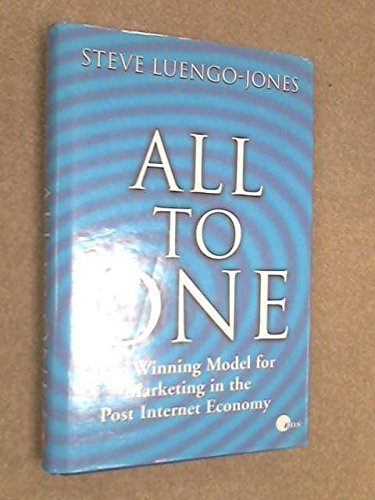
Authored by a senior executive at EDS, a global leader in providing business strategies, solutions, and services, All to One is the first post-Internet marketing book. A highly accessible, hands-on guide to the exciting potential of the new Internet-plus economy, it describes cutting-edge customer-relationship marketing principles and practices developed at some of today's most successful companies worldwide. It provides readers with valuable insights into the factors governing business success in the Internet-plus economy, and it arms them with a proven five-stage methodology RelModel for developing effective customer-relationship marketing systems.
Die Inhaltsangabe kann sich auf eine andere Ausgabe dieses Titels beziehen.
Über die Autorin bzw. den Autor
Steve Luengo-Jones heads the Customer Focus Group at EDS, a recognized global leader in ensuring that clients achieve value in the digital economy by delivering the right strategies, solutions, and services.
Auszug. © Genehmigter Nachdruck. Alle Rechte vorbehalten.
There's nothing new about 'one-to-one', even if you spell it 1:1. Treating people on that basis has been the hallmark of human relations ever since Adam and Eve first got together. Commercial relations too. Neolithic barterers, Viking traders (that's what they called themselves), Genoese merchants, Eastern bazaar wallahs, Wild West horse doctors, Victorian haberdashers and open-all- hours momma/poppa shop-keepers have done good business for millennia and made many friends into the bargain by treating consumers as people, one at a time, and getting as much business as possible from each one of them. The genius of Don Pepper and Martha Rogers all those eight years ago - at the time of writing - was to take that familiar age-old one-to-one concept and connect it to a brand-new, one-to-one medium - the Internet.
The connection was magic. At a stroke, it broke a myriad moulds.
It shattered the belief that 'more of the same is the one business aim', a belief made possible by the mass-production techniques introduced by the Industrial Revolution 200 years ago and implemented since then by virtually every manufacturer and virtually every member of every sales force. Thanks to the one-to-one/ Internet connection, the market of the masses could be replaced with the market of individuals. Loud-hailers were downgraded in favour of hand-shakers. Spray guns were beaten into snipers' rifles - firing only virtual bullets you understand. 'Buy what we tell you to buy' became 'let's talk'. Marketers were reminded that no two people are the same and that different people should be treated differently. Consumers were thrilled by the promise of new kinds of personal, bespoke buying relationships. And the unlimited possibilities of the electronic revolution and its most dynamic manifestation to date, the Internet, were revealed for all to see. (Notice how easy it is to get carried away.)
But now the world has moved on and Internet-fever has started to cool (short-lived, wasn't it?). The new economy, the Internet-plus economy, enlarged and enhanced rather than transformed by the Internet, has arrived. And the novelty has gone from 'one-to-one', at least from 'one-to-one' in its blinkered Internet-only packaging. Its one-track inadequacies are showing.
So, as the dust settles, the old truths emerge, unchanged and unavoidable. People are not content with one-track relationships with anyone including suppliers. They look for total commitment and total service, as they always have done. The product, the wrapping, the way the product is delivered, the voice at the call centre, the press and tv advertising, the website, the point-of-sale material, the posters and printed literature, the people in the store, the sales people, the service people who call round, everyone and everything must be committed and seen to be committed to each individual consumer. The supplier who does all that the best will get the sale, the loyalty, the future. The fragmented, specialist approach will always be beaten by the holistic. 'One-to-one', Internet-only, is not holistic.
So, what next?
We need a fresh vision of the old truths, a different paradigm of the old patterns, a new model of the old ways. We need 'All-to-One'. 'All-to-One' is a short-hand way of summing up a complex but inescapable commercial truth:
'individual consumers respond best, buy more and stay loyal when they feel that everyone and everything in the supplier company is committed to meeting their needs, solving their problems, and sharing their aspirations ... and they are happiest and most convinced when they are reminded of that commitment in a variety of ways in the full range of communication media.'
Or to put it another way ...
'successful long-term consumer relationships thrive on a totality of communication - personal and printed as well as electronic. And the communication must be between, on the one hand, everyone concerned in any way with manufacturing, distribution and selling the product and, on the other, the consumer who wants to buy it.'
Or to sum it all up:
'consumers prefer to be treated as people.'
'All-to-One' answers all those requirements, however expressed, in full and with flair. It is the new model for consumer relationship marketing (crm). Through its specialist methodologies - RelModel, RelTechnics and RelWeb - it can offer the companies who implement it a lasting competitive advantage. The brightest and best of the blue-chips are already moving towards it. Many smaller companies have been doing it very successfully for decades without calling it 'All-to-One'. I give examples throughout the book. But 'All-to-One' is right for any kind and size of business, not excepting e-business. It is the nearest thing that business has to a natural law. Companies ignore it at their peril.
I should emphasise here that we are talking about an evolution - from where you are now to the 'All-to-One' position where lifetime value for consumer and company is maximised.
The relevance of 'All-to-One'
'All-to-One' is relevant whichever way you look at it. It is as relevant to the way a company relates to its staff and their families as to the way it relates to its consumers and prospects, and to its suppliers ... it is relevant to the way it relates to the local community and to soci-ety as whole ... it is relevant to the way it talks to local and national media, to local and national government officials. Companies, like people, might present different aspects of themselves in different circumstances, but each of those aspects must clearly be seen to be an aspect of the same company, the same personality.
This emphasis on consistency makes 'All-to-One' the most powerful means available to a company for creating an attractive and influential image for itself. It provides the connectivity between the company persona and its reality, the reality as experienced by the consumer. When everything a company does, online and offline - and in the vast majority of cases, offline - then consumers respond.
„Über diesen Titel“ kann sich auf eine andere Ausgabe dieses Titels beziehen.
Suchergebnisse für All-To-One: The Winning Model for Marketing in the...

Beispielbild für diese ISBN
All-To-One: The Winning Model for Marketing in the Post Internet Economy
Verlag:
McGraw-Hill Publishing Co. 01/11/2000, 2000
ISBN 10: 0077097998
ISBN 13: 9780077097998
Gebraucht
Hardcover
Anbieter: AwesomeBooks, Wallingford, Vereinigtes Königreich
Verkäuferbewertung 5 von 5 Sternen

Zustand: Very Good. This book is in very good condition and will be shipped within 24 hours of ordering. The cover may have some limited signs of wear but the pages are clean, intact and the spine remains undamaged. This book has clearly been well maintained and looked after thus far. Money back guarantee if you are not satisfied. See all our books here, order more than 1 book and get discounted shipping. . Artikel-Nr. 7719-9780077097998
Gebraucht kaufen
EUR 4,91
EUR 4,81 Versand
Versand von Vereinigtes Königreich nach USA
Versand von Vereinigtes Königreich nach USA
Anzahl: 2 verfügbar
Beispielbild für diese ISBN
All-To-One: The Winning Model for Marketing in the Post Internet Economy
Verlag:
McGraw-Hill Publishing Co. 01/11/2000, 2000
ISBN 10: 0077097998
ISBN 13: 9780077097998
Gebraucht
Hardcover
Anbieter: Bahamut Media, Reading, Vereinigtes Königreich
Verkäuferbewertung 4 von 5 Sternen

Zustand: Very Good. Shipped within 24 hours from our UK warehouse. Clean, undamaged book with no damage to pages and minimal wear to the cover. Spine still tight, in very good condition. Remember if you are not happy, you are covered by our 100% money back guarantee. Artikel-Nr. 6545-9780077097998
Gebraucht kaufen
EUR 3,53
EUR 8,14 Versand
Versand von Vereinigtes Königreich nach USA
Versand von Vereinigtes Königreich nach USA
Anzahl: 2 verfügbar
Foto des Verkäufers
All-To-One: Creating Effective CustomerRelationship Marketing in the Post-Internet Age
Verlag:
McGraw-Hill, 2001
ISBN 10: 0077097998
ISBN 13: 9780077097998
Gebraucht
Hardcover
Erstausgabe
Anbieter: Southampton Books, Sag Harbor, NY, USA
Verkäuferbewertung 5 von 5 Sternen
Hardcover. Zustand: Like New. Zustand des Schutzumschlags: Like New. First Edition. First Edition, First Printing (Full Number Line). Published by McGraw-Hill, 2001. Octavo. Blue boards stamped in gold. Book is like new; clean with no writing or names. Sharp corners and spine straight. Binding tight and pages crisp. Dust jacket is like new with very light shelf wear. 278 pages. ISBN: 9780077097998. 100% positive feedback. 30 day money back guarantee. NEXT DAY SHIPPING! Excellent customer service. Please email with any questions or if you would like a photo. All books packed carefully and ship with free delivery confirmation/tracking. All books come with free bookmarks. Ships from Southampton, New York. Artikel-Nr. 148575
Gebraucht kaufen
EUR 36,33
EUR 4,40 Versand
Versand innerhalb von USA
Versand innerhalb von USA
Anzahl: 1 verfügbar