
Verwandte Artikel zu Study Guide for Technical Analysis Explained Fifth...
Inhaltsangabe
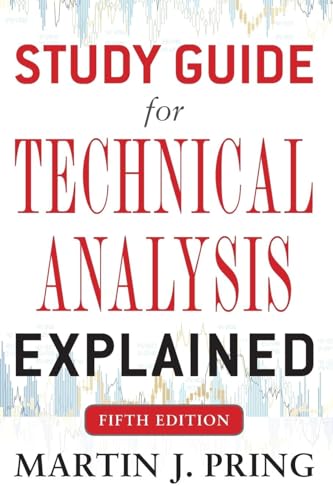
The hands-on STUDY GUIDE to Martin Pring's TECHNICAL ANALYSIS classic Technical Analysis Explained is the definitive guide for mastering technical analysis. In this hands-on companion, technical analysis wizard Martin Pring serves as your personal investing coach, taking you step-by-step through his long-proven methods. Packed with hundreds of questions that correspond to chapters and sections throughout the book, Study Guide for Technical Analysis Explained, Fifth Edition, features: Charts and graphs to help you visually digest the concepts presented Full text answers to guarantee your complete understanding of each important idea Fill-in-the-blank, multiple-choice, and matching question formats The straightforward, no-nonsense style that made Technical Analysis Explained a classic Technical analysis mastery isn't easy, but its financial rewards make it indispensable. Use Study Guide for Technical Analysis Explained to reach the next level of technical analysis education and ensure that you start every trading day with the skills you need to come out on top.
Die Inhaltsangabe kann sich auf eine andere Ausgabe dieses Titels beziehen.
Über die Autorin bzw. den Autor
McGraw-Hill authors represent the leading experts in their fields and are dedicated to improving the lives, careers, and interests of readers worldwide
Auszug. © Genehmigter Nachdruck. Alle Rechte vorbehalten.
Study Guide for Technical Analysis Explained
By MARTIN J. PRINGMcGraw-Hill Education
Copyright © 2014 McGraw-Hill Education
All rights reserved.
ISBN: 978-0-07-182398-2All rights reserved.
Contents
How to Use This Study Guide,
1 The Definition and Interaction of Trends,
2 Financial Markets and the Business Cycle,
3 Dow Theory,
4 Typical Parameters for Intermediate Trends,
5 How to Identify Support and Resistance Zones,
6 Trendlines,
7 Basic Characteristics of Volume,
8 Classic Price Patterns,
9 Smaller Price Patterns and Gaps,
10 One- and Two-Bar Price Patterns,
11 Moving Averages,
12 Envelopes and Bollinger Bands,
13 Momentum I: Basic Principles,
14 Momentum II: Individual Indicators,
15 Momentum III: Individual Indicators,
16 Candlestick Charting,
17 Point and Figure Charting,
18 Miscellaneous Techniques for Determining Trends,
19 The Concept of Relative Strength,
21 Price: The Major Averages,
22 Price: Sector Rotation,
23 Time: Analyzing Secular Trends for Stocks, Bonds, and Commodities,
24 Time: Cycles and Seasonal Patterns,
25 Practical Identification of Cycles,
26 Volume II: Volume Indicators,
27 Market Breadth,
28 Indicators and Relationships That Measure Confidence,
29 The Importance of Sentiment,
20 Integrating Contrary Opinion and Technical Analysis,
31 Why Interest Rates Affect the Stock Market,
32 Using Technical Analysis to Select Individual Stocks,
33 Technical Analysis of International Stock Markets,
34 Automated Trading Systems,
Index,
CHAPTER 1
THE DEFINITION AND INTERACTION OF TRENDS
Questions
Subjects to Be Covered
The most common types of trends
The basics of peak-and-trough analysis
How peaks and troughs are recognized.
1. Name the three most important and widely used trends.
A. ___________________________
B. ___________________________
C. ___________________________
2. Match the answers for the duration of these trends.
A. Short _______ A. 10 to 25 years
B. Intermediate _______ B. 2 to 6 weeks
C. Primary _______ C. 6 weeks 9 months
D. Secular _______ D. 9 months to 2 years
3. Who needs to have an understanding of the direction and maturity of the main trend?
A. Investors
B. Traders
C. A and B
D. None of the above
4. Peak-and-trough analysis:
A. Is far too simplistic an approach for technicians to deal with
B. Was very useful in Dow's day, but is now outdated by more sophisticated approaches and tools
C. Should be used in conjunction with other tools in the weight of the evidence approach
D. Only works with short-term and intermediate trends
E. C and D
5. In this chart, which letter marks the reversal in the upward progression of troughs?
A. _________________________
B. _________________________
C. _________________________
D. _________________________
6. Can the principles of peak-and-trough progression be applied to a 5- minute bar chart?
A. Yes
B. No
7. In a general sense, why are longer-term trends easier to spot?
A. Because the bigger they are, the easier it is to see them.
B. Because there is less random noise as the trend gets longer. Also, the expectations of market participants tend to unfold in a more gradual way as the fundamentals evolve.
C. Because there are always five intermediate movements in every primary trend, so all you have to do is count to five.
D. None of the above
8. Please look at the chart featuring Citigroup. If you knew that the high and low preceding the rally at A were 6 and 4 and the close at A was 4.25, would this represent a legitimate peak in peak-and-trough analysis?
A. Yes
B. No
9. If C qualifies as a legitimate trough, where is the reversal signal: at D or at the end of the arrow indicated at E?
10. True or false: At B, the series of rising peaks and troughs was reversed.
A. True
B. False
11. What is the most dominant or influential trend?
A. Intermediate
B. Short-term
C. Primary
D. Secular
E. Socular
12. True or false: It's a good idea to go for consistency, but even better to go for perfection.
A. True
B. False
THE DEFINITION AND INTERACTION OF TRENDS
Answers
1. Short, intermediate, and primary. Any order qualifies as a correct answer. The secular trend is an important trend, but is not widely followed.
2. A-B; B-C; C-D; and D-A
3. C. Investors need to know the direction of the long-term trend to correctly position themselves for the long-term. Since a short-term contratrend moves often result in weak price movements and numerous whipsaws, short-term traders also need to form an opinion on the direction of the primary trend. A well-known trading rule is always trade in the direction of the trend.
4. C. Peak-and-trough analysis is a basic tool of technical analysis and should never be underrated.
5. C.
6. A. The principles of technical analysis can be applied to any security in any time frame.
7. B. Not only are they easier to spot, but generally speaking, the longer the time span, the more accurate the indicator.
8. B. No, the rally at A did not retrace between one-third and two-thirds of the previous decline.
9. E. Because the series of declining troughs was still intact at D.
10. B. Only the series of rising troughs was reversed at B. The rising peaks were still intact.
11. D. The secular trend determines the characteristics of the primary trend, which determines the characteristic of the intermediate, etc. There is no such thing as the "socular" trend.
12. B. Because perfection can never be achieved in financial markets whose prices are determined by psychology.
CHAPTER 2FINANCIAL MARKETS AND THE BUSINESS CYCLE
Questions
Subjects to Be Covered
The chronological relationship between the financial markets and the business cycle
When they peak and trough in the cycle
Understanding the significance of the leads and lags
The six stages
Double cycles
The role of technical analysis
1. Trends in financial markets are:
A. Determined by investors' expectations of movements in the economy
B. The effect those changes are likely to have on the price of the asset in which a specific financial market deals
C. The psychological attitude of investors to these fundamental factors
D. All of the above
2. Which is the correct chronological sequence for peaks and troughs in the financial markets over the course of the business cycle?
A. Bonds, stocks, commodities
B. Stocks, commodities, bonds
C. Bonds, gold, stocks, commodities
D. None of the above
3. When are commodities most likely to bottom during a recession?
A. When it is particularly severe
B. When the preceding commodity rally has been particularly speculative
C. When stocks bottom earlier than usual
D. Never
4. Why does the nature of price moves in bonds, stocks, and commodities differ between different business cycles?
A. Because they discount different things
B. Because each business cycle...
„Über diesen Titel“ kann sich auf eine andere Ausgabe dieses Titels beziehen.
Suchergebnisse für Study Guide for Technical Analysis Explained Fifth...

Beispielbild für diese ISBN
Study Guide for Technical Analysis Explained Fifth Edition
Anbieter: PBShop.store US, Wood Dale, IL, USA
Verkäuferbewertung 5 von 5 Sternen

PAP. Zustand: New. New Book. Shipped from UK. Established seller since 2000. Artikel-Nr. GB-9780071823982
Beispielbild für diese ISBN
Study Guide for Technical Analysis Explained Fifth Edition
Anbieter: PBShop.store UK, Fairford, GLOS, Vereinigtes Königreich
Verkäuferbewertung 5 von 5 Sternen
PAP. Zustand: New. New Book. Shipped from UK. Established seller since 2000. Artikel-Nr. GB-9780071823982
Neu kaufen
EUR 50,10
EUR 4,85 Versand
Versand von Vereinigtes Königreich nach USA
Versand von Vereinigtes Königreich nach USA
Anzahl: 1 verfügbar
Beispielbild für diese ISBN
Study Guide for Technical Analysis Explained Fifth Edition
Anbieter: Ria Christie Collections, Uxbridge, Vereinigtes Königreich
Verkäuferbewertung 5 von 5 Sternen
Zustand: New. In English. Artikel-Nr. ria9780071823982_new
Neu kaufen
EUR 52,17
EUR 13,17 Versand
Versand von Vereinigtes Königreich nach USA
Versand von Vereinigtes Königreich nach USA
Anzahl: 1 verfügbar
Beispielbild für diese ISBN
Study Guide for Technical Analysis Explained Fifth Edition
Anbieter: Majestic Books, Hounslow, Vereinigtes Königreich
Verkäuferbewertung 4 von 5 Sternen

Zustand: New. pp. 224. Artikel-Nr. 96281832
Neu kaufen
EUR 63,47
EUR 7,58 Versand
Versand von Vereinigtes Königreich nach USA
Versand von Vereinigtes Königreich nach USA
Anzahl: 1 verfügbar
Beispielbild für diese ISBN
STUDY GUIDE FOR TECHNICAL ANALYSIS EXPLAINED FIFTH EDITION
Anbieter: Romtrade Corp., STERLING HEIGHTS, MI, USA
Verkäuferbewertung 5 von 5 Sternen
Zustand: New. This is a Brand-new US Edition. This Item may be shipped from US or any other country as we have multiple locations worldwide. Artikel-Nr. ABBB-189240
Beispielbild für diese ISBN
Study Guide for Technical Analysis Explained Fifth Edition
Verlag:
McGraw-Hill Education - Europe, 2014
ISBN 10: 0071823980
ISBN 13: 9780071823982
Neu
Softcover
Anbieter: Kennys Bookstore, Olney, MD, USA
Verkäuferbewertung 5 von 5 Sternen
Zustand: New. 2014. 5th Edition. Paperback. . . . . . Books ship from the US and Ireland. Artikel-Nr. V9780071823982
Neu kaufen
EUR 68,42
EUR 9,05 Versand
Versand innerhalb von USA
Versand innerhalb von USA
Anzahl: 1 verfügbar
Beispielbild für diese ISBN
STUDY GUIDE FOR TECHNICAL ANALYSIS EXPLA
Anbieter: Speedyhen, Hertfordshire, Vereinigtes Königreich
Verkäuferbewertung 5 von 5 Sternen
Zustand: NEW. Artikel-Nr. NW9780071823982
Neu kaufen
EUR 49,56
EUR 47,81 Versand
Versand von Vereinigtes Königreich nach USA
Versand von Vereinigtes Königreich nach USA
Anzahl: 1 verfügbar
Beispielbild für diese ISBN
Study Guide for Technical Analysis Explained
Anbieter: Revaluation Books, Exeter, Vereinigtes Königreich
Verkäuferbewertung 5 von 5 Sternen
Paperback. Zustand: Brand New. 5th study guide edition. 219 pages. 9.00x6.00x0.50 inches. In Stock. Artikel-Nr. x-0071823980
Neu kaufen
EUR 90,69
EUR 11,66 Versand
Versand von Vereinigtes Königreich nach USA
Versand von Vereinigtes Königreich nach USA
Anzahl: 2 verfügbar
Foto des Verkäufers
Study Guide for Technical Analysis Explained
Anbieter: moluna, Greven, Deutschland
Verkäuferbewertung 5 von 5 Sternen
Zustand: New. A guide for mastering technical analysis. It serves as your personal investing coach, taking you step-by-step through his long-proven methods.The hands-on STUDY GUIDE to Martin Pring s TECHNICAL ANALYSIS classicnnTechnical Analysis Explained is the defi. Artikel-Nr. 5888423
Neu kaufen
EUR 59,67
EUR 48,99 Versand
Versand von Deutschland nach USA
Versand von Deutschland nach USA
Anzahl: 2 verfügbar